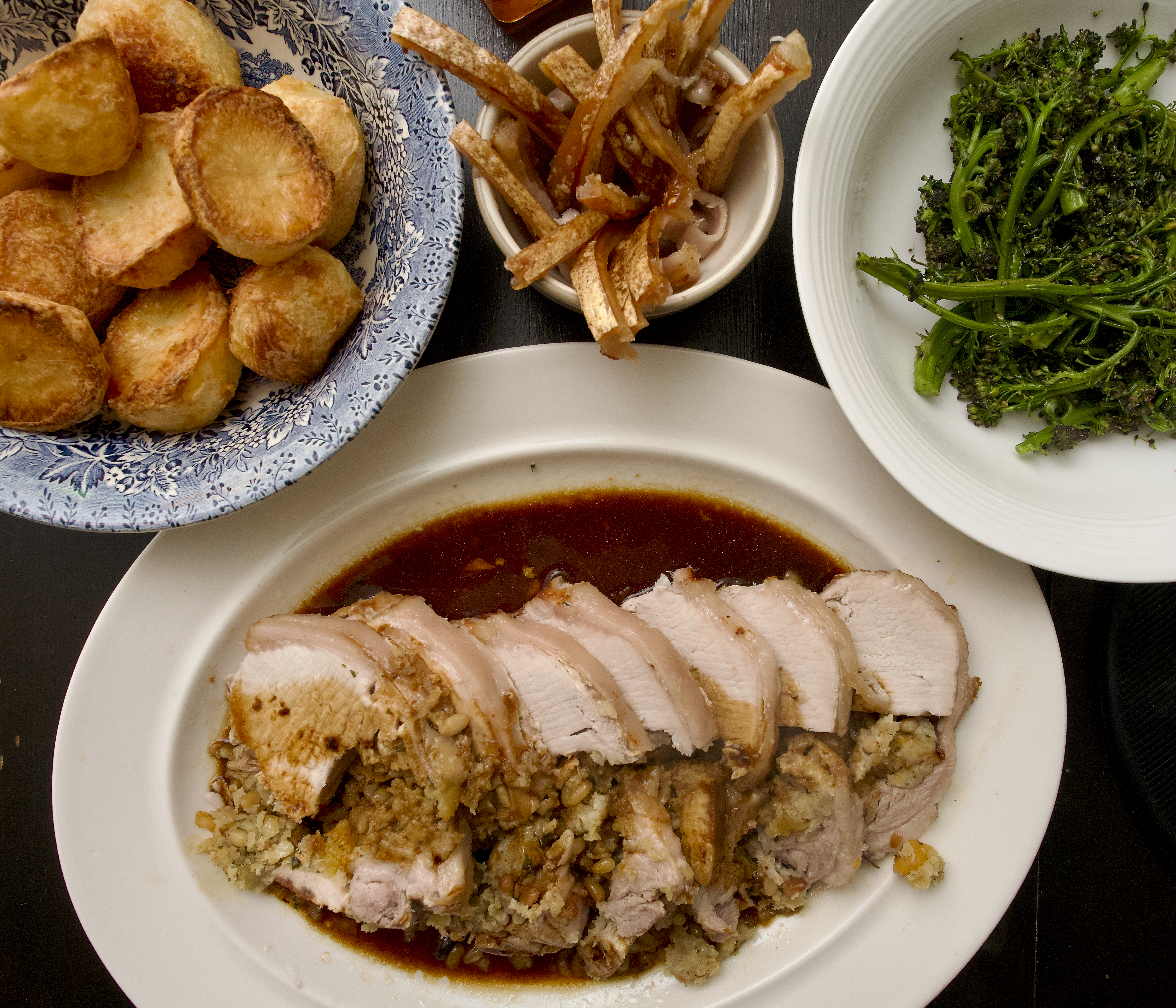
Pork is great value and this recipe will feed many people. Serve with roast potatoes and veg. To make sure you get good crackling, leave the pork, skin-side up, on a plate in the fridge for a day to dry out.
Wine Suggestion: An indulgence we know, but it was a roast dinner with friends; Domaine Jamet’s Condrieu Vernillon. A fairly new wine to this domaine, but one that echos the wonderful reds by being expressive and textural, with a vibrant core of freshness and savouriness.
Roast pork with apricot and pine nut stuffing – serves 6 to 8
- 75g butter
- 1 onion, finely chopped
- 1 clove of garlic, crushed
- 50g pine nuts
- 175g day-old, fresh white breadcrumbs
- 50g dried apricots, roughly chopped
- 1 tbsp roughly choppd parsley
- 1 tsp fresh thyme leaves
- 1.75kg boneless pork loin, skin scored at 5mm intervals, tell your butcher you plan to stuff it
- 2 tbsp olive oil
FOR THE GRAVY:
- 1 tbsp plain flour
- 3 tbsp ruby red port or red wine
- 1 tbsp clear honey
- 4 whole cloves
- 600ml beef stock
Remove the pork from the fridge about an hour before you plan to put it into the oven.
Make the stuffing by melting the butter in a large frying pan, then add the onion and garlic and cook for a few minutes until softened but not coloured.
Meanwhile, toast the pine nuts in a separate dry fring pan, watch them carefull so they don’t burn.
Stir the breadcrumbs into the onion mixture with the apricots, parsley and thyme, then stir in the toasted pine nuts and season. Remove from the heat and leave to cool.
Heat the oven to 200C/400F/Gas 6.
When the stuffing is cooled, place the pork skin-side down on a board. Spoon the cooled stuffing along the centre, roll up the joint and tie with string at intervals to secure.
Put the pork into a large roasting tin and pat the skin dry with kitchen paper. Rub the skin with olive oil and plenty of sea salt. Cover with foil and roast for 20 minutes. Reduce the heat to 180C/350F/Gas 4 and roast for another 15 minutes. Remove the foil and cook for another hour and 15 minutes or until the pork is tender and you have crispy crackling (if the crackling hasn’t crisped by the time the pork is cooked you can remove and snip it into strips with scissors and crisp it under the grill).
Transfer the pork to a warm serving plate and rest for about 15 minutes while you make the gravy.
Pour most of the fat from the roasting tin and put over a gentle heat. Stir in the flour and cook for 2 minutes, stirring. Slowly pour in the port and then add the honey and cloves, stirring to combine. Gradually add the stock, stirring continuously until it comes to the boil. Reduce the heat and simmer for 10 minutes until reduced and thickened, stirring occasionally. Season to taste.
Cut the string from the pork and cut through the fat just underneath the crackling. Remove and cut into pieces (you will have to eat a few), then carve the pork into thick slices.
Serve the pork on a platter with lots of roast potatoes, gravy and veg.
(Original recipe from Neven Maguire’s Cookery Collection, Poolbeg Press Ltd., 2005.)

 Jono & Jules do food & wine