Feeds:
Posts
Comments

Posts Tagged ‘Spinach’

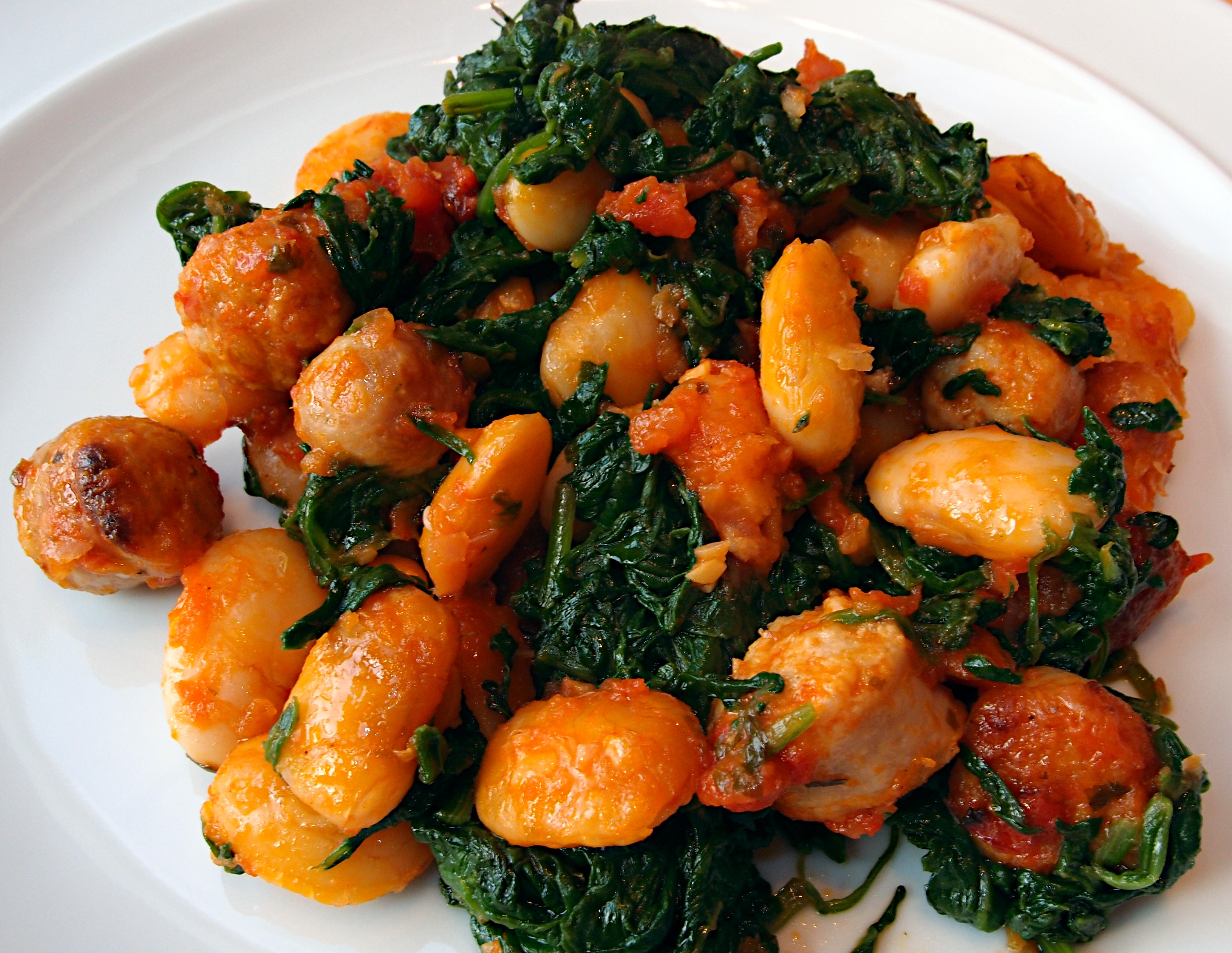
Gigantes me spanaki ke loukanika sto fourno (Bean, Spinach and Sausage Casserole)

Don’t be scared that this takes over 24 hours preparation – it’s all soaking time for the beans! It does take about an hour and a half to cook though so don’t get started too late. It is very easy despite the time it takes and is totally worth it.

Gigantes me spanaki ke loukanika sto fourno (Bean, Spinach and Sausage Casserole) – serves 4

  • 300g dried butter beans
  • 120ml olive oil
  • 250g pork sausages, cut into bite sized pieces
  • 1 onion, grated
  • 2 garlic cloves, finely chopped
  • 1 400g can chopped tomoatoes
Cover the Butter beans in plenty of cold water and soak for 24 hours.

Put the beans into a saucepan, cover them with cold water, and bring to the boil. Reduce the heat and simmer for about 30 minutes, then drain and tip into an ovenproof casserole dish.

Preheat the oven to 180°C/350°F/Gas Mark 4.

Meanwhile, heat half the oil in a frying pan. Add the sausage, onion, and garlic and cook over a low heat for 5 minutes, until the onion has softened. Stir in the tomatoes and parsley, season and simmer for 5 minutes. Pour the mixture over the beans, stir well and bake, adding a little hot water if necessary, for about 50 minutes or until the beans are soft – check every now and then that it isn’t drying out and give it a stir.

Meanwhile, roughly chop the spinach, and cook over a low heat for a few minutes, until wilted. Drain well. Heat the remaining oil in a frying pan, add the spinach and cook over a low heat for about 5 minutes.

Take the beans out of the oven and dot the top with spinach. Bake for 5 minutes more. Serve hot.

Kali orexi (bon appétit)!

(Original recipe from Vefa’s Kitchen published by Phaidon)

Read Full Post »

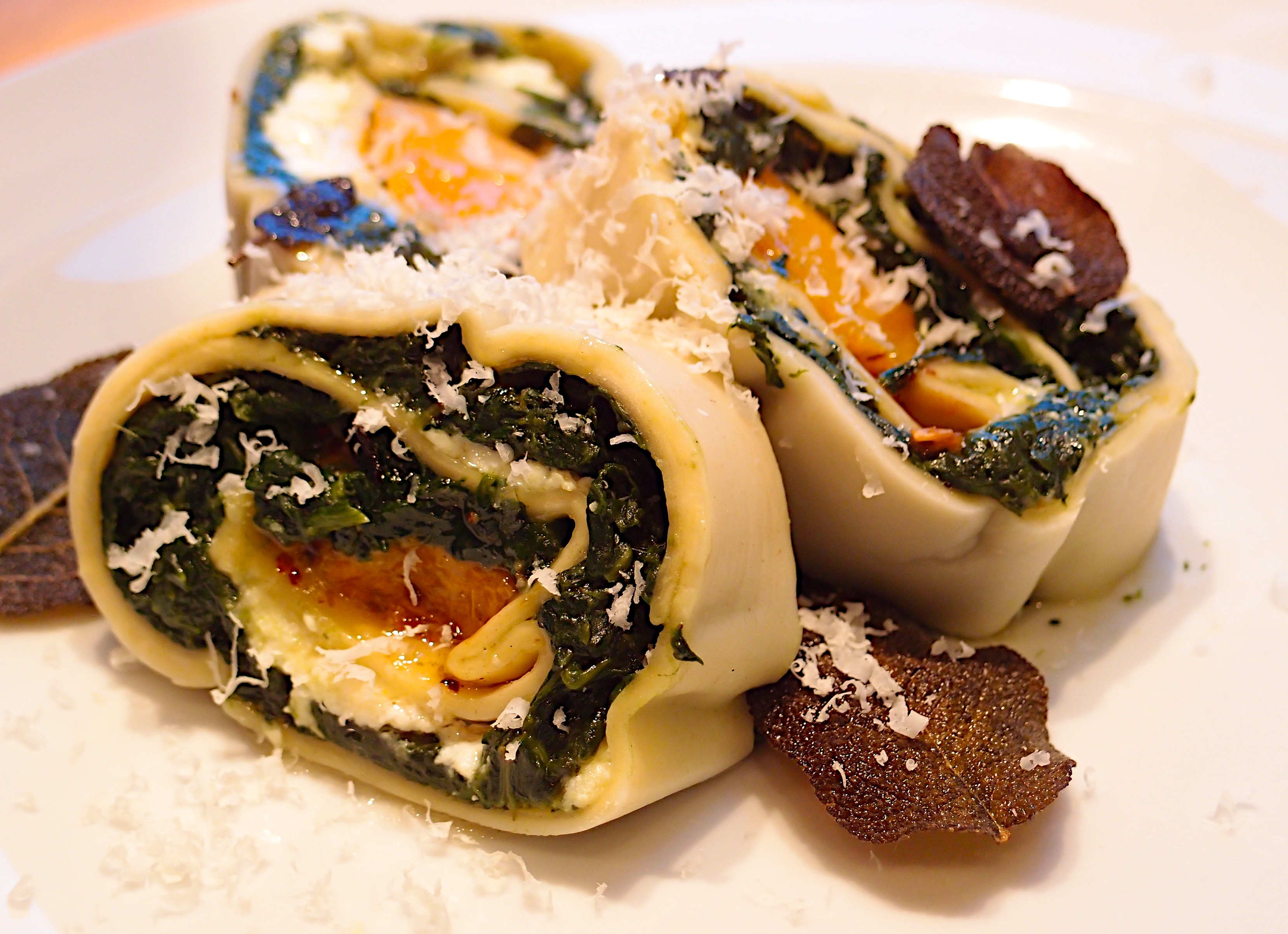
Jamie Oliver recommends you practice this recipe before serving for a crowd and we agree. We cooked this about a year ago for our friends Rob and Megan and while the flavours and presentation were great we made the pasta just a bit too thick. Second time around we slimmed down the pasta, with the help of our new pasta machine and it improved dramatically, but we miscalculated the width so had to trim the rotolo after rolling. So Jono’s tips for success:

  • You need a fish kettle;
  • make the pasta very thin, but not quite as thin as usual (we used setting 6 instead of 8). Jamie says the thickness of a beer mat, but make it a fraction thinner than this;
  • measure the width of your rotolo against the fish kettle before constructing it – allow a little of pasta at the edge to keep it sealed nicely; and
  • this takes ages, but it’s really worth it, tastes great and looks super impressive.

First you need to make some fresh pasta so here’s a recipe for that:

  • 600g type 00 flour
  • 6 eggs or 12 yolks (the 12 yolks makes a richer, more yellow pasta)
Put the flour on a board, make a well in the centre and crack the eggs into the well. Use a fork to beat the eggs until smooth. Mix the eggs with the flour as much as possible so it’s not too sticky and start to knead. It’s actually quite hard to knead pasta dough but keep at it for about 10 minutes and it will come together and form a smooth, silky and elastic dough. Cover with cling film and rest for an hour.
Rotolo di zucca e ricota (Rotolo of spinach and ricotta)
  • 455g fresh egg pasta dough (see above)
  • half a butternut squash, deseeded
  • olive oil
  • 1 tsp coriander seeds
  • 1 tsp fennel seeds
  • half a dried red chilli or half a tsp of chilli flakes
  • a handful of fresh marjoram or oregano
  • 2 cloves of garlic, peeled and finely sliced
  • 800g spinach, washed
  • 250g unsalted butter
  • a third of a nutmeg, grated
  • 150g ricotta cheese, crumbled
  • 55g freshly grated Parmesan
  • 20 fresh sage leaves
  1. Preheat the oven to 220C/425F/gas 7. Chop the squash into big chunks and rub them with a little olive oil. Bash coriander seeds, fennel seeds and chilli in a mortar and pestle with a good pinch of salt and pepper. Dust this over the squash and put into a snug fitting roasting dish or tray. Cover with a piece of damp greaseproof paper and roast for 30 minutes. Take off the paper and continue to roast for another 15-20 minutes or until golden.
  2. Heat a large pan and add a little olive oil, the marjoram or oregano and the garlic. Toss around for 20 seconds before adding the spinach. Keep moving the spinach and add a couple of knobs of butter and the nutmeg after a minute or two. Cook until the moisture has cooked away, then season to taste and leave to cool.
  3. Roll the pasta using a pasta machine into long thin strips (see tip above). Stick the strips together using a little water. Keep it in a rectangular shape but trim off as you need. Lay onto a  clean tea towel (remember to measure the long side against your kettle).
  4. Spoon a line of squash along the long edge of the sheet. Sprinkle the spinach over the rest of the sheet leaving the top 5cm clear. Crumble the ricotta over the spinach and sprinkle over the Parmesan. Brush the clear edge of the pasta with a little water then use the near edge of the tea towel to roll the pasta up and away from you. Roll up in the tea towel and tie firmly at the end with kitchen string. Tie a few bits of string round the middle too to keep the shape and tie an extra bit of string at one end so it can hang out of the kettle and act as a handle.
  5. Fill the fish kettle with boiling salted water. Lower the rotolo in and use the fish kettle rack on top to keep it submerged. Simmer for at least 25 minutes.
  6. While the rotolo is cooking you need to clarify some butter. Put the remainder of the butter into an ovenproof dish and put in a low oven (about 80C/170F) for about 10 minutes or until clear and melted. The milky whey will have sunk to the bottom, discard any white bits from the top and spoon out the clear butter. Discard the whey. You’ll have too much but the leftovers can be used for roast potatoes another day.
  7. Put 3 tbsp of clarified butter into a small pan and heat it up. Add a sage leaf and if it fries nicely add the rest of the leaves and fry until they start to crisp. Keep to one side.
  8. Carefully remove the rotolo from the pan, remove the string, unroll the tea towel and slice it up. A couple of slices per portion. Scatter sage leaves and drizzle with the sage flavoured butter and grate some Parmesan over. Serve with a leafy salad.
(Original recipe from Jamie’s Italy)

Read Full Post »

Yes we do know that it’s June but our weather has been much more suitable for stew than salad in the last few weeks – it’s freezing! If we weren’t so stingy we’d turn the heating back on. As central heating in June is against our principles we’ve had to resort to stew instead. It’s kind of a summery stew as it’s full of spinach which is in season now and is also very good for you.

Hopefully we’ve convinced you that it’s ok to eat stew in June.

Spanish chickpea, chorizo & spinach stew – to feed 4

  • 3-4 tbsp extra virgin olive oil
  • 1 onion, chopped
  • 1 carrot, finely diced
  • 1 celery stick, finely diced
  • few sprigs of thyme
  • 2 bay leaves
  • 2 cloves of garlic, finely chopped
  • 200g chorizo, diced
  • 1/4 tsp cinnamon
  • 1 tsp hot smoked paprika (it’s more common to find the sweet (dulce) one here so just add a bit of chilli powder as well)
  • 2 tins of chickpeas, rinsed and drained
  • 1-2 tbsp Sherry vinegar
  • 400g spinach leaves, washed and drained
  1. Heat the oil in a big pan, then gently fry the onion for 3-4 minutes until it starts to soften. Stir in the carrot, celery, thyme and bay leaves. Season and cook for 2-3 minutes, stirring now and then. Add the garlic, chorizo, cinnamon and smoked paprika. Fry gently until the vegetables soften and the chorizo starts to crisp up and release its oils.
  2. Stir in the chickpeas, vinegar and 150ml of water, then bring to a simmer for 1-2 minutes until the chickpeas have heated up. Add the spinach, then stir through the chickpeas until it wilts a bit – it will all fit in just be patient!
  3. Season and serve with some crusty bread to mop up juice.
Wine Suggestion: A spanish red would be good – try a Joven (young), fruity Rioja or  do like the Spanish and have a glass of Sherry.
(Original recipe by Thomasina Myers for BBC Good Food)

Read Full Post »

This was our first attempt at a Jamie 30 minute meal but we didn’t really try to do it in 30 minutes as we like to relax when we’re cooking. We didn’t bother with dessert either. The result was pretty good – very nice risotto and a fabulous salad which we’ll definitely do again with other dishes. We found the recipe quite confusing to follow and it’s particularly difficult if you’re not cooking the entire meal (dessert included). We’ve given you the recipes below but they’re in old-fashioned format, i.e. prep first and cook second, so sorry if that’s not your style but we find the traditional format easier.

Mushroom risotto to serve 4

  • 1 large white onion, halved and peeled
  • 1 stick celery
  • 15g dried porcini mushrooms
  • 2 sprigs of fresh rosemary, finely chopped
  • 300g risotto rice
  • 1/2 a glass of white wine
  • 1 vegetable or chicken stock
  • 1 litre boiling water or stock (we used Marigold swiss bouillon)
  • 500g mixed mushrooms, wiped clean and torn (we used a mixture of chestnut, shiitake and oyster mushrooms)
  • 1 clove garlic, finely chopped
  • a small bunch of thyme, leaves picked
  • a large knob of butter
  • 40g Parmesan, grated
  • juice of 1/2 a lemon
  • small bunch of flat-leaf parsley, chopped

Put the onion, celery and dried porcini into a food processor and pulse until finely chopped.

Heat a large saucepan on medium and add a good lug of olive oil. Scrape in the processed mixture and cook for a few minutes.

Throw in the chopped rosemary and rice; stir well for a minute. Pour in the white wine and crumble in the stock cube. Stir until the wine is absorbed and then season.

Add a couple of ladles of the stock or water and stir in well. You need to then keep coming back to the risotto every minute for about 16-18 minutes – stirring in a bit more stock each time. Add half the mushrooms after a couple of minutes.

Heat the grill.

Heat a large ovenproof frying pan and add a couple of good lugs of olive oil, the remaining mushrooms, garlic, and a good pinch of salt and pepper. Stir for a second, add half the thyme and take off the heat. Add the remaining thyme to the rice.

Put frying pan of mushrooms under the grill to crisp up, turn the grill off when they are golden and crispy.

When the rice is al dente stir in the butter and most of the Parmesan, add lemon juice and taste for seasoning.

Stir in half the parsley and throw the rest over the grilled mushrooms.

Put the lid on the risotto and let it rest for a minute or two – you could dress the salad at this point.

Ladle the risotto onto plates and spoon some grilled mushrooms over the top with some extra Parmesan.

Spinach salad to serve 4

  • 100g pinenuts, toasted in a non-stick pan
  • 1 tbsp balsamic vinegar
  • juice of 1/2 a lemon
  • 200g baby spinach, sliced roughly into 1cm thick strips
  • 3 large sprigs of fresh mint, leaves picked
  • 5 sun-dried tomatoes in oil, roughly chopped
  • 1 medium cucumber, halved and sliced on an angle about 1cm thick

Put balsamic vinegar, lemon juice, 3 tbsp of extra virgin olive oil and a good pinch of salt and pepper into a large salad bowl and add the pine nuts.

Add the spinach, mint leaves, sun-dried tomatoes and cucumber. Don’t toss until the last minute.

Serve with the risotto (or anything else you fancy a nice salad with).

Wine suggestion: we had a really nice Riesling from Mount Horrocks in the Clare Valley, South Australia. If you come across anything from Mount Horrocks it is well worth a try as everything we have tasted has been really special (Jono got a bottle of their Semillon, which is barrel fermented, for a Christmas gift and we loved it!). Also has a nice label if such things matter to you.


Read Full Post »
« Newer Posts