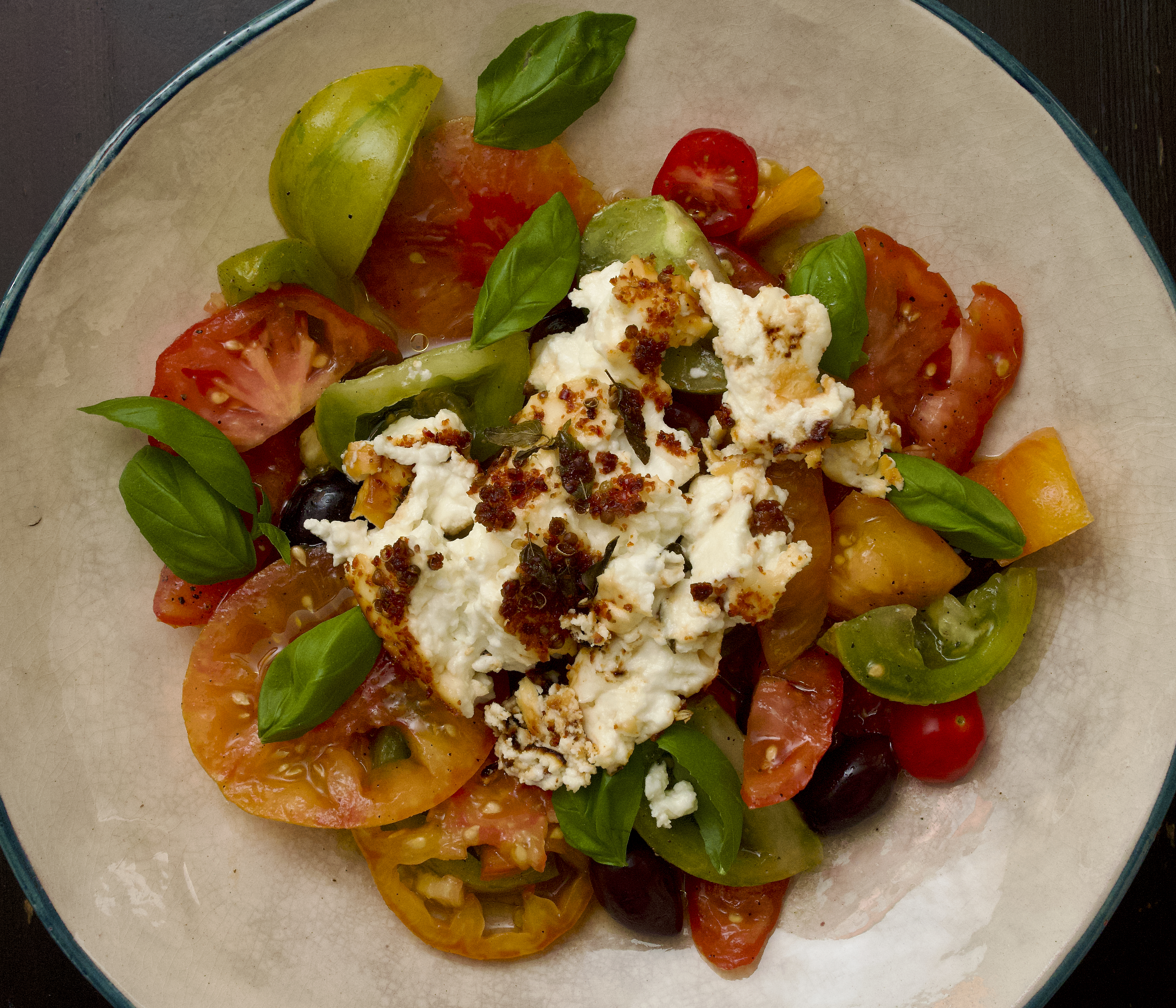
We love a tomato salad and reckon we’ll be making this one all summer. Great for a barbecue.
Baked feta and tomato salad – serves 4
1 block of feta
100ml olive oil, plus 1 tsp
a drizzle of runny honey
½ tsp coriander seeds, lightly crushed
1 tsp fresh oregano leaves, or a good pinch of dried oregano
½ tsp pul biber
600g mixed tomatoes
2 tbsp kalamata olives, pitted
2 tsp red wine vinegar
a handful of basil
Heat the oven to 220C/200C/Gas 7.
Rub the feta with a tsp of olive oil. Place on a sheet of foil, then drizzle over the honey and sprinkle with the coriander seeds, oreganoa and pul biber. Wrap the foil around the feta to make a sealed parcel then bake for 10 minutes.
Unwrap the foil and roast for another 5-10 minutes or until caraemelised.
Meanwhile, slice the tomatoes and put them into a large bowl. Sprinkle over a good pinch of sea salt and lots of black pepper. Stir in the olives and red wine vinegar and set aside.
Spoon the tomatoes onto a serving platter and drizzle with olive oil (use a nice one). Sprinkle over the basil leaves and set the baked feta on top.
(Original recipe by Rosie Birkett in Olive Magazine, June 2023).
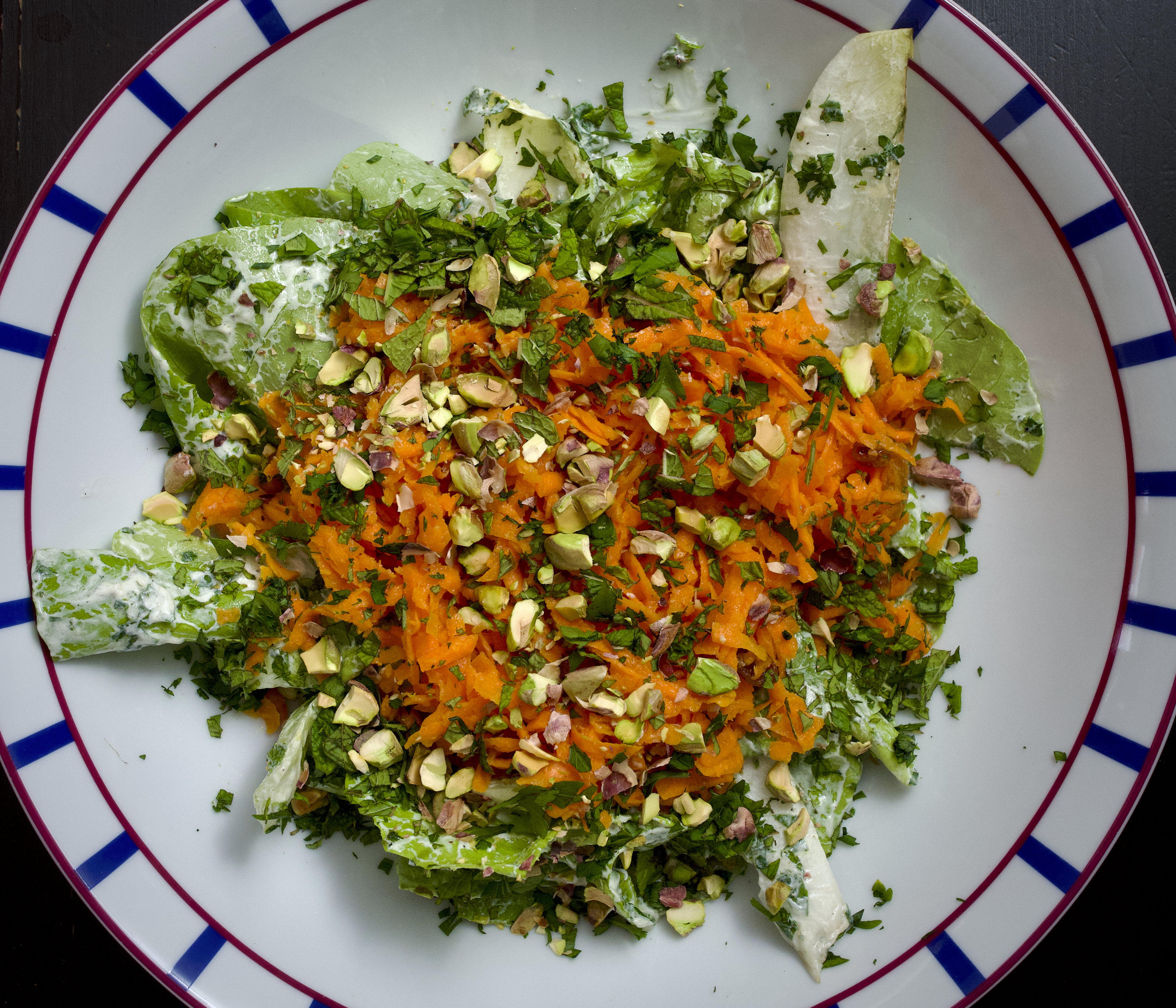
We spotted this salad idea in the Guardian so ate it outside with a barbecue … perfect!
Green salad with carrots and pistachios – serves 4
4 carrots, grated
1 tsp Dijon mustard
20g sultanas
5 tsp white wine vinegar
60ml olive oil
1 small clove of garlic, crushed
100g plain yoghurt
½ tsp caster sugar
10g mint leaves, finely chopped
20g parsley leaves, finely chopped
1 baby gem lettuce, leaves separated and halved lengthways
1 white chicory, leaves separated and halved lengthways
1 butterhead lettuce, leaves separated and large ones halved lengthways
30g pistachios, toasted and lightly crushed
Mix the grated carrots with the mustard, sultanas, 4 tsp of white wine vinegar, 1 tbsp of olive oil and ½ tsp of salt in a small bowl, then leave to marinate for at least 30 minutes.
Meanwhile, make the dressing in a large bowl by mixing 1 tsp white wine vinegar with 3 tbsp of the olive oil, the garlic, yoghurt, sugar, ¼ tsp of salt and plenty of black pepper.
Combine the chopped mint and parsley in a bowl.
Put the salad leaves and half the chopped herbs into the bowl with the dressing, then toss gently to coat.
Arrange the leaves on a shallot serving platter or bowl and scatter the marinated carrot on top. Serve with the rest of herbs and the pistachios sprinkled over.
(Original recipe by Yotam Ottolenghi in the Guardian.)
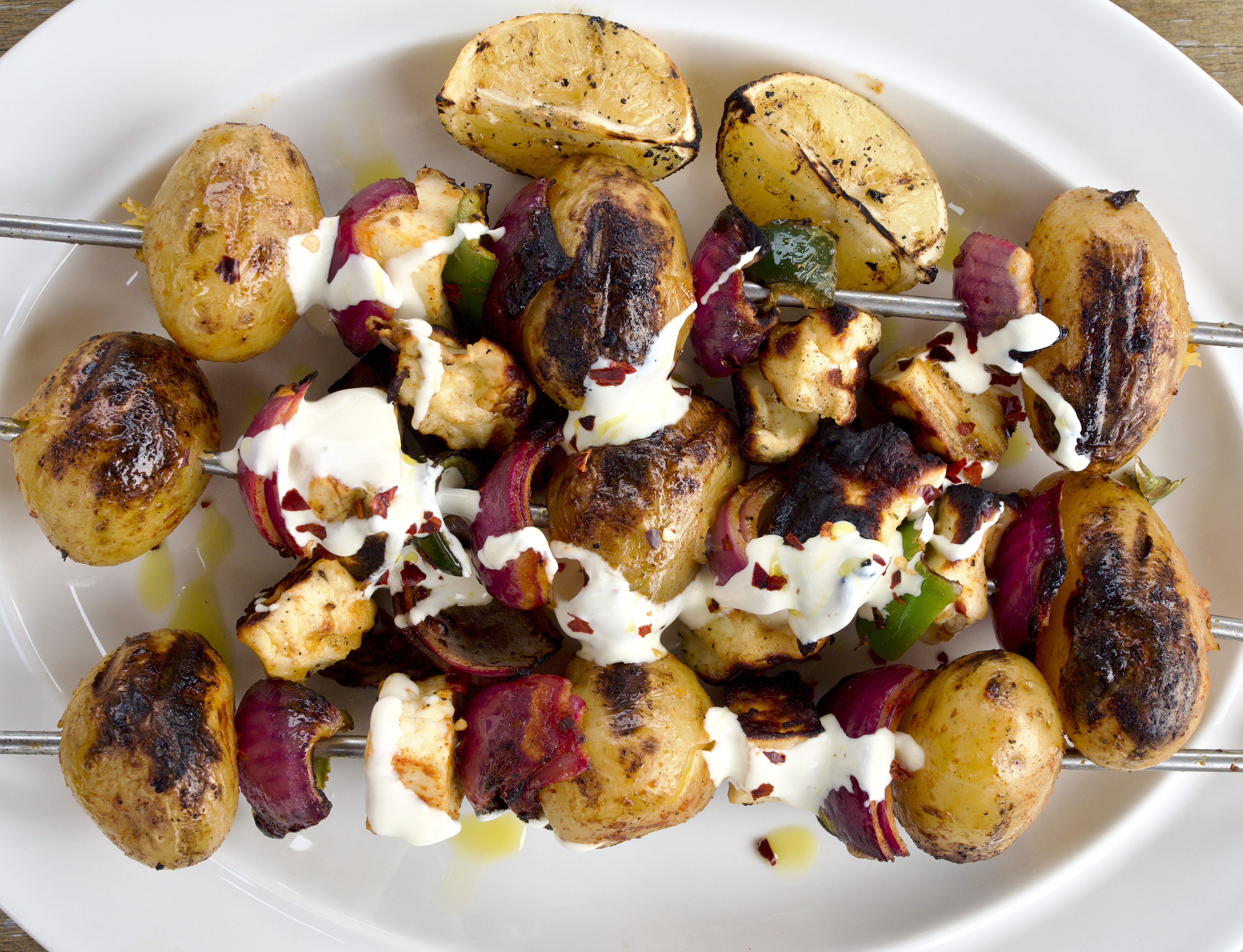
Sometimes it’s nice to cook the sides on the barbecue too. These skewers are tasty and could even be a main course with some salad.
Barbecue halloumi, potato and jalapeños with sour cream – serves 4
1 x 225g packet of halloumi cheese, cut into 3cm pieces
500g baby new potatoes, boiled until tender
2 jalapeño chillies (or other green chillies), cut into pieces and seeds discarded
1 large red onion, cut into pieces
3 tbsp olive oil, plus more to serve
1 tsp paprika
1 lemon, quartered
150g sour cream
chilli flakes, to serve
Put the halloumi, cooked potatoes, jalapeños and onion into a large bowl. Add the olive oil, paprika and juice from 2 of the lemon quarters. Season with salt and member and toss gently with your hands.
Thread everything onto metal skewers and cook on the barbecue for 5-10 minute, turning, until golden and lightly charred.
Grill the extra lemon quarters on the barbecue while the skewers are cooking.
Season the sour cream with a good pinch of salt.
Transfer the skewers to a platter and drizzle with the sour cream. Trickle over some olive oil and the juice from the barbecued lemons, then sprinkle with a few chilli flakes.
(Original recipe from Camper Van Cooking by Claire Thompson, Quadrille, 2021.)
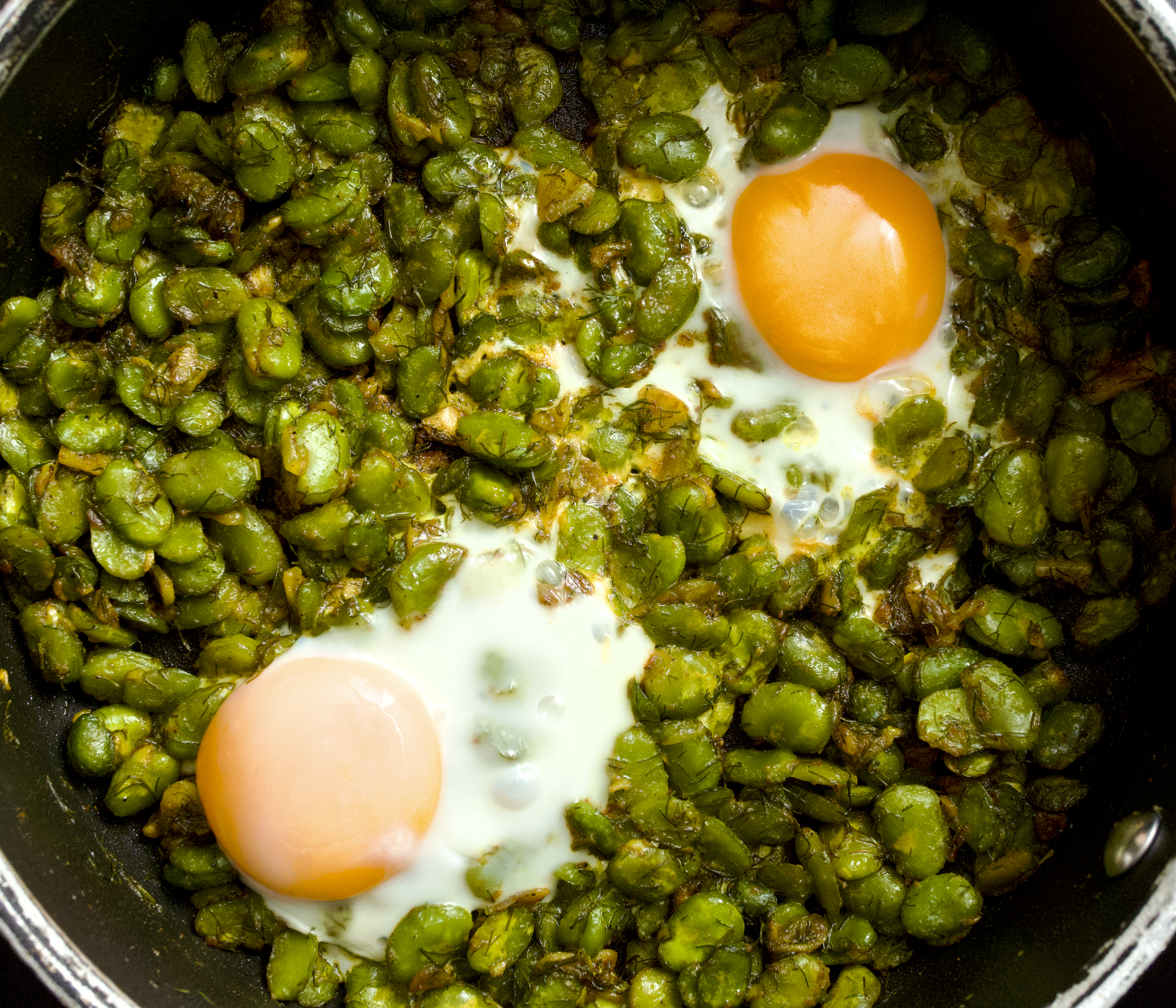
Jono picked this Iranian dish for his Father’s Day breakfast. It’s delicious! Serve with naan bread, tortillas or toast.
Broad beans with garlic, dill & eggs – serves 4
olive oil
1 bulb of garlic, cloves bashed and thinly sliced
1kg podded frozen broad beans, skins removed (blanch for a couple of minutes and the skins will pop off easily)
3 tsp turmeric
generous tsp crushed sea salt
freshly ground black pepper
60g dill, stalks and leaves finely chopped
25g butter
4 large free-range eggs
Heat a large deep frying pan over a low-medium heat, add a generous drizzle of olive oil and sweat the garlic until it softens. Add the broad beans and increase the heat to medium, then add the turmeric, sea salt and some black pepper and stir well. After 5 minutes, mix in the chopped dill and cook for another 8 minutes.
Add the butter to the pan and let it melt into the beans. Crack the eggs on to the surface of the beans and allow to cook using the heat from the beans – about 15 minutes. The beans will be a dull green by the end of the cooking time. Serve with your bread of choice.
(Original recipe from Persiana by Sabrina Ghayour, Mitchell Beazley, 2014.)
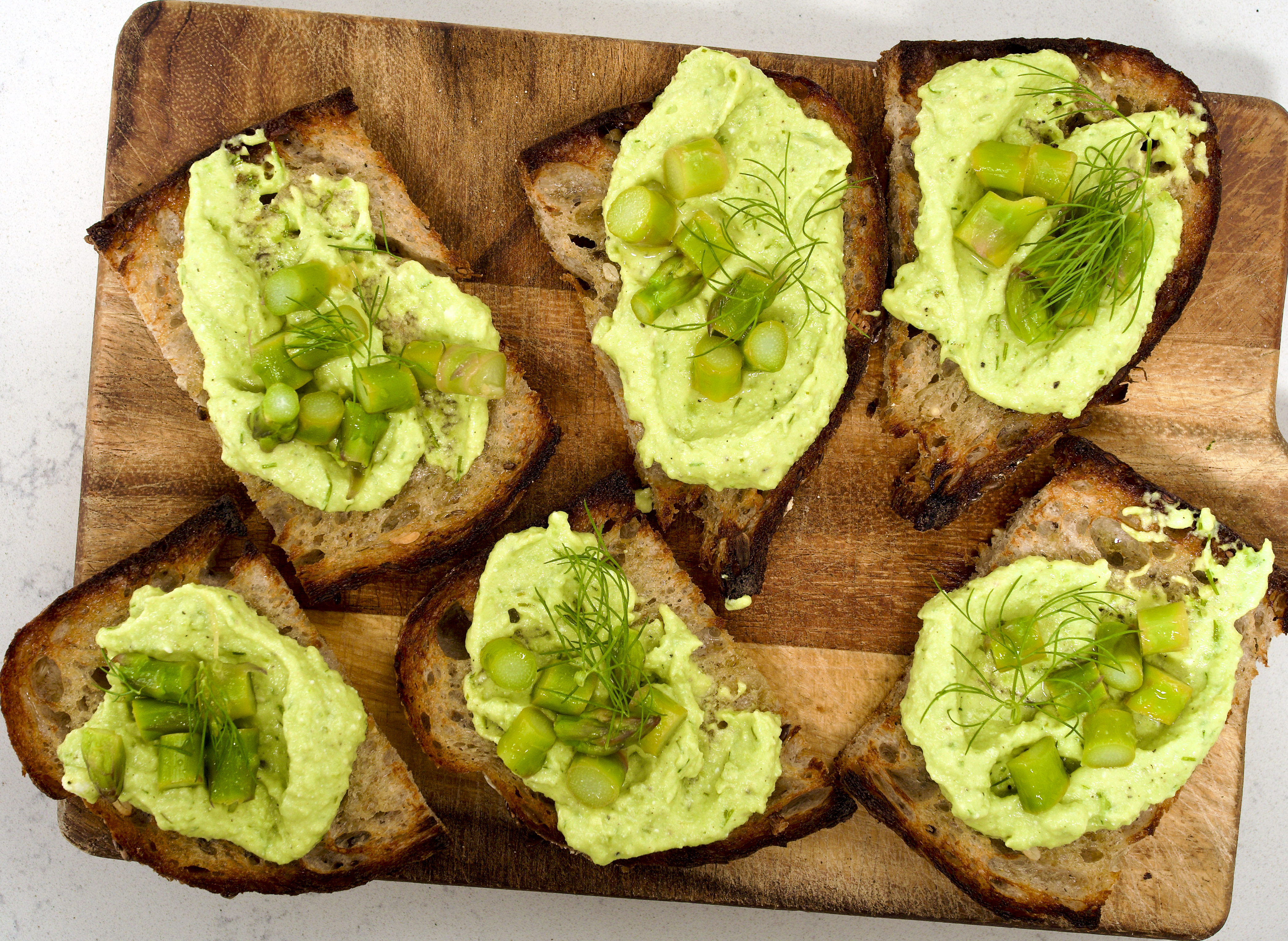
Look at the colour of these! A perfect starter or snack before the spring veg disappears.
Broad bean crostini with asparagus & dill – serves 4
160g broad beans
4 tbsp extra virgin olive oil
50g feta cheese, crumbled
1 tsp honey
juice of half a lemon
a large handful of dill fronds
4 slices of sourdough
1 clove of garlic, halved
4 blanched asparagus spears
Bring a large pot of salted water to the boil and cook the broad beans for 5-6 minutes or until tender. Drain and tip them into a bowl of ice-cold water, then pop the beans out of their pods and transfer to a food processor.
Add the olive oil, feta, honey, lemon juice and dill to the food processor, then season with black pepper and whizz to a purée.
Meanwhile, brush the bread with some olive oil and toast or griddle until golden, then rub with the cut side of the garlic clove.
Finely chop the asparagus spears and toss with a little olive oil and lemon juice.
Spread the broad bean purée over the toast and top with the asparagus and some extra dill.
After such a long, cool and wet Spring we are finally having sunny weather in Ireland and so we’re cooking anything over fire … on sticks … and lots of salads. Long may it last!
Wine Suggestion: If you’re having this as a starter we’d highly recommend a good, dry Oloroso like the Bodegas Hidalgo Oloroso Faraon which is nutty, smokey, round and honeyed on the nose, but with an enveloping roundness and richness on the palet, despite being bone dry. Very savoury and great with food.
Pork and Asparagus Kebabs – serves 4
500g pork fillet, cut across the grain into ½ cm thick slices
1 clove of garlic, finely chopped
1-2 tsp smoked paprika
3 tbsp olive oil
250g asparagus, woody ends snapped off and cut into thirds (don’t buy the very skinny stuff for this as it will be difficult to thread onto the skewers)
1 bunch of scallions, sliced into thirds
Put the pork into a large bowl, then add the garlic, smoked paprika, olive oil and sherry vinegar, then stir well to coat. Cover and put into the fridge for an hour or two, then stir in the asparagus and scallions to coat in the marinade.
Thread pieces of pork, aspargus and scallion onto skewers.
Prepare your barbecue for direct cooking, then place the skewers directly over the heat and cook for about 10 minutes, turning a couple of times to ensure they brown and cook through.
(Original recipe from Foolproof BBQ by Genevieve Taylor, Hardie Grant: Quadrille, 2021.)
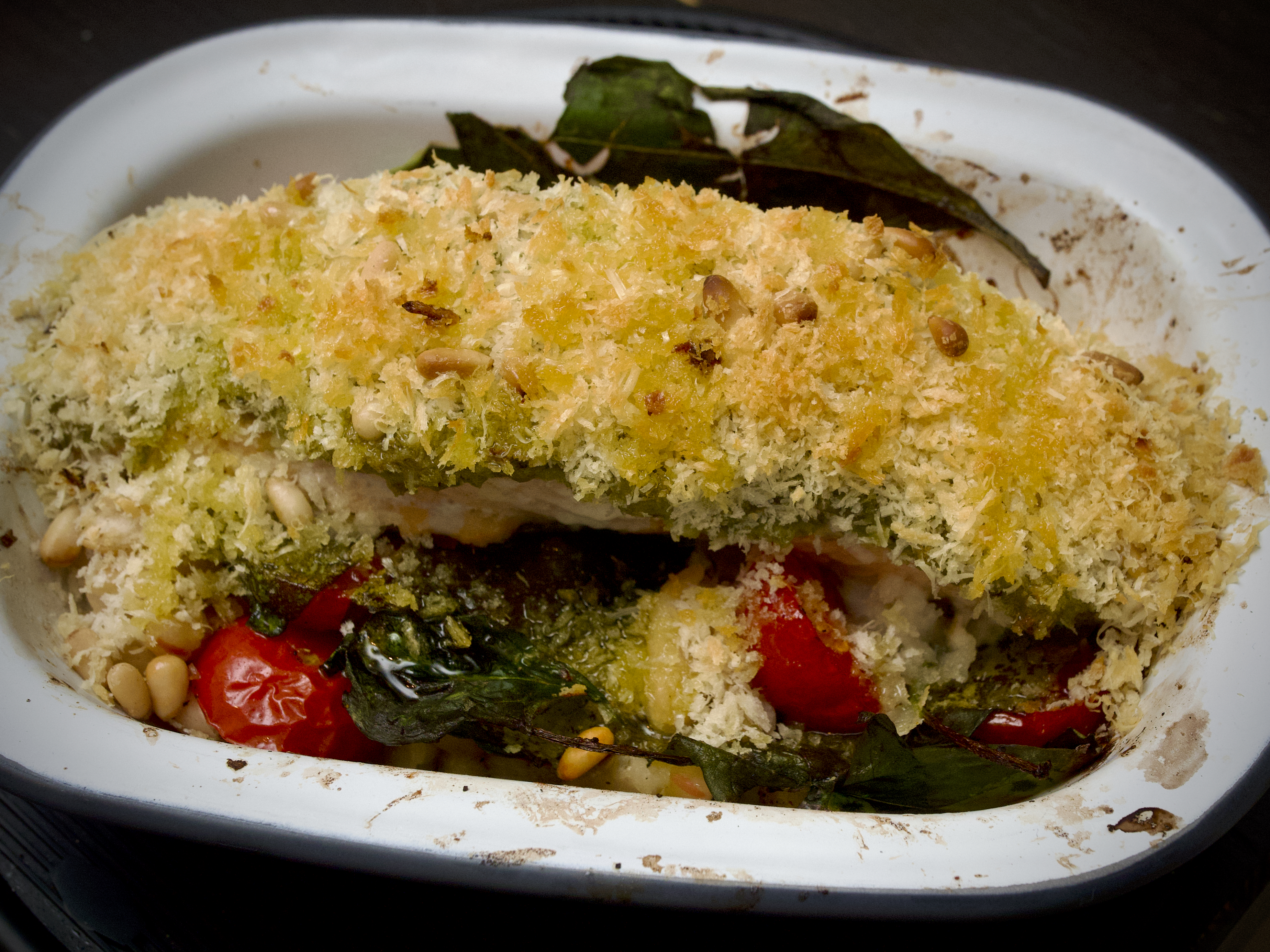
This is perfect for mid-week, super easy and very easy to assemble and bake in the oven. You can cover the dishes and freeze them if you like, then cook from frozen, uncovered for 30-35 minutes.
Wine Suggestion: With a floral, herbal and stonefruit character that’s backed up with a very textural green almond note Sartarelli’s Verdicchio Superiore Tralivio is just the business for this dish. Tomasso Sartarelli really has a feel for this cuvée and how to get the best from the old vines this is made from and it has such a natural balance it makes it so easy to drink when first released, like we’re doing tonight. However, with a bit of will power, it ages superbly too.
Pesto salmon with tomatoes, spinach & beans – serves 6
100g baby spinach
3 x 400g tins cannellini beans, drained and rinsed
300g cherry tomatoes, halved
2 tbsp olive oil
1 lemon, zested and juiced
6 tbsp Philadelphia cheese or other soft cheese
4 tbsp fresh pesto
150g breadcrumbs
40g Parmesan, grated
3 tbsp pine nuts
6 salmon fillets
Heat the oven to 200C/180C fan/Gas 6.
Divide the baby spinach 6 individual baking dishes. Spoon over the beans and tomatoes and drizzle with the olive oil. Sprinkle over the lemon zest and squeeze over the juice, then season well. Toss with your hands to mix everything together.
Mix the soft cheese with the pesto in a bowl.
In another bowl mix the breadcrumbs with the Parmesan and pine nuts.
Place a salmon fillet into each dish and season well. Spoon over the pesto mixture, then the breadcrumb mixture, pressing it down. A bit will inevitably end up in the beans and that’s ok.
Bake for 20-25 minutes, or until the salmon is cooked (a probe should read 60C) and the crumbs a nice golden colour.
Cooking a whole chicken on the barbecue can be a bit tricky but it is much easier if you spatchcock the chicken. This is quite easy and we do this ourselves; cutting out the backbone with poultry shears and then turning over and flattening out by pushing down on the breast. There are plenty of videos online to help, or just ask your butcher to do it, they never mind.
A temperature probe is also an essential piece of kit when barbecuing all meat as its the best way of determing if the meat is cooked underneath any charring. They are relatively inexpensive, but a worthwhile investment. There’s a reason professionals use them and they help remove the risk of being under-done. Cooking over fire (or gas) is inexact and using the probe has meant that any timings are just a guide; sometimes the dish is done early as it’s hotter than last time, or takes more time than planned. The probe can help you get this right.
We served this sesame sticky rice and and a Thai salad.
Wine Suggestion: As it’s summer barbecue time, a good Provençal rosé, the Love by Léoube, was opened to great success. With the thai aromatic flavours and chilli you need to avoid to much tannin especially, but with charry barbecue chicken a bit of body is still needed which these rosés give, despite their light colour and freshness. The hints of gentle strawberry and raspberry flavours really picked up on the mint and lime too.
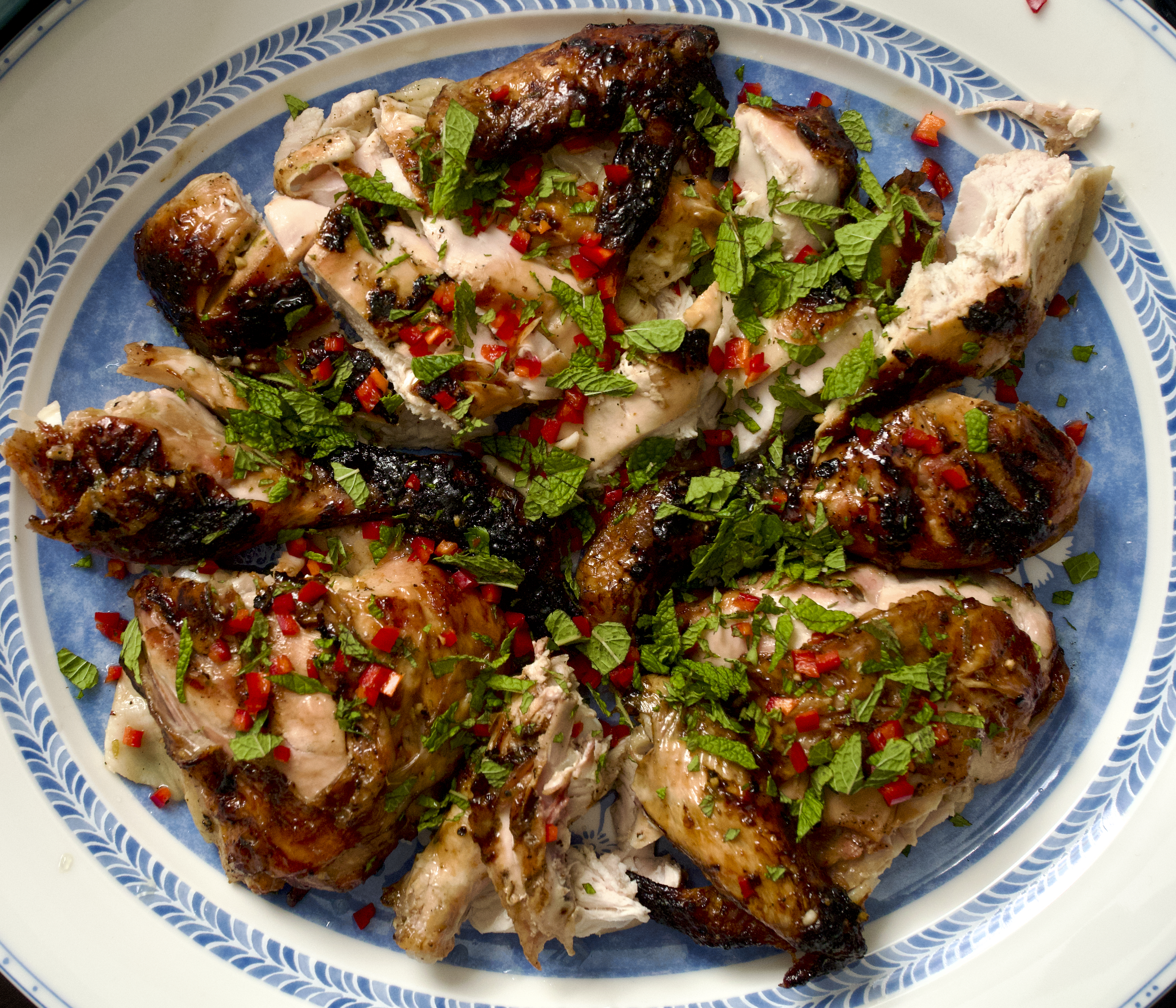
Barbecued chicken with coconut & soy – serves 4
2kg free-range chicken
1 tbsp olive oil
200g tin coconut milk (you can buy little tins or just use half a regular tin and freeze the rest for later)
1 clove of garlic, finely chopped
2 tbsp soft brown sugar
2 tbsp soy sauce
1 tbsp fish sauce
zest and juice of 1 lime
a few sprigs of mint, leaves chopped
2 red chillies, chopped
You need to get your barbecue ready for both direct and indirect cooking (i.e. hot coals on one side only).
Slash the breast and legs of the chicken with a sharp knife.
Rub the chicken with olive oil and season well with salt and pepper.
Lay the chicken on the indirect side of the barbeuce. Put something heavy on top to weight it down, we used a cast-iron frying pan, then shut the lid and leave to cook for 45 minutes. Rotate the chicken a couple of times to make sure it cooks evenly but keep the skin-side up.
Mix the coconut milk, garlic, sugar, soy sauce, fish sauce and lime zest together to make a baste for the chicen.
Once the initial 45 mintues is up, turn the chicken skin-side down and cook for another 10 minutes, with the lid on.
Now move the chicken over the coals to cook over a direct heat and start basting with the coconut mixture. Keep basting and turning for 10 to 15 minutes or until nicely browned and cooked through. A probe should read 74C.
Chop the cooked chicken into large pieces, then squeeze over the lime and scatter over the mint and chilli.
(Recipe inspiration from Foolproof BBQ by Genevieve Taylor, Hardie Grant: Quadrille, 2021.)
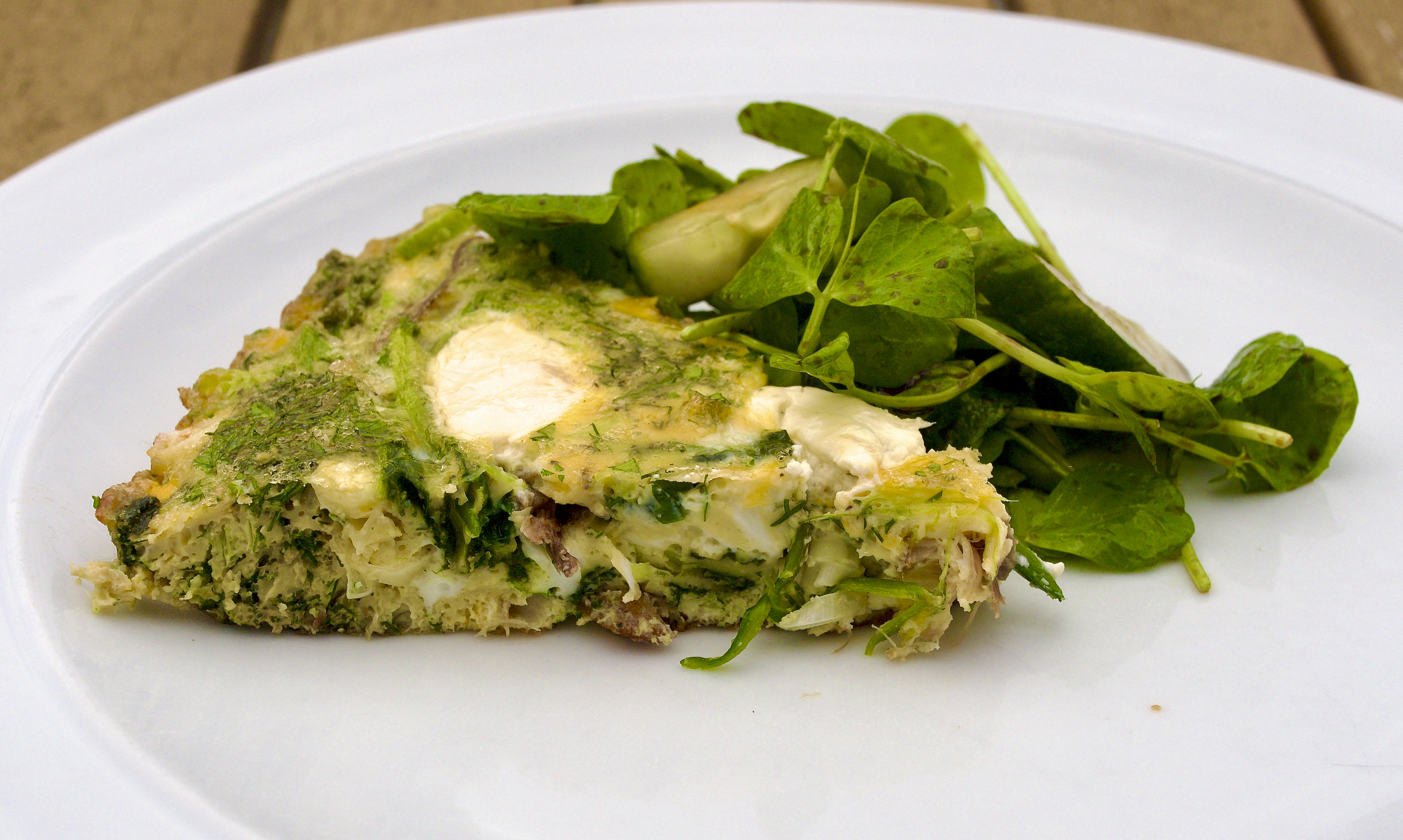
For no particular reason we’ve started cooking frittatas at last … why did no-one tell us how simple they are to make? We particularly enjoyed this one with mackerel and dotted with horseradish cream. Serve with a green salad.
Smoked mackerel and spinach frittata – serves 6
60g butter
50g baby spinach, washed and drained but still damp
220g smoked mackerel
3 scallions, trimmed and finely chopped
4 tbsp chopped flat-leaf parsley
3 tbsp chopped dill
8 eggs, lightly beaten
3 tbsp crème fraîche
1 tsp horseradish sauce
Preheat the oven to 190C/170C/Gas 5.
Melt 20g of the butter in a heavy non-stick frying pan, about 25-30cm diameter, over a medium heat. Stir in the spinach, then cover with a lid and leave for a minute or two until wilted. Tip into a colander and leave to cool. Wipe the pan out with kitchen paper.
Put the cooled spinach into a bowl. Break the mackerel into pieces, discarding any skin and bones, and add to the bowl with the spinach. Add the scallions and herbs, then pour in the eggs and stir until will combined. Season with salt and pepper.
Melt the rest of the butter in the wiped-out pan and place back over a medium heat. Swirl the pan so the base is coated in butter, then tip in the frittata mixutre and smooth out. Let the eggs cook gently for about 5 minutes.
Meanwhile, whisk the crème fraîche and horseradish together, then dot over the top of the frittata. Put the pan in to the oven and cook for about 12 minutes or until set and golden on top.
Remove from the oven and allow to cool for 10 minutes before cutting. It will be delicious eaten warm or cold.
(Original recipe from Notes from a Small Kitchen Island by Debora Robertson, Michael Joseph, 2022.)
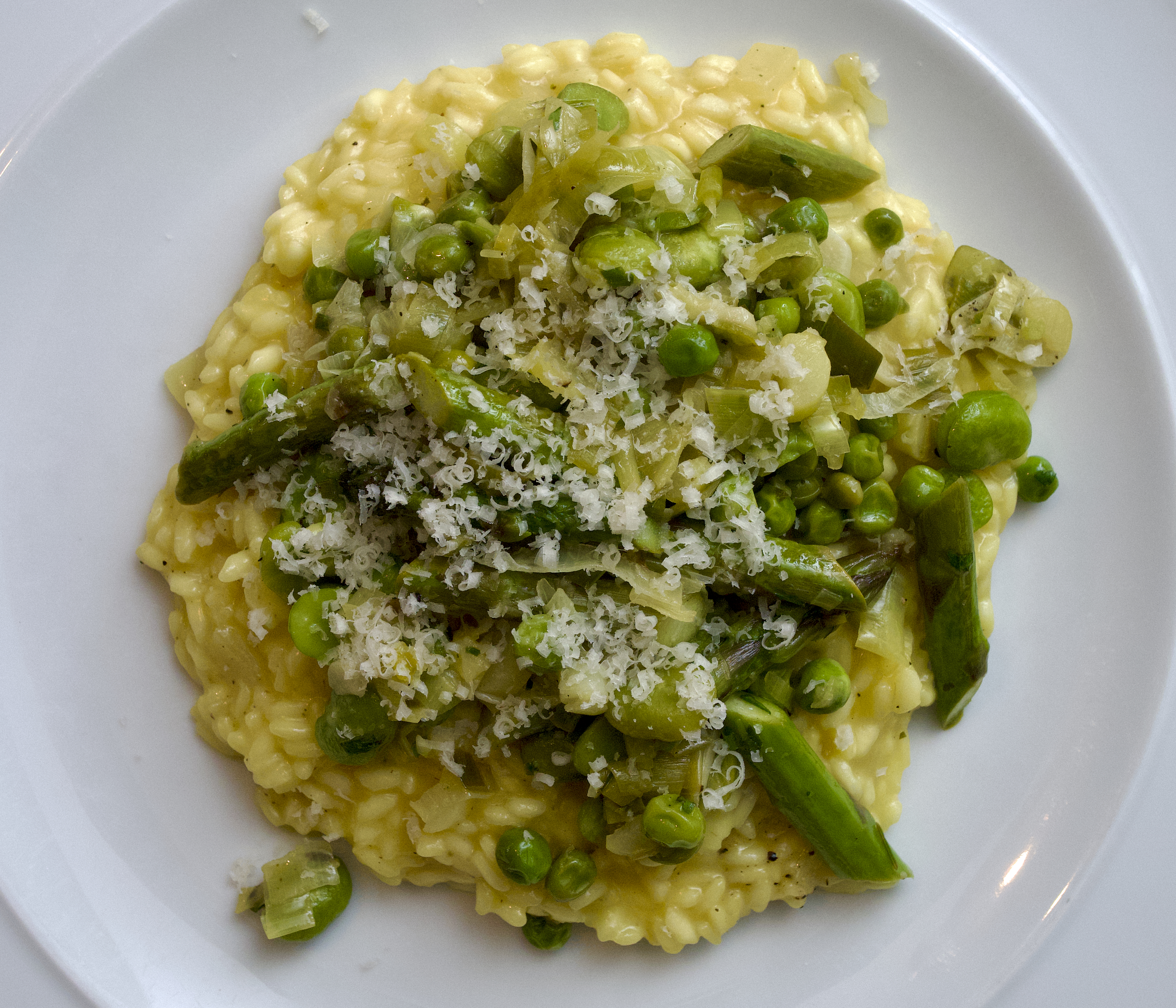
We were lucky to be gifted some top quality Persian saffron by our friend Miriam and therefore couldn’t go past this recipe, and with asparagus still available we couldn’t resist doing this despite it edging into summer.
Wine Suggestion: As this is quite rich, but also has the fresh vegetables, it lends itself to a deftly handled new world Chardonnay. Au Bon Climat is our go to choice and their Wild Boy is a perfect expression with a good blend of butter, ripe fruits and a flinty, salty core.
Saffron risotto with spring veg – serves 4
1.2 litres vegetable stock (we use Marigold Swiss Bouillon)
½ tsp saffron threads
1 tbsp rapeseed oil
a knob of butter
1 onion, finely chopped
350g risotto rice
150ml dry white wine
50g freshly grated Parmesan, plus extra to serves
FOR THE VEGETABLES
175g frozen broad beans, blanched and popped out of their skins
1 tbsp rapeseed oil
a knob of butter
2 small leeks, thinly sliced
2 garlic cloves, thinly sliced
4 tbsp dry white wine
1 bunch of fine asparagus, trimmed and cut into 2.5cm pieces
100g frozen peas
1 tbsp chopped flat-leaf parsley
1 tbsp chopped chives
juice of ½ lemon
Bring the stock to a gentle simmer in a saucepan.
Heat a sauté pan over a medium-high heat. Add the saffron and heat for a minute, shaking the pan, until the threads are dry and fragrant.
Add the oil and butter to the saffron, then tip in the onion and add plenty of seasoning. Sauté for 5 minutes, until softened but not coloured. Stir the rice into the onion and cook for 1 minute to coat the grains in the oil, then pour in the wine and bubble for a minute, stirring.
Add a ladle of stock to the rice pan and stir until completely absorbed. Keep adding a ladle of stock at a time, stirring until absorbed before adding another.
After 10 minutes, and at the same time, start cooking the veg. Heat a large non-stick frying pan over a medium heat. Add the oil and butter, then add the leeks and garlic. Season with salt and sauté for 4-5 minutes, until tender. Pour in the wine and allow to bubble down.
Add the asparagus and a splash of the stock from the risotto and simmer for a couple of minutes, until bright green and tender but still crisp. Add the broad beans and peas and cook for another 2 minutes. Remove from the heat and stir in the herbs and lemon juice; season to taste.
While this is happening, continue cooking the risotto, adding stock as necessary. After about 25 minutes the rice should be al dente. Remove from the heat, stir in the Parmesan and season to taste.
Divide the risotto between warm plates and spoon the veg into a well in the centre, then scatter over some more Parmesan and serve. We like a drizzle of best olive oil over the top too.
(Original recipe from More Midweek Meals by Neven Maguire, Gill Books, 2022).
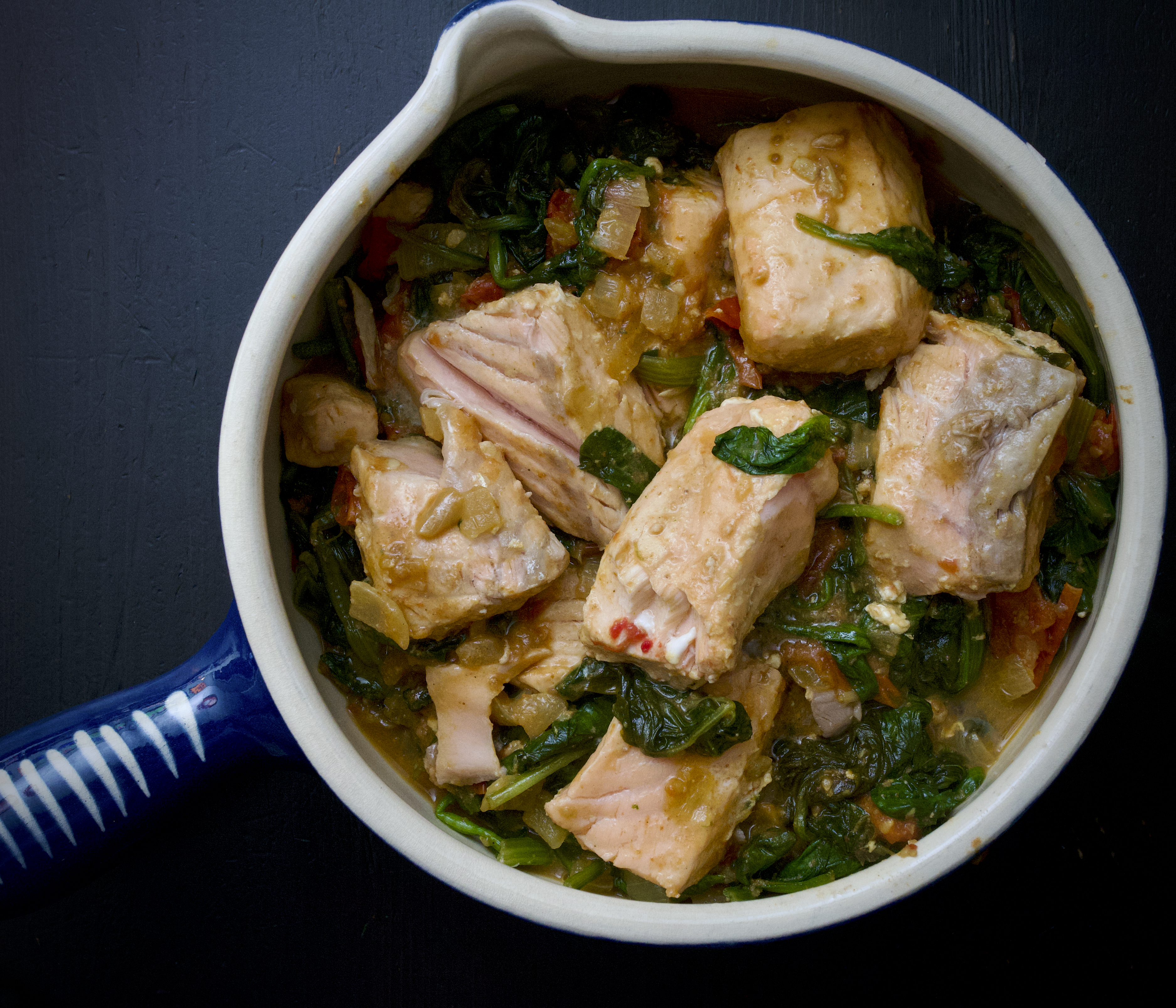
A lovely light curry from Made in India by Meera Sodha. It’s quick to make and perfect for a friday night. We served with rice.
Wine Suggestion: As this dish is quite light we think grenache based rosé is the way to go here with Chateau Pesquié Terrasses Rosé being our choice tonight. The delicate red fruits complementing the salmon really well and the open, softer nature of the grape taking on the spiciness and rounding it out.
Salmon and Spinach Curry – serves 4
2 tbsp rapeseed oil
1 cinnamon stick
6 whole peppercorns
2 cloves
1 large onion, chopped
½ tsp brown sugar
250g ripe tomatoes, roughly chopped
4cm piece of ginger, peelend and finely grated
4 clove of garlic, crushed
1 fresh green chilli, finely chopped
¼ tsp garam masala
1 tsp ground cumin
1½ ground coriander
¼ tsp ground turmeric
½ tsp chilli powder
1¼ tsp salt
500g spinach leaves
400g skinless salmon fillets
Heat the oil in a large deep pan with a lid. Add the cinnamon stick, peppercorns and cloves and fry for a minute or two until fragrant.
Stir in onion and brown sugar, then cook for 10-12 minutes until golden and caramelized. Stir in the tomatoes, then cover with a lid and leave to cook for about 5 minutes, or until the tomatoes start to soften.
Add the ginger, garlic, and green chilli, then stir in the garam masala, cumin, coriander, turmeric, chilli powder and salt. Cook the mixture, stirring so it doesn’t stick, for about 8 minutes. It will start to look like a paste. Add the spinach, turn the heat down and cover with the lid until wilted.
Cut the salmon into very big chunks (about 6cm x 6cm) and add them to the pan. Coat in the tomato and spinach sauce but be careful not to break them up. Cover with the lid for 5-7 minutes, or until the fish is cooked through.
Remove the cinnamon stick, check the seasoning and serve with rice.
(Original recipe from Made in India by Meera Sodha, Penguin:Fig Tree, 2014.)
Inspired by an extra cucumber in the veg drawer. A lovely meal for mid-week with crusty bread.
Wine Suggestion: Wines from the hills in South Western France are very underrated, especially when made by insightful provocative winemakers. The Domaine Coustarret Jurançon Sec is 100% Gros Manseng and has a great balance between a sappy, salty backbone overlayed with orange zest and fresh stonefruit flavours. Well worth seeking out.
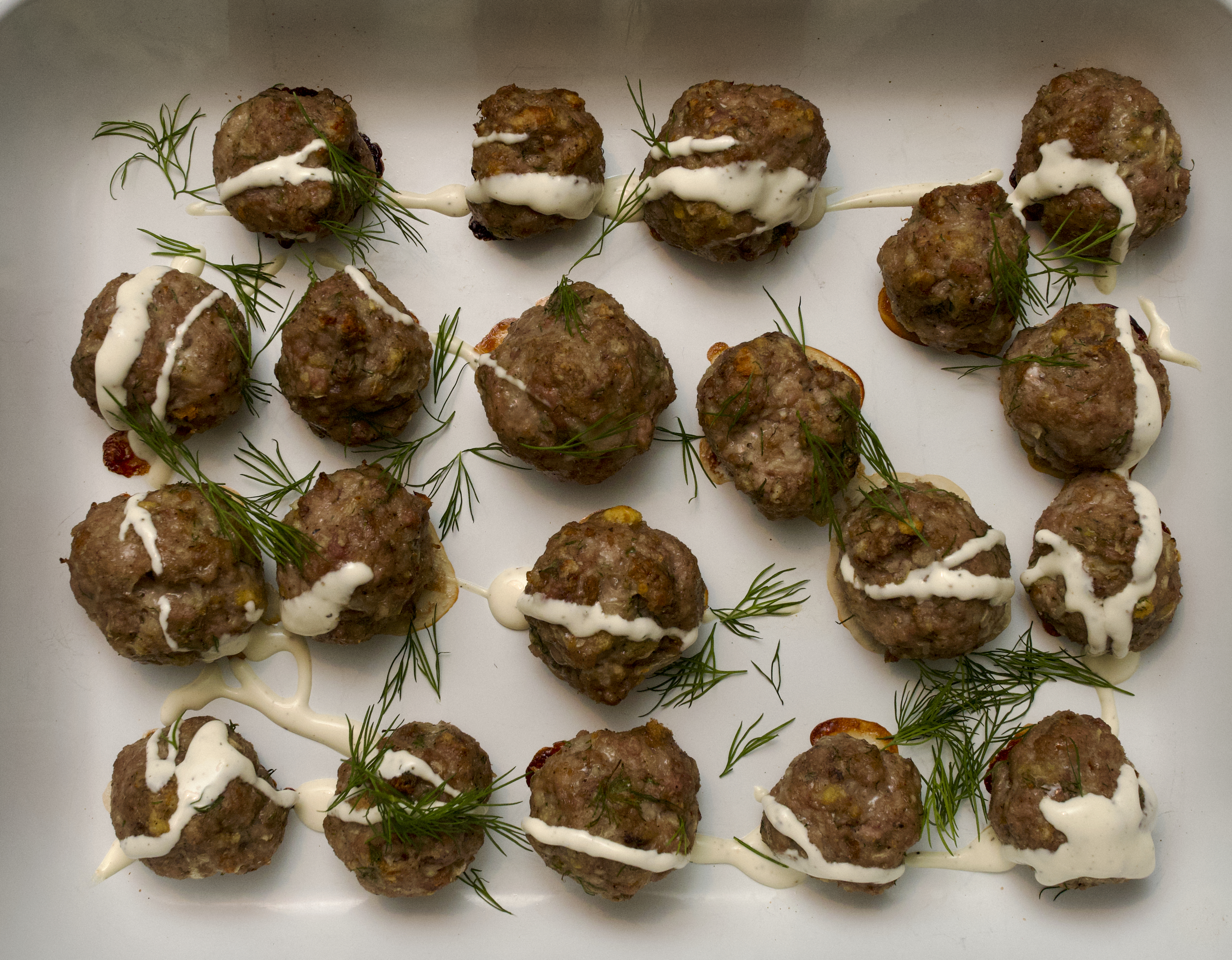
Scandi baked meatballs with pickled cucumber salad – serves 4
400g pork mince
1 egg yolk
½ tsp allspice
100g breadcrumbs
1 small onion, grated
a handful of dill, finely chopped, plus extra to serve
1 tsp freshly ground white pepper
4 tbsp sour cream, seasoned
crusty bread, to serve
FOR THE PICKLED CUCUMBER SALAD:
2 tbsp white wine vinegar
1 tbsp caster sugar
½ cucumber, peeled and cut into half moons
1 tsp yellow mustard seeds
a handful of parsley, chopped
Heat the oven to 200C/180C fan/gas 6.
Start with the pickled cucumber salad. Put the vinegar and sugar into a small saucepan and heat until the sugar has dissolved, then set aside to cool. Put the cucumber into a bowl, then pour over the cooled vinegar and add the mustard seeds. Stir and set aside.
Put the pork mince, egg yolk, allspice, breadcrumbs, grated onion, dill and white pepper, into a bowl. Season well, then mix with your hands until well combined. Form into 20 meatballs and set them into a large baking dish.
Put the meatballs into the hot oven for 20 minutes or until golden and cooked through. Drizzle with the sour cream and scatter over the reserved dill. Serve with the cucumber salad and crusty bread.
(Original recipe by Janine Ratcliffe in Olive Magazine, April 2017.)
You too can make a pasta cake like this on a Monday, trust us. Who knew it would be so easy to get cooked rigatoni to sit upright in a cake tin? The results are fun and although it will fall apart when you start serving, you can get your insta photo beforehand.
Wine Suggestion: Something fun, red and Italian like Umani Ronchi’s Rosso Conero Serrano. A blend of smooth Montepulciano and vibrant Sangiovese, this wine is fun and easy, but tied together with energy and vitality.
Torta di rigatoni – serves 4
butter, to grease the tin
4 tbsp breadcrumbs
325g rigatoni pasta
handful of basil leaves, finely chopped
250g mozzarella, cubed (buy a block of mozzarella, not buffalo)
50g grated Parmesan
FOR THE TOMATO SAUCE:
2 tbsp extra virgin olive oil
1 garlic clove, peeled and bashed
2 x 400g tins chopped tomatoes
a handful of basil leaves
Heat the oven to 180C/160C fan/gas 4.
Line the base and sides of a loose-bottomed, 20cm round cake tin with baking parchment, then butter and coat in the breadcrumbs.
Get the sauce going first. Heat the olive oil in a medium saucepan over a medium heat, then add the garlic clove and cook for about a minute. Add the chopped tomatoes, most of the basil leaves and season well with salt. Cover and simmer for 25 minutes, stirring occasionally.
Meanwhile, cook the pasta in lots of boiling salty water until al dente. Drain well, then mix with the chopped basil, half the mozzarella, some black pepper, half the tomato sauce (throw away the garlic) and half of the Parmesan. Leave to cool until the pasta is cool enough to handle.
Place the rigatoni upright in the cake tin. Pour over the remaining tomato sauce, then scatter over the rest of the mozzarella and Parmesan. Bake for 25 minutes, until golden. Leave to rest for 5 minutes before attempting to release from the tin, then scatter over a few basil leaves to serve.
(Original recipe by Gennaro Contaldo IN BBC Good Food Magazine, April 2020.)
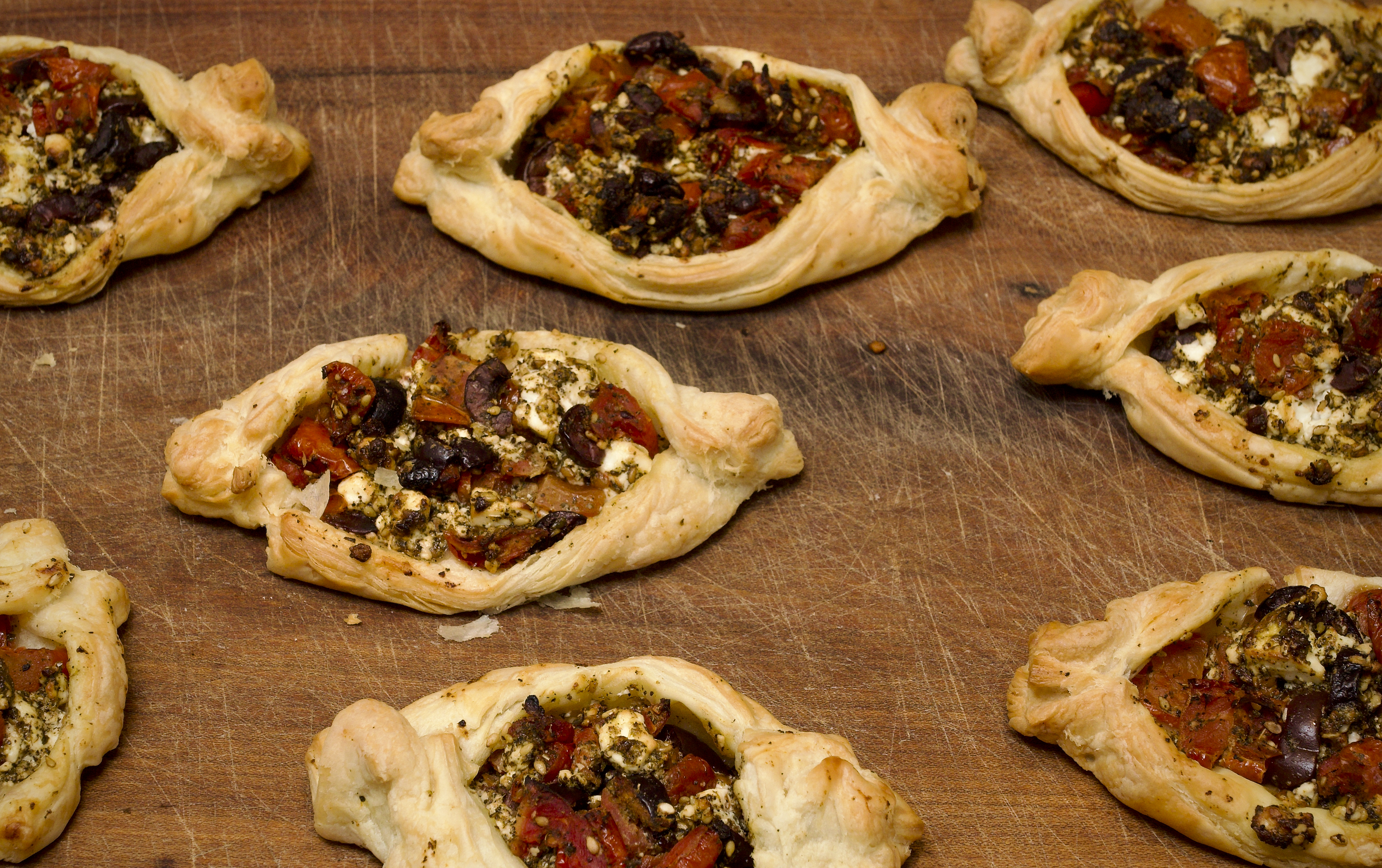
We rarely make a proper starter but we do like nibbles that you can eat in your hand with a drink. These pastries are inspired by Sabrina Ghayour and are particularly tasty.
Wine Suggestion: At this time of year we look out for savoury and dry whites, and from Crete we chose an Assyrtiko from Nikos Karavitakis. His Nomas cuvee is crisp, dry, appley citrus with a stony salinity and savoury finish; just perfect for a salty, savoury, herby pastry like this. Sunshine on a plate, and in a glass.
Za’atar, tomato, olive & feta pastries – makes 9
1 x 320g ready-rolled puff pastry sheet
150g sunblush tomatoes in oil, drained and patted dry with kitchen paper, then roughly chopped
200g feta cheese, crumbled
75g pitted Kalamata olives, roughly chopped
2 tbsp za’atar
Heat the oven to 200C/Gas 6.
Line a large baking tray with baking paper.
Cut the pastry into 3 vertically and then horizontally to give 9 rectangles.
Mix the tomatoes, feta, olives and za’atar together in a mixing bowl and season generously with black pepper.
Divide the mixture between each pastry rectangle. Put spoonfuls in the centre and pat with your fingers to flatten it down.
Take 2 corners of the pastry and twist them together like a sweet wrapper. Repeat with the 2 remaining corners, leaving the filling exposed in the middle. Repeat with each piece of pastry.
Put the pastries onto the lined baking tray and bake for 25 minutes, or until golden brown.
Remove from the oven and cool slightly, they are best served warm.
(Original recipe from Persiana Everyday by Sabrina Ghayour, Aster, 2022.)
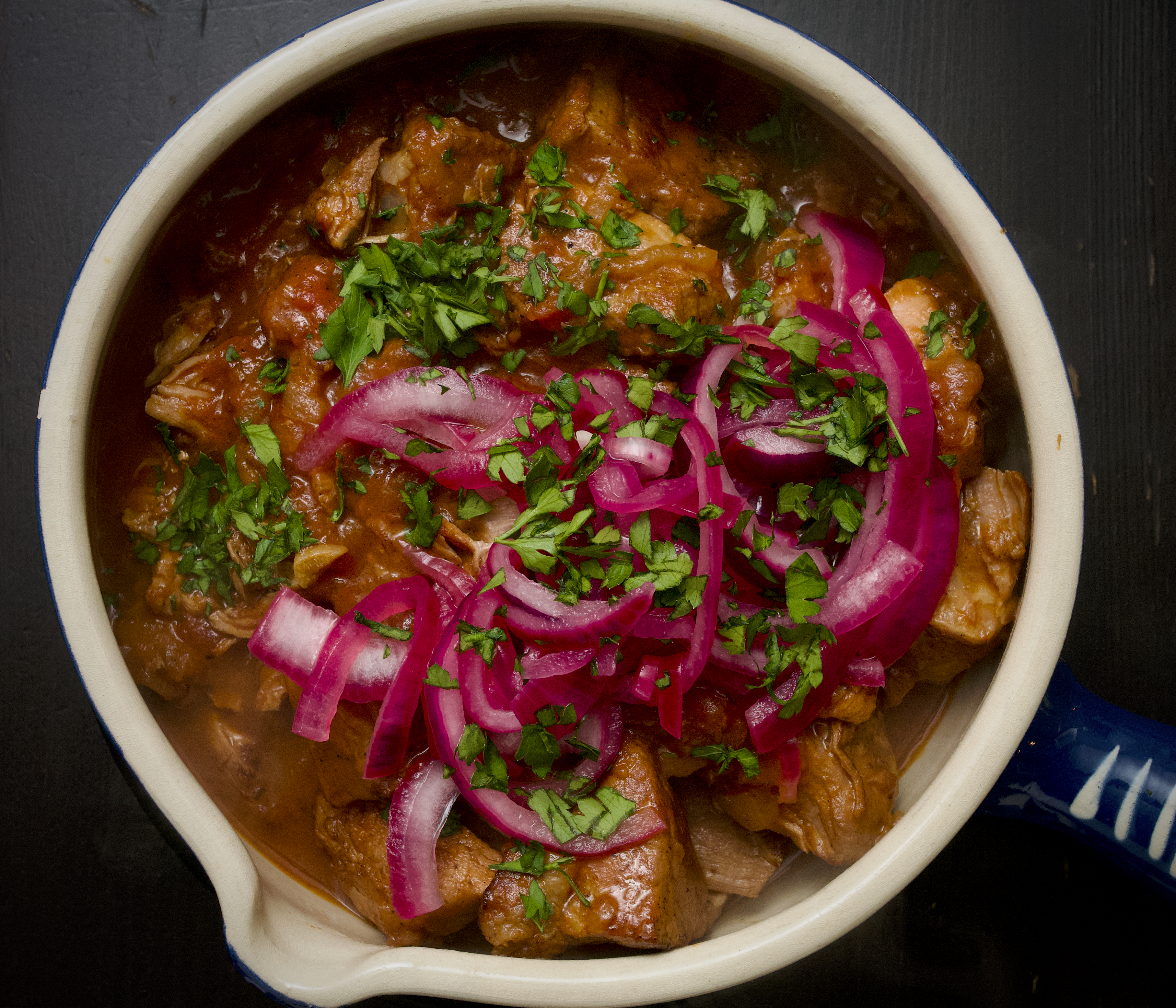
This is an Iberico pork dish inspired by José Pizarro. We did not have any Iberico and substituted Tamworth free-range pork from our butchers instead. This is not quite the same but the dish was still lovely, but of course use Iberico if you can find it.
Wine Suggestion: A dish that begs for a Spanish Garnacha.
Pork shoulder in tomato & sherry sauce with lemony couscous – serves 6
2 tbsp olive oil
1.5kg shoulder of pork (or Iberico pork), cut into 5cm chunks
2 red onions, finely sliced
3 cloves of garlic, finely sliced
2 tsp coriander seeds, lightly crushed
1 tbsp tomato purée
150ml oloroso sherry
1 x 400g tin chopped tomatoes
400ml chicken stock
FOR THE COUSCOUS:
1 red onion, finely sliced
juice of 1 lemon
250g couscous
3 tbsp extra virgin olive oil
450ml chicken stock
a large handful of flat-leaf parsley, chopped, plus extra to serve
2 preserved lemons, skin finely sliced and pulp discarded
½ cucumber, peeled, deseeded and finely diced
30g toasted flaked almonds
Heat the oven to 160C/140C fan/gas 3.
Season the pork with salt and pepper, then heat the olive oil in a large casserole and fry the pork in batches until well browned on all sides.
Reduce the heat to medium-low, then add the onions to the dish and fry gently for 10 minutes, then add the garlic and coriander seeds and fry for another 5 minutes.
Add the tomato purée and sherry and bubble for 1 minute, then return the pork to the pan and add the tomatoes and stock. Season and bring to a simmer, then cover and transfer to the oven. Cook for 2½-3 hours or until the meat is really tender.
Meanwhile, prepare the couscous. Put the onion into a heatproof bowl, then pour over boiling water from the kettle and leave to sit for 30 seconds. Drain and cool under running water. Tip the onion back into the bowl and squeeze over the lemon juice and season with salt. Set aside.
Put the couscous into a flat dish and stir in the olive oil and a good pinch of salt, then pour over the chicken stock. Stir and cover with clingfilm, then leave to steam for 10 minutes. Remove the cover and fluff the couscous up with a fork. Add the rest of the ingredients and stir to combine.
Serve the pork with the couscous, the pickled onion and its juices, and some extra parsley.
(Original recipe from The Spanish Home Kitchen by José Pizarro, Hardie Grant, 2022.)
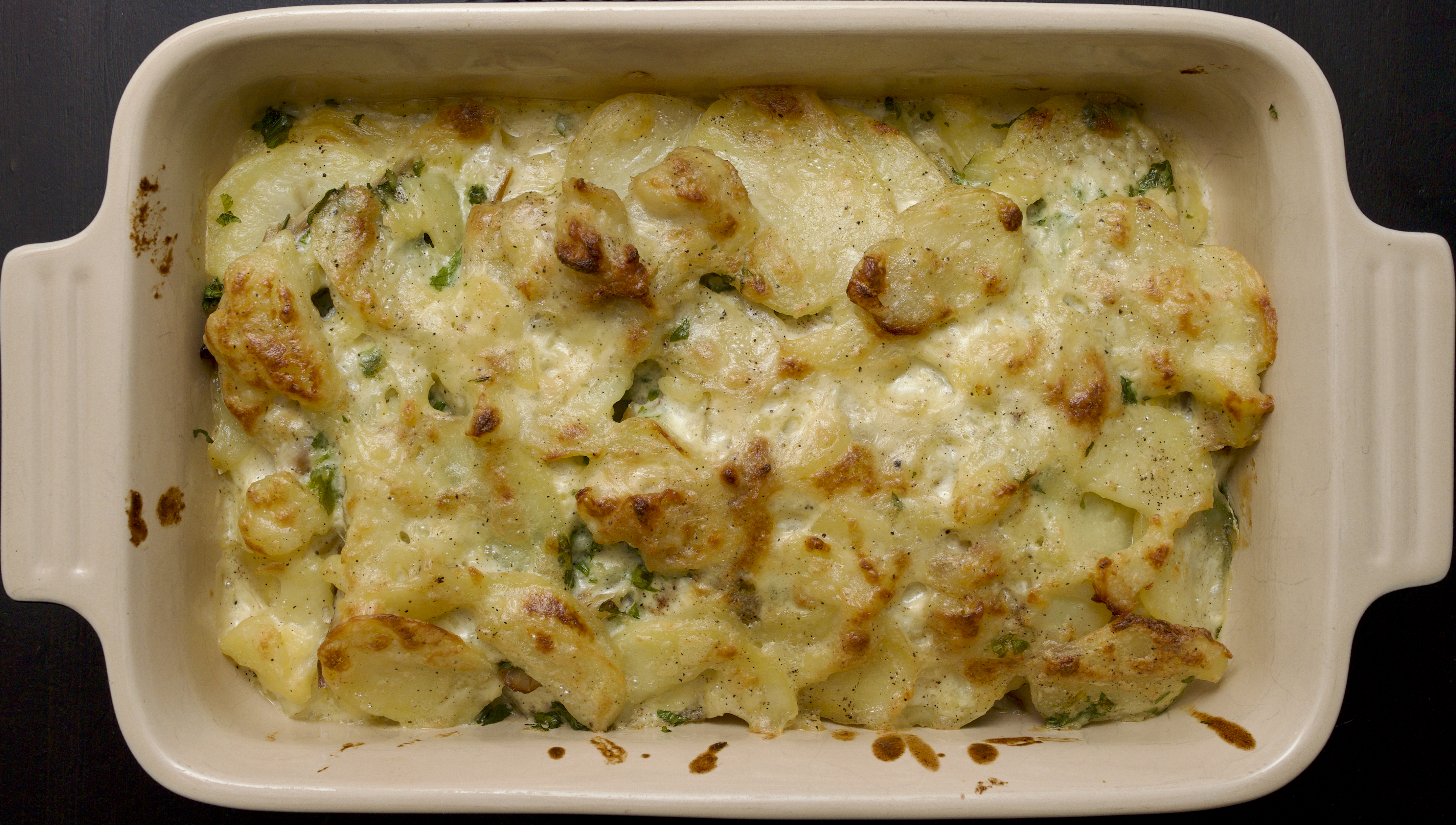
Who doesn’t love a dauphinoise? This one is extra special with some smoked mackerel and is a meal in itself with some green salad on the side.
Wine Suggestion: Chardonnay is not commonly found in the Loire, but there are gems to be found, especially around the appellation of Cheverny where it is brilliantly blended with Sauvignon Blanc. Tonight an outlier from Touraine, Domaine Bellevue’s IGP Chardonnay. Classic crisp red apple flavours with layers of tropical and citrus notes; good body but without any flabby weight. Perfect for fish and dairy combination
Smoked mackerel dauphinoise – serves 4
900g potatoes
250ml milk
250ml double cream
a small clove of garlic, crushed
freshly grated nutmeg
225g smoked mackerel, skin and bones removed and flaked into chunky pieces
a small handful of chopped flat-leaf parsley
Heat the oven to 200C/400F/Gas 6.
Peel the potatoes and slice very thinly, a mandoline is the best job for this but watch your fingers. Dry the potatoes slices with a clean cloth, then spread out and season with salt and black pepper, mixing with your hands.
Pour the milk into a saucepan, add the potatoes and bring to the boil. Cover, then reduce the heat and simmer gently for 10 minutes.
Add the cream, garlic and a generous grating of nutmeg and continue simmering for another 20 minutes. Stir occasionally to prevent the potatoes sticking to the pan. As soon as the potatoes are cooked, remove them with a slotted spoon and put a layer into a large ovenproof dish. Sprinkle over the mackerel and parsley, then cover with the rest of the potatoes. Pour the creamy liquid over the top. Put some water into the base of a large roasting tin and set the potato dish into the tin, the water should come about half-way up the sides. Bake the dish in the oven for 10 to 20 minutes or until the top is golden and bubbling.
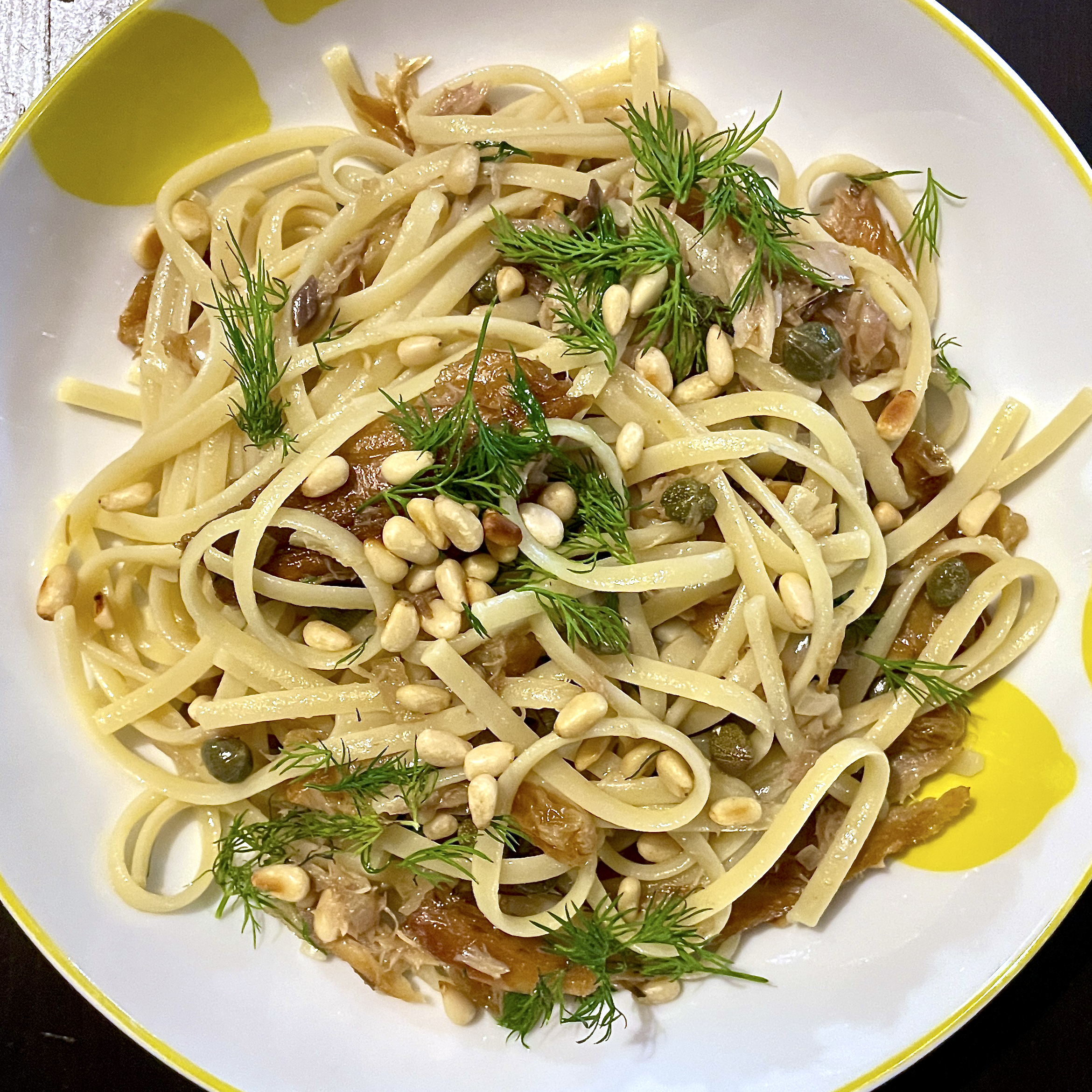
A Nigella creation that is in no way authentic and makes no apologies. Anything with mackerel goes in this house.
Wine Suggestion: Quite an exceptional wine was chosen to match with this: Sartarelli’s Balciana. From a low-yielding vineyard Verdicchio in the Marche, this is hand harvested picking only the grapes of utmost ripeness at the very end of the season. This means the picking team goes out many times picking individual grapes and bunches that meet the required levels of ripeness. It makes quite an extraordinary dry wine that has a richness of almost a sweet wine, alongside textured layers of savoury nuttiness and salty minerality. Named best white wine in Italy many times, and we understand why. We chose this as the combinations of sweet, savoury, fresh and sour flavours in the dish need a wine with substance and depth.
Pasta with mackerel, Marsala and pine nuts – serves 2
50g golden sultanas
200g linguine
2 tbsp olive oil
1 long shallot, finely chopped
60ml Marsala
2 smoked makerel fillets, skinned and flaked
2 tbsp drained capers
a few drops of red wine vinegar
a handful of dill, torn into fronds
25g toasted pine nuts
Bring a large pan of water to the boil for the pasta. Put the sultanas into a small bowl and cover with hot water from a boiled kettle.
Add lots of salt to the boiling water, then cook the linguine until al dente.
Warm the olive oil in a frying pan and cook the shallot for a couple of minutes until softened.
Add the Marsala and let it bubble, then add the mackerel, sultanas (squeeze the water out of them with your hands first), the capers and a few drops of vinegar. Remove from the heat once the mackerel is warm. There should be barely any liquid left.
Reserve a cupful of pasta cooking water before draining. Return the pasta to the pan, then tip in the mackerel, half the dill and half the pine nuts and a tbsp of pasta water. Toss gently to combine, then taste and add another few drops of vinegar if you like.
Divide between warm bowls and finish with the remaining dill and pine nuts.
(Original recipe from Nigellissima, Chatto & Windus, 2012.)
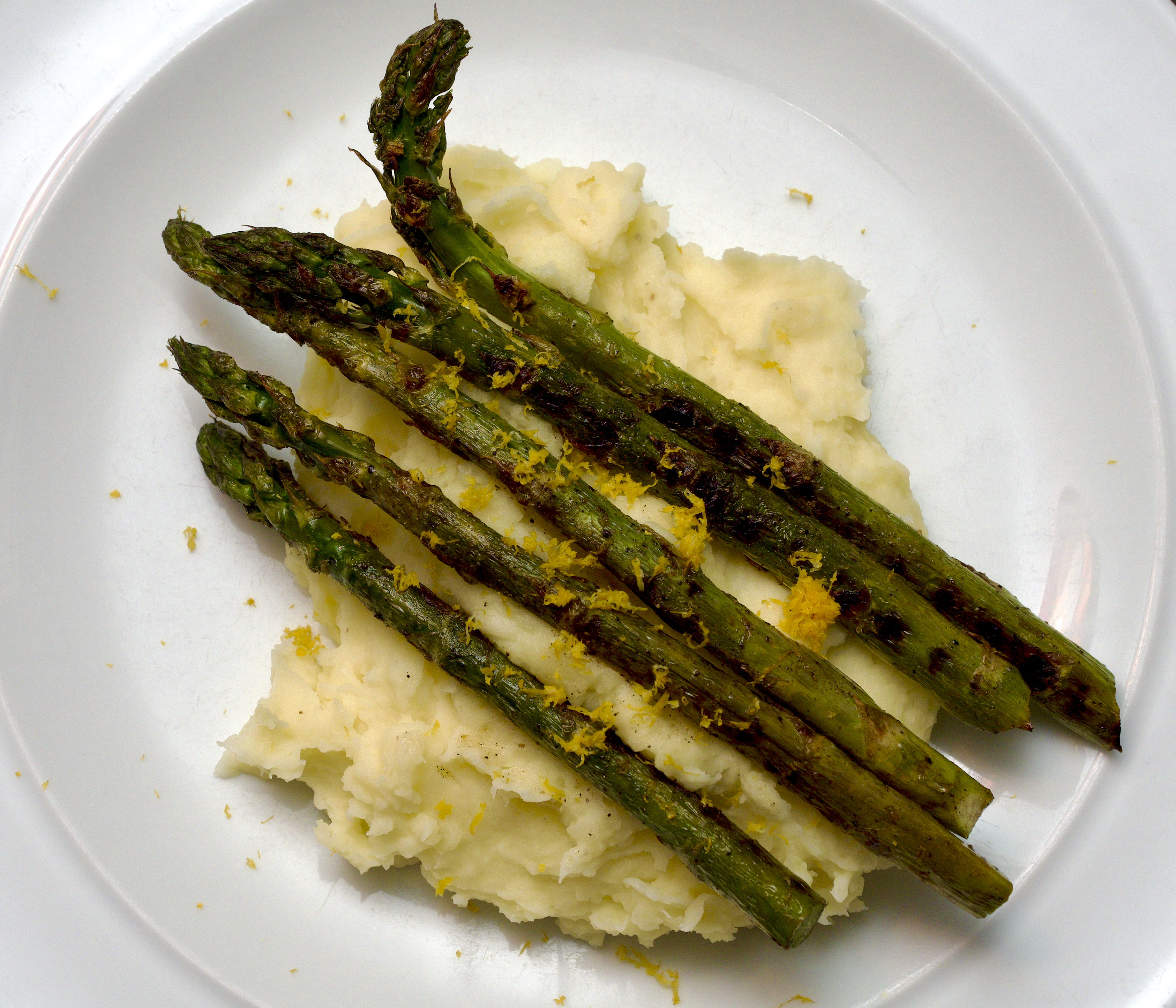
When asparagus arrives we have it with everything and if there’s nothing else with buttery mash.
Wine Suggestion: We know asparagus can clash with many wine grapes, but we enjoyed this with a glass of the Rustenberg Chardonnay, because it just goes so well with the buttery mash.
Asparagus & mash – serves 2
850g potatoes, a good variety for mashing, peeled and cut into even-sized pieces
300ml full cream milk
1 lemon, juiced, plus 1tsp grated zest
lots of butter
250g asparagus
Cook the potatoes in boiling salty water for about 20 minutes or until tender, then drain.
Warm the milk in a small saucepan, then set aside.
Put the potatoes into a food mixer with a flat paddle beater. Slowly beat the potatoes, adding the warm milk and lemon juice, until you have a smooth mash, then beat in plenty of butter.
Brush the asparagus with olive oil, then cook for 3-4 minutes on a griddle pan, turning to colour on all sides.
Taste the mash and season with white pepper and salt if needed. Divide the mash between two plates, top with the asparagus and scatter over the lemon zest.
(Original recipe from A Cook’s Book by Nigel Slater, 4th Estate, 2021.)
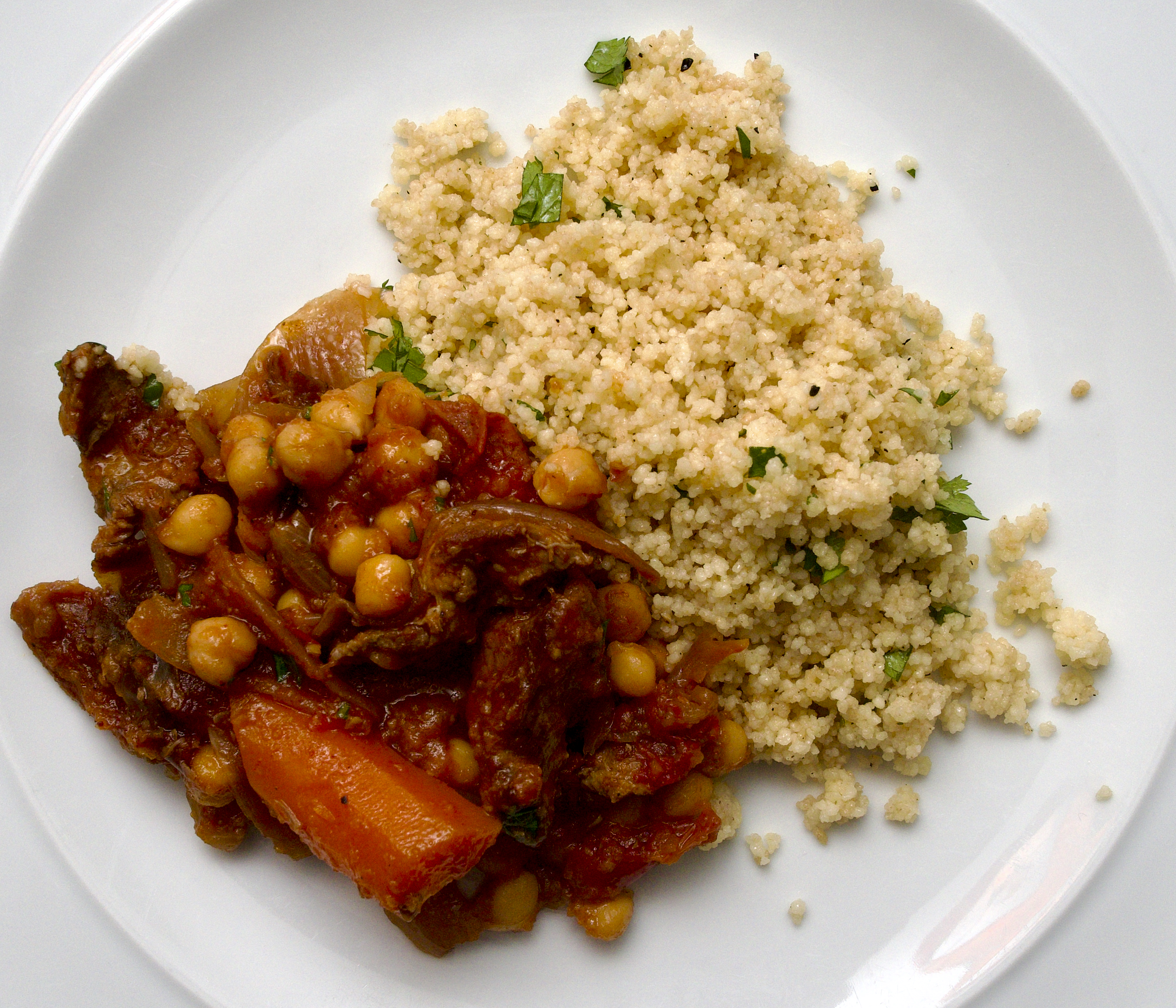
This is delicious and you can prep it all in advance. If you like you can cook for the initial 1 hour and 15 minutes earlier in the day, then bring back to a simmer before adding the chickpeas and dates and putting back into the oven for the final 40 minutes.
Wine Suggestion: We think juicy, but elegant Shiraz from the Clare Valley is hard to beat with lamb and warm spices so we opened Killikanoon’s Killerman’s Run Shiraz and enjoyed the delightful plum and sloe flavours with the elegant spicy tannins adding their own to the dish.
Lamb and chickpea tagine – serves 6
1 tbsp olive oil
750g lamb neck, cut into chunks and seasoned well
4 carrots, peeled and cut into chunky pieces
1 red onion, cut into wedges
400ml chicken stock, plus extra to make the couscous
400g tin cherry tomatoes
1 cinnamon stick
8 medjool dates, pitted and halved
660g jar chickpeas, drained and rinsed
300g couscous
50g butter, diced
a large bunch of coriander, leaves picked and stems reserved for the spice paste
FOR THE SPICE PASTE:
1 small red onion, roughly chopped
3 cloves of garlic, roughly chopped
a walnut-sized piece of ginger, roughly chopped
2 tsp ground cumin
2 tsp paprika
4 cloves, ground
4 allspice berries, ground
2 tsp mild chilli powder
1 lemon, zested and juiced
2 tbsp olive oil
a large bunch of coriander stalks, reserve the leaves to add at the end
Heat the oven to 190C/fan 170C/gas 5.
Put all of ingredients for the spice paste into a small food processor and whizz to a paste.
Heat the olive oil in a large, heavy casserole and brown the lamb in batches until well browned all over. Remove with a slotted spoon and set aside.
Add the spice paste to the casserole and cook for a few minutes, until fragrant. Add the carrots, red onion, chicken stock, tinned tomatoes and cinnamon stick. Then stir in the browned lamb. Bring to a simmer, then cover with a lid and cook in the oven for 1 hour 15 minutes.
Stir in the dates and chickpeas and return to the oven for a further 40 minutes.
To make the couscous, put the couscous into a heatproof bowl and add the diced butter and some seasoning. Add enough just-boiled stock to cover, then cover the bowl with a plate or cling film and leave to steam for about 10 minutes. Fork through to separate the grains then stir some chopped coriander leaves. Scatter the rest of the chopped coriander leaves over the lamb and chickpeas before serving.
(Original recipe by Janine Ratcliffe, in Olive Magazine, January 2020.)




 Jono & Jules do food & wine