Feeds:
Posts
Comments

Archive for the ‘Vegetarian’ Category

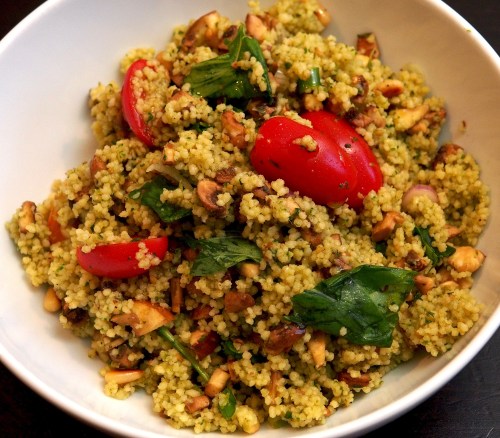
Thrill of grill couscous

This is an old favourite that we make every summer. The chopped up mushrooms give it a fantastic earthy flavour and it works really well with barbecues and on picnics.

Tasty Couscous Salad – serves 4

  • 200g couscous
  • 400ml boiling vegetable stock (we still use Swiss Marigold Bouillon Powder)
  • 250g cherry tomatoes, halved
  • 175g chestnut mushrooms, finely chopped
  • half a bunch of scallions, finely chopped
  • 2 tbsp olive oil
  • 3-4 tbsp pesto
  • a handful of toasted pine nuts, almonds or rough chopped hazelnuts
  • a generous handful of basil

Put the couscous into a bowl and pour over the hot stock. Cover with cling film and leave to soak for 5 minutes.

When the 5 minutes is up, fork the couscous through to break up any lumps, then stir in the oil and pesto, then tip in all the veg and nuts and tear in the basil. Taste and season.

Simple as that!

(Original recipe from BBC Good Food Magazine, August, 2002.)

Read Full Post »

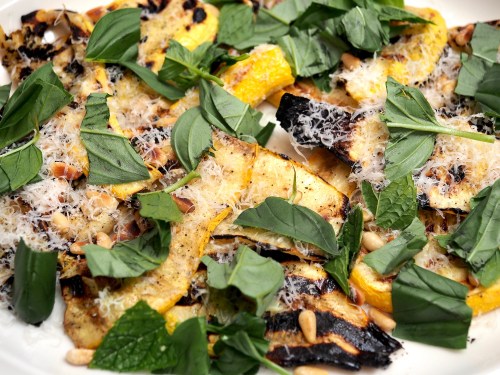
Griddled courgettes with parmesan & basil

We have used some fancy yellow courgettes for this dish but the usual green variety will be just as good. An excellent side dish for barbecues… of which we are having many at the moment. If you don’t want to light the barbecue you can also griddle the courgettes with good results.

Griddled courgettes with Parmesan & basil – serves 4 as a side dish

  • 5 medium courgettes
  • 2 tbsp salt flakes
  • 3 tbsp extra-virgin olive oil
  • ½ lemon
  • 25g pine nuts
  • 1 clove of garlic, finely chopped
  • 25g Parmesan, finely grated
  • a handful of basil leaves, roughly torn
  • a few mint leaves, roughly torn

Preheat the barbecue (or griddle pan). Cut the ends of the courgettes and cut a long thin slice off two opposite sides and discard. Cut each courgette into 4 long strips. Mix the courgettes with the salt and place in a colander to drain with some plates on top. Let them drip over the sink or a bowl or an hour or so.

Shake off any excess salt from the slices, then rub each side with a little olive oil, a squeeze of lemon juice and season with freshly ground black pepper.

Cook the courgettes on the barbecue/griddle for about 5 minutes per side or until softened and well charred. Transfer to a serving dish and squeeze over a little more lemon juice.

Meanwhile, toast the pine nuts in a dry frying pan for a couple of minutes or until golden.

Scatter the pine nuts, parmesan, basil & mint over the courgettes. Trickle over the rest of the olive oil and serve warm.

(Original recipe from by Valentine Warner in BBC Olive Magazine, July 2009.)

Read Full Post »

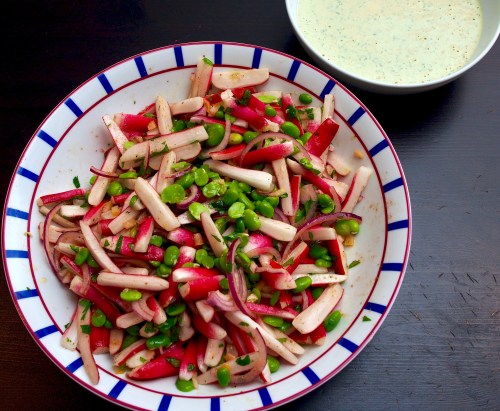
Radish & broad bean salad

We’ve been revisiting the original ‘Cookbook’ from Ottolenghi and found this delicious spring salad. Works well as a side for a barbecue or on its own with some warm pitta breads. The leftovers didn’t suffer too much packed into lunchboxes the next day.

Radish & broad bean salad with green tahini sauce – serves 4

  • 500g broad beans, fresh or frozen
  • 350g small radishes
  • ½ red onion, very thinly sliced
  • 2 tbsp chopped coriander
  • 30g preserved lemon, finely chopped
  • 2 lemons, juiced
  • 2 tbsp chopped flat-leaf parsley
  • 3 tbsp olive oil
  • 1 tsp ground cumin

For the Green Tahini Sauce:

  • 150ml tahini paste
  • 150ml water
  • 80ml lemon juice
  • 2 garlic cloves, crushed
  • ½ tsp salt
  • 30g flat-leaf parsley, finely chopped if making by hand

First make the tahini sauce by using a food processor or blender to whizz all the ingredients except the parsley together until smooth. Add more water if necessary until you have a honey-like consistency. Add the parsley and blitz for another few seconds, then adjust the seasoning to taste. (If you don’t have a processor you can whisk the ingredients together in a bowl and add the chopped parsley at the end.)

Chill the tahini sauce until needed. It will thicken the longer it is left in the fridge so add a bit more water if necessary before serving.

Simmer the broad beans in a pan of boiling water for 1-2 minutes. Drain in a colander and rinse under cold water. Remove the beans from their papery skins by squeezing them gently.

Cut the radishes into 6 wedges each and mix with the broad beans, onion, coriander, preserved lemon, lemon juice, parsley, olive oil and cumin. Season with salt and pepper.

Serve with warm pitta breads.

(Original recipe from Ottolenghi: the cookbook, by Yotam Ottolenghi & Sami Tamimi, Ebury Press, 2008.)


Read Full Post »

Radish & fennel salad

Let’s eat more radishes. They’re delicous and in season right now. Try this easy spring salad that tastes good with almost anything.

Lemony Radish & Fennel Salad – serves 4

  • 2 bunches leafy breakfast radishes
  • 1 unwaxed lemon
  • 2 shallots, finely sliced into rings
  • 2 fennel bulbs
  • 5 tbsp olive oil

Separate the leaves from the radishes, then wash & dry them.

Finely grate the zest of half the lemon, then juice all of it.

Put the lemon zest into a salad bowl and stir through the shallots. Leave to macerate.

Trim the fennel & slice it as finely as possible (a job for your mandolin if you have one). When you’re ready to serve, toss all the ingredients, including the radish leaves, with the lemon juice & olive oil. Season with salt and black pepper.

(Original recipe from BBC Good Food)

Read Full Post »

Radicchio & Gorgonzola pasta

In some ways this is an opportunistic dish because we don’t always see Radicchio in our grocer’s shop. We love the creamy, salty, bitter flavours  which come together with the rich creamy sauce. We like serving it with a bit of Parmesan too, but it’s not necessary.

Wine suggestion: The Rocca delle Macie’s Vermentino from the Maremma was our choice and the crisp, almost sappiness, helped to cut through the richness and complement the bitterness of the radicchio. If we’d had one we would have loved to have tried a good, dry Lambrusco from near Bologna. We could be wrong but think this might work too.

Pasta with Radicchio & Gorgonzola – serves 4

  • 1 onion, diced
  • 1 radiccio, shredded
  • 50ml white wine
  • 4 tbsp cream
  • 75g gorgonzola
  • 300g pasta

Cook the pasta in a large pan of boiling salted water according to the timings on the packet.

Heat 1 tbsp of olive oil and fry the onion until softened, then add the radicchio and continue to cook until wilted.

Add the white wine and season. Pour in the cream, melt in the gorgonzola and mix through the cooked pasta.

(Original recipe from BBC Olive Magazine, April, 2014.)

Read Full Post »

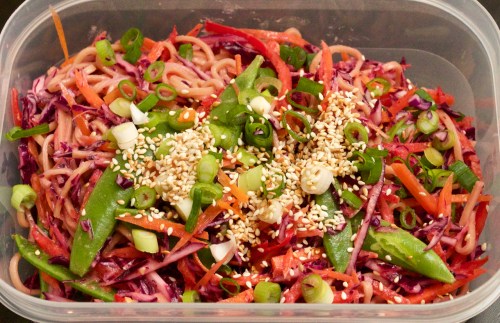
Rainbow noodle salad

A healthy salad for lunchboxes and a good use for red cabbage which always seem impossible to get through. If you have a mandolin it will make short work of shredding the vegetables.

Rainbow Veg Noodle Salad – serves 2

  • 50g medium egg noodles
  • sesame oil
  • juice of ½ a lime
  • 1 tbsp peanut butter
  • 1 tbsp rice wine vinegar
  • 1 carrot, peeled and julienned
  • ½ a red pepper, thinly sliced
  • ¼ of a small red cabbage, thinly sliced
  • 50g sugar snap peas
  • 1 scallion, sliced
  • 1 tsp toasted sesame seeds

Cook the noodles according to the instructions on the packet, then rinse under cold water and drain well.

Whisk 2 tsp of the sesame oil, the lime juice, peanut butter and rice wine vinegar together in a large bowl. Add a splash of boiling water if the dressing appears too thick.

Add the noodles, carrot, pepper, cabbage and sugar snaps and toss to coat.

Divide between 2 containers and scatter with the scallion and sesame seeds.

(Original recipe from BBC Olive Magazine, February, 2014.)


Read Full Post »

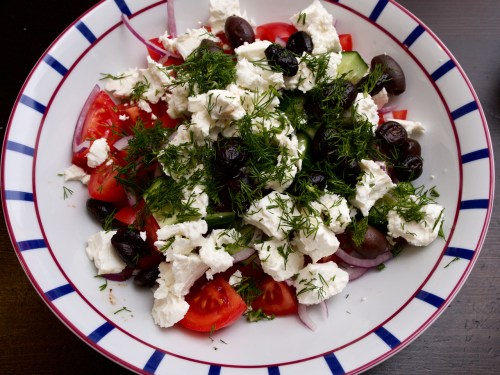
Greek salad

Perfect with many Greek dishes, but none mores than barbecued lamb cutlets or kebabs/souvlaki. You could also serve it as as starter with some crusty bread. A very popular salad in our house when the days get warmer. In fact, we blogged it here a few years ago and it’s still a firm favourite.

Greek Salad – serves 4

  • 450g ripe tomatoes
  • ½ a cucumber
  • 1 red onion (we only use half an onion)
  • 200g Greek feta cheese
  • 4½ tbsp extra virgin olive oil
  • 1 tbsp red wine vinegar
  • 1 tsp ouzo/Pernod
  • 2 tbsp chopped dill
  • 20 small black olives
  • large pinch of dried oregano – Greek if you can find it

Cut the tomatoes into chunky pieces and cut the cucumber in half lengthways and then across into thick slices. Slice the red onion as thinly as possible (a mandolin is good for this if you have one). Crumble the feta into chunky pieces.

To make the dressing whisk the olive oil, ½ tsp salt, the red wine vinegar, ouzo/Pernod and some black pepper in a large salad bowl. Add the tomatoes, cucumber and onions and toss gently. Add the feta, dill and olives and mix briefly.

Drizzle with more olive oil, sprinkle with the dried oregano and some coarsely ground black pepper.

(Original recipe from Rick Stein’s Mediterranean Escapes, BBC Books, 2007.)

Read Full Post »

Pesto Lasagne

A really quick and easy lasagne full of Spring flavours. You don’t have to buy fresh pesto from the fridge as this tends to be more oily and makes this dish very rich; we successfully used a jar from a shelf instead.

Wine suggestion: A grassy European styled Sauvignon Blanc which tends to have a longer, if cooler, growing season is a good match. Avoid the big flavoured Sauvignon’s with the kiwi / tinned asparagus flavours that you might typically find from NZ and Chile as these flavours clash a bit. Exceptions to this always exist like the Dog Point Marlborough Sauvignon, but a good Touraine or Sancerre would be our match.

Pesto Lasagne – serves 4 to 6

  • 190g jar of pesto
  • 500g tub mascarpone
  • 200g bag spinach, roughly chopped
  • 250g frozen peas
  • small pack of basil
  • small pack of mint
  • 12 fresh lasagne sheets
  • 85g Parmesan, finely grated
  • 50g pine nuts
  • Green salad & garlic bread to serve

Heat the oven to 180C/160 fan/gas 4.

Put the pesto, half the mascarpone and 250ml vegetable stock in a saucepan. Heat, stirring, until smooth and bubbling. Add the spinach and peas and cook for another few minutes until the spinach has wilted and the peas have defrosted. Add the herbs and season but go easy with the salt.

Put a third of this pesto mixture into the base of a baking dish (approx. 18 x 25cm). Top with 4 lasagne sheets, then repeat with 2 more layers of sauce and lasagne sheets, finishing with a layer of pasta. Mix some milk into the remaining mascarpone to make a sauce consistency, season then pour over the top of the dish. Sprinkle with the Parmesan and pine nuts, then bake for 35-40 minutes or until brown on the top and bubbling. Scatter over a few basil leaves before serving.

(Original recipe from BBC Good Food Magazine, February 2014.)

Read Full Post »

Feta salad with spinach, crispbread, sumac & pinenuts

Another success from Sam & Sam Clark of Moro. Great textures and interesting flavours. Works as a starter or a side with grilled meat.

Feta salad with spinach, crispbread, sumac & pinenuts – serves 4

  • 500g young spinach, washed and dried (in a salad spinner ideally)
  • 200g good-quality feta cheese, crumbled
  • 1 dessertspoon fresh oregano or marjoram leaves
  • 75g pinenuts, very lightly toasted
  • 25g butter
  • 2 pitta breads
  • ½ garlic clove, crushed to a paste with salt
  • 1 tbsp good-quality red wine vinegar
  • 2 tsp sumac
  • 4 tbsp extra virgin olive oil
  • sea salt and black pepper

Preheat the oven to 180C/350F/Gas 4.

Melt the butter. Split the pitta in half lengthways and brush the melted butter on both sides. Put the pittas on a rack in the middle of the oven and bake for 10-15 minutes or until golden brown. Remove and cool.

Whisk the garlic, red wine vinegar, sumac, olive oil together to make a dressing. Season to taste with the salt and pepper.

Put the spinach, roughly broken crispbread, half the feta cheese, the oregano/marjoram and pinenuts into a large bowl. Pour over most of the dressing and toss together. Serve with the rest of the feta and dressing on top.

(Original recipe from Moro: the cookbook by Sam & Sam Clark, Ebury Press, 2001.)

Read Full Post »

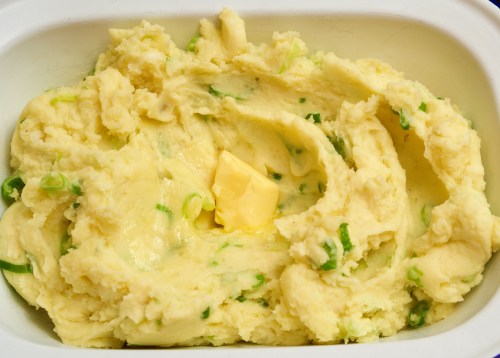
Champ

This is how Julie’s Granny served champ, with a great big lump of Irish butter in the middle!

Irish Champ – serves 4 as a side or 2 on it’s own

  • 700g potatoes – it helps if they are roughly the same size
  • salt and white pepper (no black pepper please)
  • 6 tbsp milk
  • 4 scallions, finely chopped
  • 50g butter (plus extra to serve)

Put the potatoes (unpeeled) in a pot and cover with cold water and a good pinch of salt. Bring to the boil, then simmer until completely tender (usually about 20 minutes but keep checking and don’t let them go to mush).

Heat the milk with the scallions for about 5 minutes.

Drain the potatoes and peel while still hot. If you have a potato ricer you could use that but we tend to use a standard masher.

Beat the butter into the mashed potato with a wooden spoon, then stir in the warm milk and scallions. Season well with salt and white pepper.

Serve the potatoes in a warm bowl. Make a dip in the middle with the back of a spoon and add a lump of good quality (preferably Irish) salted butter.


Read Full Post »

Cheesy leek baked potatoes

We’re regularly left with a rogue leek in the bottom of the fridge and it usually finds its way into a dish like this, particularly if there is some cream lurking as well. Quantities don’t matter too much here so use what you’ve got.

  • Baking potatoes
  • Butter
  • Leeks, sliced finely
  • Cream
  • Cheddar cheese, grated

Heat the oven to 220°C.

Rub the potatoes with olive oil and place on a tray in the oven to bake for 20 minutes. Turn the oven down to 200ºC and continue to cook for about another hour.

Meanwhile, melt the butter in a large frying pan and gently sauté the leeks until they are meltingly tender. Add the cream and bubble together until you have a thick sauce.

When the potatoes are soft, cut them in half and scoop out the centres, leaving a thin layer of potato on the skins. Mash the removed potato, mix with the creamy leeks and season with salt and lots of pepper. Pile this mixture back into the potato skins and sprinkle over the grated cheese. Return to the oven for a few minutes until the cheese has melted and started to brown.

Serve this on its own for a midweek supper or as a side dish with chargrilled chops or sausages.

Read Full Post »

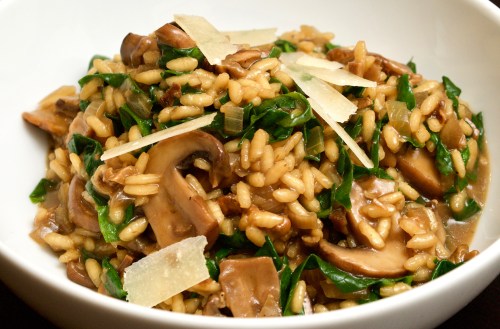
Porcini & spinach risottoWe love a good risotto and this simple one doesn’t disappoint. Perfect cold weather comfort food.

Wine Suggestion: as this is a richer flavoured mushroom dish our first choice would be to head to a Nebbiolo, especially a good Barolo. With the addition of the spinach which has a fresh, iron bitterness we would swing back to a full-bodied white and go for a good Alsace Pinot Gris. The depth of flavour of this dish can balance a really intense Pinot Gris like one from Zind- Humbrecht, which sometimes can be edgy and a bit much for many foods. This one can handle it so push the boat out for flavour and enjoy.

As we had this as a weeknight treat, however, we found that a more humbleVilla Wolf Pinot Gris from the Pfalz also worked.

Porcini & spinach risotto – serves 2

  • 25g dried porcini mushrooms
  • 50g butter
  • 1 small onion, finely chopped
  • 1 garlic clove, crushed
  • 200g chestnut mushrooms, sliced
  • 150g risotto rice
  • a glass of white wine
  • 750ml veg stock, simmering (we use Marigold Swiss Bouillon powder)
  • 100g spinach, washed & chopped
  • parmesan shavings

Soak the porcini mushrooms in a cup of boiling water for 10 minutes. Strain the liquid through a sieve to remove any gritty bits and keep for later. Roughly chop the porcini.

Heat the butter in a wide shallow pan and cook the onion and garlic until softened. Add the chestnut mushrooms and cook for 5 minutes, then add the porcini and risotto rice and stir until coated.

Pour in the wine and bubble until it has been absorbed by the rice. Gradually add the stock and porcini soaking liquid, stirring until the rice is al dente (you may not need all of the stock). Stir through the spinach until just wilted and serve sprinkled with shavings of parmesan.

(Original recipe by Janine Ratcliffe in BBC Olive Magazine, February 2009.)

Read Full Post »

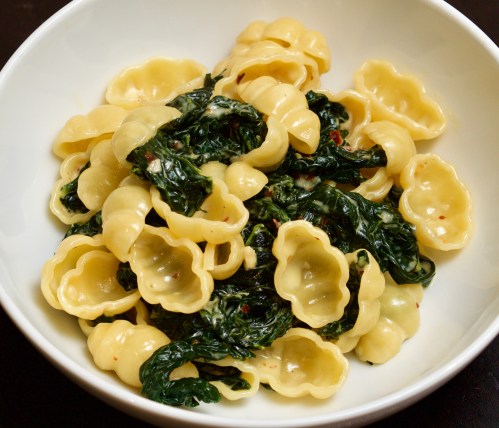
Conchiglie al Cavolo Nero

We’ve made this a couple times recently as  Cavolo Nero is around and we keep on being drawn to it. Especially as we’re starting to tire of root veg and looking forward to all the treats that will come with Spring.

The dish is  creamy and cheesy, with load of garlic and iron rich Cavolo Nero. Fairly rich for a main course in our opinion but absolutely perfect served in small starter portions.

If it suits you can blanch and dry the Cavolo nero and make the garlic puree in advance which leaves very little to do to get the dish on the table.

Wine suggestion: An old favourite came to the rescue here in the form of the Sartarelli Verdicchio dei Castelli di Jesi Classico Superiore “Tralivio” which has a great weight but also a freshness and vibrant texture. The flavour of the food isn’t shy, so make sure whatever you choose has enough body to cope.

Conchiglie al Cavolo Nero – serves 6 as a starter

  • 900g Cavolo Nero
  • 300ml double cream
  • 7 garlic cloves, peeled
  • 3 tbsp extra virgin olive oil
  • 2-3 dried chillies, crumbled or 2 tsp chilli flakes (adjust to your heat preference)
  • 150g Parmesan, freshly grated
  • 250g conchiglie or other shell-shaped pasta

Remove the central stalk from the Cavelo Nero leaves and cut each one into 3 or 4 pieces. Blanch the leaves in boiling salted water for 3 minutes by which time they should be tender and bright green. Drain and dry in a clean tea towel.

Put the double cream and 5 of the whole garlic cloves into a pan and simmer until the garlic is soft, about 15 minutes. Purée in a blender.

In a separate pan, heat the olive oil and fry the remaining 2 garlic cloves, cut into thin slices, and the chilli. When the garlic has coloured, add the blanched Cavolo Nero, stir & season. Pour in the cream and garlic purée, bring to the boil, and cook for 5 minutes until the Cavolo Nero is coated and the sauce has thickened. Add the Parmesan.

Meanwhile, cook the pasta in plenty of boiling salted water, then drain well before mixing well with the sauce.

(Original recipe from The River Cafe Cookbook by Rose Gray & Ruth Rogers, Ebury Press, 1995.)

Read Full Post »

Roast pumpkin and spinach lasagne

Making lasagne is a bit of a labour of love but if you take it in stages it can be assembled in advance and baked when you need it. Always worth the effort in our opinion. This veggie version is particularly good.

Wine Suggestion: we found the Rustenberg Chardonnay from Stellenbosch really matched this dish with it’s masterful balance of oak, fruit and freshness. This is one of South Africa’s classics and one of the best value Chardonnay’s we know. It is picked, crushed and gently settled before fermenting by itself (wild yeasts) and after gentle care in oak barrels on fine lees it is bottled. Only at this stage do they add a touch of sulphur to keep it stable in the bottle. A natural wine without the faults of other proponents of this term.

Roast Squash & Spinach Lasagne – serves 6

  • 750g butternut squash
  • 2 tbsp olive oil
  • 500g spinach, washed
  • 1 tbsp butter
  • whole nutmeg
  • 6 fresh lasagne sheets
  • 100g Parmesan, grated

FOR THE TOMATO SAUCE:

  • 1 medium onion, finely chopped
  • 1 tbsp olive oil
  • 1 celery stick, finely chopped
  • 2 garlic cloves, finely chopped
  • 400g tin cherry tomatoes
  • 2 tsp light muscovado sugar

FOR THE BECHAMEL SAUCE:

  • 500ml full-fat milk
  • 6 peppercorns
  • ½ onion
  • 1 bay leaf
  • 50g plain flour
  • 50g butter

Heat your oven to 200C/180C fan/gas 6.

Halve the squash, peel and deseed, then cut into slices about 1cm thick. Toss with the oil in a roasting tin, season well, then roast until tender and beginning to char at the edges – about 40 minutes.

Meanwhile, make the tomato sauce. Soften the onion in the oil for 5 minutes, then add the celery and garlic and cook for another minute. Add the tomatoes & sugar, then leave to simmer, uncovered, for 30 minutes or until you have a thick puree. Season.

Wash the spinach and put into a saucepan with the water that clings to the leaves. Place over a medium heat and toss for about 4 minutes or until completely wilted. Leave to cool, then squeeze as much water as you can out of the spinach with your hands. Chop and put into a pan with the butter, then gently heat and toss together so the spinach is coated in butter, season with salt, pepper and a good grating of nutmeg.

To make the bechamel, bring the milk to the boil in a pan with the peppercorns, onion and bay leaf. Set aside for 5 minutes to infuse, then strain into a clean pan. Add the flour & butter and whisk over a gentle heat until you have a thick smooth sauce.

Heat your oven again to 200C/180C fan/gas 6.

To assemble the lasagne start by buttering a baking dish – about 1.4 litres capacity. Put a layer of roasted squash in the bottom followed by a layer of tomato sauce. Place lasagne sheets on top of this, making sure they don’t overlap (you can cut them with scissors to fit your dish). Add a layer of bechamel, followed by a handful of spinach and half the grated cheese. Top with more lasagne, pumpkin, tomato sauce, more lasagne and a final layer of bechamel. Sprinkle the rest of the cheese over the top. Bake for 40 minutes or until bubbling and golden.

(Original recipe by Diana Henry in BBC Good Food Magazine, December, 2016.)


Read Full Post »

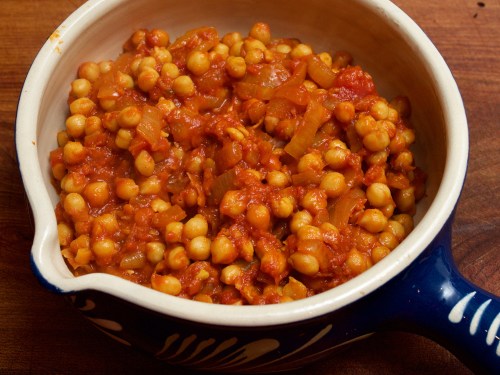
Chana masala

Meehra Sodha describes this as a Workers’ Curry variations of which are eaten all over India. We love the flavours and textures here and have eaten this part of a wider spread of dishes and also on its own with some naan bread from the local takeaway. It’s worth soaking your own chickpeas if you can as they have a better texture. Thi

Wine suggestion: a simple, medium-bodied and earthy red is required here, nothing fancy. We had a bottle of the Monfil Garnacha from Cariñena in Spain which is uncomplicated but satisfying.

Chana masala – serves 4

  • 200g dried chickpeas (or 2 x 400g tins of chickpeas)
  • 1 tsp bicarbonate of soda
  • 3cm piece of ginger, peeled and roughly chopped
  • 2 garlic cloves, roughly chopped
  • 1 green chilli, roughly chopped
  • salt
  • 3 tbsp rapeseed oil
  • 2 onions, sliced
  • 1 tin of plum tomatoes
  • 1 tbsp tomato puree
  • 1 tsp garam masala
  • ¾ tsp ground cumin
  • ½ tsp chilli powder
  • ¼ tsp ground turmeric

Put the dried chickpeas into a large bowl, cover with cold water, then add the bicarbonate of soda and soak overnight or for at least 6 hours. Rinse and drain the chickpeas, then cover with more cold water and boil for 30-45 minutes, until soft, keep spooning off any scum that rises to the surface. (If you are using tinned chickpeas you just need to rinse and drain them.)

Crush the ginger, garlic & green chilli together in a pestle and mortor with a pinch of salt to make a paste.

Put the oil into a large frying pan over a medium heat. When the oil is hot, add the onions and cook for 10-12 minutes, or until golden brown. Stir the ginger and chilli paste through the onions, then tip in the tomatoes, crushing them with your hands. Add the tomato puree, stir well and cook for 8-10 minutes or until you have a rich, thick sauce.

Add the garam masala, 1½ tsp of salt, cumin, chilli powder & turmeric, and cook for a couple of minutes before adding the drained chickpeas. You can add some water at this point to thin the sauce a bit, start with about 5 tbsp and add more if necessary. Taste and season.

Serve with naan breads or as alongside a few other Indian dishes.

(Original recipe from Made in India by Meera Sodha, Penguin, 2014.)

Read Full Post »

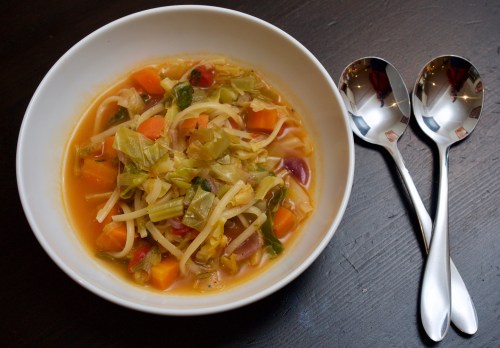
Minestrone

This minestrone soup is from Jamie Oliver’s very first cookbook, back when his recipes were from the heart, had a simplicity and weren’t designed to be chucked together in 15 minutes. If you bake a ham be sure to reserve the water that you cook the ham in before baking, it makes a great ham stock for soups like this one.

Minestrone Soup – serves 6

  • 2 tins of chopped tomatoes
  • 3 carrots, peeled and diced into 1 cm cubes
  • 2 leeks, remove the outer leaves and dice into 1 cm cubes
  • 5 sticks of celery, remove the stringy bits with a vegetable peeler and dice into 1 cm cubes
  • 2 red onions, peeled and diced into 1 cm cubes
  • 1 cabbage, roughly chopped
  • 1 tbsp olive oil
  • 2 cloves of garlic, finely sliced
  • 1 heaped tbsp of chopped rosemary
  • 850ml gammon/ham stock (or chicken or vegetable stock)
  • 3 handfuls of basil
  • 170g spaghetti
  • Parmesan cheese, grated

Put the olive oil into a warmed heavy-based pan and sweat the carrots, leeks, celery, onion, garlic and rosemary over a medium heat until just tender – around 15 minutes. Add the tomatoes and cook for 1-2 minutes. Add the stock, bring to the boil and simmer for 15 minutes, skimming off any froth that comes to the top. Add the cabbage, cover the pan and simmer for 10 minutes, then rip in the basil leaves and add the pasta. Simmer for a further 5 minutes. Taste and season.

Serve garnished with the grated Parmesan and a slug of good olive oil.

(Original recipe from The Naked Chef by Jamie Oliver, Michael Joseph, 1999.)

Read Full Post »

Vegan Pie

Vegan Pie

Vegan recipes often get bad press, not helped by the poor offerings of restaurants. This dish has bags of flavour and doesn’t require any extras to make it a whole meal. A big splodge of ketchup on the side doesn’t go a miss if you’re that way inclined.

Wine Suggestion: not all wines are Vegan, but there are no standards on stating this on a bottle or to say what fining agents (which determines if it is Vegan friendly) have been used in making the wine.

Fining agents are used by winemakers to make a bright, clean coloured and tasting wine. Naturally most wines begin quite cloudy or hazy because of proteins, tannins, tartrates and phenolics. Winemakers traditionally add fining agents to rectify this and these include casein (a milk protein), albumin (egg whites), gelatin (animal protein) and isinglass (fish bladder protein) as well as others like various clays. These bind with the proteins etc which then fall out of the wine. So by the time it reaches the bottle and then your glass there are no traces of these products. However they have been used and part of Veganism is not only if the product is not in the food, but also the use in the production.

A lot of wines are potentially Vegan friendly, but quite often don’t say on the label and aren’t obliged to so don’t dismiss a wine for not being Vegan if it doesn’t say so, it may still be.

Look online on the winery sites if you are in doubt and even email the winemakers – they love to discuss their wines and are happy to answer questions on how each wine is made.

We drank some Domaine du Joncier Lirac Blanc from a wonderful, biodynamic and natural wine maker Marine Roussel. A blend of Roussanne, Marsanne and Bourboulenc and fined naturally with time and gentle handling this is both round, fresh and full of depth.

Vegan Shepherd’s Pie – serves 8 (make in 2 dishes and freeze one for later)

  • 1.2kg floury potatoes, such as Maris Piper
  • 50ml vegetable oil
  • 30g dried porcini mushrooms, soaked in hot water for 15 mins, then drained (reserve the liquid)
  • 2 large leeks, chopped
  • 2 small onions, chopped
  • 4 medium carrots, cut into small cubes
  • 1 vegetable stock cube
  • 3 garlic cloves, crushed
  • 2 tbsp tomato purée
  • 2 tsp smoked paprika
  • 1 small butternut squash, peeled and cut into small cubes
  • a handful of marjoram or oregano, leaves picked and roughly chopped
  • a handful of thyme, leaves picked
  • a handful of sage, leaves picked and roughly chopped
  • 4 celery sticks, chopped
  • 1 tin of chickpeas
  • 300g frozen peas
  • 300g frozen spinach
  • 20ml olive oil
  • a handful of flat-leaf parsley, chopped
  • tomato ketchup, to serve (optional)

Put the unpeeled potatoes in a large saucepan, cover with water, bring to the boil and simmer for 30-40 mins until the skins start to split. Drain and leave to cool a little.

Meanwhile, heat the vegetable oil in a large casserole dish. Add the mushrooms, leeks , onions, carrots and stock cube and cook gently for 5 minutes, stirring.

Add the garlic, tomato purée, paprika, squash and herbs. Stir and turn the heat up a bit, cook for 3 mins, then add the celery and continue to stir and cook for a few more mins.

Tip in the chickpeas along with the water in the can and reserved mushroom stock. Add the peas and spinach and stir well. Cook for 5 mins, stirring occasionally, then season, turn off and set aside.

Peel the potatoes and discard the skin. Mash 200g with a fork and stir into the veg. Break the rest of the potatoes into chunks, mix with the olive oil and parsley and season.

Divide the filling into two pie dishes and top with the potatoes. Heat oven to 190C/170C fan/gas 5 and bake the pies for 40-45 mins, until the top is golden and the filling is heated through.

(Original recipe from BBC Good Food)

Read Full Post »
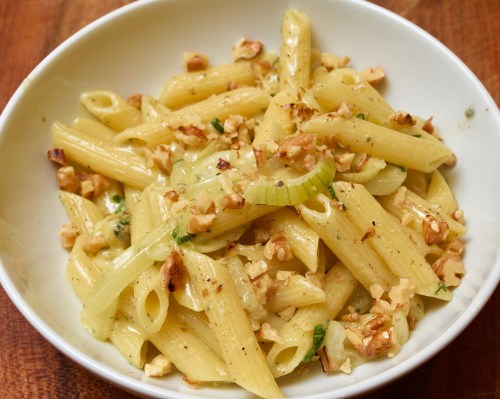
Penne Stilton

We often have lumps of leftover Stilton in the fridge after the weekend and particularly after Christmas. If you find yourself in a similar situation try this simple pasta dish for a mid-week dinner. If that doesn’t solve the problem here’s a few other ideas:

Broccoli and Stilton Soup

Creamy baked Brussels sprouts with stilton

Pasta with Blue Cheese Cream

Roussillon Baked Potatoes

Pork and Pears

Wine Suggestion: delicious with the Bott-Geyl Points Cardinal Metiss, a dry but rich and full white made from all the Pinot varieties you can think of, including the red and pink ones. When young this wine is fresh and enticing but with an extra year in the bottle it fills out and the aromas seem to ramp up a bit more with hints of honey, pears and apples and a lovely dry spice on the palate. More than a match for the powerful flavour of Stilton.

Stilton & Penne Pasta – serves 4

  • 400g penne pasta
  • 25g butter
  • 1 onion, thinly sliced
  • 1 garlic clove, crushed
  • 1 tbsp fresh chopped sage
  • 100g Stilton, cubed
  • handful toasted walnuts, chopped

Cook the pasta according to the instructions on the pack.

Melt the butter in a medium saucepan, then gently fry the onion until golden. Add the garlic and sage, fry for a further 2 mins, then remove the pan from the heat.

Drain the pasta and reserve some cooking water. Stir through the onions, Stilton and 2 tbsp cooking water, then sprinkle with the toasted walnuts to serve.

(Original recipe from BBC Good Food)

Read Full Post »
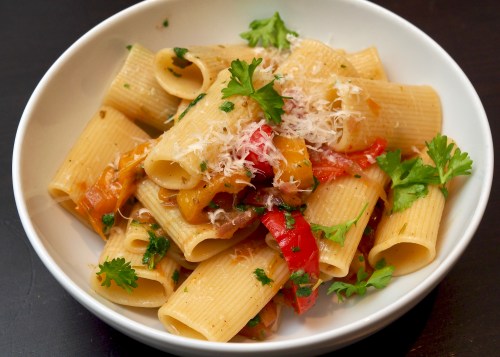
Rigatoni Peperonata

A simple midweek pasta supper for using up those multi-pack peppers. It reminds us of summer and Italy.

Wine suggestion: a great match with Cabernet Franc. The bell pepper, inky and pencil shaving character really compliments the flavours in this simple dish. A favourite of our is the Ch du Hureau from Saumur. Their “Tuffe” a youthful Cab Franc is a gem that regularly makes its way onto our wine rack. If you want to stick with Italian a 100% Sangiovese would make an excellent choice too.

Pasta Peronata – serves 4 (easily halved)

  • 2 red peppers, sliced
  • 2 yellow peppers,  sliced
  • 2 red onions, finely sliced
  • 2 cloves garlic, grated or crushed
  • 2 handfuls fresh flat-leaf parsley, leaves finely chopped and stalks reserved
  • 2 tbsp balsamic vinegar
  • 2 handfuls grated Parmesan cheese
  • 2 heaped tablespoons mascarpone cheese or crème fraîche (optional – we don’t usually add this unless we have some already)
  • 500g rigatoni or penne pasta

Put the peppers into a large frying pan over a medium heat with a little olive oil and a pinch of salt and pepper. Cover with a lid, and cook gently for about 15 minutes until softened. Add the onion and cook for a further 20 minutes. Then add the garlic and parsley stalks and cook, stirring, for about 3 minutes. Season to taste. Add the vinegar, then add a handful of the grated Parmesan and the mascarpone or crème fraîche if you are using it and turn the heat down to minimum while you cook the pasta.

Cook the pasta according to the instructions on the pack. Reserve a little of the cooking water before draining. Toss the peppers, pasta & chopped parsley in a large warm bowl. Add a bit of the reserved pasta water and a splash of good olive oil to coat the pasta. Serve with the rest of the Parmesan.

(Original recipe by Jamie Oliver).

Read Full Post »

Middle-eastern Veggie Pizza.jpg

These were so easy and would make a great weeknight supper or lunch at the weekend. A great way to use up Turkish red pepper paste!

Wine Suggestion: we’d suggest a light red wine or dry rosé to compliment these. For a splash out we drank the Felton Rd Vin Gris from Central Otago. This is made from Pinot Noir juice, only in selected vintages and is very dry and textural with summer fruit flavours and aromas with hints of chervil, fennel and an earthy spice we can’t put our finger on. Together with the pizza it all came together to make us feel like we were on holidays, even though we aren’t!

Middle Eastern Veggie Pizzas – makes 5

  • 5-10 tbsp Turkish red pepper paste (you could always use tomato paste)
  • pack of 5 large pitta breads or Middle Eastern flatbreads
  • ½ a bag of frozen spinach, defrosted
  • 1 garlic clove, chopped
  • 3 balls mozzarella, patted dry and torn
  • 5 eggs
  • freshly grated nutmeg
  • small bunch basil
  • shaved Parmesan, to serve

Preheat your oven to the highest setting.

Put the  flatbreads onto baking trays and spread 1-2 tbsp red pepper paste over each one.

Squeeze the spinach with your hands to get as much water out as possible, then scatter on top, leaving a little space in the centre (to crack an egg into). Divide the garlic & mozzarella between the pizzas and season generously.

Carefully crack an egg into the middle of each pizza, into the space you made with the spinach, and season with nutmeg and some of the basil. Bake for 7 mins until the cheese has melted and the egg is cooked as you like it (you will probably have to cook them in batches).

Serve with a little more basil and some Parmesan shavings.


Read Full Post »

« Newer Posts - Older Posts »