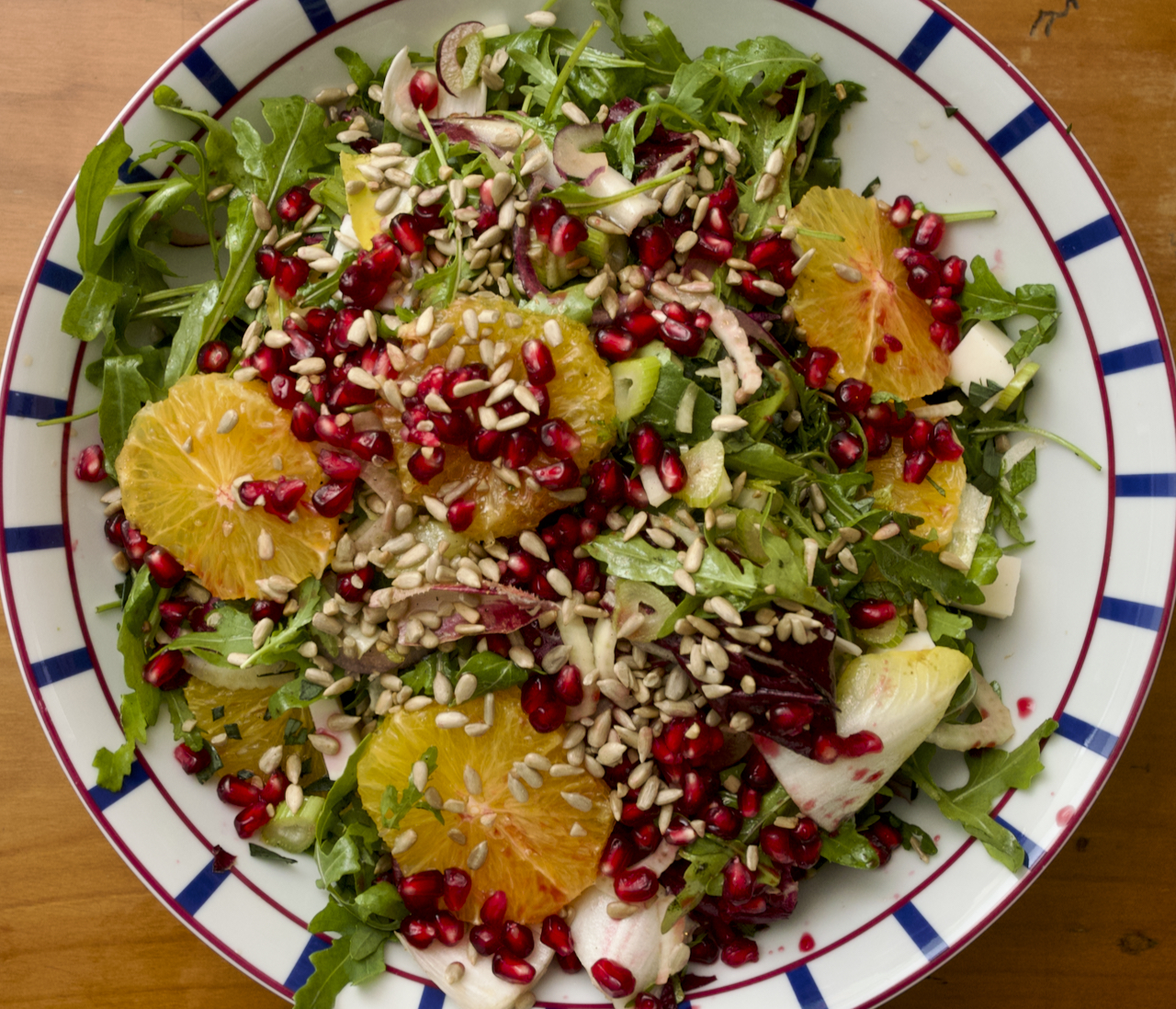
This stunning salad is a riot of colour, texture, and flavours. From Boustany by Sami Tamimi, this is not your average side salad. We served it alongside pan-fried duck breasts.
Bitter leaves with orange and fennel – serves 4 to 6
4 blood oranges (or regular oranges)
4 tbsp lemon juice
2 tbsp orange juice
75ml olive oil
1 tbsp pomegranate molasses
2 tsp orange blossom water
100g radicchio leaves
100g white or red endive
½ small red onion, very thinly sliced
1 small fennel bulb, very thinly sliced
120g rocket
5g fresh tarragon leaves
70g hard goat’s cheese, broken into chunks
3 tbsp pomegranate seeds
25g sunflower seeds, toasted
Remove the skin and white pith from the oranges (use a sharp knife), then slice the oranges into ½ cm slices.
Make the dressing by putting the lemon juice, orange juice, olive oil, pomegranate molasses and orange blossom water into a small bowl. Add ½ tsp of salt and plenty of black pepper, then whisk well and set aside.
Separate the radicchio and endive into leaves and tear into large pieces, then add to a mixing bowl. Add the onion, fennel and rocket. Pour over about a quarter of the dressing, add a pinch of salt and some black pepper and toss well.
Layer the leaves, oranges, goat’s cheese and herbs onto a large platter or salad bowl. Finish with a few pieces of orange, some chunks of cheese and spoon over the dressing. Scatter the pomegranate and sunflower seeds over, then serve.
(Original recipe from Boustany by Sami Tamimi, Ebury Press, 2025.)
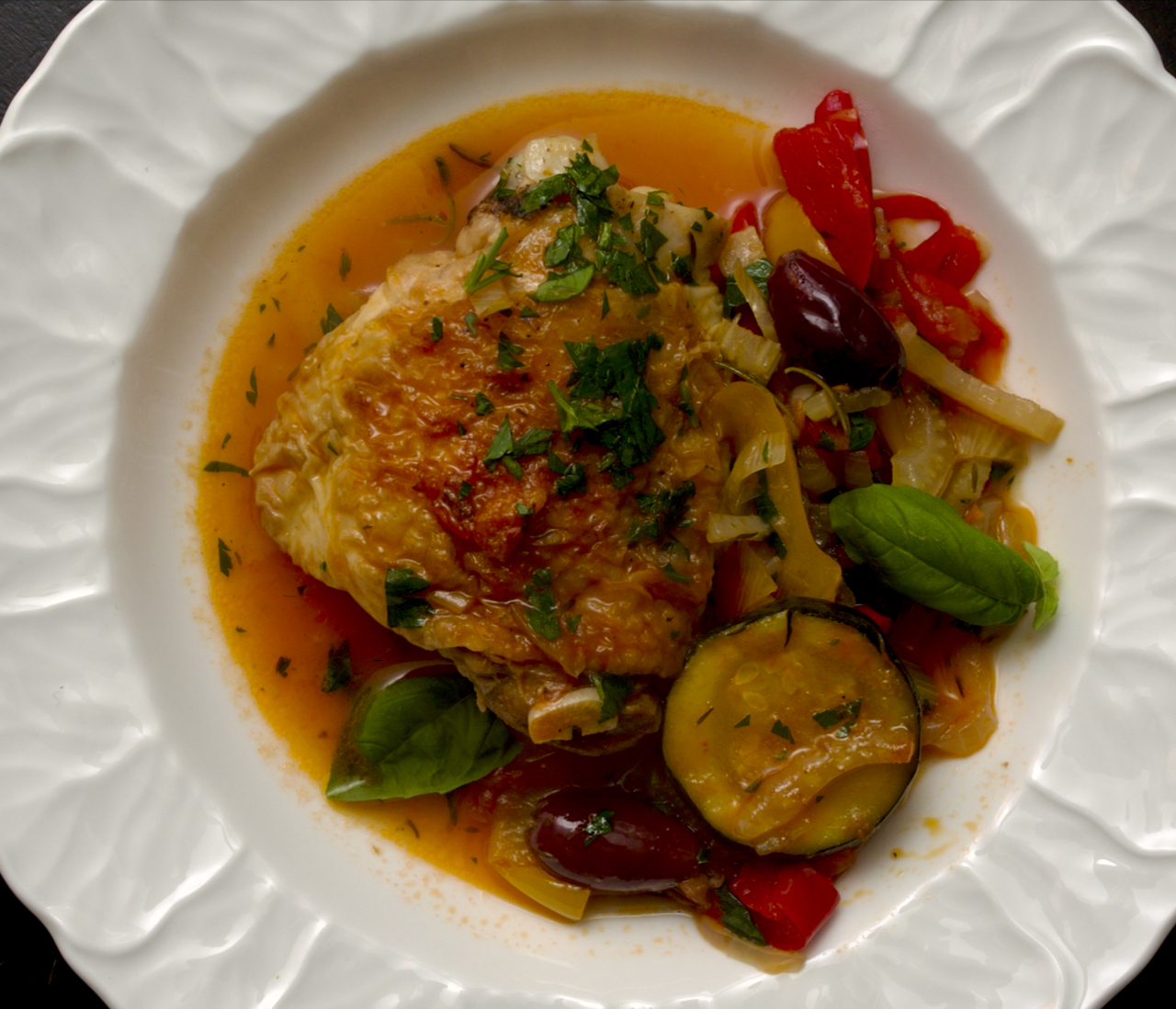
Hanging onto summer like rosé in October… As Autumn seems to appear intermittantly in Dublin, we’re clinging to the flavours of sunnier days. This simple Chicken Provençal is sunshine in a frying pan. You can’t beat the cheerful tones of this French classic, perfect for lifting spirits as the evenings draw in. Serve it with buttery new potatoes or a chunk of crusty baguette.
Wine Suggestion: We paired it with a classic dry Provençal rosé from Château Léoube – textured and full-bodied (for a rosé), yet still elegant and crisp on the finish.
Chicken Provençal – serves 4
2 tbsp olive oil
8 chicken thighs
2 onions, thinly sliced
2 anchovies in oil, chopped
4 sprigs of thyme
2 bay leaves
2 red peppers, cut into strips
1 yellow pepper, cut into strips
1 big fennel bulb, quartered, core removed and thinly sliced
2 courgettes, cut into 1cm thick slices
8 cloves of garlic, thinly sliced
200ml white wine
1 x 400g tin chopped tomatoes
1 litre chicken stock
100g pitted black olives
1 sprig of rosemary
15g flatleaf parsley, leaves only, finely chopped
a handful of small basil leaves
a small handful of capers
Warm the oil in a large, heavy-bottomed saucepan over a medium-high heat. Season the chicken with salt and pepper and brown well. You will probably need to do this in two batches. Put the browned chicken aside on a plate.
Turn the heat down and add the onion, anchovies, bay leaves and thyme with a good pinch of salt. Sauté gently for about 15 minutes or until very soft.
Turn the heat up a little, then add the peppers, fennel and courgettes, then sauté for 5 minutes. Add the garlic and sauté for a further minute.
Pour in the wine and simmer for a couple of minutes, then add the tomatoes, stock, rosemary and olives. Season with salt and pepper and simmer for 5 minutes. Return the chicken to the pan with any juices on the plate and simmer very gently for 35-40 minutes or until the chicken is very tender.
Stir in the parsley, half the basil and the capers. Taste and season again if required.
Serve with the rest of the basil scattered over.
(Original recipe from Lickedspoon with Debora Robertson on Substack, 4 Jun 2025.)
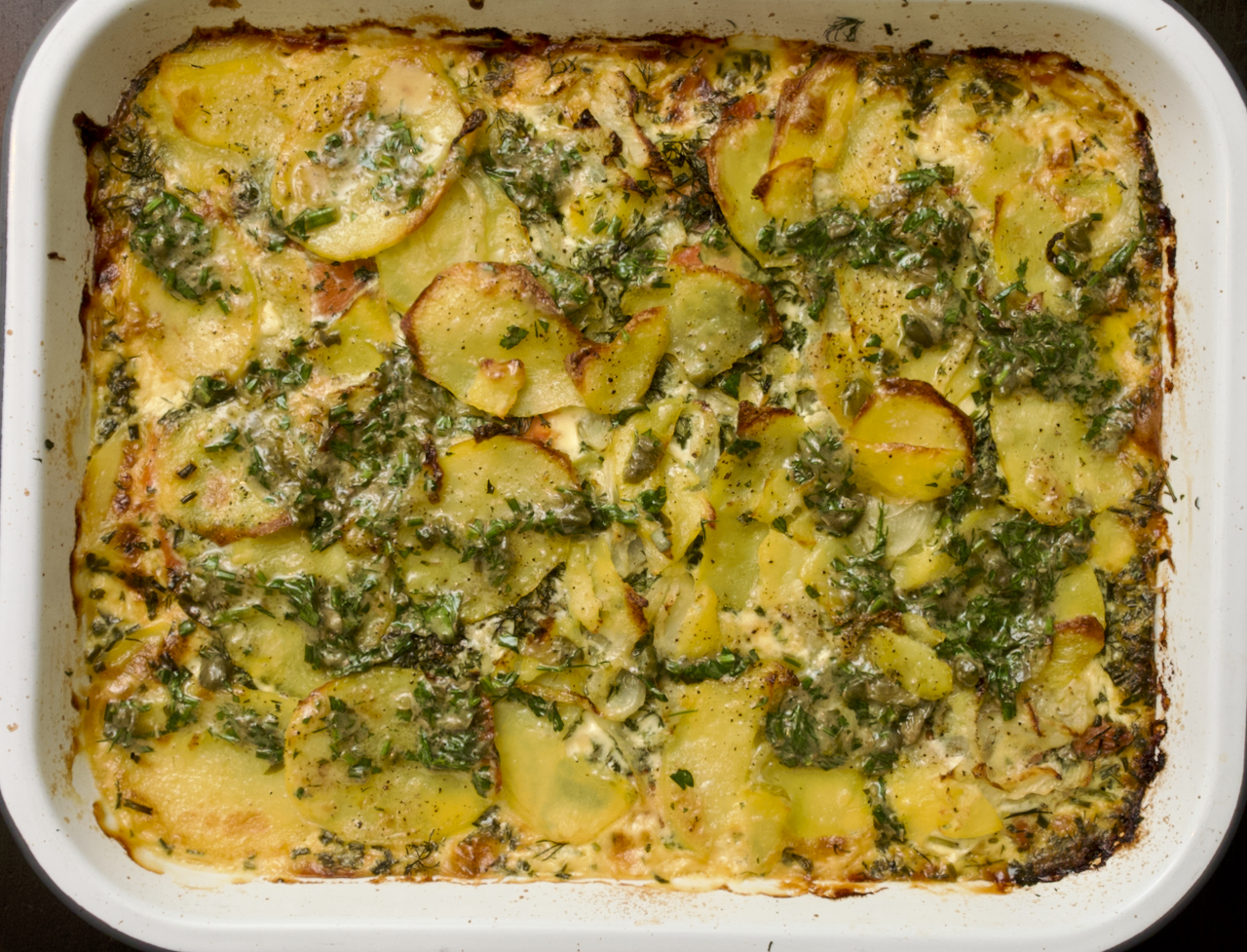
Such a lovely recipe, and you can of course use smoked salmon. We like smoked trout from Goatsbridge which is a local supplier. Recipe inspiration from the new Ottolenghi book – Comfort. You must have a green salad and a glass of white wine to serve. If you have a mandolin it will cut the potatoes and fennel just right.
Wine Suggestion: Weserved an oddity/one-off from Chateau Hureau from Saumur in the Loire. They grew a low quantity of Chenin Blanc grapes in 2022 due to frost so decided to make a Blanc de Noirs from Cabernet Franc for a bit of fun. Only available at cellar door it’s both crisp and fresh, but significantly has bags of texture which this dish needs. Look for whites with a touch of skin contact, or aged on lees as a substitute.
Potato, fennel & smoked trout bake – serves 4
200ml milk
425ml double cream
2 anchovies, finely chopped
3 cloves of garlic, lightly smashed with skin on
1 lemon, skin finely shaved into strips
2 tsp fennel seeds, finely ground
850g Yukon gold or red potatoes, peeled and sliced into ½ cm thick slices
1-2 large fennel bulbs, thinly sliced
4 egg yolks
10g dill fronds, roughly chopped
20g chives, finely chopped
20g parsley leaves, finely chopped
1½ tbsp unsalted butter, softened
200g smoked trout (or smoked salmon) slices, roughly torn
for the lemon butter sauce:
2 tbsp lemon juice
2 tsp capers, roughly chopped
40g unsalted butter, fridge cold and roughly chopped
Heat the oven to 170C fan.
Put the milk, cream, anchovies, garlic, lemon strips and ground fennel into a small saucepan. Place over a low heat and warm for 10 minutes, making sure it never comes to the boil. Give it a stir now and then and press on the solids to get plenty of flavour out of them. Remove from the heat.
Put the potato and fennel slices into a saucepan and cover with cold, salted water. Bring to the boil and cook for 6-7 minutes or until just tender. Drain and set aside.
Whisk the egg yolks with ¾ tsp of salt and a good grind of pepper in a large bowl. Strain the infused milk into the eggs, pressing on the solids against the sieve. Whisk to combine.
Combine all the herbs in bowl. Measure out 2 tbsp and reserve for the butter sauce.
Grease an ovenproof dish with ½ tbsp of the butter. Spoon a third of the potato and fennel over the base and grind over some pepper. Sprinkle over half the herbs and lay half the smoked trout over the top. Repeat with half the remaining potatoes and fennel, season with pepper, then add all the remanining trout and the rest of the herbs. Arrange a final layer of potato and fennel on top and carefully pour over the egg mixture. Grind over some more pepper and dot over the remaining butter. Bake for 45 minutes or until set and just golden. Remove from the oven and rest for 10 minutes.
Meanwhile make the lemon butter sauce. Put the lemon juice into a small saucepan on a medium-high heat and bring to a bubble. Allow to bubble for 1 minute, then add the capers and butter, a few pieces at a time. Whisk until smooth and creamy, then remove from the heat and stir in the reserved herbs and some more pepper. Spoon over the dish and serve warm with a green salad.
(Original recipe from Ottolenghi Comfort by Yotam Ottolenghi, Helen Goh, Verena Lochmuller & Tara Wigley, Ebury Press, 2024.)
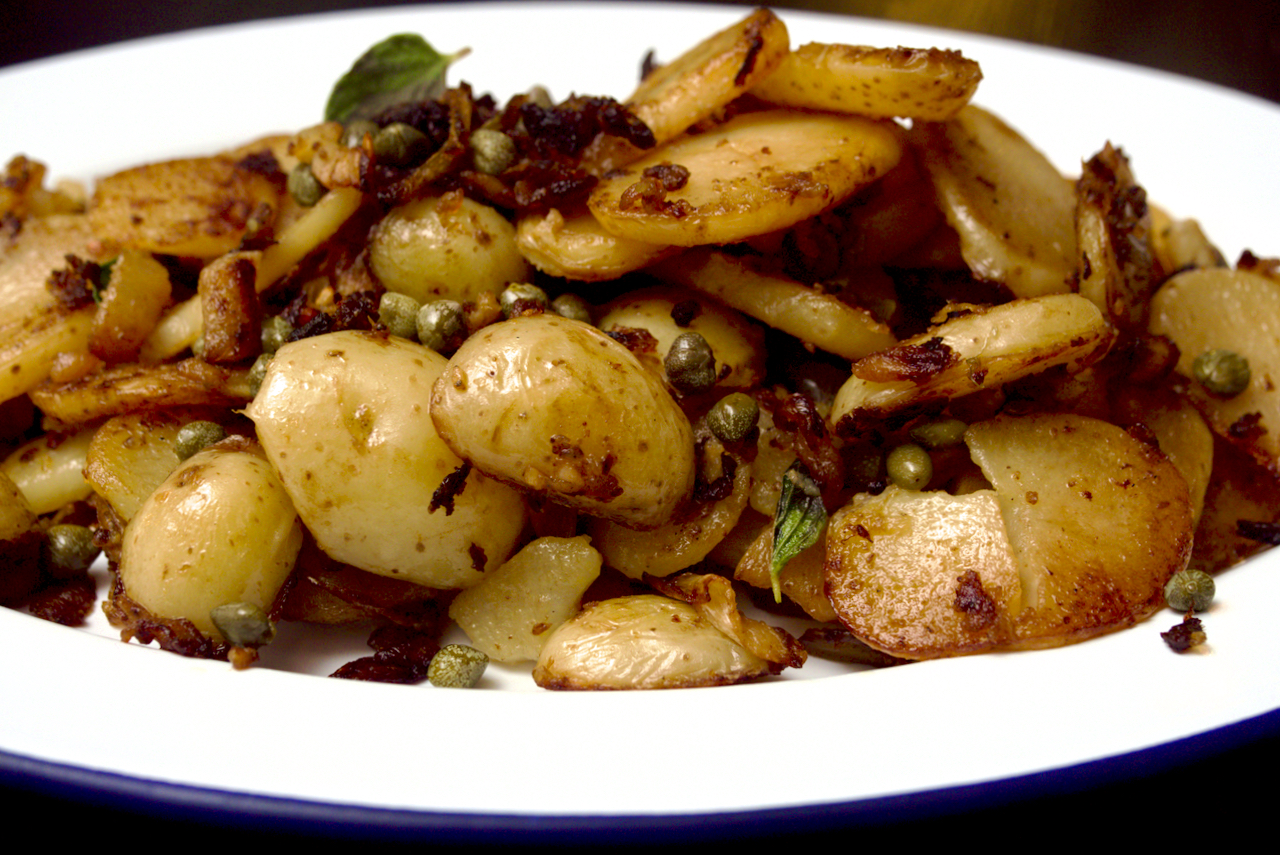
A tasty side dish to get us out our potato rut of baby roast or dauphinoise. These went spectacularly well with roast chicken.
Patatas a lo pobre – serves 4
600g waxy potatoes e.g. Charlottes
1 bulb of fennel, cut into quarters lengthways and shred into 5mm slices
75ml olive oil
2 cloves of garlic, finely chopped
2 tbsp sherry vinegar
2 tbsp capers, rinsed
a few sprigs of fresh oregano
Slice the potatoes into 5mm rounds.
Heat the olive oil in a large, heavy-based pan and add the potatoes and fennel. Cook over a medium heat until the potatoes are tender and starting to brown about 10-15 minutes. Keep tossing gently so it all cooks evenly.
When the potatoes are almost ready, add the garlic and sherry vinegar. Keep cooking for another 5 to 10 minutes or until the liquid has been absorbed and the potatoes are completely soft. Stir in the capers and oregano leaves and season with salt and pepper.
(Original recipe from The Hairy Bikerrs Mediterranean Adventure, Si King & Dave Myers, Seven Dials, 2017.)
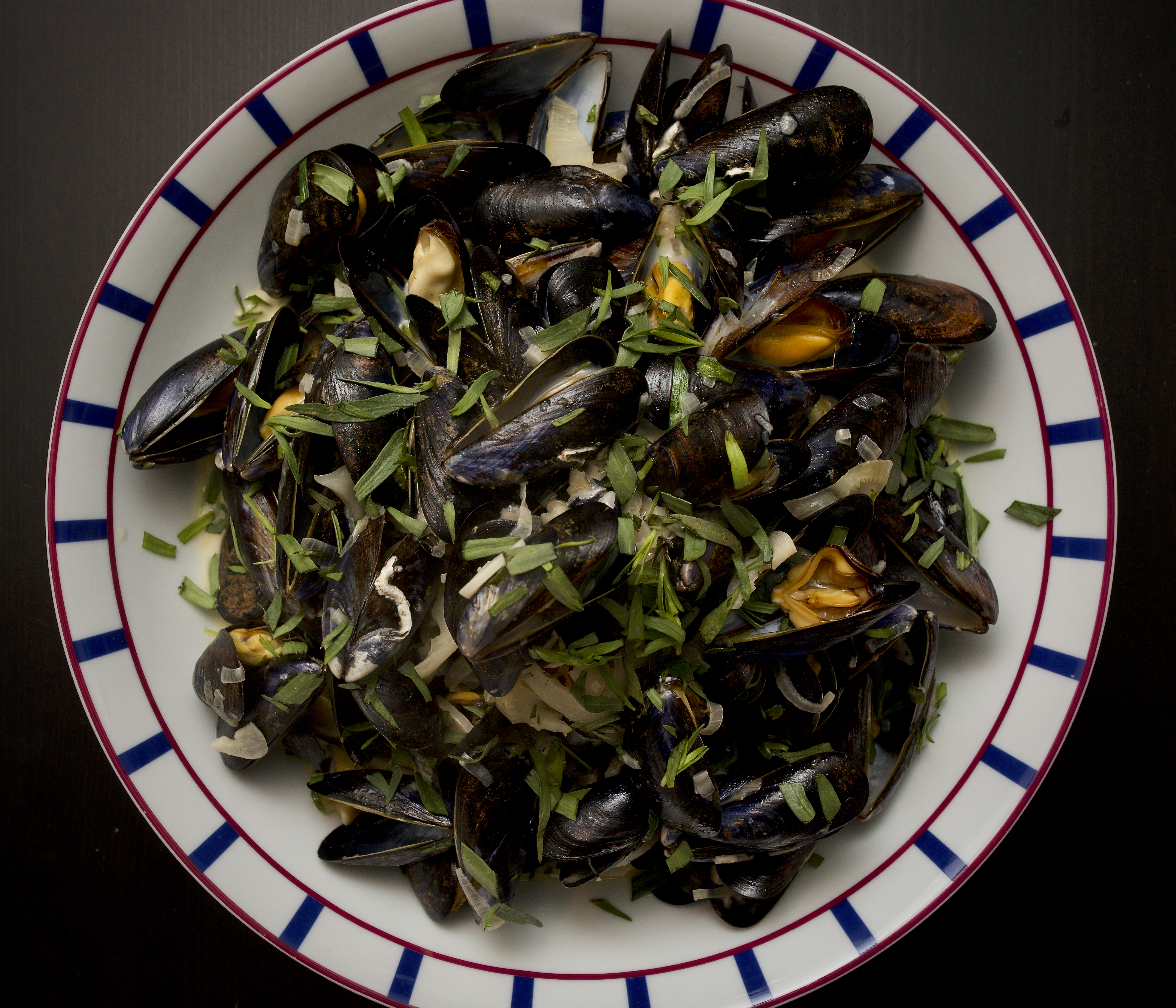
Mussels are cheap and plentiful and they’re one of the few food items that haven’t increased in price. We should all be eating this fabulous local resource. This recipe is just delicious.
Wine Suggestion: We served this with one of those under-the radar wines the La Clef du Recit Menetou Salon. While Anthony Girard from this domain makes a fab Sancerre, we are continually delighted by his other appelations: Menetou Salon which we think has more body, and is a tad more Chablis like, despite it being Loire Sauvignon Blanc; and his Quincy which is elegant and perfumed.
Mussels with fennel & tarragon – serves 2
2 tbsp olive oil
2 long shallots, finely sliced
1 small fennel bulb (or half a big one), finely sliced
3 cloves of garlic, finely sliced
100ml dry white wine
1kg mussels, cleaned and debearded
75ml double cream
a handful of tarragon leaves, roughly chopped
crusty bread, to serve
Heat the olive oil in a large heavy casserole over a medium-high heat. Add the shallots, fennel and a good pinch of salt. Cook for about 10 minutes, until starting to caramelise. Add the garlic and cook for another minute.
Tip the mussels into the pot and stir well, then pour in the white wine and season well with salt and pepper. Bring to the boil, then clamp on the lid and cook for 3-4 minutes, shaking occasionally, until the shells have opened. Stir in the cream, then scatter over the tarragon.
Serve in warm bowls with crusty bread.
(Original recipe by Adam Bush in Olive Magazine, January 2022.)
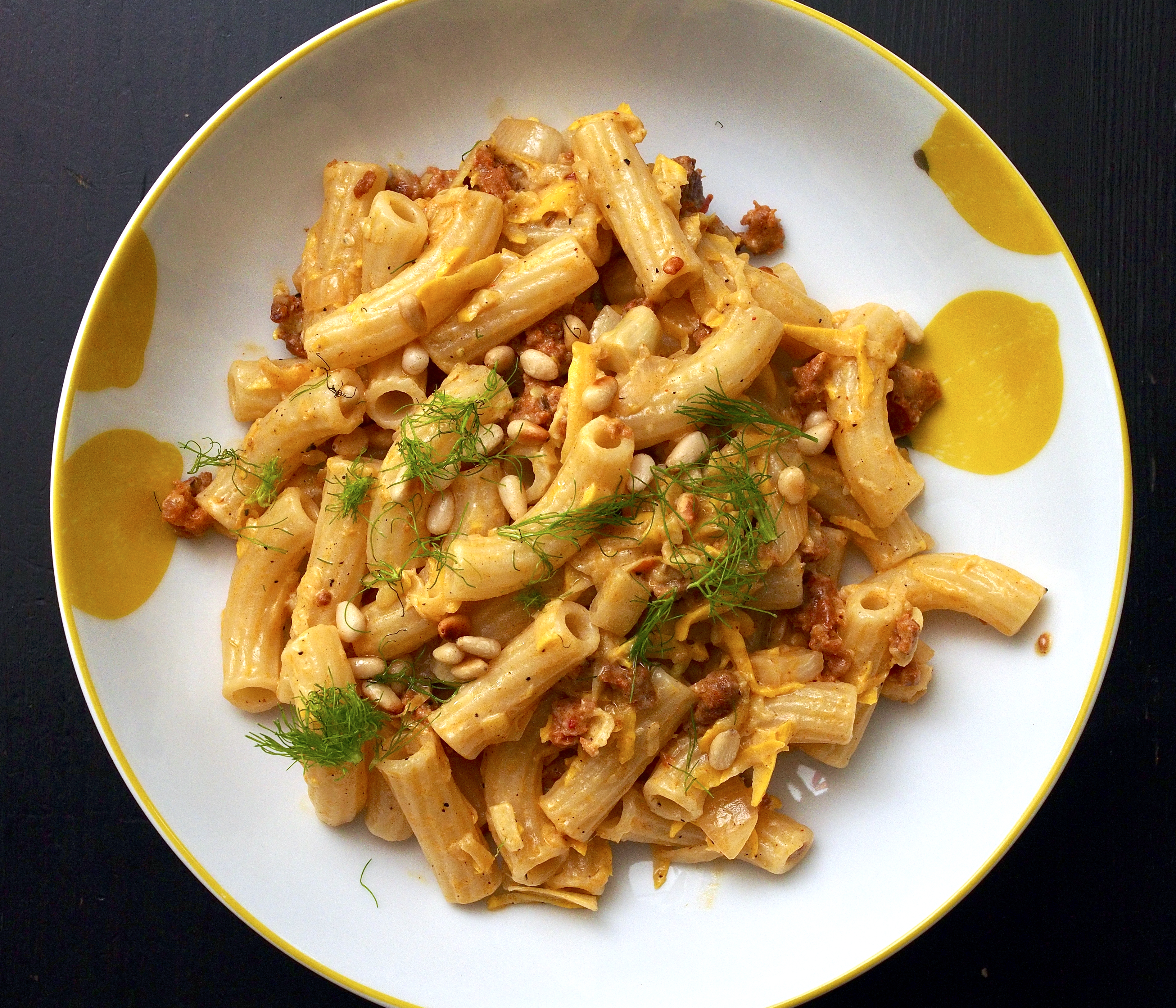
A nice pasta with unusual flavours. Use good-quality Italian sausages for this if you can find them.
Wine Suggestion: As this dish is full-flavoured we’d suggest a full flavoured white like Cline Cellars Sonoma Coast Chardonnay, which has a wonderful Californian ripeness combined with a core of fresh minerality and zing from the cooling breezes and fog coming through the Petaluma Gap each day. The subtle oak gives a lovely texture which helps matching this dish too.
Pasta with fennel, sausage and courgette – serves 4
3 good-quality pork sausages (we like Italian sausages)
1 tsp olive oil
½ small fennel bulb, trim off any green bits and chop finey, reserve any fronds to garnish
½ onion, diced
2 big cloves of garlic, finely chopped
200g rigatoni pasta
zest and juice of a lemon
100g mascarpone
1 medium-large courgete, grated
1 tbsp toasted pine nuts
grated Parmesan (to serve)
Take the skins off the sausages and crumble them into small chunks. Heat the oil in a large frying pan, then fry the sausages until browned and crispy, breaking the lumps up with a wooden spoon. Scoop out with a slotted spoon and set aside.
Add the fennel, onion and garlic to the sausage fat in the pan and cook for about 10 minutes, or until softened but not coloured. You can add a splash of water if it starts to stick.
Bring a large pan of salty water to the boil, add the pasta and cook according to the timings on the pack. Drain but reserve a mugful of the cooking water.
Return the frying pan to the heat and stir in the lemon zest, lemon juice, mascarpone, grated courgette and a splash of pasta cooking water. Bubble for 2 minutes, then stir in the cooked pasta and sausages. Season, then serve garnished with fennel fronds, pine nuts and Parmesan.
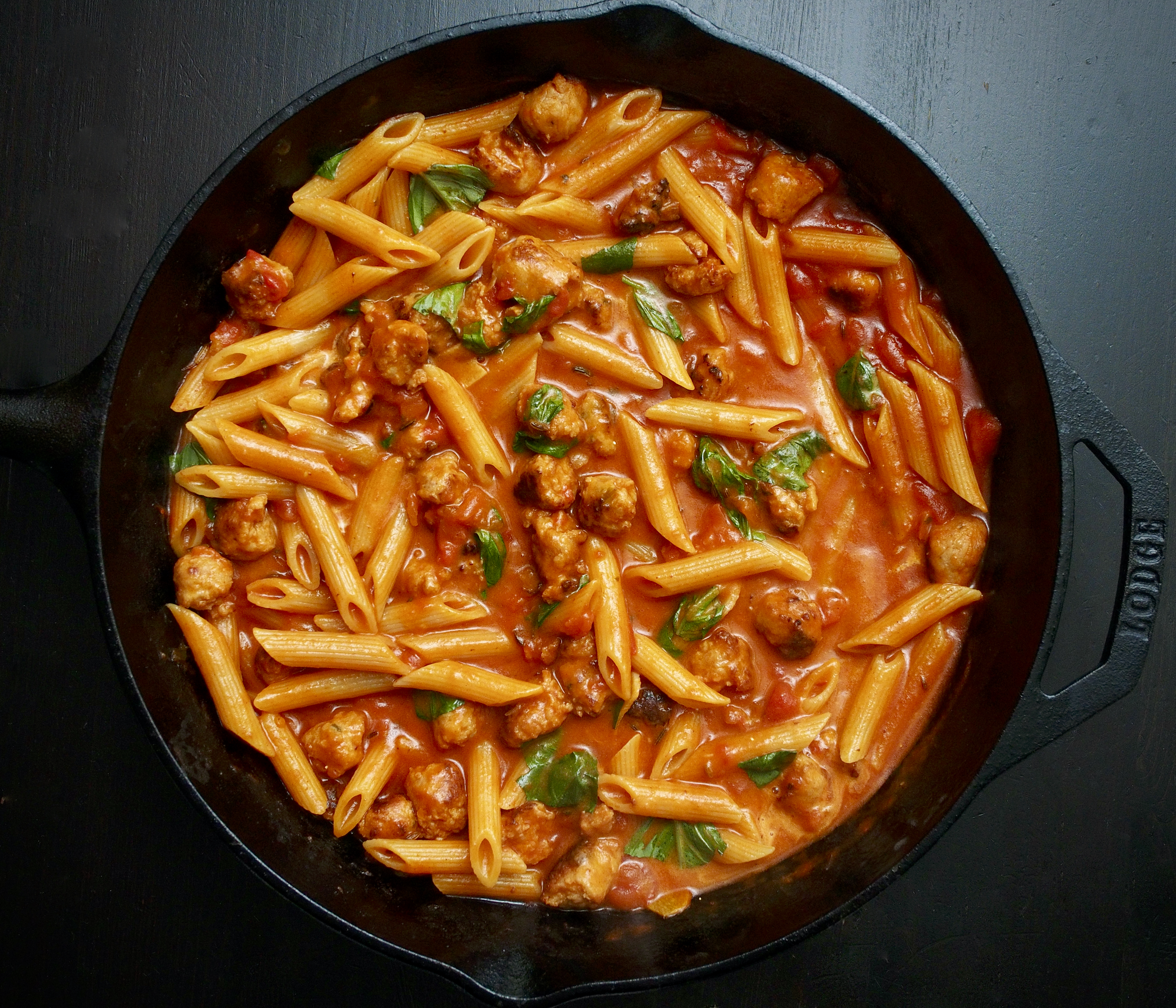
We’ve tried a few of these lately; a pasta dish where you literally chuck everything into the one pan, pasta and all, and cook. Perfect for weeknight/late night cooking.
Wine Suggestion: Well we wouldn’t go too fancy here as it would sort of defeat the purpose, something red, Italian, and not too expensive would be our choice.
One-pan pasta with sausage & fennel – serves 2-3
1 tbsp olive oil
4 pork sausages, skinned
1 clove of garlic, finely sliced
1 tsp fennel seeds
½ tsp hot-smoked paprika
a pinch of chilli flakes
1 x 400g tin of chopped or plum tomatoes
1 tbsp tomato purée
450ml chicken stock
175g penne pasta or similar
2 tbsp crème fraîche, soft cheese or double cream
2 tbsp Parmesan, finely grated, plus more to serve
a bunch of basil, roughly torn
Heat the oil in a a large deep frying pan. Pull off small pieces of sausage and add them to the pan. Fry until nicely browned all over. Add the garlic, fennel seeds, paprika and chilli flakes and cook for another couple of minutes.
Add the tomatoes, tomato purée and stock and bring to a simmer. Stir in the pasta, then cover with a lid and simmer gently for 12-15 minutes or until almost cooked, give it a stir now and then as it cooks. Stir in the crème fraîche, Parmesan and basil, then remove from the heat, cover with a lid and leave to sit for a couple of minutes. Serve with extra Parmesan.
(Original recipe by Janine Ratcliffe in Olive Magazine, May 2020.)
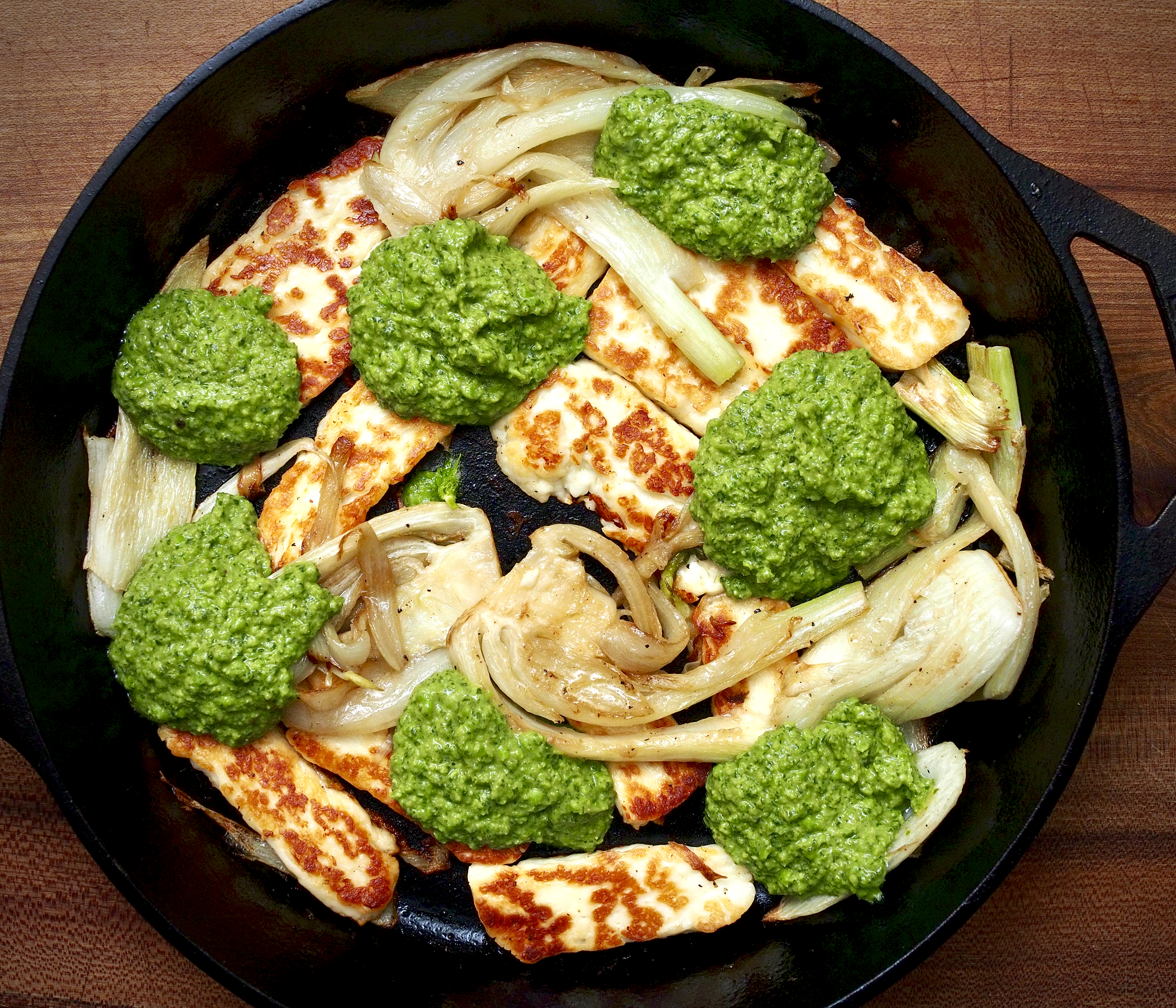
Sometimes the simplest of recipes turn out the best. This one is absolutely delicous and depends on the ingredients being good as there is nowhere to hide.
Wine Suggestion: Find an easy mediterrranean dry white with a touch of sappy, minerality and you’ll have a good match. We had no Greek white’s to hand but had the La Piuma Pecorino from the Abruzzo so we enjoyed the light melon, pear and citrus flavours and light herbal, camomile and green almond touch on the fiinish.
Fennel with Peas & Halloumi – serves 2
300g fennel, trimmed and thinly sliced
3 tbsp olive oil
250g halloumi, sliced
FOR THE DRESSING:
250g frozen peas, defrosted in a colander under cold running water and drained
30g basil leaves
20g mint leaves
150ml olive oil
Warm the 3 tbsp of oil in a very big frying pan. Place the fennel in the pan in a single layer and season lightly. Cook until the fennel is browned on one side, then turn and continue to cook until soft.
Place the halloumi in the pan, tucking it in wherever you can so it browns on the pan. Allow to turn golden on both sides.
To make the dressing tip the peas, basil, mint and olive oil into a food processor and whizz until almost smooth, the texture should be slightly smooth. Spoon over the fennel and cheese and serve.
(Original recipe from Greenfeast: autumn, winter by Nigel Slater, 4th Estate, 2019.)
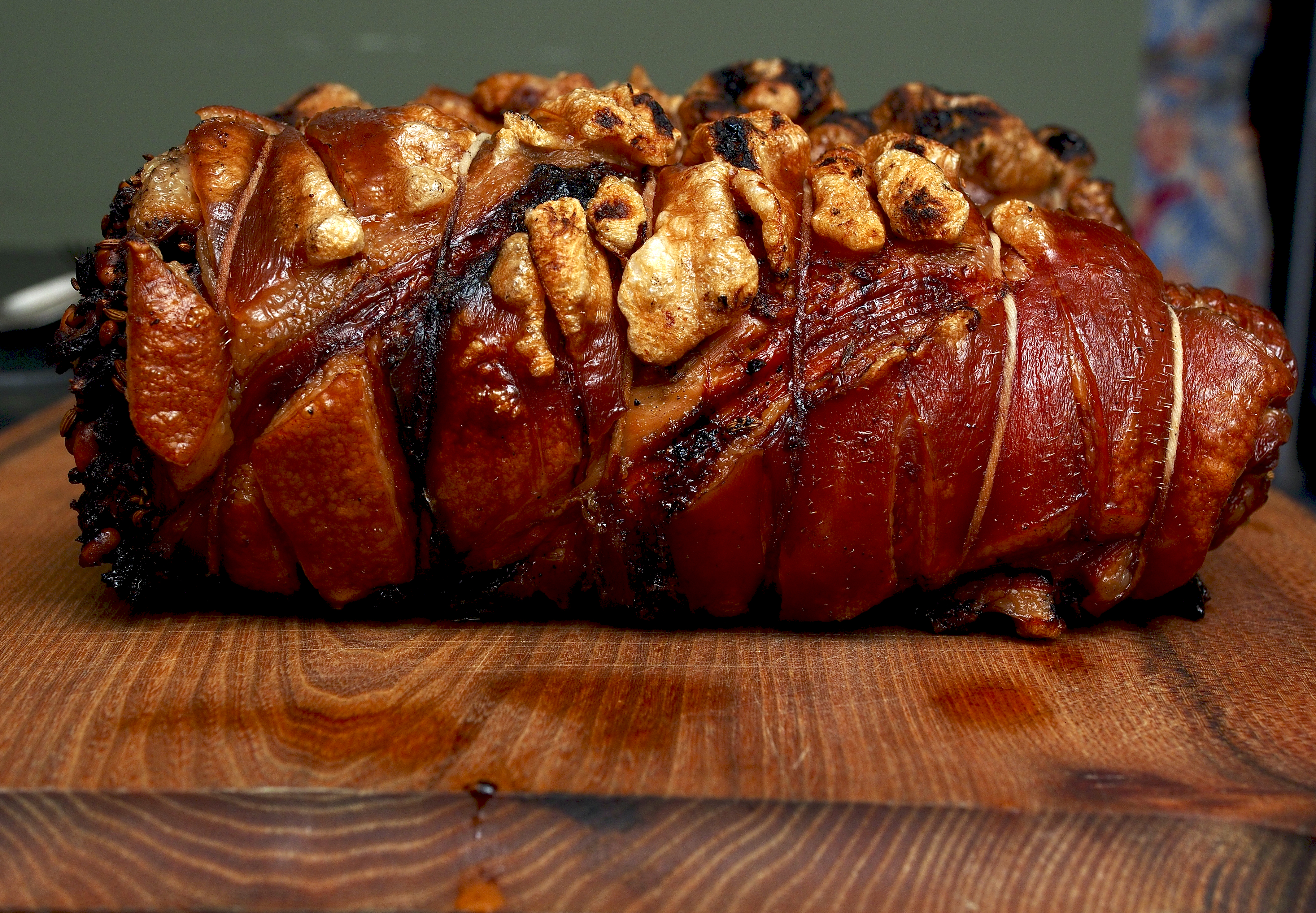
You need to start this the day before but it’s surprisingly easy and the results are amazing. A great barbecue dish to serve a crowd and most of the work is done beforehand. Ours was too big to fit in the oven so we sliced it into two which made it much more manageable.
Wine Suggestion: Quite often we’d suggest a wine with good acidity to cut through the richness of this dish, and we wouldn’t be wrong, with a number od Chardonnays coming to mind. However, instead of cutting through the richness we tried accentuating it and playing with the phenolics (white wine tannins) and drank Jean-Michel Gerin’s La Champine Viognier from the Northern Rhône valley. Grown on vineyards above Condrieu this is accessible and yet still heady, slightly oily and rich with stone fruit flavours and character. It always pays to think outside the box every now and again.
Fennel and ‘Nduja Spiced Porchetta – serves 6 to 8
3kg belly of pork, boned and skin scored and butterflied, your butcher will do this for you
FOR THE SEASONING:
3 tsp salt
50g fennel seeds
25g cracked black pepper
10 sage leaves
FOR THE STUFFING:
2 tbsp vegetable oil
2 onions, chopped
½ fennel bulb, finely chopped
3 garlic cloves, coarsely chopped
100g pine nuts, toasted
100g pitted green olives, sliced
175g ‘nduja
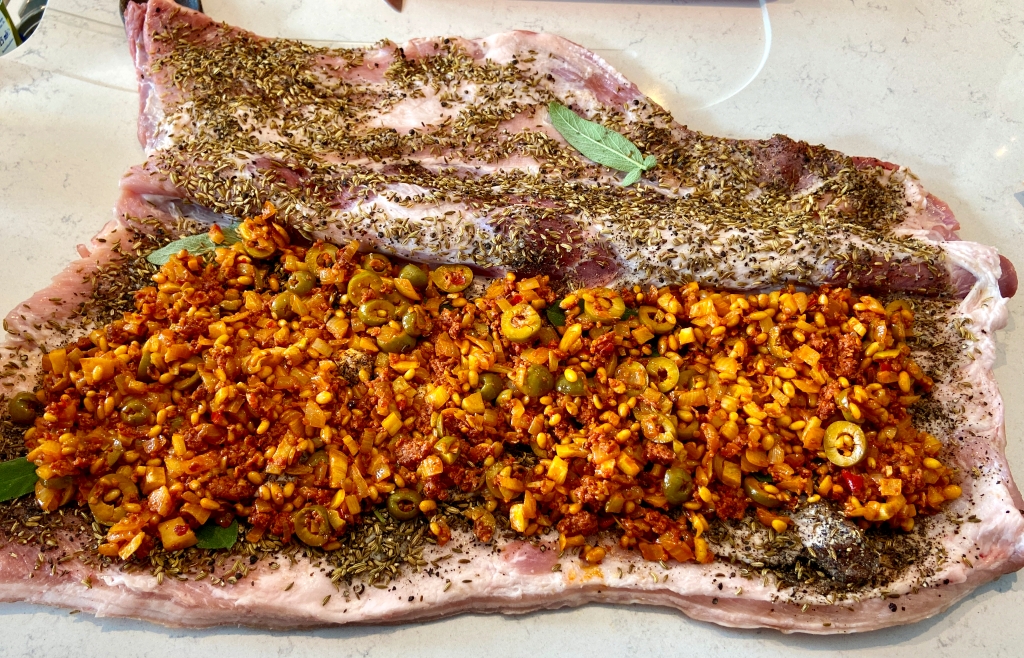
Make the sfuffing first as you need to leave it to cool. Heat the oil in a large frying pan and fry the onions and fennel for about 10 minutes or until softened and golden brown, add the garlic after about 5 minutes. Stir in the pine nuts, olives and ‘nduja and warm through briefly. Spoon onto a tray and leave to cool.
Lay the pork skin side down on a board and open up flat.
To make the seasoning, mix the the salt, fennel seeds and cracked pepper together in a bowl. Sprinkle the rub evenly over the pork and scatter the sage leaves on top. Fold the belly over to enclose the seasoning, then cover and chill for an hour in the fridge.
Lay the pork belly back onto the board and open up to expose the seasoning. Spread the stuffing evenly over the surface, leaving a border at the edges.
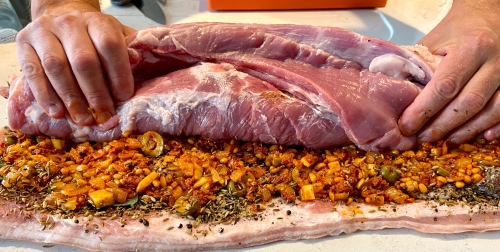
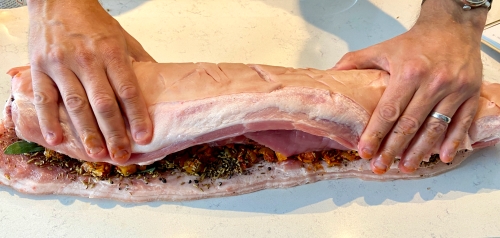
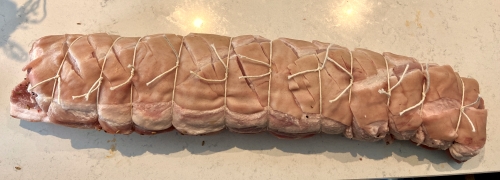
Roll the meat up tightly and tie with kitchen string at 4cm intervals, starting in the middle. You need to tie it firmly but careful not to squeeze out the stuffing. Put onto a tray and leave overnight in the fridge. If your pork is too big you can carefully slice through the middle to give two pieces.
The next day, take the pork out the fridge at least 1 hour before you want to start cooking.
Preheat the oven to 160C/Fan 140C/Gas 3.
Put the pork onto a baking tray and cook in the oven for 3½ hours.
Near the end of the cooking time, get your barbecue on and get it ready to cook on. Transfer the pork to the barbecue and cook for another hour. Roll it over onto the fat side at the end to crisp up the crackling. Transfer to a platter and leave to rest for 15-20 minutes, then carve into thick slices.
(Original recipe from Outdoor Cooking by Tom Kerridge, Bloomsbury Absolute, 2021.)
We’re always up for mussels, and this made good use of some leftover ‘nduja, plus we always love fennel. A nice treat for two.
Wine Suggestion: try not to fight the warm spices of the ‘nduja with a wine higher in acidity, rather look for a naturally softer grape like Grenache Blanc. From southern Catalonia in the region of Terra Alta they grow more Garnacha Blanca than anywhere else in the world: Edetaria’s “via Terra” white utulises this to great effect by harvesting in two tranches; the first to give freshness, and the second fruit and aromatics. Elegantly beautiful, with a vibrancy based not on searing acidity but a great balance. You can almost taste the ancient seabed it’s grown on and the breezes that keep the vines cool; a gem.
Mussels with ‘nduja and fennel – serves 2
1 tbsp olive oil
1 small fennel bulb, thinly sliced
½ tsp fennel seeds, lightly crushed
50g ‘nduja
150ml white wine
1kg mussels, scrubbed
a handful of coriander, chopped
toasted sourdough, to serve
Heat the olive oil in a large pan and cook the fennel for 10 minutes or until caramelised and soft. Stir in the garlic and cook for a minute before adding the fennel seeds and ‘nduja. Break the ‘nduja up with a wooden spoon.
Pour in the white wine and bring to the boil, then add the mussels and stir. Cover with a lid and cook for 5 minutes, shaking occasionally, until the mussels have opened (chuck any that stay closed).
Stir really well, then add the coriander and stir again, then serve with the toasted sourdough.
(Original recipe by Adam Bush in Olive Magazine, September 2019.)
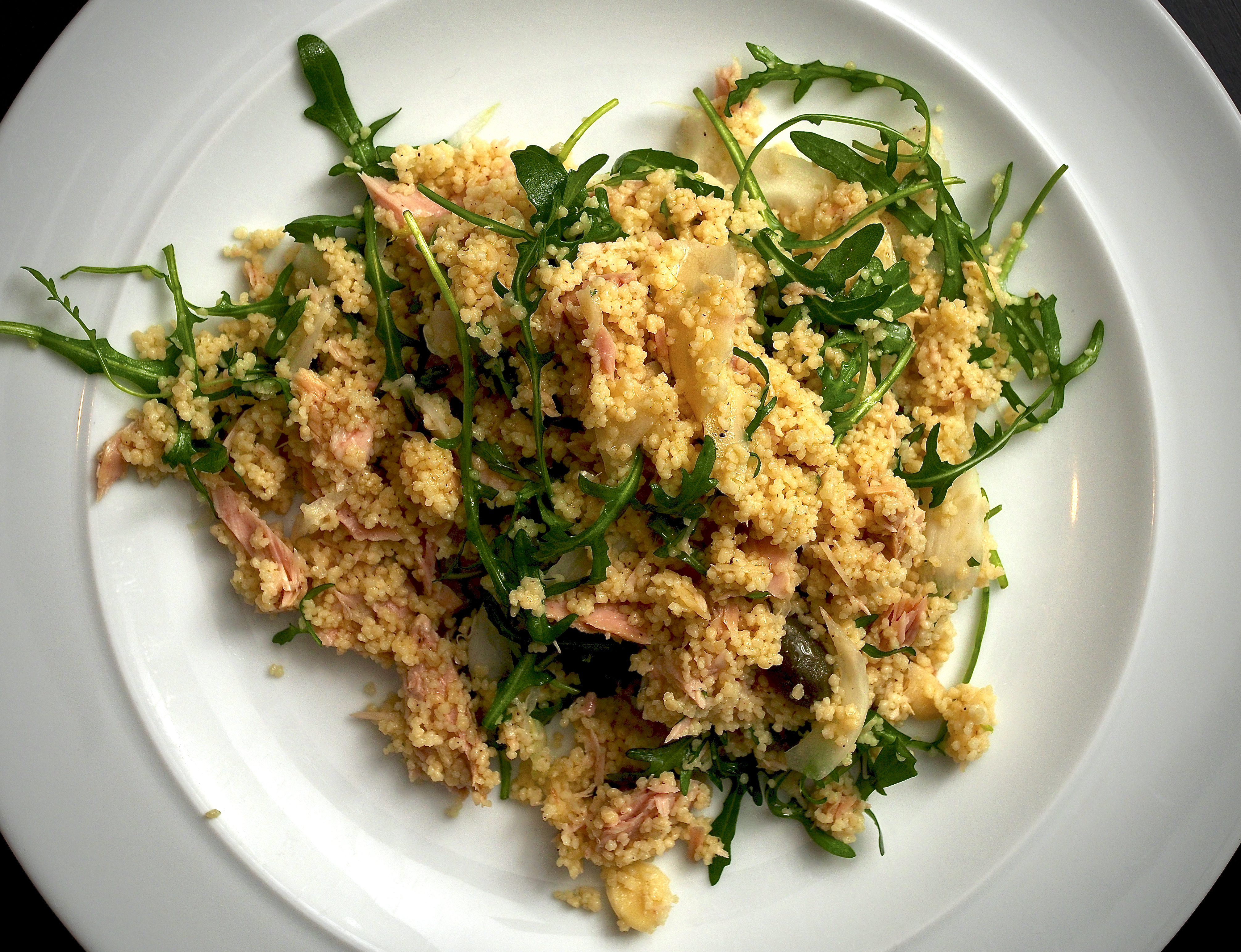
This couscous salad with fennel and tuna is perfect for lunch at the weekend. It’s very simple but the flavours all come together brilliantly. Do buy top quality tuna in oil – we used our local Shines Wild Irish Tuna in Olive Oil.
Wine Suggestion: not having a Sicilian wine to hand we still kept it Italian and opened Patrizia Felluga’s Zuani Vigne Collio Bianco. A multivarietal blend typical of the region this is precise, broad and complex while retaining good vibrancy.
Sicilian couscous salad – serves 3
150g couscous
1 tsp vegetable bouillon powder made up with 200ml of boiling water
30ml best extra virgin olive oil, plus extra to serve
10g flaked almonds
9 caper berries
half a fennel bulb, finely sliced, a mandoline works best for this if you have one
185g jar of tuna in olive oil
a handful of rocket
juice of ½ a lemon
Put the couscous into a large bowl, pour over the hot stock, cover tightly with cling film and leave aside for 10 minutes.
Remove the cling film and fluff the couscous with a fork to separate the grains. Drizzle with 10ml of olive oil, then stir in the flaked almonds, caper berries and fennel and toss well.
Add the tuna, breaking it into chunks with a fork and mixing through.
Finally add the rocket, squeeze in the lemon juice, the rest of the olive oil and season with sea salt and black pepper. Toss again and transfer to a platter to serve.
(Original recipe from A Table for Friends by Skye McAlpine, Bloomsbury Publishing, 2020.)
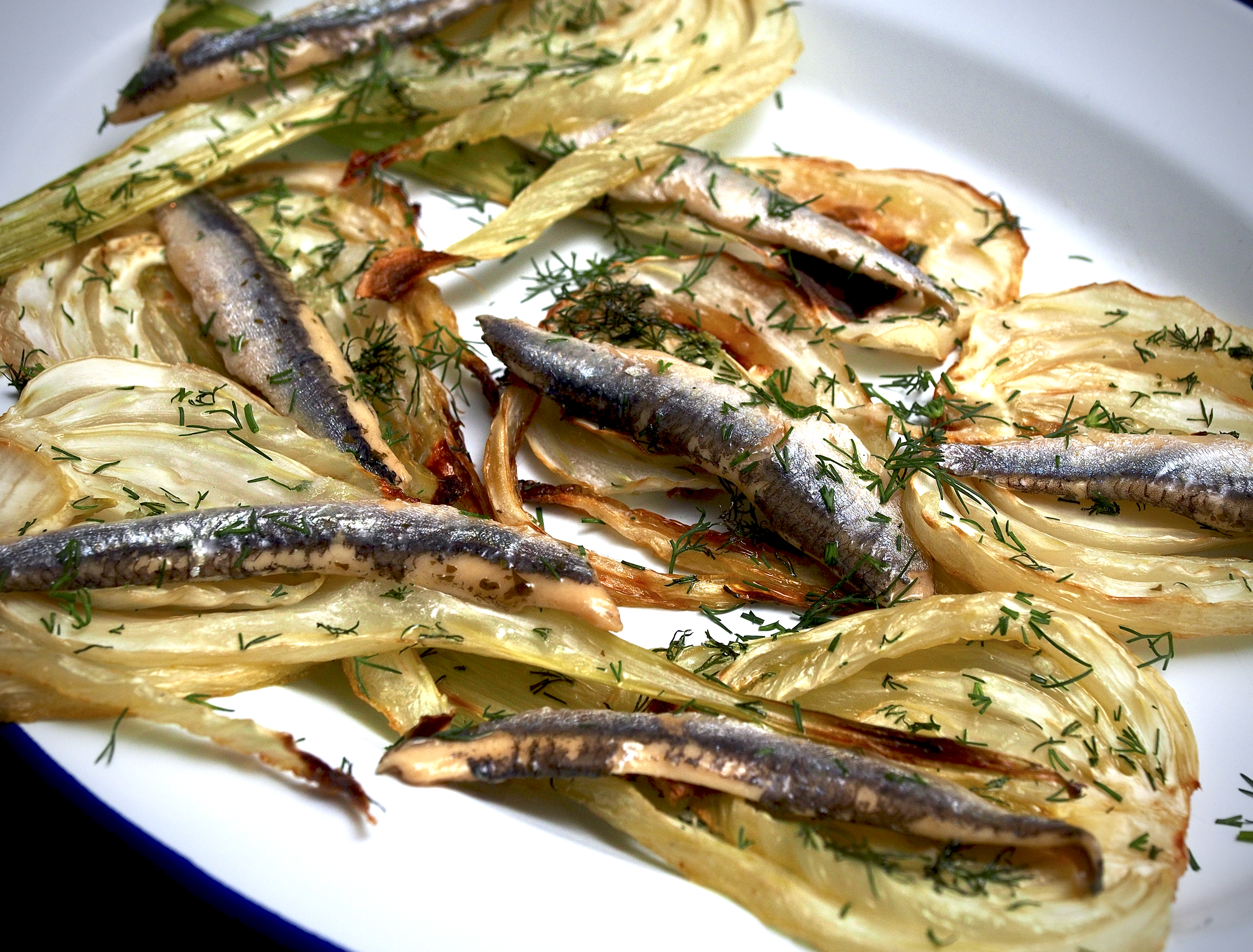
A proper Venetian cichéti or wine bar snack. If you haven’t grilled fennel before we strongly suggest that you do, it becomes all caramelised and the flavour is much stronger. Here two strong flavours come together to great effect. Serve as a nibble with drinks.
Wine Suggestion: we didn’t have have any dry Venetian whites to hand but from further south in the Marches we had a bottle of Sartarelli’s Verdicchio Classico. Crisp, with hints of bitter, green almonds and pure peach and apple flavours and a saline twist that seemed to echo the anchovies. We were almost sitting in a bacaro overlooking a canal.
Grilled fennel with White Anchovies
1 small fennel bulb, sliced through the root into medium-thin pieces about 5mm thick
extra virgin olive oil
flaky sea salt
a handful of roughly chopped dill
10 white anchovy fillets
Preheat the grill to medium.
Put the fennel slices onto a baking tray, drizzle with oil and sprinkle with salt. Add half the dill and toss to coat, then put the baking tray under the grill for 10-15 minutes, turning once, or until starting to brown and caramelise at the edges. Remove and set aside to cool slightly.
Spread the fennel over a platter and place an anchovy fillet on each slice, then scatter over the rest of the dill and serve.
(Original recipe from Polpo by Russell Norman, Bloomsbury Publishing, 2012.)
We cooked this the night that further restrictions were placed on Ireland. We were a bit unsure how it would all work and if we would still be able to get fresh produce in the local shops or if we’d be stuck with supermarkets. Yesterday we heard that we’d be home for another few weeks but thankfully we can still get fresh fish and almost anything else we need (except plain flour!) from our local shops. We served this with some steamed waxy potatoes.
Wine Suggestion: Light, white and minerally. Our choice is the Allo by Quinta Soalheiro from northern Portugal made from Alvarinho for texture and body, and Loureiro for the fruity, aromtic white flowers. All at 11.5% abv.
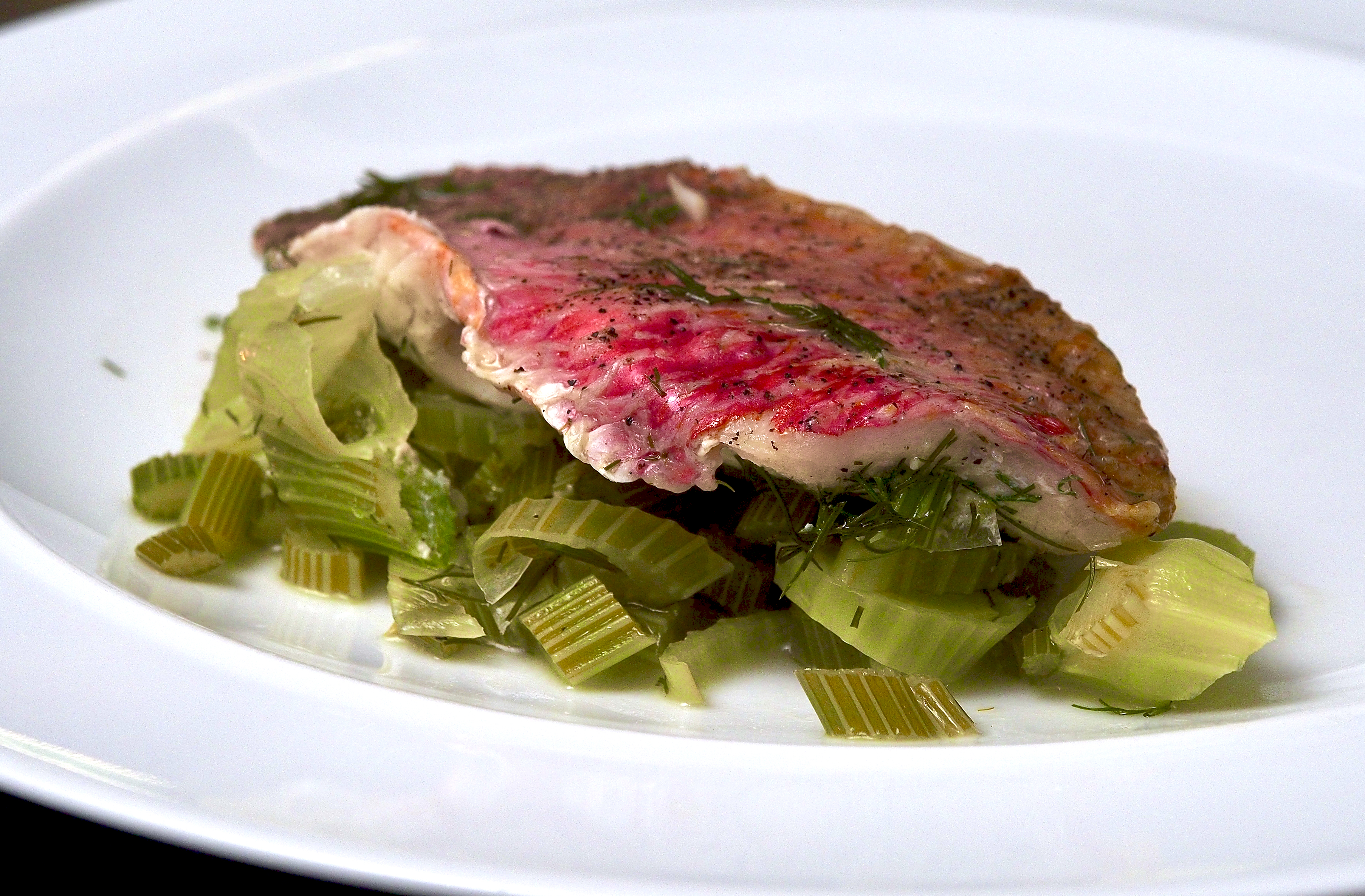
Fennel, Pernod and red mullet parcels – serves 4
2 fennel bulbs, sliced thinly
2 tbsp chopped herb fennel leaves
180ml dry white wine
2 tbsp Pernod
1 tbsp butter
4 fillets of red mullet or sea bass
Preheat the oven to 190C/375F/Gas 5.
You need large 4 pieces of double thickness tin foil – probably bigger than you think. Divide the sliced fennel between the sheets – keep the edges turned up so you don’t lose anything. Divide the rest of the ingredients between the parcels and lay the fish fillets on the top with the fennel leaves sprinkled over. Season everything well with salt and pepper.
Fold the foil up around the ingredients to make parcels, twisting the edges together to seal, make sure you leave some air inside.
Place the parcels on a baking sheet and bake in the oven for about 15 minutes or until the fish flakes easily. Remove the fish and ingredients from the parcels and arrange on warm plates. Pour the juices from the parcels over the top.
(Original recipe from Herbs by Judith Hann, Nourish, 2017.)
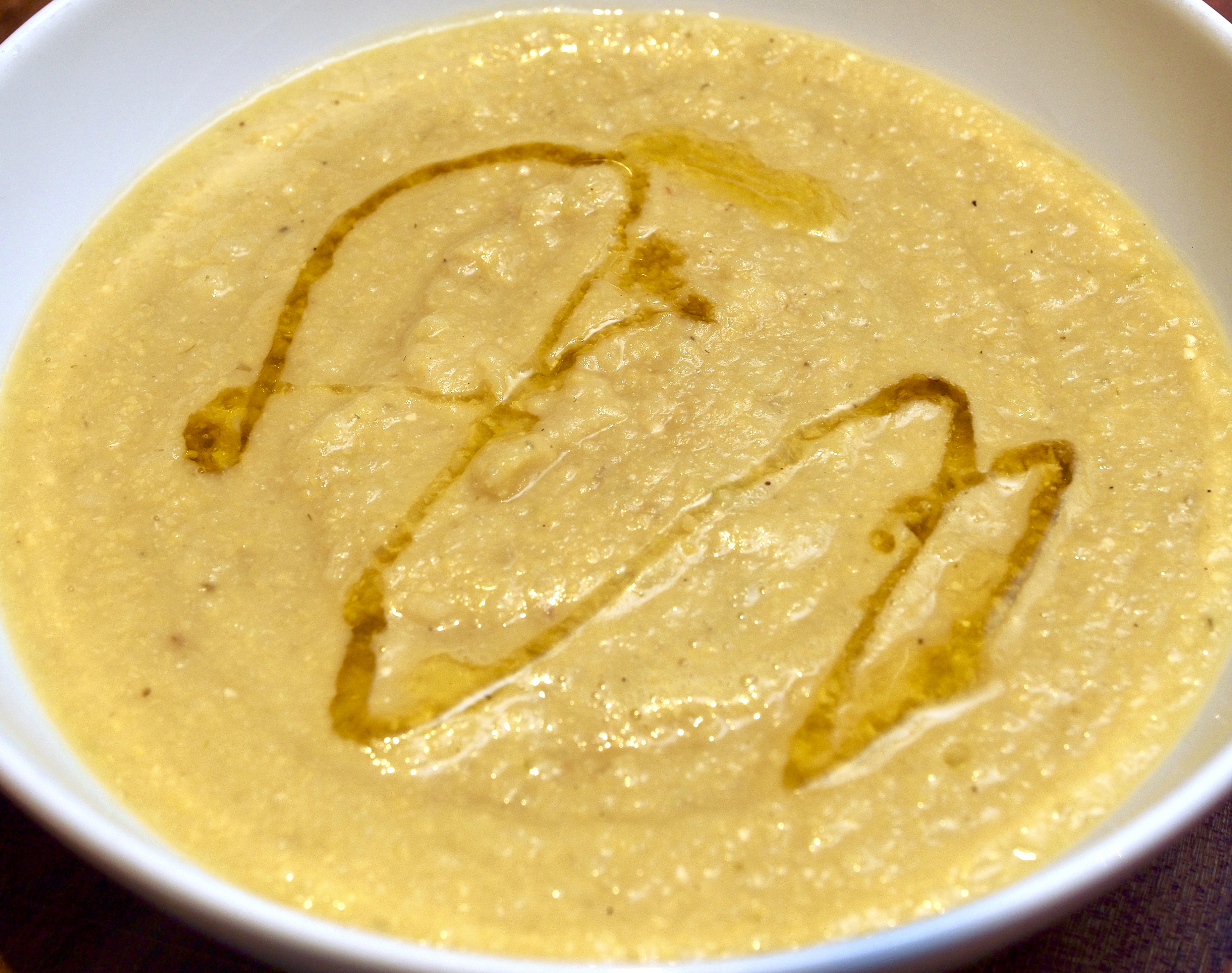
We recently bought a copy of the Venetian cookbook, Polpo, by Russell Norman – it’s about 7 years since it was published and we’ve been coveting it ever since. This soup doesn’t sound exciting but it’s absolutely delicious and will fill even the hungriest of bellies (perhaps with some bread).
Chickpea, leek & fennel soup – serves 6 to 8
500g dried chickpeas
2 litres chicken stock
a pinch of dried chilli flakes
2 shallots, finely diced
2 leeks, cut into 1cm pieces
2 small fennel bulbs, cut into 1cm pieces
Cover the chickpeas in water and soak overnight. Drain and put into a heavy-based pan with the chicken stock. The stock needs to cover the chickpeas by about 3 cm. Add the dried chilli and cook until tender (start checking after the first 30 minutes but they could take an hour).
Heat a little olive oil in another heavy pan and sweat the shallots, leeks and fennel until soft. Season with salt and pepper. Combine the chickpeas and stock with the sweated vegetables and simmer for 5 minutes.
Remove about a quarter of the veg and chickpeas and set aside (we forgot to do this!). Blend the remainder until smooth. Return the reserved veg and chickpeas to the pan and season to taste. Serve with a drizzle of good olive oil.
(Original recipe from Polpo: A Venetian Cookbook (of sorts) by Russell Norman, Bloomsbury, 2012.)
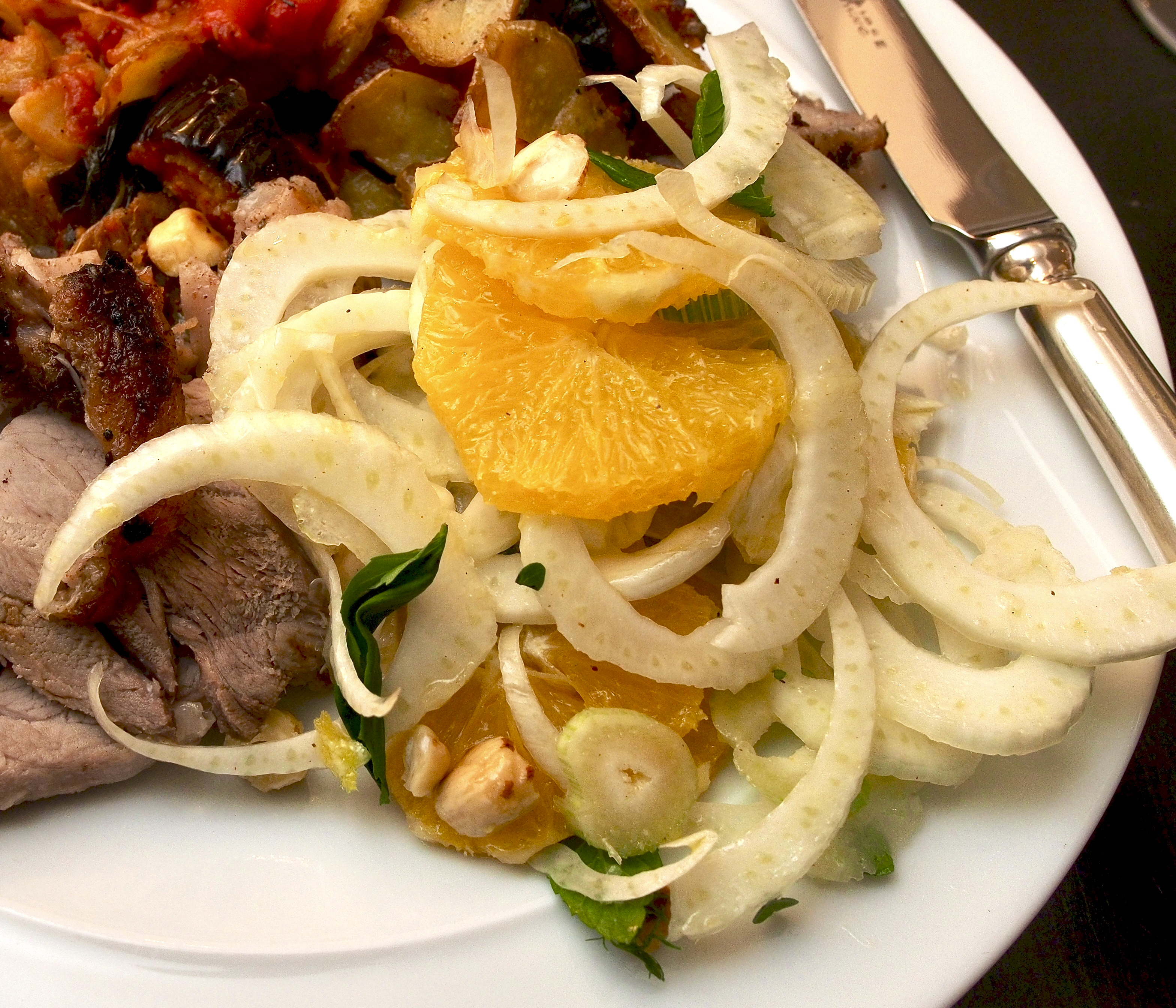
We had this as a side dish with pork but it would also work well as a fresh starter or with oily fish.
Fennel & Orange Salad – serves 4
2 fennel bulbs
3 oranges
25g hazelnuts
small bunch of mint leaves
small bunch of basil leaves
small bunch of oregano leaves (optional)
FOR THE DRESSING
3 tbsp olive oil
juice of ½ lemon
1 tsp red wine vinegar
½ tsp mustard
Trim the base and stalks off the fennel but keep any feathery fronds. Slice the fennel as thin as you can – we use a mandolin for this. Put the slices in a bowl of iced water until ready to serve.
Top and tail the oranges, then cut the skin and membrane off with a sharp knife. Reserve the peel and slice the oranges thinly, removing the seeds, then arrange over a large plate.
Toast the hazelnuts in a dry frying pan until they have coloured and smell good. Rub the skin off with a clean tea towel if needed, then crush lightly into large pieces.
Make the dressing by putting the olive oil, lemon juice, vinegar and mustard into a large bowl. Squeeze any juice from the pieces of orange peel, then season well with salt and pepper and whisk together. Drain the fennel and add to the dressing. Mix well and pile on top of the orange slices. Sprinkle over the hazelnuts, herbs and fennel fronds.
(Original recipe from The Hairy Bikers Mediterranean Adventure by Si KIng & Dave Myers, Seven Dials, 2017.)
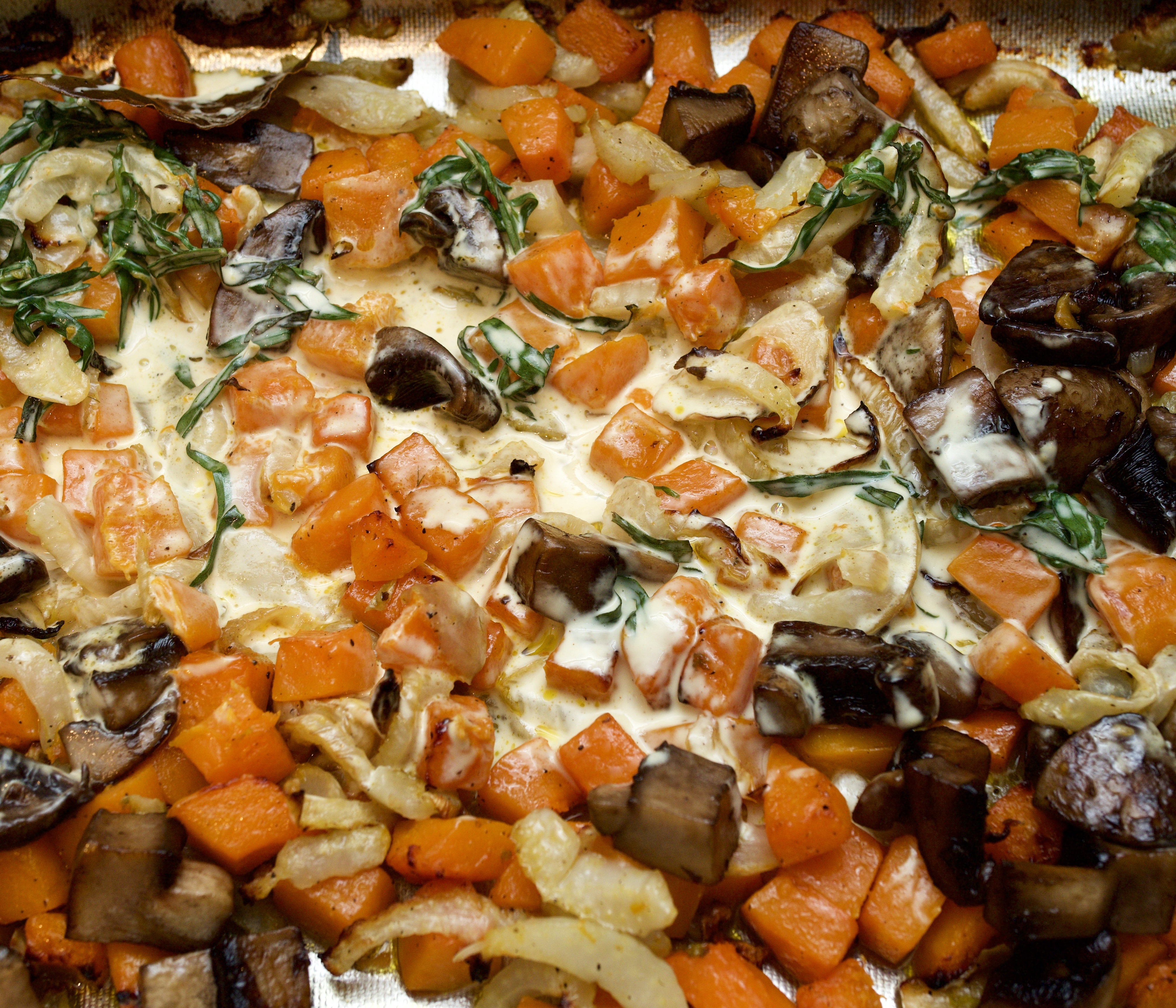
Such a beautiful autumnal side dish. We served this with some grilled pork but it would be nice with roasts or with some potatoes and greens if meat’s not your thing.
Roast pumpkin and fennel with mushrooms – serves 6
2 fennel bulbs, cut into thin slices
1 small pumpkin/squash, peeled and diced
1 clove of garlic, crushed
1 bay leaf
300g portobello or field mushrooms, diced into big chunks
butter
a few sprigs of tarragon
100ml double cream
1 tsp Dijon
Heat the oven to 200C/Fan 180C/Gas 6.
Toss the fennel and pumpkin/squash with the garlic, bay leaf and some olive oil and plenty of seasoning. Roast for 20-30 minutes or until completely tender.
Meanwhile, fry the mushrooms in butter until any liquid they have released has evaporated.
To serve, heat the cream in a small pot, then stir in the mustard and tarragon. Spoon the squash and fennel mixture onto a platter, toss through the mushrooms, then drizzle with the creamy sauce.
(Original recipe by Matt Tebbutt in BBC Olive Magazine, December 2010.)
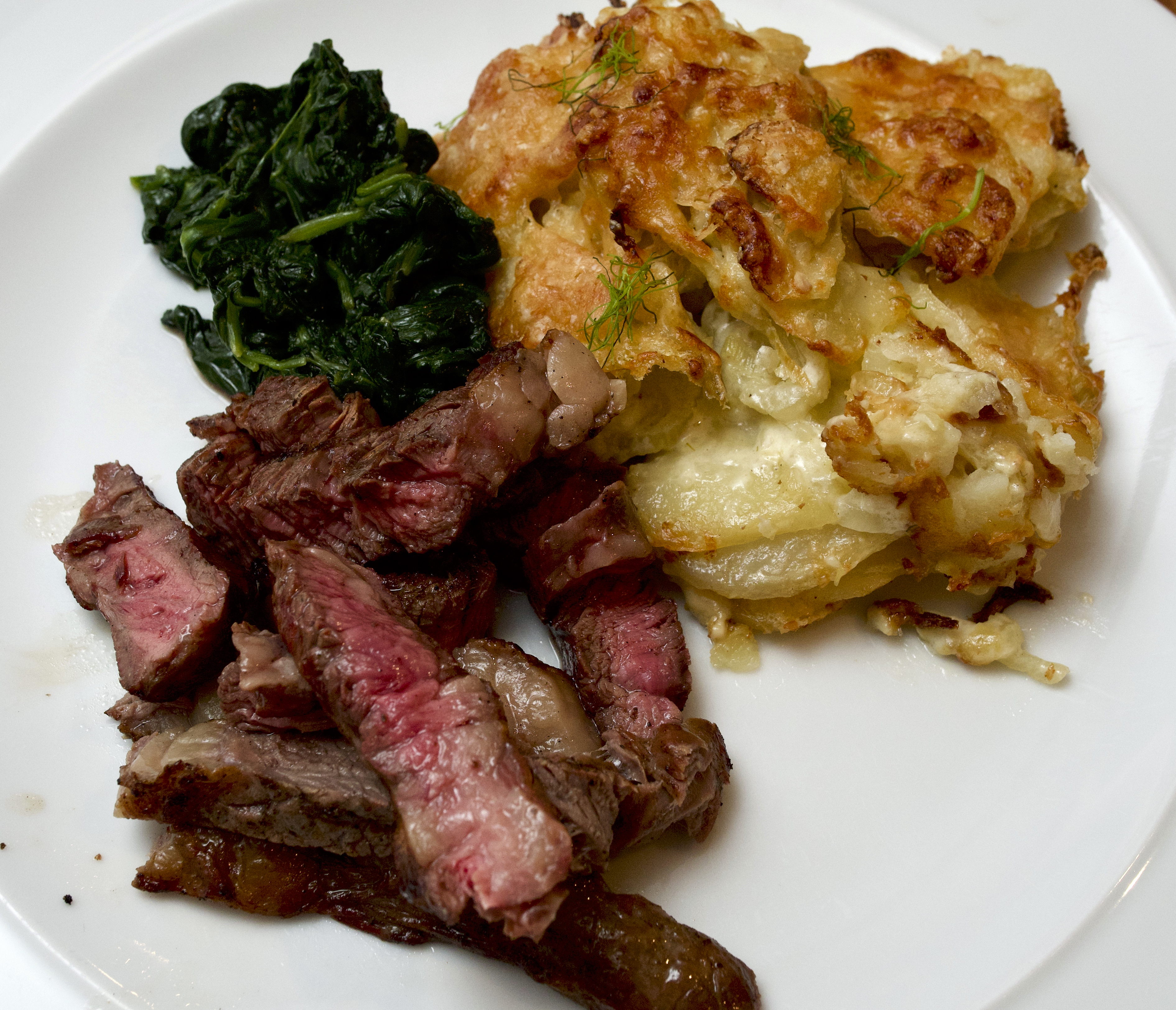
Fennel makes a great addition to a classic dauphinoise. We served with chargrilled steak and spinach but it would also be great with venison.
Fennel Dauphinoise – serves 2
225g medium potatoes, very thinly sliced (a mandolin works best for this)
1 small fennel bulb, sliced (reserve the fronds)
1 garlic clove, finely chopped
75ml whole milk
100ml double cream
2 tbsp finely grated Parmesan
butter
Heat the oven to 180C/160C fan/gas 4.
Put the potatoes, fennel and garlic in a medium non-stick pan. Pour in the milk and cream, season well and simmer gently, covered, for 10 minutes, stirring halfway through, until the potatoes are just tender.
Divide the mixture between 2 small (about 150ml) buttered ramekins and sprinkle with the Parmesan.
Bake for 40 minutes or until the potatoes are golden and tender when pierced with a knife. Snip the fennel fronds over before serving.
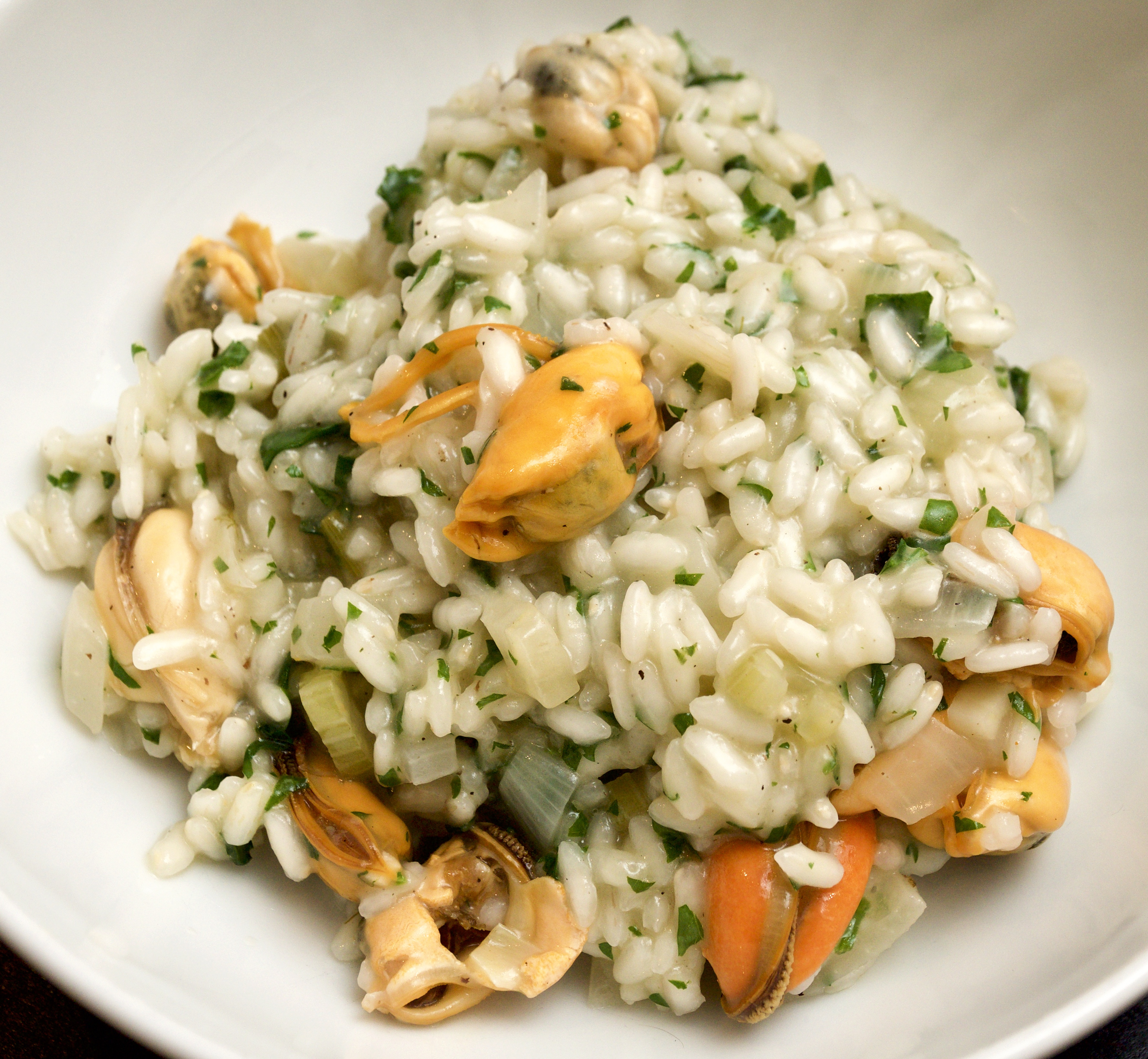
We really liked this tasty risotto made with delicious stock from the mussels. Jules bought half the quantity of mussels (in error!) but it was no worse for it. The sort of thing we like to eat on a Friday night with a glass of something bubbly.
Wine Suggestion: As we have a few bottles of Sparkling Saumur lying around after our summer holiday to the Loire this year, we automatically gravitated to this and found it a good match. This time we opened the Bouvet-Ladubay Trésor blanc, a blend of mostly Chenin Blanc with some Chardonnay. Fresh and vibrant but with the quality of fruit to stand up to the food. Cost aside, we don’t know why more sparkling wines aren’t matched with food.
Mussel & fennel risotto – serves 4
1.75kg mussels, cleaned thoroughly (discard any that don’t close when you hit them off the side of the sink)
250ml dry white wine
a few parsley stalks
6 black peppercorns
1 onion, finely chopped
3 garlic cloves, chopped
½ fennel bulb, trimmed & diced
300g risotto rice
50ml dry vermouth
4 tbsp finely chopped parsley
a squeeze of lemon juice
Put the mussels into a large saucepan over a medium heat with the white wine, parsley stalks and peppercorns. Cover and cook for 4 to 6 minutes or until opened. Shake the pan a couple of times as they cook.
Strain over a bowl to catch the cooking liquor and remove the mussels from their shells. Throw away any that haven’t opened.
Strain the liquor through a sieve lined with muslin to catch any grit, then heat until simmering gently.
Heat 5 tbsp olive oil in a heavy pan and sauté the onion, garlic and fennel over a medium heat until the onion is soft but not coloured. Stir in the risotto rice. Pour on the vermouth, then add the mussel liquor a ladleful at a time, stirring continuously. The rice should be cooked after about 20 minutes. Add some water if you run out of mussel liquor.
Stir in the mussels, parsley, lemon juice and seasoning to taste.
(Original recipe from Food from Plenty by Diana Henry, Mitchell Beazley, 2010.)
Let’s eat more radishes. They’re delicous and in season right now. Try this easy spring salad that tastes good with almost anything.
Lemony Radish & Fennel Salad – serves 4
2 bunches leafy breakfast radishes
1 unwaxed lemon
2 shallots, finely sliced into rings
2 fennel bulbs
5 tbsp olive oil
Separate the leaves from the radishes, then wash & dry them.
Finely grate the zest of half the lemon, then juice all of it.
Put the lemon zest into a salad bowl and stir through the shallots. Leave to macerate.
Trim the fennel & slice it as finely as possible (a job for your mandolin if you have one). When you’re ready to serve, toss all the ingredients, including the radish leaves, with the lemon juice & olive oil. Season with salt and black pepper.
This is a great veggie dish that has had two outings in our house within a short space of time. It’s also one of the best recipes we’ve found for fennel which we sometimes find a bit uninspiring. We’ve made this in a larger tin, and thus thinner, and also in a deeper one. Both tasted great but we think the smaller diameter deeper dish works better.
Wine Suggestion: a classic match with Sangiovese especially from Chianti in Tuscany. Look out for wines with 100% Sangiovese in this case, even though there are some superb blends out there, as the nature of these wines complements the Fennel and Tomato more. We’ve tried both the Rocca delle Macie Sant’Alfonso Chianti Classico, which is unusally grown on thick clay, and the Selvapiana Chianti Rufina and both complemented the Lasagne excellently.
Fennel & Roast Tomato Lasagne – serves 4
3 fennel bulbs, sliced
3tbsp extra virgin olive oil
800g tomatoes on the vine
2tbsp balsamic vinegar
150ml double cream, plus a bit extra if needed
100g Parmesan, grated
250g dried lasagne sheets
Heat the oven to 160C Fan. Place the fennel in a large roasting tray, season well and drizzle with 2tbsp of the oil. Place the tomatoes in a separate roasting tray. Season and drizzle with the remaining oil and balsamic. Roast both trays for 30mins
Stir the cream into the fennel and return to the oven for a further 10mins. Meanwhile lightly mash the tomatoes with a fork. Remove the fennel from the oven, grate over most of the cheese and stir to melt – it should make a little sauce that clings to the fennel – add a bit more cream if you need to. Reduce oven temp to 140c fan.
Spoon a thin layer of tomatoes into an ovenproof dish. Top with a layer of pasta, followed by a layer of fennel, then another layer of pasta. Repeat, finishing with a layer of fennel. Scatter over remaining cheese and bake for 45mins until golden and the pasta is cooked. Serve with a green salad.
(Original recipe by Matt Follas in BBC Good Food Magazine, July 2010.)