Feeds:
Posts
Comments

Archive for the ‘Pasta’ Category

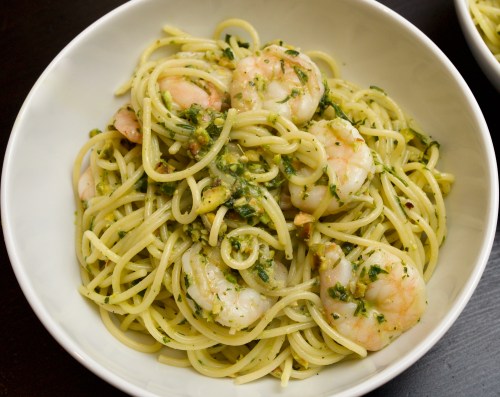
Spaghettini w. prawns basil parsley and pistachios

We know it’s Sunday and it’s getting colder and the clocks have changed, so we should really be posting a nice roast. However, we figure you probably have dinner sorted for today and you might like something to inspire you later in the week.

Wine Suggestion: the fresh, zesty Staforte Soave from Gaziano Prà would be a great match for this. Made from 100% Garganega it has apricot, peach and apple fruit flavours with touches of camomile and white flowers; followed by a textural finish. We would also try southern Italian Greco di Tufo and Falanghina’s with this dish; try to look for something with crispness, mid-weight and mineral texture and it should work.

Spaghettini with prawns, basil, parsley & pistachios – serves 4

  • 1 clove of garlic
  • ½ tsp sea salt
  • a large handful of basil leaves
  • a large handful of flat-leaf parsley leaves
  • a large handful of mint leaves
  • 75g roasted unsalted pistachio nuts
  • 1 tbsp finely grated parmesan
  • 1 tbsp lemon juice
  • 60ml extra virgin olive oil
  • 400g dried spaghettini
  • 500g raw peeled king prawns

Pound the garlic and half the sea salt to a paste with a pestle and mortar. Add the basil, parsley and mint and keep pounding together to make a thick paste. Add half the pistachios and grind them into the paste to get a creamy texture. Roughly chop the rest of the pistachios and stir into the paste with the Parmesan, lemon juice and 2 tbsp of the olive oil. Season with some more salt if needed and black pepper.

Meanwhile, bring a large saucepan of salty water to the boil and cook the pasta until al dente.

Put a heavy-based frying pan over a high heat and add the rest of the olive oil. Fry the prawns for a minutes on each side, then season with the remaining ¼ tsp of sea salt. Remove from the heat.

Drain the pasta and keep a little of the cooking water. Immediately tip the pasta back into the pot, then toss together with the herb paste and cooked prawns. Add a little of the pasta cooking water if necessary to loosen. Serve immediately on warm plates.

(Original recipe from Neil Perry’s Good Cooking, Murdoch Books, 2016.)
 

Read Full Post »

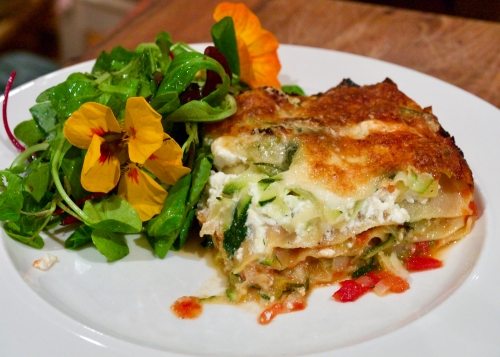
Courgette lasagne

It’s the season where vegetables seem to come in waves of excess. Here’s a nice weekday lasagne for any of you that are still harvesting courgettes.  Our friend Nicola also dropped by with some home-grown salad ingredients including these pretty nasturtiums.

Wine Suggestion: We think fresh, crisp whites work with courgettes really well and when combined with pasta and cheese naturally lean towards young Semillon, Chenin Blanc or Chablis. To mix it up a bit, however, we tried the Villa Sparina Gavi di Gavi from Piedmont in Italy, another good option.

Courgette Lasagne – serves 6

  • 8 plum tomatoes, halved
  • 2 garlic cloves, lightly bashed
  • 1 tbsp olive oil
  • 1 sprig of rosemary
  • ½ tbsp golden caster sugar
  • 2 leeks, sliced into rings
  • 20g unsalted butter
  • 100g baby spinach
  • 500g courgettes, grated
  • 10 lasagne sheets
  • 250g tub of ricotta
  • 125g mozzarella, torn
  • 50g Parmesan, grated

Heat the oven to 200C/180 fan/gas 6.

Put the halved tomatoes onto a baking tray with the garlic, oil, rosemary and season well. Bake for 25-30 minutes or until soft, then discard the rosemary and remove the skin from the garlic. Put the tomatoes and garlic in a blender and blitz a few times to make a chunky sauce.

Meanwhile, put the leeks in a pan over a low heat, add the butter, season and cook for about 10 minutes or until soft. Add the spinach and grated courgettes, and continue to cook for another couple of minutes to wilt and soften. Set aside.

Layer the ingredients in a large ovenproof dish starting with a layer of tomato sauce, then some pasta, followed by ricotta and vegetables. Repeat until all the ingredients are used, finishing with a vegetable layer. Scatter over the mozzarella and Parmesan, then bake for 40 to 45 minutes or until golden brown and bubbling.

(Original recipe by John Torode in BBC Good Food Magazine, August 2016.)


Read Full Post »

Pasta with red peppers and sausages

We love dishes like this! So cheap and easy yet tastes of Italian holidays. Try and find some good Italian sausages as they tend to be really well flavoured.

Wine Suggestion: the fresh and pure fruited Rocca delle Macie Chianti Vernaiolo was our successful match with this. With no oak this is a delicious expression of cherry fruited flavours that celebrates the freshness of the dish at the same time.

  • 1 small red onion, finely sliced
  • 3 red peppers, deseeded and cut into 2cm squares
  • 4 pork sausages – try and get your hands on some Italian ones if possible
  • 6 tbsp olive oil
  • a couple of pinches of salt and chilli flakes
  • 5 ripe tomatoes, peeled and roughly chopped (cover with hot water for a minute to make them easier to peel)
  • 400g pasta, we used rigatoni but use any short pasta variety
  • plenty of freshly grated Parmesan, to serve

Run a sharp knife down each sausage and remove the meat from inside the casing. Crumble roughly with your fingers to break it up a bit and set aside.

Over a medium-low heat, fry the onion in the olive oil with a small pinch of salt until soft but not browned. Add the chilli and sausage meat, crumbling it with your fingers, then fry, breaking the pieces up with the back of a wooden spoon until the meat is no longer pink. Add the peppers, another pinch of salt and cook, stirring every now and then, for another 10 minutes.

Add the tomatoes to the pan and cook for another 15 minutes or until the sauce is rich and thick and the peppers are very soft.

Meanwhile, cook the pasta in  boiling salty water until al dente. Warm a large bowl, then mix the cooked pasta with the sauce and the grated Parmesan before serving.

(Original recipe published in The Guardian 18th July 2017.)


Read Full Post »

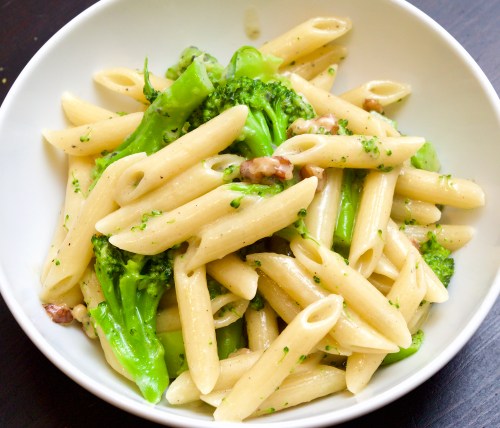
Broccoli, walnut & blue cheese penne

We almost always have a bit of leftover blue cheese in the fridge and much as we love a cheese board, we don’t tend to have them on weeknights. So here’s a simple weeknight pasta – broccoli, walnuts & blue cheese – yum!

Broccoli Walnut & Blue Cheese Pasta – serves 2

  • 200g penne pasta
  • 250g broccoli florets
  • 2 tbsp olive oil
  • a handful of chopped walnuts
  • 100g blue cheese e.g. dolcelatte, cubed
  • 1 lemon

Cook the pasta in a large pan of salty water and add the broccoli 4 minutes before the end of the cooking time. Meanwhile, heat the oil in a small pan and gently fry the walnuts for a minute.

Scoop 4tbsp of the pasta cooking water out and add to the walnuts before draining. Return the pasta to the pan and add the walnuts and blue cheese. Stir gently until the cheese melts. Squeeze over some lemon juice before serving.

(Original recipe from BBC Good Food)

Read Full Post »

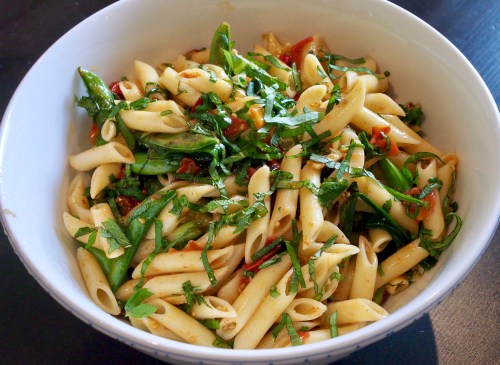
Tomato and sugar snap pea pasta salad

We’ve really embraced salads recently, especially as this Irish summer has been quite nice and sunny. This works as a main dish or as a side and will feed a large crowd. It’s nice to find a pasta salad that doesn’t rely on heaps of mayonnaise!

Tomato & Sugar Snap Pea Pasta Salad – serves 6

  • 9 cloves of garlic, crushed
  • 3 sprigs of thyme
  • 3 x 5 cm strips of orange zest
  • a thumb-sized piece of ginger, peeled and cut into tiny matchsticks
  • 600 g cherry tomatoes
  • 6 tbsp fresh orange juice
  • 60 ml olive oil plus 2 tbsp (and a bit extra for drizzling at the end)
  • 1 tbsp light brown sugar
  • ¼ tsp sea salt plus extra
  • 200 g scallions
  • 200 g sugar snap peas, trimmed and halved
  • 350 g pasta e.g. penne, casarecche or fusilli
  • 2 tbsp lemon juice
  • a large bunch of basil, leaves picked and shredded
  • a large bunch of mint, leaves picked and shredded

Preheat the oven to 160ºC.

Put the garlic, thyme, orange zest, ginger, tomatoes, orange juice, 60 ml olive oil, brown sugar, salt and a pinch of black pepper into baking dish and toss with your hands. Place in the oven to roast for 50-60 minutes, tossing every 20 minutes or so. Discard the thyme and orange zest when the cooking time is up.

Separate the green and white parts of the scallions. Cut the green parts in half lengthwise and then across into 5 cm lengths. Slice the white parts into halves or quarters, depending on their size. Heat a large frying pan over a high heat and add 1 tbsp of oil. Add the sugar snap peas and spread out into a single slayer. Cook, turning once, until charred on both sides, about 4 minutes, then transfer to a large bowl.

Heat another 1 tbsp of oil in the same pan. Add the green and white parts of the scallions and spread out in a single layer. Cook these in the same way as the peas, until charred. Transfer to the bowl with the sugar snap peas and season with salt.

Cook the pasta in a large pot of boiling salted water until al dente, then drain and transfer to a large bowl to cool. Toss it occasionally to prevent it sticking together.

Add the tomato mixture, the sugar snap peas and onion, the lemon juice, most of the basil and most of the mint, to the pasta. Toss gently with your hands to combine without breaking up the tomatoes too much. Season with salt and pepper and a bit more lemon juice if necessary.

Serve with the remaining herbs scattered over the top and drizzle with olive oil.

(Original recipe by Yotam Ottolenghi on bon appétit.)


Read Full Post »

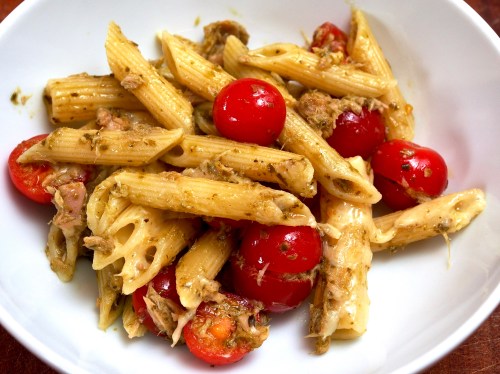
Cheesy tuna pesto pasta

Oh this is soooo easy and has become a regular feature in our house at lunchtime on Saturdays. Also adored by the resident 3 year old which is always a bonus. Maybe save the wine for after 7pm 😉

Cheesy Tuna Pesto Bake – serves 4 generously and the leftovers are good

  • 400g penne pasta
  • 200g tin or jar of good quality tuna in olive oil
  • 190g jar of pesto (we find that off the shelf rather than out of the fridge works better here as the fresh-made pestos make the dish a bit oily)
  • 100g cheddar, grated
  • 250g cherry tomatoes, halved

Cook the pasta according to the instructions on the pack.

Meanwhile empty the contents of the tin of tuna (including the oil) into a large bowl and add the pesto. Mash together with a wooden spoon. Stir in about a third of the cheese and all the tomatoes. Heat the grill to high.

Drain the pasta and stir into the bowl with the tuna and pesto mixture, then tip into a shallow baking dish and sprinkle with the remaining cheese.

Put the dish under the grill for 3-4 minutes or until the cheese has just melted.

Serve with salad and garlic bread if you like.

(Original recipe from BBC Good Food.)


Read Full Post »

Radicchio & Gorgonzola pasta

In some ways this is an opportunistic dish because we don’t always see Radicchio in our grocer’s shop. We love the creamy, salty, bitter flavours  which come together with the rich creamy sauce. We like serving it with a bit of Parmesan too, but it’s not necessary.

Wine suggestion: The Rocca delle Macie’s Vermentino from the Maremma was our choice and the crisp, almost sappiness, helped to cut through the richness and complement the bitterness of the radicchio. If we’d had one we would have loved to have tried a good, dry Lambrusco from near Bologna. We could be wrong but think this might work too.

Pasta with Radicchio & Gorgonzola – serves 4

  • 1 onion, diced
  • 1 radiccio, shredded
  • 50ml white wine
  • 4 tbsp cream
  • 75g gorgonzola
  • 300g pasta

Cook the pasta in a large pan of boiling salted water according to the timings on the packet.

Heat 1 tbsp of olive oil and fry the onion until softened, then add the radicchio and continue to cook until wilted.

Add the white wine and season. Pour in the cream, melt in the gorgonzola and mix through the cooked pasta.

(Original recipe from BBC Olive Magazine, April, 2014.)

Read Full Post »

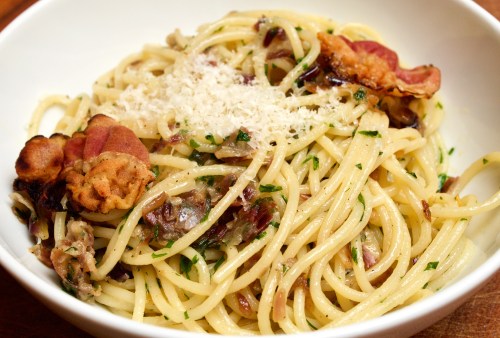
Spaghetti with parsley, pancetta & parmigiano

We’re never surprised at how reliable the cookbooks from River Cafe are as in general they celebrate fabulous ingredients with simple cooking methods; our favourite way to cook too. This is a rich dish and works best served in small portions as a starter.

Wine Suggestion: The richness and parmesan cry out for higher acidity in the wine. We combined this idea with the almost bacon-ny yeasty and almondy autolysis of a sparkling Trento DOC, the Ferrari Perlé Nero Riserva. Body, richness, nuttiness and freshness; a great combo with the pasta.

When choosing between Italian sparkling wines we find the Trento DOC area has a bit more body and richness than the creamier and refined Franciacorta. This is not to say that top producers like Ferrari don’t have refinement, they do in spades, but that there is a lightness and elegance to be found in Franciacorta. Too light for this dish. Both areas produce some stunning wines.

Spaghetti with parsley, pancetta & parmesan – serves 6

  • 8 tbsp finely chopped flat-leaf parsley
  • 3 medium red onions, finely chopped
  • 200g pancetta, finely sliced, then cut into 5mm pieces plus an extra Rose 6 thin slices (one each)
  • 400g spaghetti
  • 150g butter
  • 2 garlic cloves, peeled and finely chopped
  • 1 dried red chilli or a good pinch of dried chilli flakes
  • olive oil
  • 120g Parmesan, grated

Gently heat the butter in a heavy-based saucepan. Add the onion and cook gently for 15-20 minutes, then add the pancetta and garlic. Turn down the heat, stir and continue to cook for a further 10 minutes. You can turn up a bit again at the end if you want the pancetta to crisp up.  Season well with salt, pepper and the dried chilli. Stir in the parsley.

Heat a small frying pan, brush with oil, and fry the slices of pancetta to crisp them. Drain on paper towels.

Cook the spaghetti in a large saucepan of boiling salted water until al dente. Drain, but scoop out a few tablespoons of the cooking water first. Throw the spaghetti into the warm parsley mixture and toss, adding a little of the pasta water to help the sauce coat the pasta.

Serve with lots of Parmesan and a slice of pancetta on each bowl.

(Original recipe from River Cafe Green by Rose Gray & Ruth Rogers, Martin Gray, 2000.)


Read Full Post »

Pesto Lasagne

A really quick and easy lasagne full of Spring flavours. You don’t have to buy fresh pesto from the fridge as this tends to be more oily and makes this dish very rich; we successfully used a jar from a shelf instead.

Wine suggestion: A grassy European styled Sauvignon Blanc which tends to have a longer, if cooler, growing season is a good match. Avoid the big flavoured Sauvignon’s with the kiwi / tinned asparagus flavours that you might typically find from NZ and Chile as these flavours clash a bit. Exceptions to this always exist like the Dog Point Marlborough Sauvignon, but a good Touraine or Sancerre would be our match.

Pesto Lasagne – serves 4 to 6

  • 190g jar of pesto
  • 500g tub mascarpone
  • 200g bag spinach, roughly chopped
  • 250g frozen peas
  • small pack of basil
  • small pack of mint
  • 12 fresh lasagne sheets
  • 85g Parmesan, finely grated
  • 50g pine nuts
  • Green salad & garlic bread to serve

Heat the oven to 180C/160 fan/gas 4.

Put the pesto, half the mascarpone and 250ml vegetable stock in a saucepan. Heat, stirring, until smooth and bubbling. Add the spinach and peas and cook for another few minutes until the spinach has wilted and the peas have defrosted. Add the herbs and season but go easy with the salt.

Put a third of this pesto mixture into the base of a baking dish (approx. 18 x 25cm). Top with 4 lasagne sheets, then repeat with 2 more layers of sauce and lasagne sheets, finishing with a layer of pasta. Mix some milk into the remaining mascarpone to make a sauce consistency, season then pour over the top of the dish. Sprinkle with the Parmesan and pine nuts, then bake for 35-40 minutes or until brown on the top and bubbling. Scatter over a few basil leaves before serving.

(Original recipe from BBC Good Food Magazine, February 2014.)

Read Full Post »

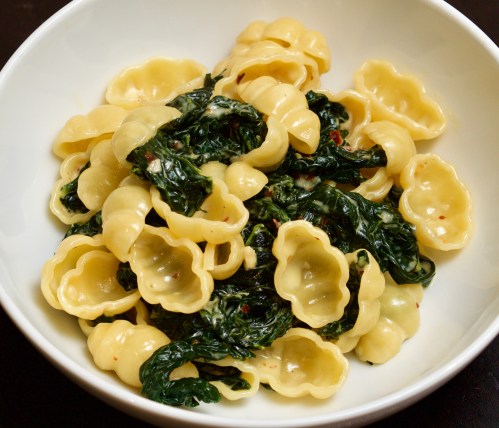
Conchiglie al Cavolo Nero

We’ve made this a couple times recently as  Cavolo Nero is around and we keep on being drawn to it. Especially as we’re starting to tire of root veg and looking forward to all the treats that will come with Spring.

The dish is  creamy and cheesy, with load of garlic and iron rich Cavolo Nero. Fairly rich for a main course in our opinion but absolutely perfect served in small starter portions.

If it suits you can blanch and dry the Cavolo nero and make the garlic puree in advance which leaves very little to do to get the dish on the table.

Wine suggestion: An old favourite came to the rescue here in the form of the Sartarelli Verdicchio dei Castelli di Jesi Classico Superiore “Tralivio” which has a great weight but also a freshness and vibrant texture. The flavour of the food isn’t shy, so make sure whatever you choose has enough body to cope.

Conchiglie al Cavolo Nero – serves 6 as a starter

  • 900g Cavolo Nero
  • 300ml double cream
  • 7 garlic cloves, peeled
  • 3 tbsp extra virgin olive oil
  • 2-3 dried chillies, crumbled or 2 tsp chilli flakes (adjust to your heat preference)
  • 150g Parmesan, freshly grated
  • 250g conchiglie or other shell-shaped pasta

Remove the central stalk from the Cavelo Nero leaves and cut each one into 3 or 4 pieces. Blanch the leaves in boiling salted water for 3 minutes by which time they should be tender and bright green. Drain and dry in a clean tea towel.

Put the double cream and 5 of the whole garlic cloves into a pan and simmer until the garlic is soft, about 15 minutes. Purée in a blender.

In a separate pan, heat the olive oil and fry the remaining 2 garlic cloves, cut into thin slices, and the chilli. When the garlic has coloured, add the blanched Cavolo Nero, stir & season. Pour in the cream and garlic purée, bring to the boil, and cook for 5 minutes until the Cavolo Nero is coated and the sauce has thickened. Add the Parmesan.

Meanwhile, cook the pasta in plenty of boiling salted water, then drain well before mixing well with the sauce.

(Original recipe from The River Cafe Cookbook by Rose Gray & Ruth Rogers, Ebury Press, 1995.)

Read Full Post »

Roast pumpkin and spinach lasagne

Making lasagne is a bit of a labour of love but if you take it in stages it can be assembled in advance and baked when you need it. Always worth the effort in our opinion. This veggie version is particularly good.

Wine Suggestion: we found the Rustenberg Chardonnay from Stellenbosch really matched this dish with it’s masterful balance of oak, fruit and freshness. This is one of South Africa’s classics and one of the best value Chardonnay’s we know. It is picked, crushed and gently settled before fermenting by itself (wild yeasts) and after gentle care in oak barrels on fine lees it is bottled. Only at this stage do they add a touch of sulphur to keep it stable in the bottle. A natural wine without the faults of other proponents of this term.

Roast Squash & Spinach Lasagne – serves 6

  • 750g butternut squash
  • 2 tbsp olive oil
  • 500g spinach, washed
  • 1 tbsp butter
  • whole nutmeg
  • 6 fresh lasagne sheets
  • 100g Parmesan, grated

FOR THE TOMATO SAUCE:

  • 1 medium onion, finely chopped
  • 1 tbsp olive oil
  • 1 celery stick, finely chopped
  • 2 garlic cloves, finely chopped
  • 400g tin cherry tomatoes
  • 2 tsp light muscovado sugar

FOR THE BECHAMEL SAUCE:

  • 500ml full-fat milk
  • 6 peppercorns
  • ½ onion
  • 1 bay leaf
  • 50g plain flour
  • 50g butter

Heat your oven to 200C/180C fan/gas 6.

Halve the squash, peel and deseed, then cut into slices about 1cm thick. Toss with the oil in a roasting tin, season well, then roast until tender and beginning to char at the edges – about 40 minutes.

Meanwhile, make the tomato sauce. Soften the onion in the oil for 5 minutes, then add the celery and garlic and cook for another minute. Add the tomatoes & sugar, then leave to simmer, uncovered, for 30 minutes or until you have a thick puree. Season.

Wash the spinach and put into a saucepan with the water that clings to the leaves. Place over a medium heat and toss for about 4 minutes or until completely wilted. Leave to cool, then squeeze as much water as you can out of the spinach with your hands. Chop and put into a pan with the butter, then gently heat and toss together so the spinach is coated in butter, season with salt, pepper and a good grating of nutmeg.

To make the bechamel, bring the milk to the boil in a pan with the peppercorns, onion and bay leaf. Set aside for 5 minutes to infuse, then strain into a clean pan. Add the flour & butter and whisk over a gentle heat until you have a thick smooth sauce.

Heat your oven again to 200C/180C fan/gas 6.

To assemble the lasagne start by buttering a baking dish – about 1.4 litres capacity. Put a layer of roasted squash in the bottom followed by a layer of tomato sauce. Place lasagne sheets on top of this, making sure they don’t overlap (you can cut them with scissors to fit your dish). Add a layer of bechamel, followed by a handful of spinach and half the grated cheese. Top with more lasagne, pumpkin, tomato sauce, more lasagne and a final layer of bechamel. Sprinkle the rest of the cheese over the top. Bake for 40 minutes or until bubbling and golden.

(Original recipe by Diana Henry in BBC Good Food Magazine, December, 2016.)


Read Full Post »

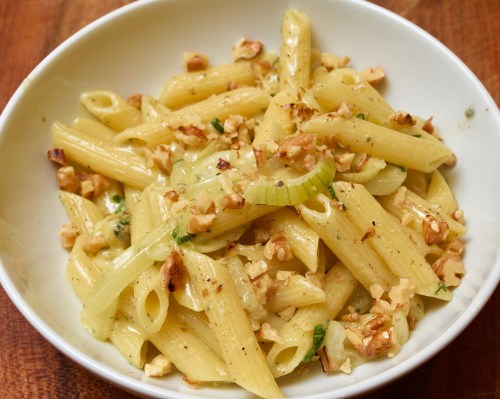
Penne Stilton

We often have lumps of leftover Stilton in the fridge after the weekend and particularly after Christmas. If you find yourself in a similar situation try this simple pasta dish for a mid-week dinner. If that doesn’t solve the problem here’s a few other ideas:

Broccoli and Stilton Soup

Creamy baked Brussels sprouts with stilton

Pasta with Blue Cheese Cream

Roussillon Baked Potatoes

Pork and Pears

Wine Suggestion: delicious with the Bott-Geyl Points Cardinal Metiss, a dry but rich and full white made from all the Pinot varieties you can think of, including the red and pink ones. When young this wine is fresh and enticing but with an extra year in the bottle it fills out and the aromas seem to ramp up a bit more with hints of honey, pears and apples and a lovely dry spice on the palate. More than a match for the powerful flavour of Stilton.

Stilton & Penne Pasta – serves 4

  • 400g penne pasta
  • 25g butter
  • 1 onion, thinly sliced
  • 1 garlic clove, crushed
  • 1 tbsp fresh chopped sage
  • 100g Stilton, cubed
  • handful toasted walnuts, chopped

Cook the pasta according to the instructions on the pack.

Melt the butter in a medium saucepan, then gently fry the onion until golden. Add the garlic and sage, fry for a further 2 mins, then remove the pan from the heat.

Drain the pasta and reserve some cooking water. Stir through the onions, Stilton and 2 tbsp cooking water, then sprinkle with the toasted walnuts to serve.

(Original recipe from BBC Good Food)

Read Full Post »

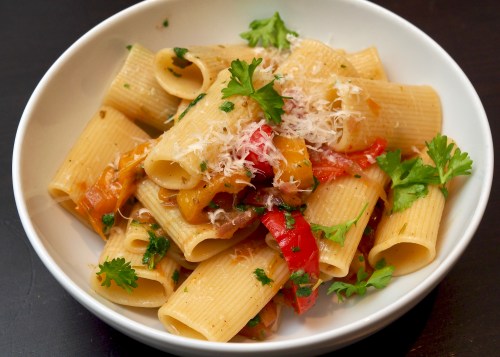
Rigatoni Peperonata

A simple midweek pasta supper for using up those multi-pack peppers. It reminds us of summer and Italy.

Wine suggestion: a great match with Cabernet Franc. The bell pepper, inky and pencil shaving character really compliments the flavours in this simple dish. A favourite of our is the Ch du Hureau from Saumur. Their “Tuffe” a youthful Cab Franc is a gem that regularly makes its way onto our wine rack. If you want to stick with Italian a 100% Sangiovese would make an excellent choice too.

Pasta Peronata – serves 4 (easily halved)

  • 2 red peppers, sliced
  • 2 yellow peppers,  sliced
  • 2 red onions, finely sliced
  • 2 cloves garlic, grated or crushed
  • 2 handfuls fresh flat-leaf parsley, leaves finely chopped and stalks reserved
  • 2 tbsp balsamic vinegar
  • 2 handfuls grated Parmesan cheese
  • 2 heaped tablespoons mascarpone cheese or crème fraîche (optional – we don’t usually add this unless we have some already)
  • 500g rigatoni or penne pasta

Put the peppers into a large frying pan over a medium heat with a little olive oil and a pinch of salt and pepper. Cover with a lid, and cook gently for about 15 minutes until softened. Add the onion and cook for a further 20 minutes. Then add the garlic and parsley stalks and cook, stirring, for about 3 minutes. Season to taste. Add the vinegar, then add a handful of the grated Parmesan and the mascarpone or crème fraîche if you are using it and turn the heat down to minimum while you cook the pasta.

Cook the pasta according to the instructions on the pack. Reserve a little of the cooking water before draining. Toss the peppers, pasta & chopped parsley in a large warm bowl. Add a bit of the reserved pasta water and a splash of good olive oil to coat the pasta. Serve with the rest of the Parmesan.

(Original recipe by Jamie Oliver).

Read Full Post »

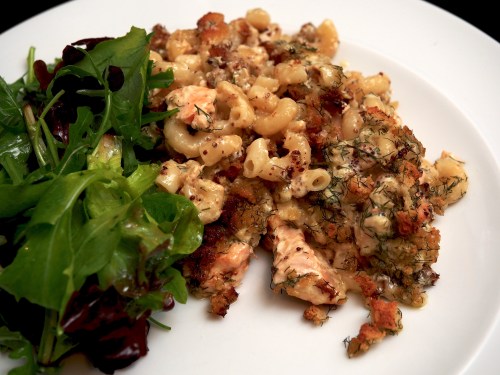
Rich Salmon Macaroni

This is super rich and luxurious and needs no other accompaniment than lots of dressed salad leaves (and a glass of wine of course).

Wine Suggestion: There are two options here. One is to balance the richness of the dish with an equally weighty wine and for this we’d drink a good white Burgundy, Meursault preferably. Conversely you can cut through the richness with something a bit more fresh and zingy such as a good Sancerre, the key here is to make sure the wine has texture and concentration so it’s not overwhelmed. Again, choose a very good producer if you can. 

Salmon with macaroni – serves 4

  • 600ml double cream
  • 400g piece of salmon fillet
  • 1 bay leaf
  • 150g macaroni
  • 2 tbsp wholegrain mustard
  • 50g sourdough bread
  • large handful of fennel fronds/dill

Preheat the oven to 200ºC.

Pour the cream into a saucepan and add the salmon, bay leaf and some freshly ground black pepper. Bring almost to the boil, then turn the heat down and cook gently for about 10 minutes or until the flesh flakes easily, then remove from the heat.

Boil the pasta in lots of salty water for about 9 minutes, then drain and tip into a baking dish. Remove the salmon from the cream and flake into large chunks, discarding any skin and bones. Tuck the salmon in amongst the pasta. Add the mustard to the cream with a little salt, then pour over the salmon & pasta.

Put the sourdough bread and fennel/dill into a food processor and pulse to coarse crumbs. Scatter the herby crumbs over the pasta. Bake for 20-25 minutes or until the crumbs are golden.

(Original recipe from The Kitchen Diaries III by Nigel Slater, Fourth Estate, 2015.)

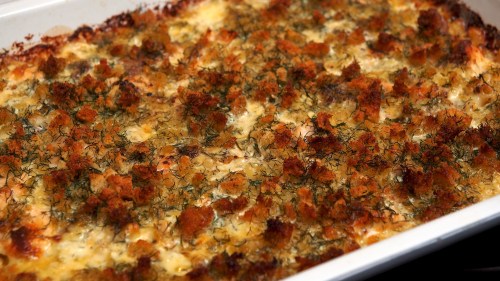
Mac n Salmon

Read Full Post »

Walnut Pesto

We first tasted walnut pesto in Florence a few years ago but it has taken us a while to get around to making it ourselves. This works equally well for a casual dinner or in smaller portions as a starter and it tastes really special. You can make this with fresh walnuts which you buy whole and shell yourself but it also works well with shelled walnuts, provided you make sure they are fresh (we buy our walnuts from Lidl which come in a sealed foil bag). You can keep the pesto in the fridge for up to a week and it freezes well too.

Wine Suggestion: we like to drink dry white wines that have texture and a certain crunchiness with walnuts, which aren’t always easy to match. Italian whites come to mind first and the nutty ones work very well, like Verdicchio, but it has been dry (sec) Jurançon that has proved a stellar match, like Cauhapé’s Chants des Vignes. A wine with a vibrancy of fruit, a fresh acidity like a crunchy green and red apple mix, some white flowers in the aromas and a texture on the palate that carries through with a long length and food friendly finish.

Pasta with creamy walnut pesto – serves 4 (with some pesto left over)

  • 400g orecchiette pasta
  • 175g walnut halves/pieces
  • 1 clove of garlic
  • handful fresh basil, roughly torn
  • 100g Parmesan, freshly grated, plus extra to serve
  • 50g butter
  • 4 tbsp extra virgin olive oil
  • 50ml double cream

Cook the pasta for the recommended time on the packet.

Meanwhile, put the walnuts and garlic in a food processor and whizz until finely chopped. Add the basil, cheese, butter and oil and pulse for a few more times, then season.

Pour the cream into a pan and warm through. Add two-thirds of the pesto, then gently heat to loosen it.

Take 2 tbsp of water out of the pasta pan before draining, then mix the pasta and the water into the sauce. Serve immediately with some extra Parmesan and a few basil leaves.

The leftover pesto will keep in the fridge for a week or the freezer for a month.

(Original recipe by Ursula Ferringo in BBC Good Food Magazine, April 2009.)


Read Full Post »

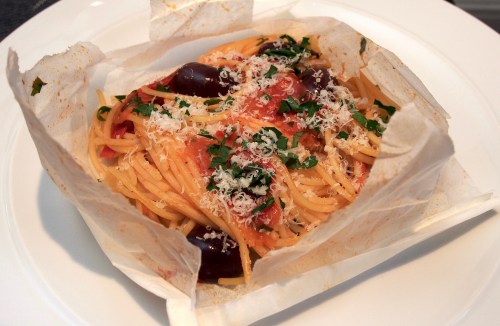
Spaghetti al cartoccio

This starter portion of pasta is perfect for entertaining as it can be prepared up to 6 hours in advance and finished off in the oven when required. We had this as a second course after broad bean bruschetta and followed by barbecued balsamic beef and then home-made ice cream and summer berry compote for dessert.

Wine Suggestion: lovely with a slightly chilled red, and naturally, given the inspiration from the food we’d suggest Italian. A light, lively, youthful and fruity Sangiovese hits the spot in the form of a Rocca delle Macie Chianti Vernaiolo given 30-40 minutes in the fridge before serving; chilled but not ice cold. The fresh acidity works perfectly with the fresh tomatoes and olives and the combination speaks to us of summer.

Pasta al Cartoccio – serves 4

  • 2 tbsp olive oil
  • 1 large clove of garlic, peeled and left whole
  • 450g ripe fresh tomatoes, chopped
  • 1 red chilli, seeded and chopped
  • 280g dried spaghetti
  • 100g large black olives
  • a handful of flat-leaf parsley, chopped
  • grated Parmesan cheese, to serve

Cut 4 pieces of parchment paper, about 30x20cm.

Heat the oil in a saucepan over a medium heat, add the garlic and sauté for a couple of minutes. Remove the garlic, then add the tomatoes and chilli and season well. Simmer for 20 minutes, stirring now and then.

Meanwhile, preheat the oven to 200C/Gas 6/fan oven 180C.

Cook the spaghetti in salted water for half the time given on the pack, then drain well.

Add the olives and half the parsley to the tomato sauce and stir in the pasta. Taste and season to taste.

Divide the spaghetti between the pieces of paper, piling it into the middle of each. Scrunch the edges of each parcel  to seal tightly. Put the parcels in a roasting tin and bake for 7 minutes after which time the spaghetti should be al dente.

Remove the tin from the oven and transfer each parcel to a warm plate. Let everyone open their own parcels and sprinkle the spaghetti with the remaining parsley and some parmesan.

(Original recipe by Ursula Ferrigno in BBC Good Food, August 2001.)

Read Full Post »

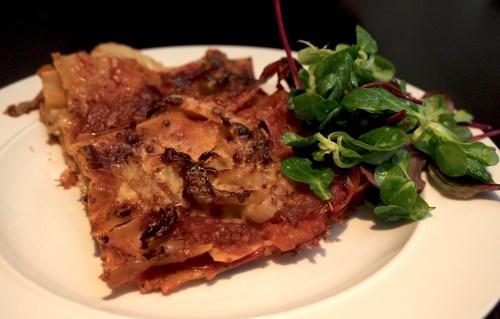
Fennel & Roasted Tomato Lasagne 1

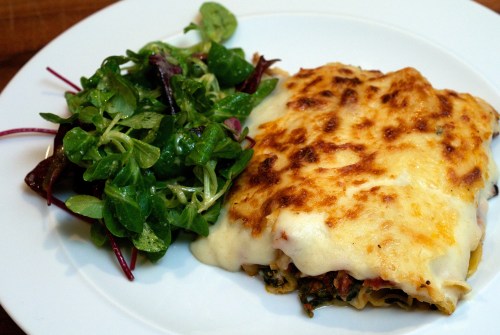
This is a great veggie dish that has had two outings in our house within a short space of time. It’s also one of the best recipes we’ve found for fennel which we sometimes find a bit uninspiring. We’ve made this in a larger tin, and thus thinner, and also in a deeper one. Both tasted great but we think the smaller diameter deeper dish works better.

Wine Suggestion: a classic match with Sangiovese especially from Chianti in Tuscany. Look out for wines with 100% Sangiovese in this case, even though there are some superb blends out there, as the nature of these wines complements the Fennel and Tomato more. We’ve tried both the Rocca delle Macie Sant’Alfonso Chianti Classico, which is unusally grown on thick clay, and the Selvapiana Chianti Rufina and both complemented the Lasagne excellently.

Fennel & Roast Tomato Lasagne – serves 4

  • 3 fennel bulbs, sliced
  • 3tbsp extra virgin olive oil
  • 800g tomatoes on the vine
  • 2tbsp balsamic vinegar
  • 150ml double cream, plus a bit extra if needed
  • 100g Parmesan, grated
  • 250g dried lasagne sheets

Heat the oven to 160C Fan. Place the fennel in a large roasting tray, season well and drizzle with 2tbsp of the oil. Place the tomatoes in a separate roasting tray. Season and drizzle with the remaining oil and balsamic. Roast both trays for 30mins

Stir the cream into the fennel and return to the oven for a further 10mins. Meanwhile lightly mash the tomatoes with a fork. Remove the fennel from the oven, grate over most of the cheese and stir to melt – it should make a little sauce that clings to the fennel – add a bit more cream if you need to. Reduce oven temp to 140c fan.

Spoon a thin layer of tomatoes into an ovenproof dish. Top with a layer of pasta, followed by a layer of fennel, then another layer of pasta. Repeat, finishing with a layer of fennel. Scatter over remaining cheese and bake for 45mins until golden and the pasta is cooked. Serve with a green salad.

(Original recipe by Matt Follas in BBC Good Food Magazine, July 2010.)

Fennel & Roasted Tomato Lasagne 2

Read Full Post »

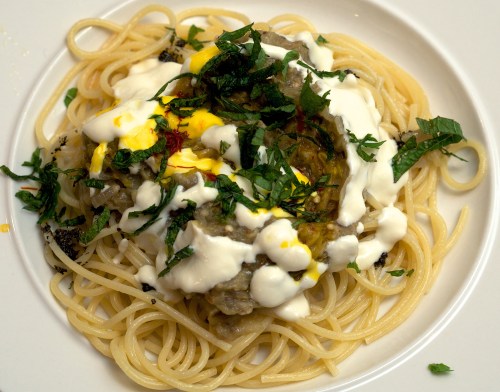
Iranian Pasta

This dish from Yotum Ottolenghi is very different from the Italian pasta dishes that we’re all familiar with. As Yotam points out, Italy totally dominates the pasta scene when in fact there are pasta recipes from all over the place. Try this if you’re up for something way more exotic than spag bol.

Wine Suggestion: We chilled down a Spanish red to go with this, the Jesus Romero Rubus, a vibrant blend of Garnacha, Tempranillo and Syrah from one of the highest vineyards in Spain. Unoaked this wine has a delicious purity and an excellent length with deep plum flavours, hints of pepper and spice.

Iranian-style Pasta – serves 4

  • 3 large aubergines (1.2 kg in total)
  • 140g crème fraîche mixed with 60g of Parmesan
  • 75ml of olive oil, plus a bit extra
  • 1 large onion, finely chopped
  • 2 tsp cumin seeds
  • 3 garlic cloves, crushed
  • 2 tbsp lime juice
  • 150g Greek yogurt
  • 2 tsp dried mint
  • 500g linguine pasta
  • ½ tsp saffron threads diluted with ½ tbsp of lukewarm water
  • 10g fresh mint, shredded

Preheat the oven to 230ºC/210ºC Fan/Gas Mark 8.

Pierce the aubergines a few times with a sharp knife, then place on a baking tray lined with baking parchment and roast in the oven for about 1 hour, or until the flesh is totally soft. Set aside to cool a bit, then cut in half and scoop out the flesh into a colander. Leave to drain for at least 30 minutes and discard the skin.

Put the crème fraîche and Parmesan mixture into a small saucepan with 75ml of water. Bring to a simmer over a medium heat, stir, then set aside.

Heat 2 tbsp of the olive oil in a medium sauté pan and place on a medium-high heat. Add the onion and cumin seeds and cook for 12 minutes or until soft. Add the aubergine flesh and garlic, along with 1 tsp of salt and some black pepper. Cook for another 2 minutes before adding the lime juice. Stir for a final minute, then remove from the heat.

Add the yoghurt to the crème fraîche mixture and heat over a low flame for 5 minutes. Watch the mixture carefully – stir regularly and don’t let the pan heat too much or the yoghurt may split.

Mix the dried mint with a tbsp of the oil and set aside.

Cook the pasta in a large pan of salted water according to the pack instructions or until al dente. Stir 2 tbsp of the oil through the cooked pasta and divide between shallow bowls or plates. Drizzle over the mint oil, followed by the aubergine. Top with the crème fraîche and yoghurt mixture, followed by the saffron water, fresh mint & a final drizzle of oil. Serve straight away.

(Original recipe from Plenty More by Yotam Ottolenghi, Ebury Press, 2014.)

Read Full Post »

Cherry tomato & chipolata bake

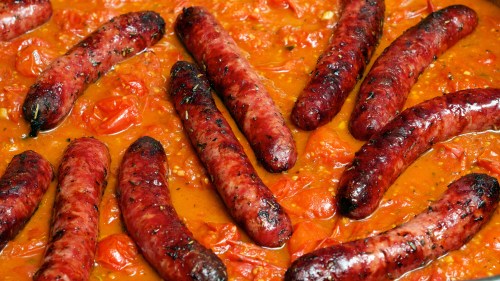
Despite the simplicity of this dish it really showcases perfectly ripe cherry tomatoes; excellent when the garden is overflowing and you’re trying to think of recipes to use them all! One of our butchers does great, meaty and coarsely filled chipolata sausages which we used here, but Cumberland or coarse Italian ones work just as well. Leftovers make a great pasta sauce (see below).

It’s might be a bit early yet for Irish garden tomatoes but our friend Patty, who has just left Ireland to become the Garden Program Director at the University of the Pacific in Stockton California, has a huge tomato glut. So we promised a tomato recipe to help Patty, Michael, and the rest of the staff use up all the tomatoes.

Wine suggestion: Great with a robust and juicy red, don’t over complicate it and pick a moderately priced one. We’ve tried Southern Italian Primitivo’s, Barbera from the north, Cotes du Rhone, Spanish Tempranillo’s and Garnacha and a couple of juicy Aussie Shiraz’s. All work a treat. Californians won’t go wrong with a good Lodi Zin!

Sweet cherry tomato and sausage bake – serves 6

  • 2kg ripe cherry tomatoes, mixed colours if you have them
  • 2 sprigs each of thyme, rosemary & bay
  • 1 tbsp dried oregano
  • 3 garlic cloves, peeled and chopped
  • 12 good-quality sausages (see above)
  • extra virgin olive oil
  • balsamic vinegar

Preheat the oven to 190ºC/375ºF/gas 5.

Put the tomatoes, herbs, oregano, garlic and sausages in a large roasting tray – big enough to take the tomatoes in a single layer. Drizzle with the olive oil and balsamic vinegar and season with salt and pepper. Toss together and make sure the sausages end up on the top, then bake for 30 minutes in the hot oven. Give the tin a good shake and turn the sausages over, then return to the oven for 15-30 minutes or until the sausages are at your desired level of stickiness (we like them pretty sticky!).

Lift the sausages out of the sauce, then put the tray on the hob and reduce the sauce to a nice thick consistency, before putting the sausages back in. Check the seasoning and serve with some warm bread and a green salad.

(Original recipe from Jamie Oliver’s Jamie at Home, Michael Joseph, 2007.)

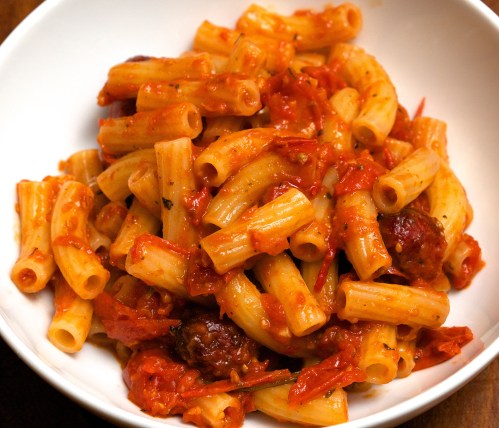
Cherry tomato & sausage penne

As the bake makes loads just chop up the leftovers the next day and reheat to serve with penne or another chunky pasta like rigatoni or macaroni. Delicious altogether!

Cherry tomato & suasage penne

Read Full Post »

Veal Cannelloni

This is a delicious party dish from Croatia where the cooking has lots of Italian influences. Most veal these days is ethical rose veal (even in Italy, where they’re adamant it’s the traditional production methods) so don’t write off veal too quickly … it’s definitely worth trying.

Wine Suggestion: definitely drink a Croatian white if you can find one but failing that try a white from Eastern Italy, like a good Verdicchio or Pecorino.

Veal Cannelloni – serves 6

  • 250g dried cannelloni tubes
  • 300ml tomato sauce (see recipe below)

For the filling: 

  • 650g veal mince
  • 1 onion, finely chopped
  • 4 cloves of garlic, crushed
  • 45ml olive oil
  • 150ml dry white wine
  • 2 tbsp tomato puree
  • 2 tsp salt
  • 15 turns black pepper
  • 300g fresh spinach, wilted over a medium heat, drained and chopped
  • 15 rasps of nutmeg
  • 50g Parmesan cheese, grated

For the béchamel sauce: 

  • 75g butter
  • 125g plain flour
  • 1 litre full-fat milk
  • 1 bay leaf
  • 50g Parmesan/Pecorino

Make the filling by combining the veal, onion and garlic in a food processor and pulsing briefly to make a coarse paste.

Warm the olive oil in a large frying pan over a high heat, add the veal and cook until browned. Add the white wine, tomato puree, salt and pepper and keep cooking, covered, for 20-30 minutes. Stir in the spinach, nutmeg & Parmesan.

Next make the béchamel sauce. Melt the butter in a saucepan over a medium heat, then add the flour to make a roux. Cook for 2 minutes, then remove from the heat and slowly add the milk, whisking to avoid lumps. Return to the pan, add the bay leaf and stir until thickened. Add half the Parmesan/Pecorino and set aside.

Heat the oven to 180ºC/gas 4.

Spoon a ladle of the béchamel over the base of a large greased rectangular baking dish. Spoon some of the veal into each of the cannelloni tubes (use both ends of a teaspoon to do this).

Arrange the filled tubes in a single layer in the dish and pour the tomato sauce over. Cover with the remaining béchamel, top with the remaining cheese and bake for about 40 minutes. Leave to rest for 5 minutes before serving.

(Original recipe from Rick Stein’s Venice to Istanbul, Penguin 2015.)


Read Full Post »

« Newer Posts - Older Posts »