This dish is big on flavour but could not be simpler to throw together. Leftover salmon is unlikely but delicious for lunch the next day.
Wine Suggestion: you need a white with some oomph to match the umami, deep flavours here. Something like the Soalheiro Alvarinho Reserva from northern Portugal which combines ripe stonefruit flavours with a twist of quinine minerality and texture, overlaid with a toasty, nuttiness from barrel aging.
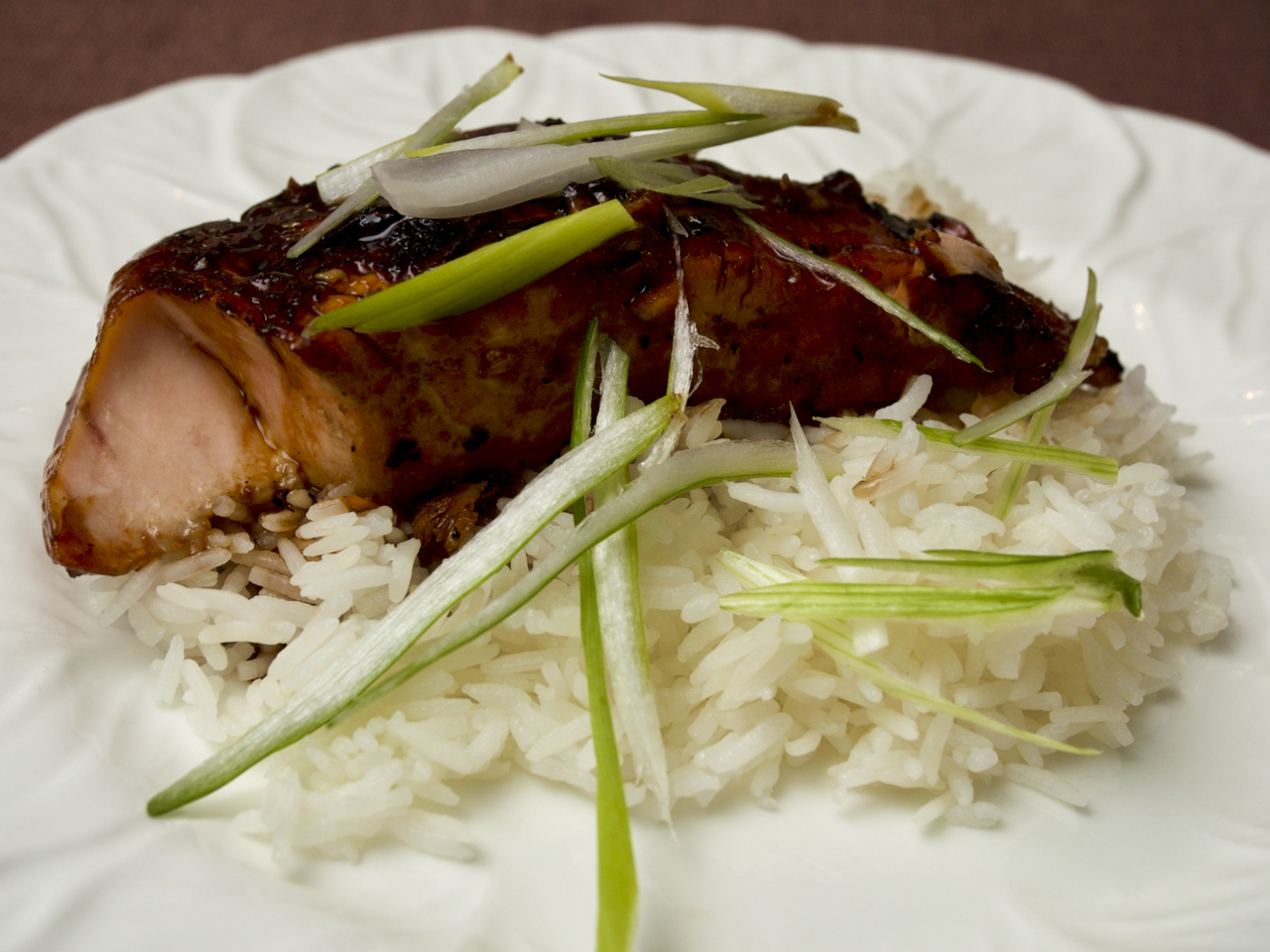
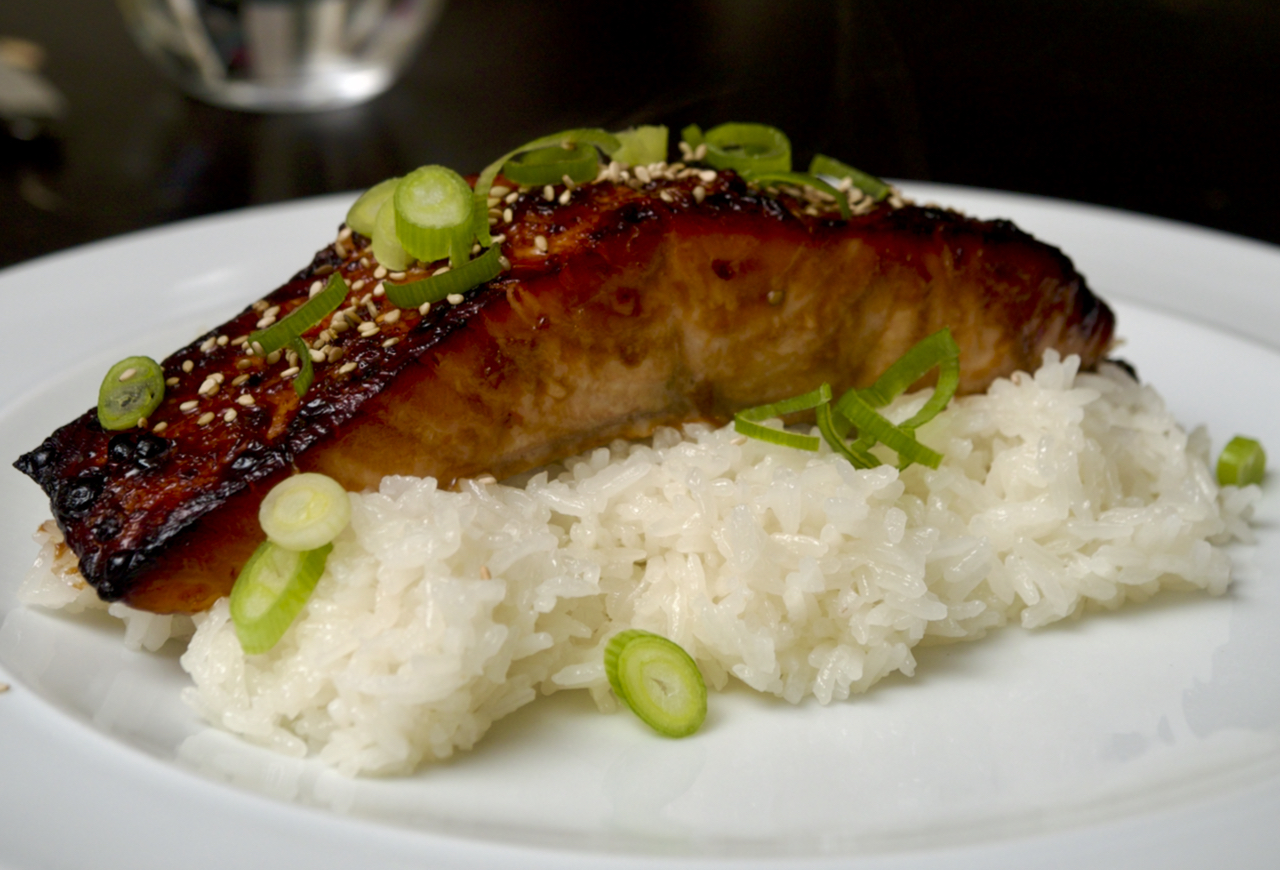
Mirin-glazed salmon – serves 4
60ml mirin
50g light brown sugar
60ml soy sauce
4 x pieces skinless salmon fillet
2 tbsp rice vinegar
1-2 scallions, shredded into fine strips
Mix the mirin, brown sugar and soy sauce in a shallow dish that will fit the salmon pieces. Marinate the salmon for 3 minutes on the first side, then turn it over and leave for another 2 minutes. Meanwhile, heat a large non-stick frying pan on the hob.
Heat a dry pan over high heat. Place the salmon in the pan and sear for 2 minutes. Flip the pieces over and continue cooking. After another 2 minutes, pour in the marinade. If your salmon pieces are thick or very large, extend the cooking time before adding the marinade, wait until the salmon is almost cooked through. If you add the marinade too soon it will turn to caramel.
Remove the salmon to a plate, then add the vinegar to the sauce and warm through.
Pour the glaze over the salmon and top with the scallions. Serve with sticky rice and sushi ginger if you have it (though not essential).
(Original recipe from Nigella Express, Chatto & Windus, 2007.)
Salmon is one of the most popular dishes in our house so it’s nice to find a recipe with some different flavours.
Wine Suggestion: double down on the citrussy aspect when choosing a wine so for this we headed to a Loire Sauvignon Blanc, but not from one of the “big two”, rather an under-rated Menetou Salon made by Anthony Girard at La Clef du Recit. A touch more grapefruit and orange, but with hints of lemon, the freshness really worked well with the salmon.
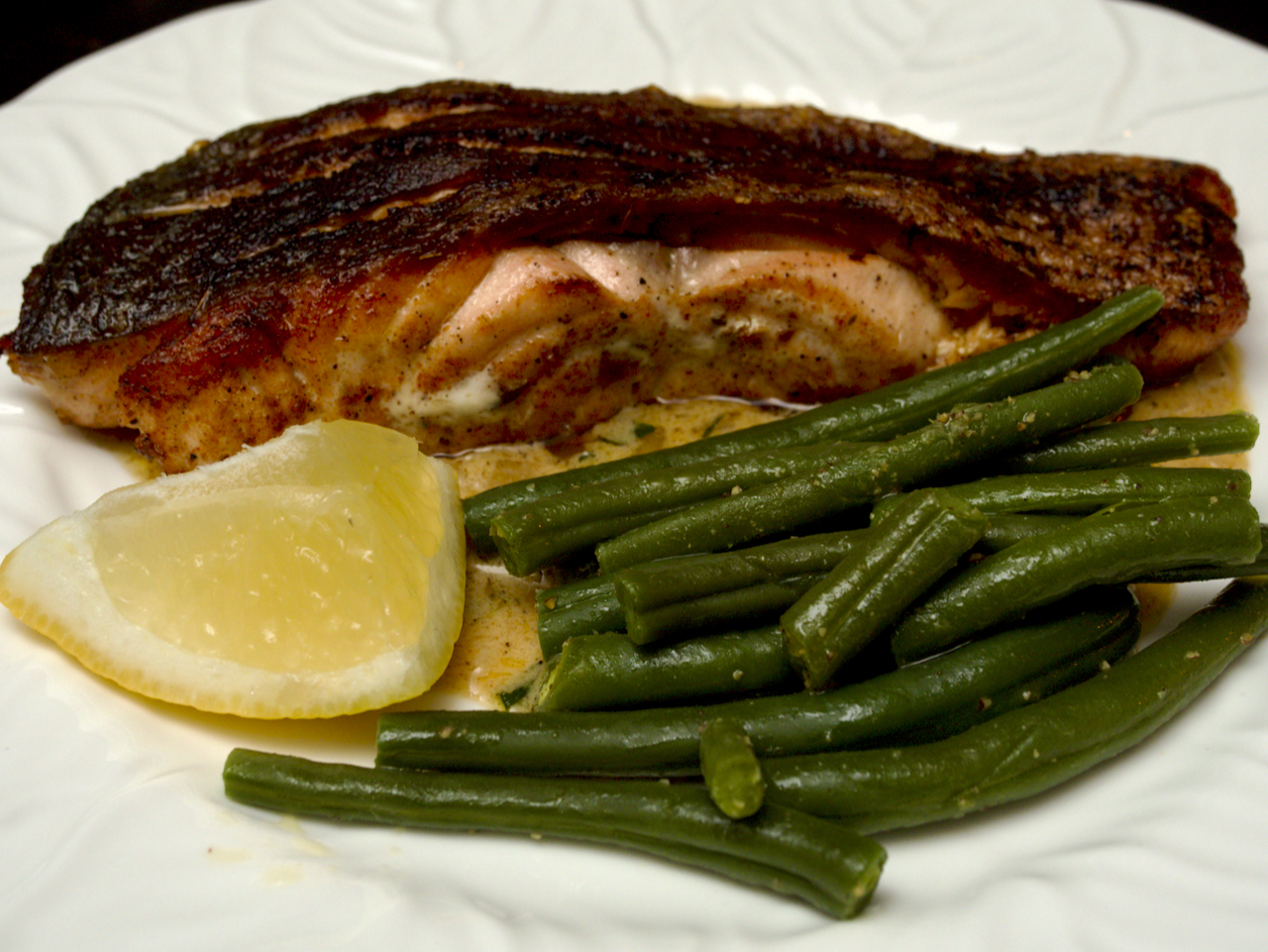
Salmon with Cajun spices – serves 2
2 salmon fillets, skin on
2 tsp Cajun spice blend
1-2 tbsp olive oil
30g butter
lemon wedges, to serve
FOR THE SAUCE:
1 tbsp olive oil
2 banana shallots, finely diced
2 cloves of garlic, finely diced
½ tsp Cajun spice blend
150ml fish stock
150ml crème fraîche
juice of 1 lemon
1 tbsp finely chopped flat-leaf parsley
Score the skin of the salmon with a sharp knife, then sprinkle both sides with the Cajun spice mix and a little salt. Heat the olive oil over a medium heat in a frying pan.
Add the salmon to the hot oil, skin side down, pressing the fillets down with a fish slice. Cook for a few minutes on each side, then remove the pan from the heat.
Add the butter to the pan and baste the salmon with it as it melts. Transfer the salmon to a warm plate and leave to rest while you make the sauce.
Put the frying pan back over a medium-high heat and add the olive oil. Add the shallots and cook for a few minutes, then add the garlic and Cajun spice blend and cook for a couple of minutes.
Add the stock to the pan and let it bubble until reduced by half. Stir in the crème fraîche and cook for a minute or two until the sauce thickens. Season and add the lemon juice to taste. Remove from the heat and stir through the parsley.
Spoon the sauce onto warmed serving plates and top with the salmon. Serve with lemon wedges and green beans.
(Original recipe from Tom Kerridge Cooks Britain, Bloomsbury, 2024.)
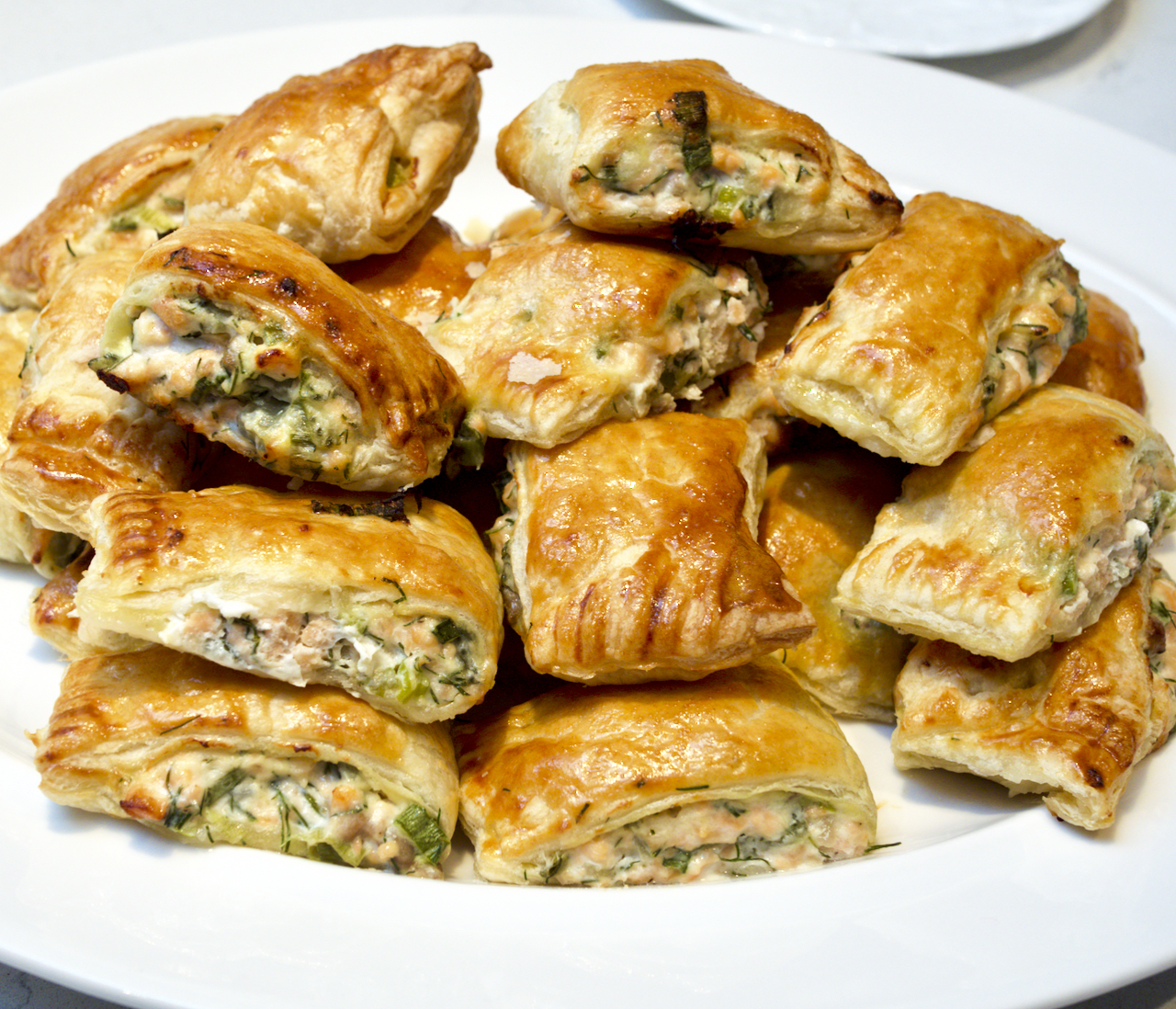
These are great with drinks and much lighter than actual sausage rolls. You can also freeze them uncooked and then cook from frozen for a handy standby.
Wine Suggestion: Bubbles of course … we’re particularly fond of the Domaine de la Taille aux Loups Triple Zero, so named as it uses no chaptilisation, no liquer de tirage and no dosage. As unfettered and refined a Pet Nat you can find anywhere and very special for it.
Little salmon sausage rolls – makes 24
1 x 320g sheet all-butter puff pastry
1 egg beaten
FOR THE FILLING:
200g skinless salmon fillet, finely chopped
115g smoked salmon, finely chopped
125g full-fat cream cheese
25g Parmesan, finely grated
small bunch of dill, finely chopped
6 scallions, finely chopped
juice of ½ lemon
75g dill pickle from a jar, finely chopped
Heat the oven to 200C/180C Fan/Gas 6.
Preheat a large baking tray.
Put all the filling ingredients into a large bowl, season with salt and pepper and mix well.
Roll the puff pastry sheet out on a lightly floured surface to make a rectangle 30 x 40 cm. Brush with the beaten egg, then divide vertically into 3 even-sized pieces.
Divide the filling into 3 and make a mound down each piece of pastry. Lift and fold the pastry over and seal by pressing down with the back of a fork.
Cut each section into 8 and brush the tops with the beaten egg.
Line the hot baking tray with non-stick baking paper and place the rolls on top. Bake for 18-20 minutes or until golden brown.
(Original recipe from Mary’s Foolproof Dinners by Mary Berry, BBC Books, 2024.)
This is a quick curry but it still tastes delicious and simple enough to throw together after work.
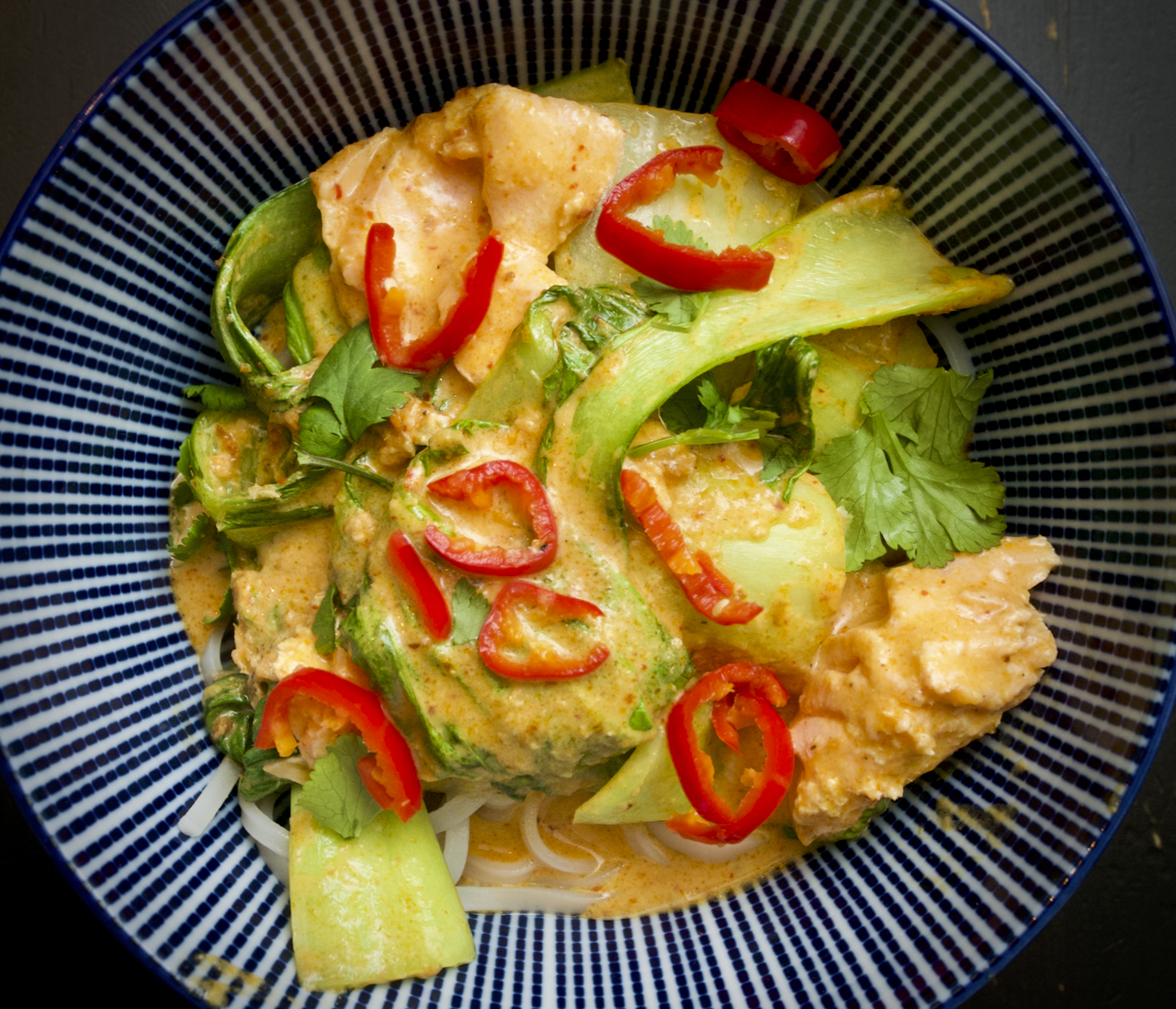
Thai red salmon curry – serves 2
100g dried rice noodles
350g skinless salmon fillets, cut lengthways into 4 thin pieces
1½ tbsp vegetable oil
3 tbsp Thai red curry paste
1½ tsp finely grated garlic
1 tsp finely grated ginger
125ml chicken stock
400ml tin coconut milk
2 tsp fish sauce
1 tsp white sugar
4 baby bok choy, leaves separated
1-2 tbsp lime juice, plus wedges for serving
fresh coriander leaves, to serve
red bird’s eye chilli, finely sliced, to serve
Soak the noodles in boiling water according to the pack instructions, then drain and divide between two bowls.
Season the salmon, then heat the oil in a large non-stick frying pan over a high heat. Cook the salmon for a minute on each side, then transfer to a plate. It doesn’t need to be cooked through yet, just lightly golden on the surface.
Add the curry paste, garlic and ginger to the pan. Cook, stirring continuously, for a minute, then add the chicken stock and simmer rapidly for a minute, stirring to scrape any sticky bits from the bottom of the pan. Add the coconut milk, fish sauce and sugar, then simmer rapidly for 2 minutes.
Return the salmon to the pan and push the bok choy in around it. Simmer for 2 minutes, pushing the bok choy into the liquid as it wilts. Once the salmon flakes easily, remove the pan from the heat.
Pour the lime juice over the fish and serve over the noodles. Sprinkle with the coriander and fresh chilli before serving with extra lime wedges.
(Original recipe from Recipetin Eats Tonight by Nagi Maehashi, Pan Macmillan, 2024.)
Wine Suggestion: a little indulgent, but we wanted to see how a bottle we picked up in the Loire from the winemaker was developing: the Domaine de la Taille aux Loups Montlouis les Hauts de Husseau. A crystalline Chenin Blanc from the neighbouring area to Vouvray, this was exciting, racy and edgy and exceptionally youthful. It may not be super cheap, but we’d argue still a bargain given the quality, complexity, depth and potential to age superbly. We’d even conjecture that it’s a very good option to top white Burgundy. The remaining bottles we’ll try to ignore for a few more years if we can resist.
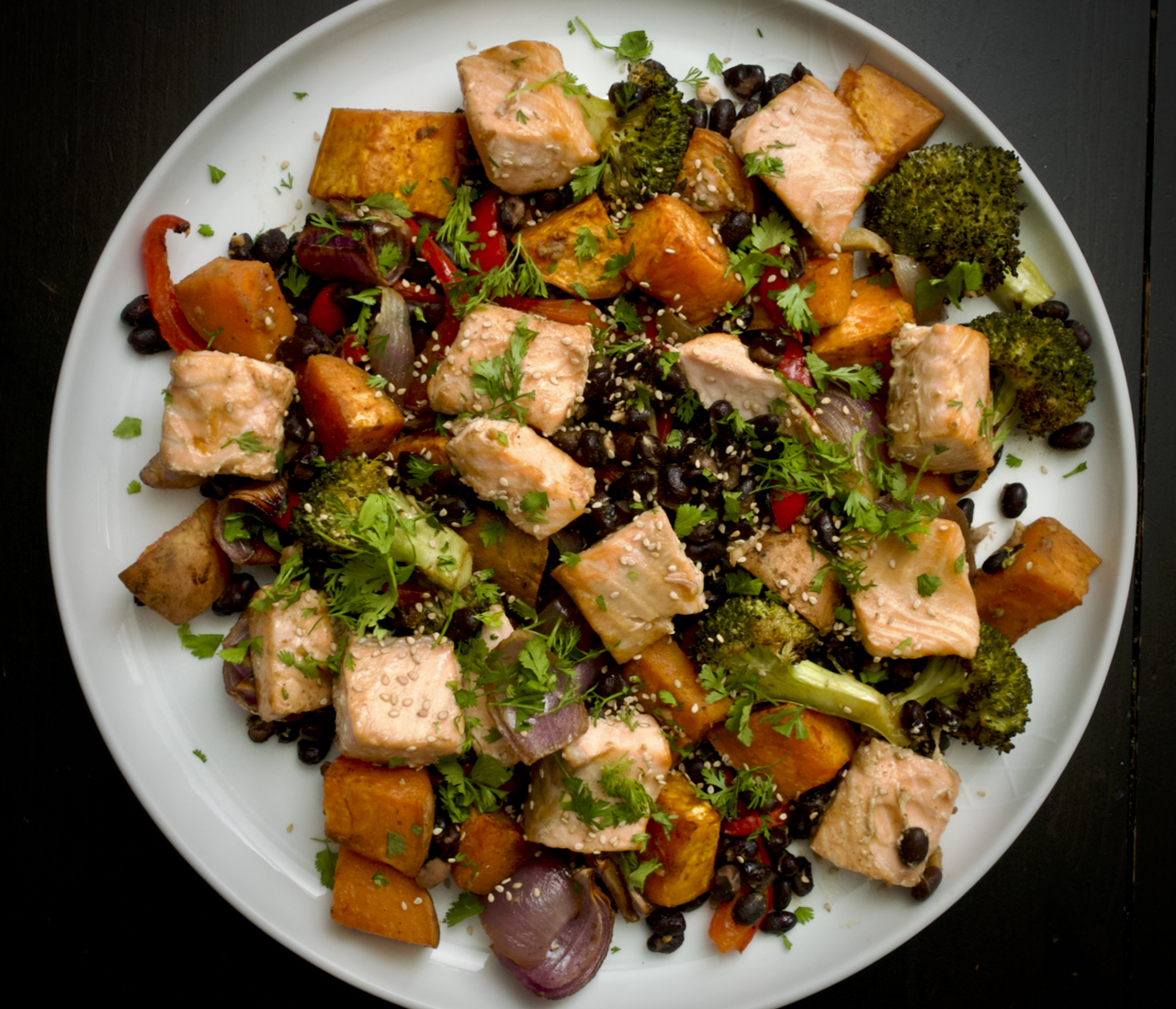
Salmon, veg and black bean tray bake – serves 4 to 6
2 red onions, cut into wedges
2 sweet potatoes, cut into chunks
2 red peppers, cut into strips
2 tbsp sesame oil or olive oil
1 head of broccoli, cut into florets
400g tin of black beans, drained and rinsed
1 tbsp soy sauce
1 tbsp rice wine
2 cloves of garlic, crushed
5g fresh ginger, grated
½ tsp Chinese 5-spice powder
1 tbsp sesame seeds
fresh coriander, chopped
FOR THE SALMON:
600g skinned salmon fillet, cut into large chunks
1 tbsp soy sauce
1 tsp runny honey
Heat the oven to 200C/fan 180C/Gas 6.
Put the onions, sweet potatoes and peppers into a large roasting tray. Drizzle over 1 tbsp of sesame oil and toss to coat, then season with salt and pepper. Roast for 20 minutes.
Toss the broccoli in the other tbsp of sesame oil and add to the roasting tin. Mix the beans with the soy sauce, rice wine, garlic, ginger and Chinese 5-spice powder and add 100ml of water. Pour this around the veg and cook for another 20 minutes, turning the broccoli over after 10.
Toss the salmon in the soy sauce and honey and place on top of the vegetables. Roast for another 8-9 minutes, or until cooked.
Serve sprinnkled with the sesame seeds and coriander.
(Original recipe from The Hairy Bikers One Pot Wonders by Si King and Dave Myers, Seven Dials, 2019.)
Salmon is very popular in our house and we particulary like this recipe with a delicious barbery butter.
Wine Suggestion: we like dry Rosé with barberry dishes and chose the Quinta de la Rosa Rosé this time as it has great depth and poise alongside the refreshing red berried flavours.
Salmon with barberry butter – serves 4
olive oil
4 salmon fillets, skinned
FOR THE BARBERRY BUTTER:
75g softened butter
2 tbsp dried barberries, finely chopped
1 tsp pul biber
1 tsp garlic granules
1 tsp clear honey
Put the ingredients for the barberry butter into a bowl with plenty of salt and black pepper and mix well.
Heat a large frying pan over a medium-high heat and add a little olive oil. Season the salmon fillets on the skinned side, then put skinned-side down into the pan. Cook for a couple of minutes, then turn over and add the butter. When the butter has melted, start basting the salmon. You need to go quite quickly so the butter doesn’t burn. Keep basting for a couple of minutes or until the salmon is just cooked through.
Serve and spoon the butter over.
(Original recipe from Flavour by Sabrina Ghayour, Aster*, 2023.)
We’ve cooked this easy Indian salmon a load of times now. The salmon is really soft and tender and the flavours are fab! Nice with potatoes and a green salad or with other Indian dishes.
Grilled masala salmon – serves 2
⅛ tsp salt
¼ tsp ground cumin
⅛ tsp ground coriander
⅛ tsp ground turmeric
¼ tsp ground cayenne pepper
340g skinned salmon fillet
2 tbsp Dijon mustard
1 tbsp olive or rapeseed oil
2 tsp lemon juice
2 tbsp finely chopped fresh coriander
Mix the salt, cumin, coriander, turmeric and cayenne pepper together, then rub all over the salmon fillet. Cover and leave in the fridge for 1-4 hours.
Heat the oven to 180C/Gas 4, and heat the grill to it’s highest setting.
Mix the mustard, oil and lemon juice together and add the chopped coriander. Rub this all over the fish and place under the grill until the top has slightly browned, about 4 minutes. Transfer the fish to the oven and bake for about 10 minute or until cooked through.
(Original recipe from Curry Easy by Madhur Jaffrey, Ebury Press, 2010.)
You need to marinade the salmon for 30 minutes or up to 24 hours ahead. After that, it’s dinner in 15 minutes. We served with with some sticky rice and dressed Asian greens.
Wine Suggestion: This works with a good Pinot Gris, like Neudorf’s Tiritiri. An underestimated grape, given the oceans of bland Pinot Grigio sold, but in the right hands … the riper, richer and more textural French styled Pinot Gris is a joy. Neudorf’s version is all about mouth feel: depth, viscosity, and richness while staying deliciously clean and deceptively moreish. And the back-bone is a fresh, salty-stoney texture keeping it all clean and vibrant.
Sticky glazed salmon – serves 2-3
2-3 salmon fillets
rapeseed oil spray
FOR THE MARINADE:
1 tsp finely grated ginger
1 garlic clove, finely grated
1 tbsp soy sauce
2 tbsp oyster sauce
2 tbsp sweet chilli sauce
TO SERVE
sesame seeds
1 scallion, finely sliced
Mix all of the marinade ingredients together in a shallow dish, then add the salmon and turn to coat.
When you are ready to cook, heat the grill to high. Line a grill tray with tin foil and place the salmon fillets on top, skin-side down. Brush with the marinade but don’t pour if over as any on the tin foil will burn, discard any extra.
Put the salmon under the grill, about 15-20 cm away from the heat. Cook for 7 minutes, then remove and spray with the rapeseed oil. Put back under the grill for another 1-3 minutes or until nicely caramelised.
Allow the salmon to rest for 5 minutes before serving with the scallions and sesame seeds scattered over.
(Original recipe from Recipetin Eats Dinner by Nagi Maehashi, Pan MacMillan, 2022.)
This is very much a weeknight dish but it’s suprisingly good. Baking in a bag means very few dishes to wash which always helps. Serve with a green salad.
Wine Suggestion: try to find a good Vermentino with a medium body, not the richer ones with higher alcohol like you sometimes find from Sardinia and similar. A favoured one at the moment is Domaine Ventenac’s “les Dissidents” Cassandre from Cabardes in southern France.
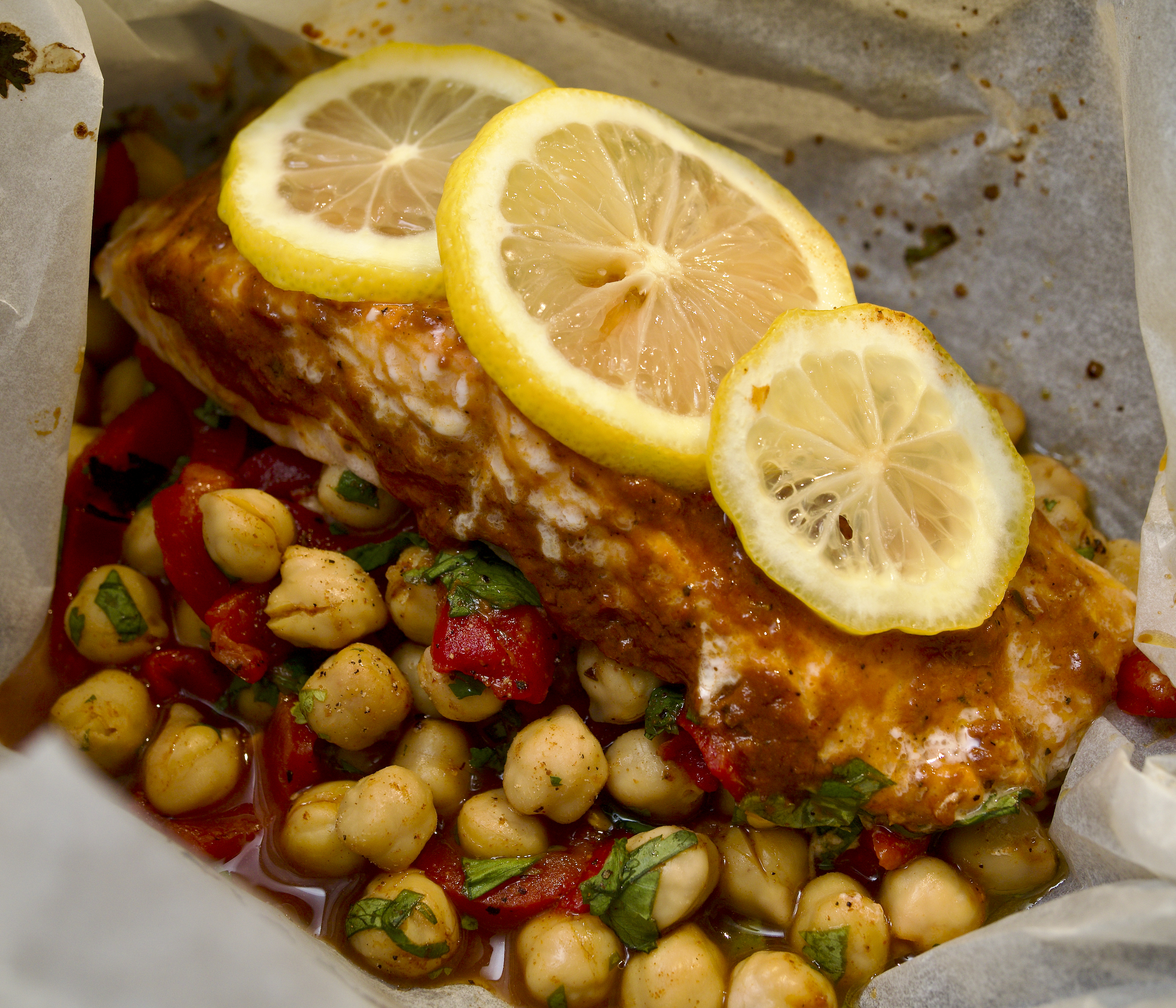
Baked salmon with harissa and chickpeas – serves 2
1 unwaxed lemon
1 x 400g tin chickpeas, drained and rinsed
1 tsp smoked paprika
1 tsp clear honey
3 tsp harissa paste
150g roasted red peppers from a jar, sliced
15g coriander, roughly chopped
2 salmon fillets, skinned
1 tsp olive oil
Heat the oven to 190C/170C fan/gas 5.
Tear off 2 large sheets of baking paper.
Halve the lemon and cut one half into thin slices.
Toss the drained chickpeas with the smoked paprika, honey, 1 tsp of the harissa paste, the peppers, most of the coriander and seasoning, then divide this between the two sheets of paper.
Season the salmon and spread each piece with 1 tsp of harissa, then place on top of the chickpeas and drizzle with the olive oil. Place the lemon slices on top, then fold over the edges to seal the parcels.
Put the parcels onto a baking tray and bake for 15 minutes or until the salmon is cooked. Open the parcels and scatter over the rest of the coriander, then serve with some salad on the side.
(Original recipe by Tom Mitchell-Dawson in Sainsbury’s Magazine, September 2023.)
This is perfect for mid-week, super easy and very easy to assemble and bake in the oven. You can cover the dishes and freeze them if you like, then cook from frozen, uncovered for 30-35 minutes.
Wine Suggestion: With a floral, herbal and stonefruit character that’s backed up with a very textural green almond note Sartarelli’s Verdicchio Superiore Tralivio is just the business for this dish. Tomasso Sartarelli really has a feel for this cuvée and how to get the best from the old vines this is made from and it has such a natural balance it makes it so easy to drink when first released, like we’re doing tonight. However, with a bit of will power, it ages superbly too.
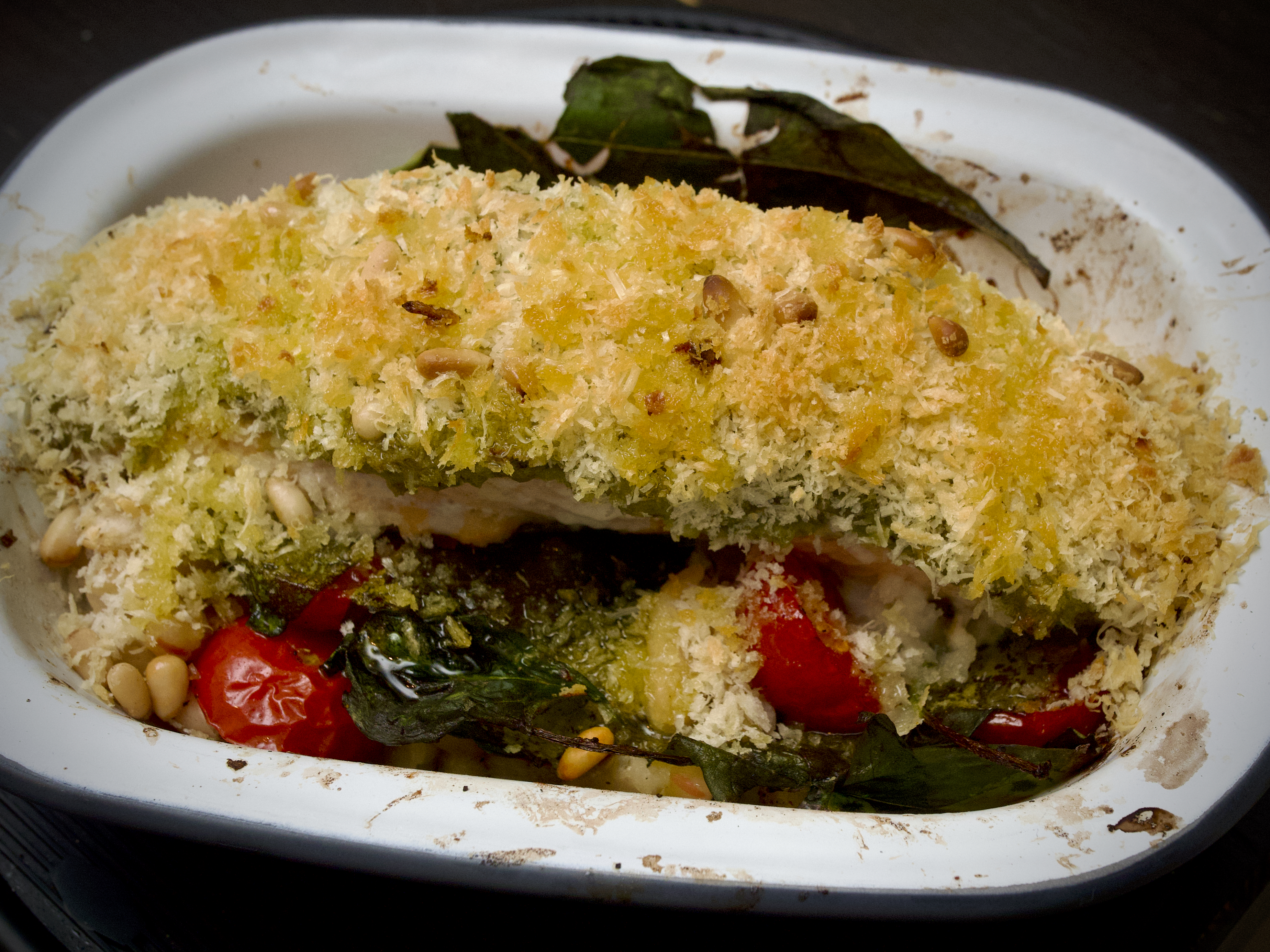
Pesto salmon with tomatoes, spinach & beans – serves 6
100g baby spinach
3 x 400g tins cannellini beans, drained and rinsed
300g cherry tomatoes, halved
2 tbsp olive oil
1 lemon, zested and juiced
6 tbsp Philadelphia cheese or other soft cheese
4 tbsp fresh pesto
150g breadcrumbs
40g Parmesan, grated
3 tbsp pine nuts
6 salmon fillets
Heat the oven to 200C/180C fan/Gas 6.
Divide the baby spinach 6 individual baking dishes. Spoon over the beans and tomatoes and drizzle with the olive oil. Sprinkle over the lemon zest and squeeze over the juice, then season well. Toss with your hands to mix everything together.
Mix the soft cheese with the pesto in a bowl.
In another bowl mix the breadcrumbs with the Parmesan and pine nuts.
Place a salmon fillet into each dish and season well. Spoon over the pesto mixture, then the breadcrumb mixture, pressing it down. A bit will inevitably end up in the beans and that’s ok.
Bake for 20-25 minutes, or until the salmon is cooked (a probe should read 60C) and the crumbs a nice golden colour.
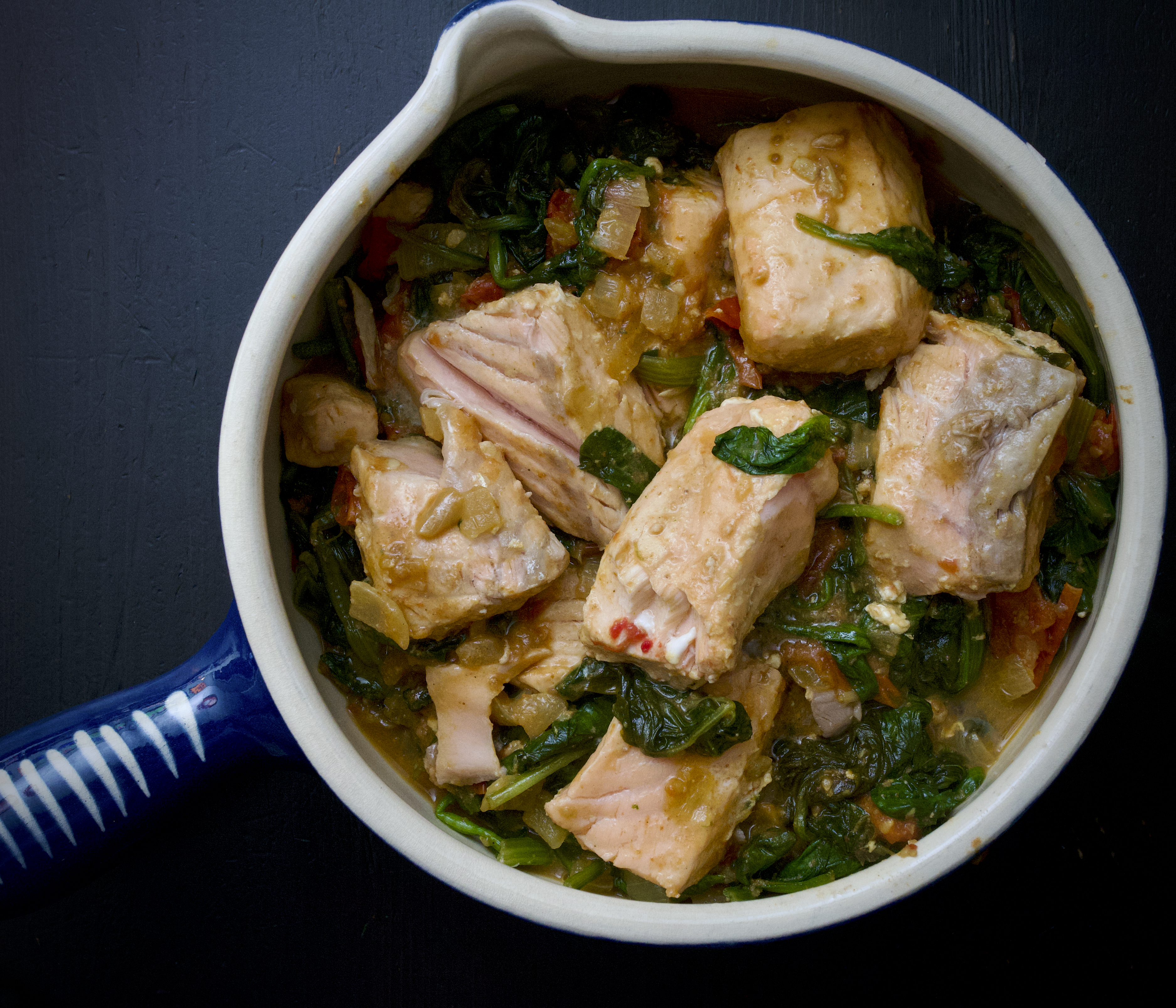
A lovely light curry from Made in India by Meera Sodha. It’s quick to make and perfect for a friday night. We served with rice.
Wine Suggestion: As this dish is quite light we think grenache based rosé is the way to go here with Chateau Pesquié Terrasses Rosé being our choice tonight. The delicate red fruits complementing the salmon really well and the open, softer nature of the grape taking on the spiciness and rounding it out.
Salmon and Spinach Curry – serves 4
2 tbsp rapeseed oil
1 cinnamon stick
6 whole peppercorns
2 cloves
1 large onion, chopped
½ tsp brown sugar
250g ripe tomatoes, roughly chopped
4cm piece of ginger, peelend and finely grated
4 clove of garlic, crushed
1 fresh green chilli, finely chopped
¼ tsp garam masala
1 tsp ground cumin
1½ ground coriander
¼ tsp ground turmeric
½ tsp chilli powder
1¼ tsp salt
500g spinach leaves
400g skinless salmon fillets
Heat the oil in a large deep pan with a lid. Add the cinnamon stick, peppercorns and cloves and fry for a minute or two until fragrant.
Stir in onion and brown sugar, then cook for 10-12 minutes until golden and caramelized. Stir in the tomatoes, then cover with a lid and leave to cook for about 5 minutes, or until the tomatoes start to soften.
Add the ginger, garlic, and green chilli, then stir in the garam masala, cumin, coriander, turmeric, chilli powder and salt. Cook the mixture, stirring so it doesn’t stick, for about 8 minutes. It will start to look like a paste. Add the spinach, turn the heat down and cover with the lid until wilted.
Cut the salmon into very big chunks (about 6cm x 6cm) and add them to the pan. Coat in the tomato and spinach sauce but be careful not to break them up. Cover with the lid for 5-7 minutes, or until the fish is cooked through.
Remove the cinnamon stick, check the seasoning and serve with rice.
(Original recipe from Made in India by Meera Sodha, Penguin:Fig Tree, 2014.)
This is a long recipe but it’s not difficult and quite nice and methodical. You can make the fishcakes earlier in the day and cook when you’re ready if you like. You will get big fishcakes full of chunky pieces of fish. Serve with green salad.
Wine Suggestion: a top-notch Muscadet, like Jérémie Huchet’s, very special Clos des Montys. Finely toned and vibrant with citrus and grapefruit on the palate; both dry and salty, and creamy at the same time. It’s a little edgy, but we like that. Wines like this bring out the flavours of the sea and celebrate the three fish in this dish.
Fishcakes with parsley sauce – serves 6
600g Maris Piper potatoes, cut into chunks
250g thick unskinned cod fillet
250g thick unkinned salmon fillet
100g unskinned smoked haddock fillet
500ml full-fat milk
1 bay leaf
grated zest of ½ lemon
6 scallions, finely sliced
25g plain flour
2 eggs
100g fresh white breadcrumbs
75ml vegetable oil
lemon wedges, to serve
FOR THE PARSLEY SAUCE:
25g butter
25g plain flour
reserved milk from cooking the fish
25g curly parsley, finely chopped
Put the potatoes into cold salted water, bring to the boil, then simmer for 12 to 15 minutes or until tender, then drain and mash. Season with salt and white pepper, then spread the potatoes out over a plate to cool.
Put the fish pieces into a large saucepan with the milk and bay leaf. Season with a little salt and peppper. Cover with a lid and gently bring to a simmer, then remove from the heat and set aside for 10 minutes to finish cooking.
Remove the fish from the milk and set onto a plate. Pour the milk into a jug as you will need this for the parsley sauce later. Remove the skin from the fish and break it into chunky pieces, discarding any bones, then leave to cool completely.
When the potato has cooled, transfer it to a large bowl and stir in the lemon zest and scallions. Gently stir in the fish with a wooden spoon, trying not to break it up too much.
Divid the mixture into 6 balls. Flatten the balls into cakes, about 3cm thick, and place on a lined baking tray. Put the tray into the fridge for 45 minutes or into the freezer for 20 to firm up.
Sprinkle the flour over a plate. Beat the eggs together in a shallow bowl. Spread half the breadcrumbs over another plate. Now take each fishcake and coat in the flour, shaking off any excess, then into the egg, allowing excess to drip off and finally into the breadcrumnbs to coat. Place on a lined baking tray. When you have coated 3 fishcakes put the rest of the breadcrumbs onto the plate for the rest. The fishcakes will keep in the fridge for 24 hours at this stage.
Heat the oven to 200/C/180C fan.
Heat the oil in a large frying pan, then place 3 fishcakes into the pan and fry for about 3 minutes on each side. Put onto a baking tray while you fry the rest.
Put the fishcakes into the hot oven for 10 minutes to finish cooking. Test with a skewer to make sure they are hot right through to the middle.
To make the parsley sauce, melt the butter in a small pan, then stir in the flour. Cook for a minute, then gradually add the reserved milk, stirring continually until you have a smooth sauce. Allow to simmer, then cook gently for a few minutes until thickened, then season. Remove from the heat and stir in the chopped parsley.
Serve the fishcakes with the sauce and some lemon wedges. A green salad works well on the side.
(Original recipe from The Hairy Bikers’ British Classice by Si King and Dave Myers, Seven Dials, 2018.)
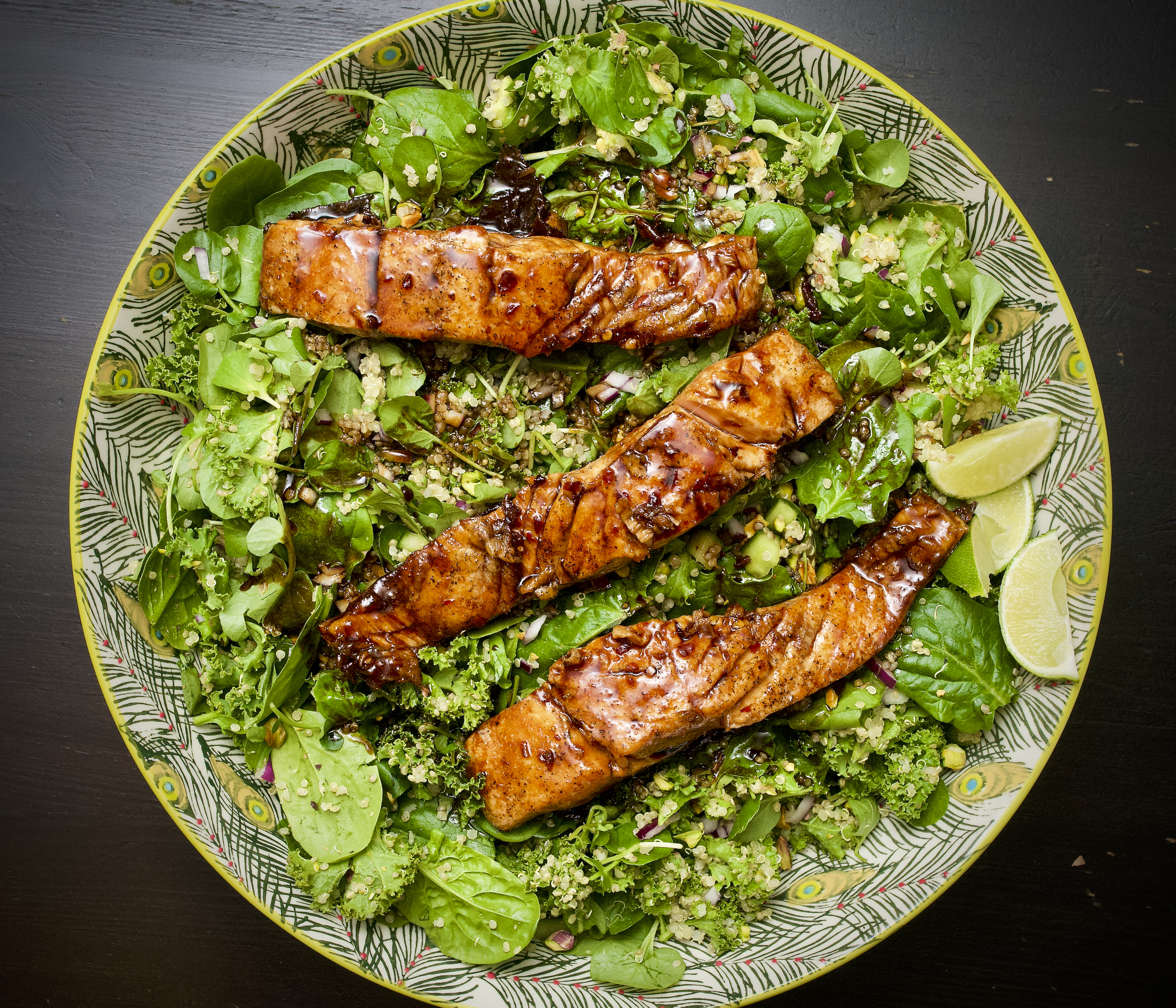
And so we’ve realised that we do like quinoa after all. This green salad is delicious and the quantity given below is half that suggested by Neven Maguire. Feel free to double if you think you can manage it.
Wine Suggestion: We think this suits a young, fruit forward Cabernet Franc like Olga Raffault Cuvée Domaine. Unoaked and joyful dark cherry fruits with a crispness and earthiness that really complements the kale, spinach and watercress.
Honey and Soy Glazed Salmon with Green Quinoa – serves 4
100ml soy sauce
3 tbsp honey
a good pinch of chilli flakes
1 tbsp rapeseed oil
1 tsp sesame oil
4 salmon fillets, skin on
FOR THE QUINOA:
75g quinoa
150ml vegetable stock
50g curly kale, remove the stalks
50g baby spinach
50g pistachios, toasted and chopped
40g watercress
½ an avocado, diced
¼ cucumber, deseeded and finely diced
1 tbsp chopped coriander
lime wedges, to garnish
Rince the quinoa then put into a small saucepan with the vegetable stock and bring to the boil. Cover with a lid and simmer gently for 10-12 minutes until tender and the stock has been absorbed. Tip into a large bowl and leave to cool.
Put the soy sauce, honey and chilli flakes into a small bowl and whisk to combine.
Prep the rest of the ingredients for the quinoa and fold them gently in to the cooled quinoa. Taste and season with salt and black pepper.
Season the salmon fillets, then heat a non-stick frying pan over a medium heat. Add the rapeseed and sesame oil, then fry the salmon fillets, skin side up, for 2-3 minutes, until lightly golden. Turn them over gently and cook for another 4 minutes. Turn the heat to hight and pour in the honey and soy mixture. Allow to simmer for a couple of minutes, spooning the sauce over the salmon, it should thicken to a syrupy sauce.
Put the quinoa onto a large serving platter and sit the salmon fillets on top. Drizzle over the syrupy sauce and garnish with the lime wedges.
(Original recipe from More Midweek Meals by Neven Maguire, Gill Books, 2022.)
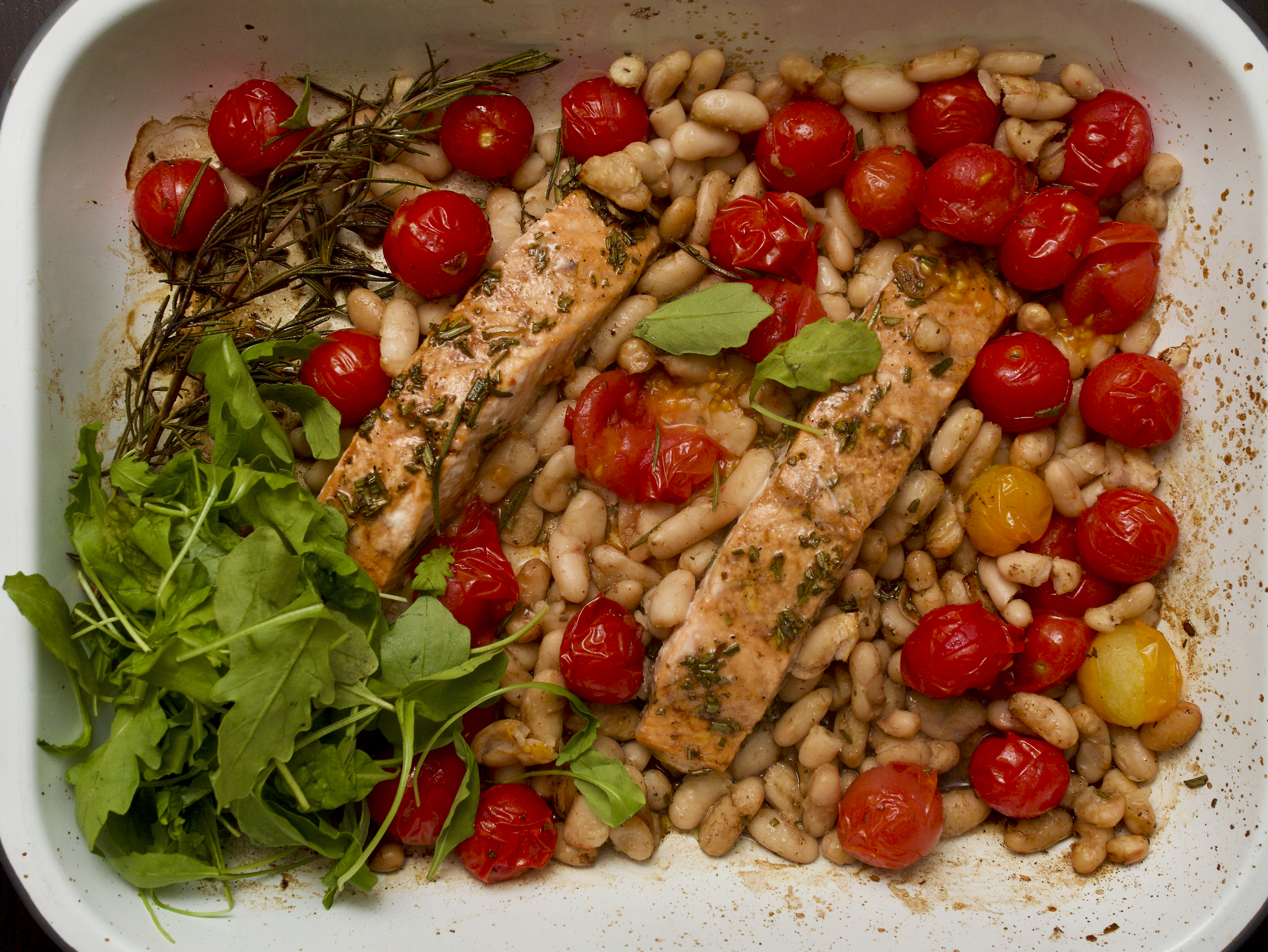
4 sprigs rosemary, 2 left whole and needles picked and finely chopped from the rest
1 clove of garlic, finely sliced
600g cherry tomatoes
2 x 400g tins cannellini beans, rinsed and drained
4 small salmon fillets
2 handfuls of rocket
Heat the oven to 220C/200 Fan/Gas 7.
Whisk the baslsamic, olive oil, chopped rosemary, garlic, and seasoning, together in a small bowl.
Tip the tomatoes and beans into a large roasting tray. Nestle in the salmon fillets, then pour over the dressing. Toss gently to make sure everything is coated in dressing.
Bake for 12-14 minutes or until the fish flakes easily. Give the beans and tomatoes another gentle toss and push down on a few tomatoes to burst them. Scatter over the rocket and serve.
(Original recipe by Anna Glover in Olive Magazine, October 2021.)
A lovely fiskesuppe with delicate flavours and delicious chunks of seafood. You can use whatever mix of fish and shellfish you like, clams would be nice. Serve with lots of steamed potatoes.
Wine Suggestion: Fish, cream, brandy … demands a richer white with a touch of oak and Quinta Soalheiro’s Alvarinho Reserva fitted the bill. Textured and buttery, but at the same time bone dry and vibrantly fresh and full of citrus fruit and salty crisp peaches. A wine so fresh and pure, and yet round and embracing.
Norwegian Fish Chowder – serves 4
100g cooked shell-on prawns
1 litre fish stock
1 bay leaf
a handful of flat-leaf parsley, plus a handful of parsley leaves, chopped, to serve
12 peppercorns
2 carrots, roughly diced
2 celery sticks, roughly diced
1 leek, thinly sliced
100ml dry white wine
50ml brandy
300ml double cream
100g skinless salmon fillet, cubed into 2cm pieces
150g haddock fillet, cubed into 2cm pieces
20 mussels, cleaned
steamed potatoes (to serve)
Shell the prawns and put the shells in a large saucepan with the fish stock, bay leaf, parsley, peppercorns, carrot, celery and leek. Bring to the boil and cook for 10-15 minutes. Pour in the wine and brandy and boil for another 5 minutes, then strain into a clean pan.
Add the double cream and bring back to a simmer. Add the salmon, haddock and mussels and cook for 3-4 minutes, adding the cooked prawns for just a minute to warm through at the end. Season and scatter over the chopped parsley. Serve in warm bowls and add potatoes.
(Original recipe by Signe Johansen in Olive Magazine, January 2014.)
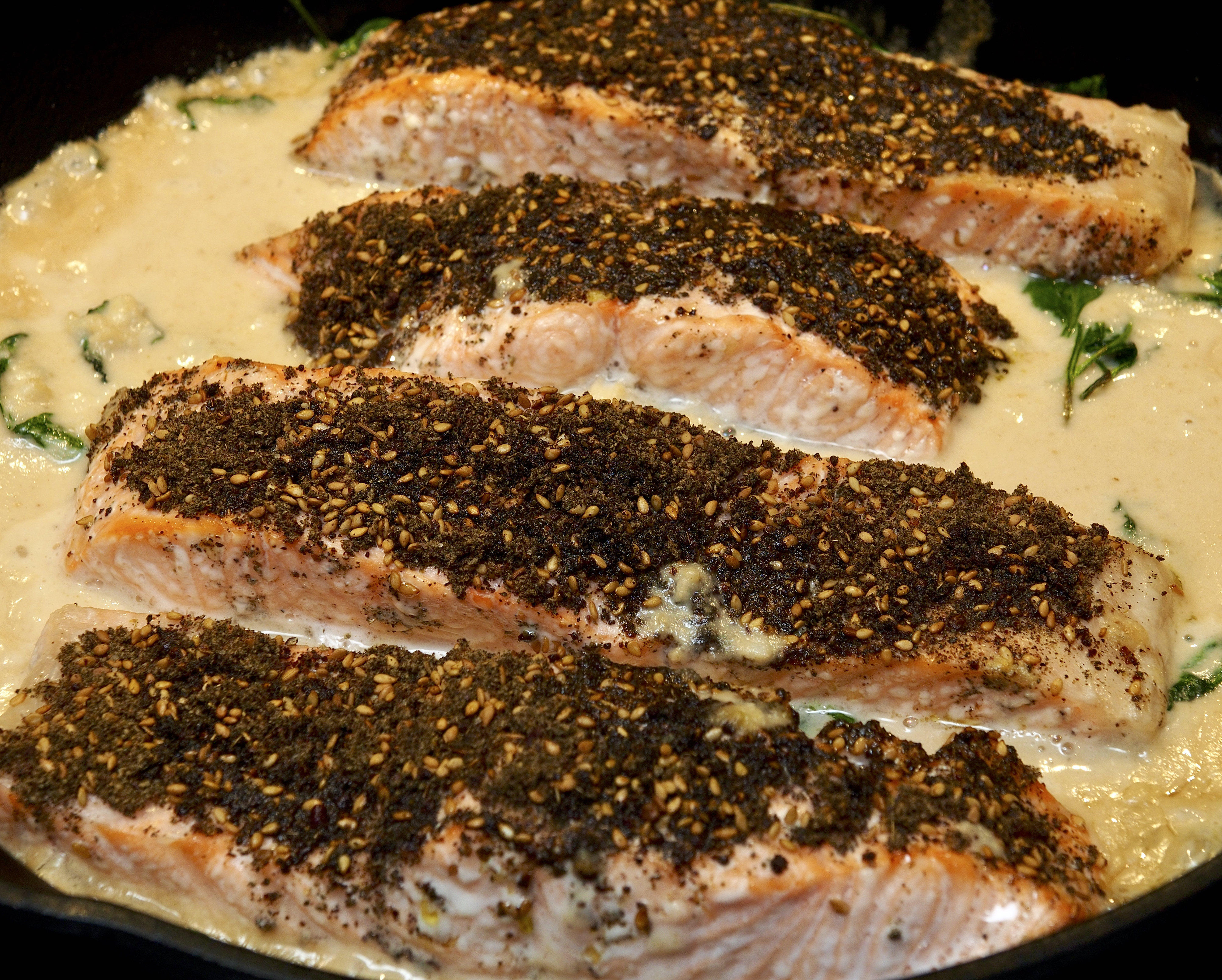
We’ve made plenty of fish and tahini dishes before but particularly liked this one with the additions of zingy za’atar and fresh spinch.
Wine suggestion: this works brilliantly with a juicy, crisp Verdejo, especially those that come from Rueda in Spain. Crunchy, juicy apples, lemons and grapefuit. In our glass was Dominio la Granadilla which demonstrates a passionate family all working together and speaking of the place they grew up.
Za’atar salmon and tahini – serves 4
4 salmon fillets (about 600g in total), skin on
2 tbsp za’atar
2 tsp sumac, plus and extra ½ tsp for sprinkling at the end
4 tbsp olive oil
250g baby spinach
90g tahini
3 cloves of garlic, crushed
3½ tbsp lemon juice
1½ tbsp roughly chopped coriander leaves
Heat the oven to 220C Fan.
Pat the salmon dry with kitchen paper and season.
Mix the za’atar and sumac together in a small bowl, then sprinkle this over the top of the salmon to form a crust.
Put a large ovenproof sauté pan over a medium-high heat and add 1 tbsp of the oil. When the pan is hot, add the spinach with a little seasoning and cook for 2-3 minutes or until just wilted.
Set the salmon fillets on top of the spinach, skin side down, then drizzle the top of the fish with 2 tbsp of oil. Bake in the hot oven for 5 minutes.
Meanwhile, whick the tahini, garlic, 2½ tbsp of lemon juice, a good pinch of salt and 100ml of water together until smooth. It will be quite runny.
Pour the tahini around the salmon (but not over the fish) and bake for another 5 minutes, or until the fish is just cooked through and the sauce is bubbling. Spoon over the rest of the lemon juice and oil and top with the coriander and extra sprinkle of sumac.
(Original recipe from Ottolenghi Test Kitchen: Shelf Love by Noor Murad & Yotam Ottolenghi, Ebury Press, 2021.)
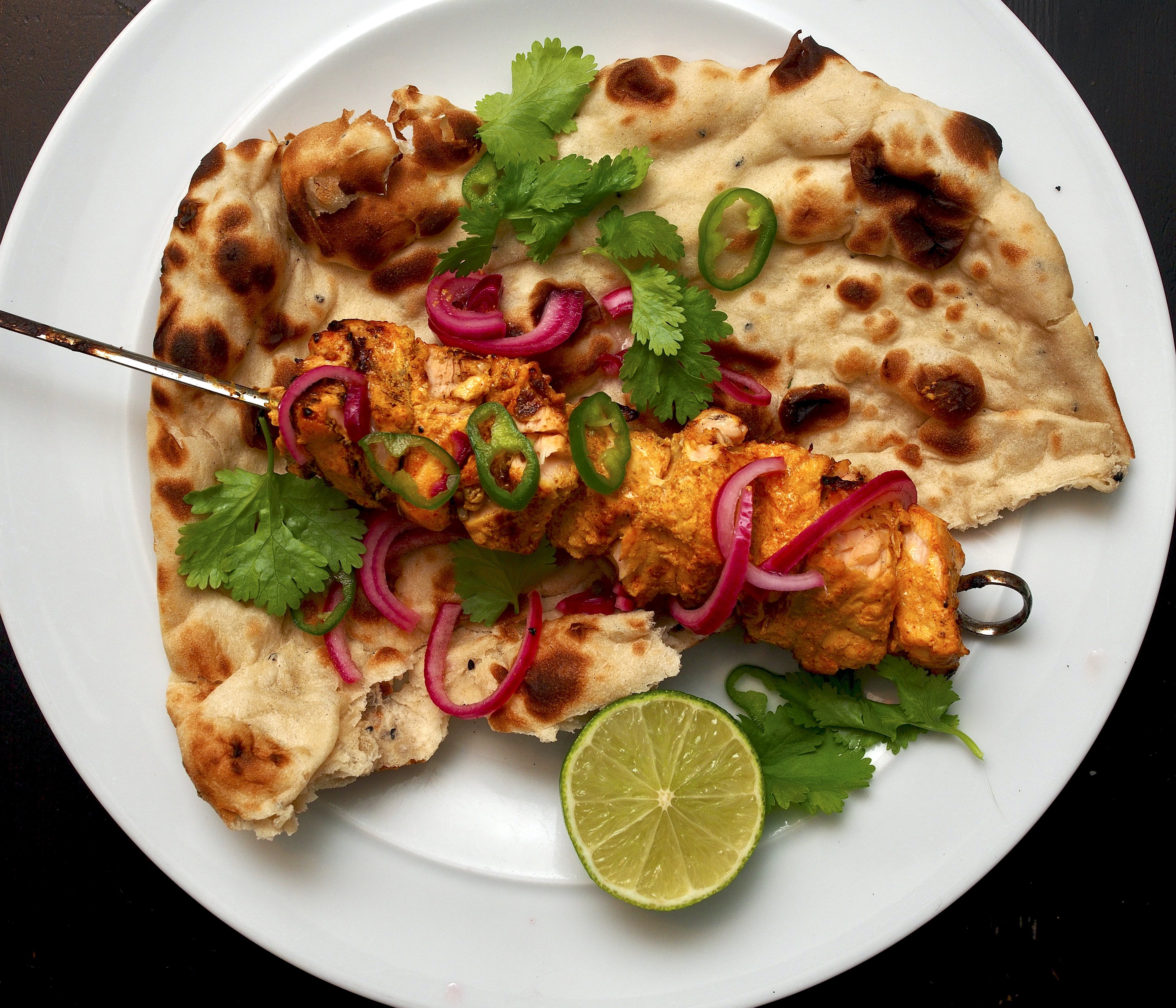
These are super tasty, especially with the quick pickled onions and some naan breads from the takeaway.
Wine Suggestion: Cline Cellar’s Sonoma Coast Viognier; a wonderfully fresh, stonefruit flavoured wine with a soft acidity. Rich and flavoursome to match the flavour depth of salmon and spices. This is dry with low residual sugar levels, however it has juicy, fruit flavours carrying the chilli and paprika well and complementing the ginger and lime.
Tandoori Fish Skewers – serves 8 (easily halved)
8 salmon fillets, skin removed (about 125g each)
2 large garlic cloves, grated
2.5 cm piece of ginger, grated
juice of 1 lime
200g Greek yoghurt
1 tsp Kashmiri chilli powder
1 tsp ground turmeric
1 tsp ground cumin
2 tsp ground coriander
2 tsp sweet smoked paprika
veg oil for brushing
FOR THE QUICK PICKLED RED ONIONS:
2 small red onions
125ml water
125ml white white vinegar
½ tsp fennel seeds
½ tsp cumin seeds
1 tbsp salt
2 tbsp sugar
TO SERVE:
warm naan breads
a handful of coriander leaves
1 long green chilli, finely sliced
lime halves
sweet chilli sauce
You can start the pickled onions about an hour ahead. Slice them finely and put into a bowl.
Put the water, wine vinegar, fennel and cumin seeds, salt and sugar into a small pan over a medium heat and stir until the sugar has dissolved. Pour this hot liquid over the onions and leave to cool, then cover the bowl and leave in the firdge.
Cut the salmon fillets into large chunks. Put into a bowl with the garlic, ginger and lime juice and mix well.
Put the yoghurt into a bowl, then mix in the spices and some seasoning. Add the spiced yoghurt to the salmon and mix gently, then leave to marinate in a cool place for about 20 minutes.
Thread the salmon onto skewers, brush the barbecue witha little veg oil, then cook for 2-3 minutes on each side until lightly charred.
Serve the skewers on warm naan breads with pickled red onions, coriander and green chilli sprinkled over. Serve with some lime for squeezing over and sweet chilli sauce (we served with our hot pepper jam).
(Original recipe from Outdoor Cooking by Tom Kerridge, Bloomsbury Absolute, 2021.)
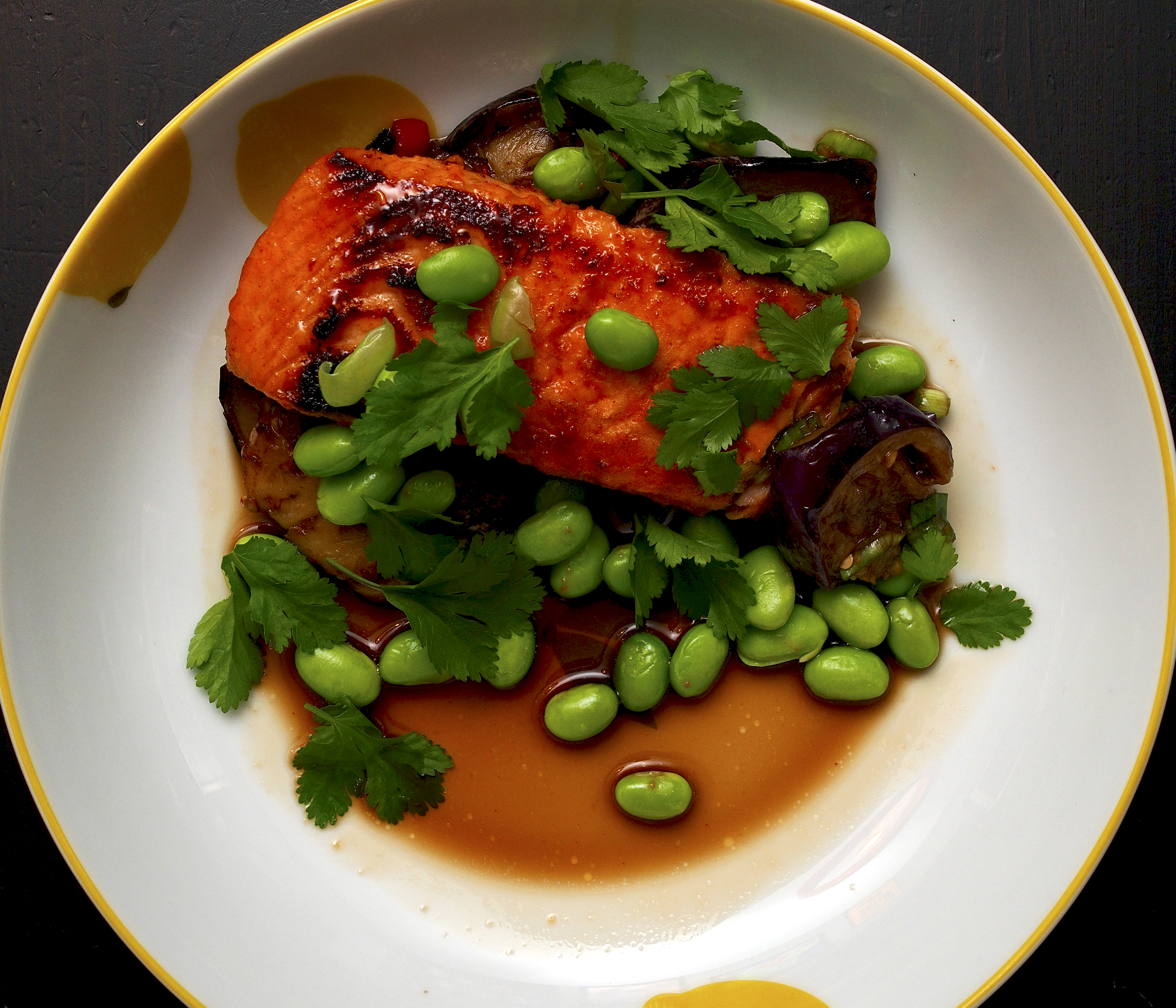
This dish was inspired by the prettiest striped baby aubergines in our local grocers. The recipe is from a new book of ours, Australian Food by Bill Granger. We all loved this dish, jam-packed with Asian flavours and truly delicious. You need to marinade the salmon the day before. Serve with rice.
Wine Suggestion: A friend had given us a bottle of Albert Pic Chablis which we found a surprising match for this dish as we’d thought the aromatics, chilli and spices might fight the wine, but no! A relatively rich and full-flavoured Chablis, the dryness inherent in the wine just accentuating and complimenting the umami savouriness through the dish. We like surprises.
Chilli miso salmon with hot & sour aubergine – serves 4
4 tbsp sugar
4 tbsp mirin
2 tbsp sake
6 tbsp white miso paste
2 tbsp gochujang paste
4 x 250g pieces skinless salmon fillet
100g frozen edamame beans
a small handful of pea shoots (if you can find them, don’t worry if not)
a handful of coriander leaves
lime wedges, to serve
FOR THE HOT & SOUR AUBERGINE:
125ml light flavoured oil, for frying
4 baby aubergines, thickly sliced
100ml tamari soy sauce (if you don’t have this use dark soy instead)
100ml mirin
50ml rice vinegar
1 tbsp runny honey
1 small chilli, finely sliced
4cm piece fresh ginger, peeled and sliced into matchsticks
2 scallions, finely sliced
You need to marinade the salmon fillets the day before. Make the marinade by mixing the sugar, mirin and sake together in a small pan and bring to the boil. Reduce the heat and simmer for 2-3 minutes, stirring until the sugar has dissolved. Take off the heat and whisk in the miso, then stir in the gochujang paste and leave to cool.
Put the salmon into a dish, cover with the marinade, then cover and leave overnight in the fridge.
To make the hot & sour aubergine, heat the oil in a large frying pan over a medium heat. Shallow-fry the aubergine in batches, turning after 1 minute, until golden and tender. Drain on kitchen paper.
To make the dressing for the aubergine, whisk together the tamari, mirin, rice vinegar and honey in a large bowl. Whisk in the chilli, ginger and scallions. Add the cooked aubergine and toss gently to coat. Set aside.
Cook the edamame beans according to the instructions on the pack, then drain.
Lift the salmon pieces out of the marinade. Heat a large frying pan over a medium-high heat and cook the salmon for 6-8 minutes, turning once.
Serve the aubergine and salmon with the edamame, pea shoots and coriander sprinkled over and with lime wedges on the side.
(Original recipe from Australian Food by Bill Granger, Murdoch Books, 2020.)
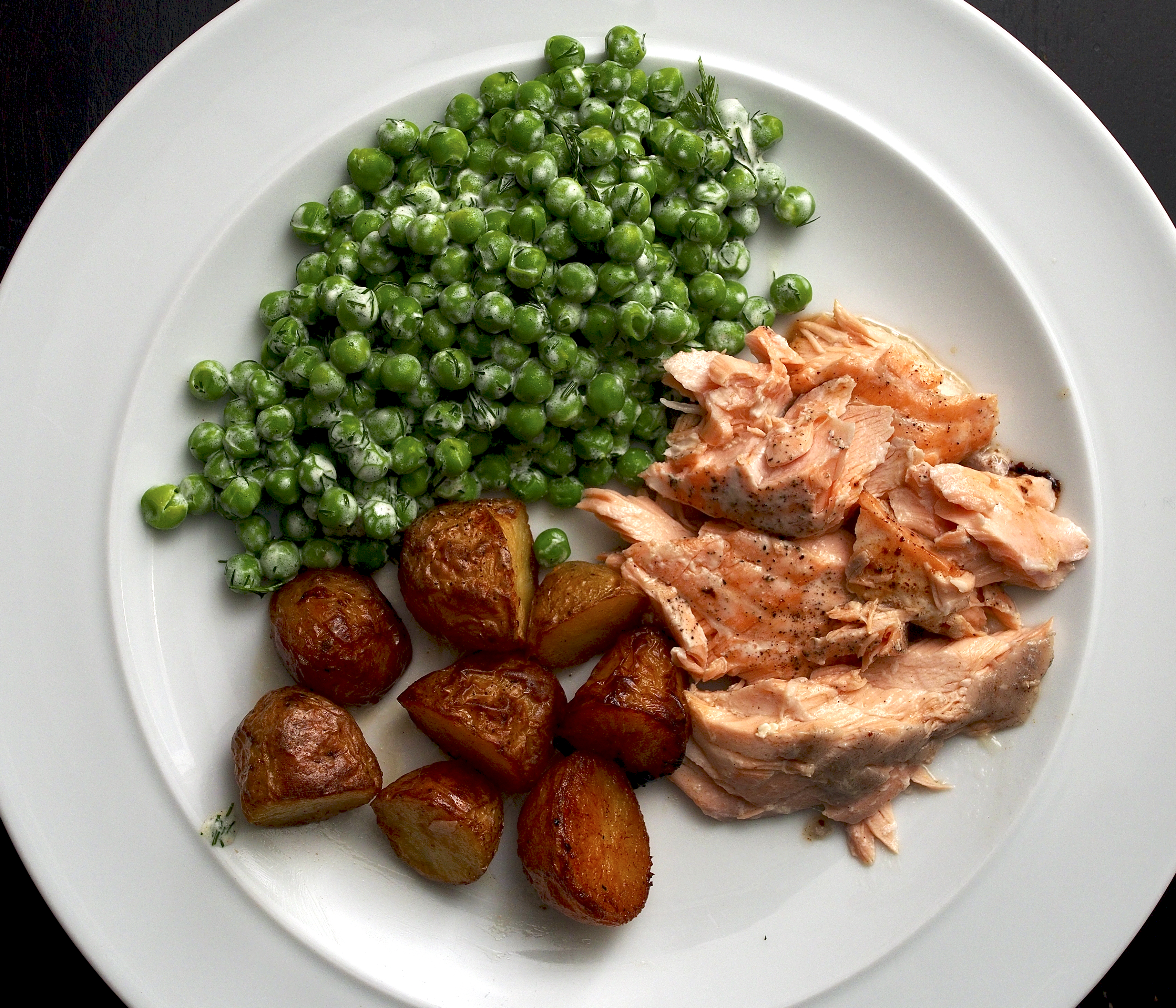
This is good family-friendly stuff. Easy to put together and nothing too challenging for junior palates.
Wine Suggestion: An alpine Chardonnay took our fancy tonight so we opened Cantina Colternezio’s Altkirch Chardonnay from the Südtirol – Alto Adige. With a lovely purity and precision this is both thirst quenching and comforting.
Roast salmon & potatoes with herby peas – serves 2 adults and 2 kids
500g baby potatoes, halved
1 tbsp olive oil
2 tbsp butter
500g single piece of skinless salmon fillet (try and get the middle, chunky bit from a side of salmon if you can)
2 lemons, halved
250g frozen peas
2 tbsp crème fraîche
1 tbsp chopped dill or mint
Heat the oven to 200C/180C/gas 6.
Boil the potatoes for about 10 minutes or until just tender, then drain and leave to steam-dry in the pot.
Toss the potatoes with the oil and butter, then tip onto a baking tray and roast for 20 minutes.
Push the potatoes aside and add the salmon to the tray, add the lemon halves and season everything with salt and black pepper. Roast for 15 minutes or until cooked through.
Simmer the peas for a couple of minutes, then drain and tip into a warmed bowl. Add the crème fraîche and herbs.
Flake the salmon into chunks and serve with the potatoes and peas.
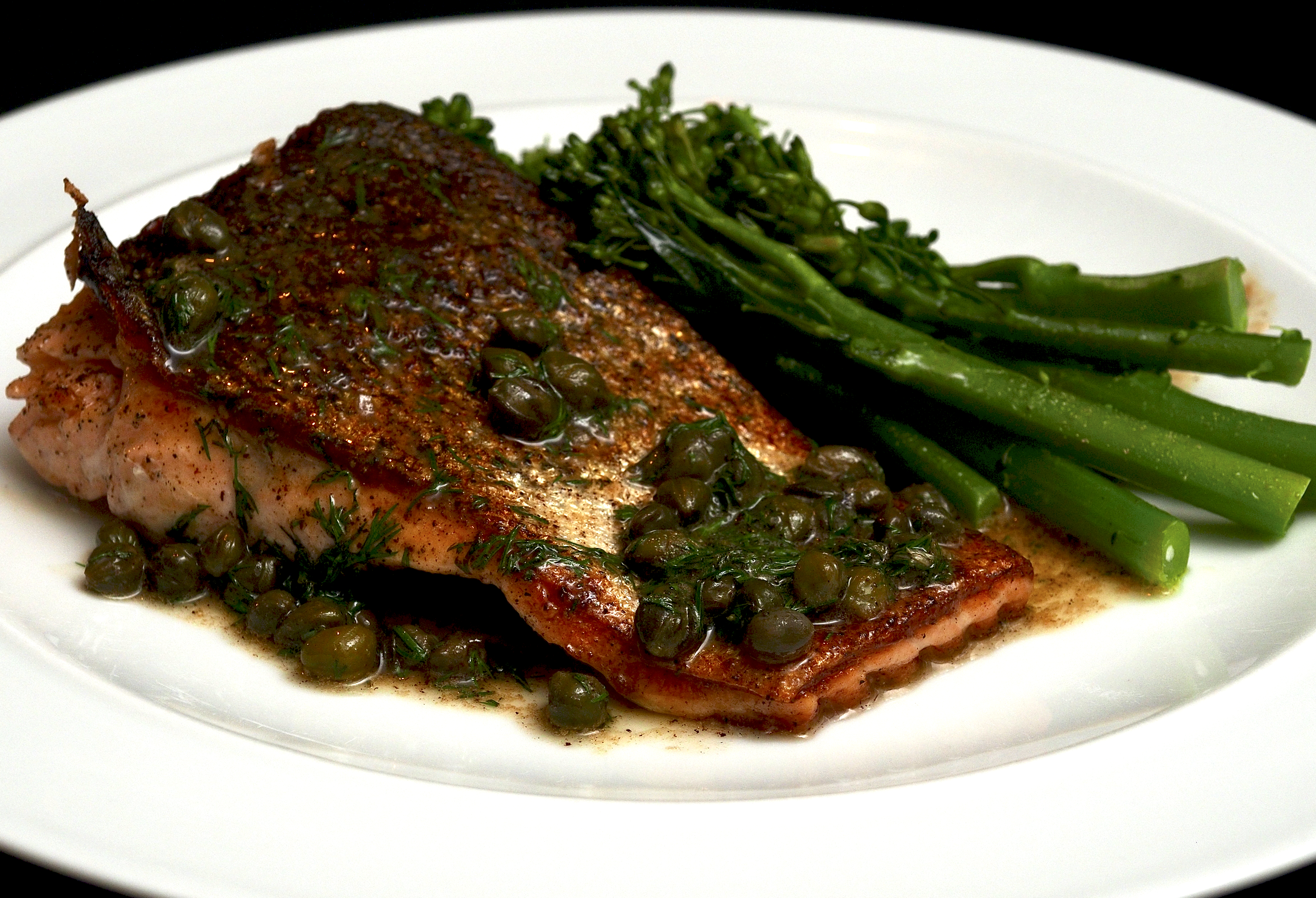
We like weeknight dishes that use fresh dill, like this one, particularly helpful as we often have leftover dill from the weekend. We never mind as we just love the lift dill can bring and hate to waste it. Don’t be tempted to turn the salmon too soon, you want nice crispy skin.
Wine Suggestion: A number of Italian whites have a good affinity to fish and capers so we chose a favourite, the Graziano Prá Soave Classico “Otto”. A DOC with a number of standout winemakers like Prá championing the local grape Garganega; green apple, hints of almond, a mid-weight and refreshing, textured finish.
Salmon with capers & dill – serves 4
50g butter, diced
4 x salmon fillets, preferably with the skin on, seasoned with salt and pepper
4 tbsp capers, drained and rinsed
2 tbsp lemon juice mixed with 6-8 tbsp water
4 tsp chopped dill
Heat a frying pan over a medium-high heat, then add a couple of knobs of butter and add the salmon fillets, skin side down. Fry for 3-4 minutes or until crispy and browned underneath, then turn over and continue to cook for a couple of minutes or until cooked through.
Add the capers, the rest of the butter and the lemon juice mixed with water, boil for 1 minute. Season to taste, then transfer the salmon onto warmed plates, stir in the chopped dill and pour over the fish to serve.
(Original recipe by Rachel Allen in BBC Good Food Magazine, November 2011.)





 Jono & Jules do food & wine