Feeds:
Posts
Comments

Archive for the ‘Gluten-free’ Category

Spicy prawn & tomato stew

We recently picked up a copy of Zaitoun by Yasmin Khan – a truly stunning book filled with Palestinian recipes & stories.  Our first dish from the book was this spicy prawn and tomato stew. We served it with rice but next time we’ll go for some flatbreads instead. Delicious nonetheless.

Wine Suggestion: We’d recommend a light red with elegant fruit like the Dezat Sancerre Rouge which was our choice.  A perfumed and delicate Pinot Noir with a tension and thrill running through it; the earthy red cherry and currant flavours flavours went with the prawns, tomatoes and herbs in a delightful fashion.

Spicy Prawn & Tomato Stew – Zibdiyit Gambari (serves 4)

  • 2 tbsp light olive oil
  • 1 red onion, finely chopped
  • 400g tin plum tomatoes
  • 1 tsp sugar
  • ¾ tsp ground cumin
  • ¼ tsp ground allspice
  • ½ tsp caraway seeds
  • 3 garlic cloves, crushed
  • 2 tbsp finely chopped dill
  • 1 – 2 green chillies, finely chopped
  • 2 tbsp sesame seeds
  • 400g raw prawns, peeled and deveined
  • chopped parsley

Heat the olive oil in a saucepan over a medium heat. Add the onion and fry for about 10 minutes or until softened. Add the tomatoes, sugar, spices & ½ tsp each of salt and pepper, with 200ml just-boiled water.

Use a pestle & mortar to smash the garlic, dill, chillies and ½ tsp of salt together for a few minutes. Add this to the tomato pan, cover and simmer for 20 minutes over a low heat.

Meanwhile, toast the sesame seeds in a dry pan until golden brown, then set aside.

Adjust the seasoning in the sauce, then add the prawns – make sure they are submerged and you may need to turn them. Cook in the sauce for a couple of minutes, or until they have just turned pink and are cooked through.

Drizzle with plenty of extra virgin olive oil and scatter with the sesame seeds and chopped parsley to serve.

(Original recipe form Zaitoun by Yasmin Khan, Bloomsbury, 2018.)

Read Full Post »

Baby Octopus and Peas

At last we’ve got our hands on The Modern Italian Cook by Joe Trivelli and what a treat it is! Our local fish shop often has baby octopus on the counter but you can also buy it frozen. This was Jono’s pick for his birthday dinner and he wasn’t disappointed.

Wine Suggestion: as befits a birthday dinner, it was Champagne to match and tonight we drank the Billecart-Salmon Blanc de Blancs Grand Cru NV which plays a delightful balance of delicacy, elegance, depth and bags of character. Both the dish and Champagne a wonderful treat.

Baby Octopus & Peas (Polipetti e Piselli) – serves 4

  • 1 kg frozen baby octopuses, defrosted (or fresh if you can find them)
  • extra virgin olive oil
  • 1 red onion, finely diced
  • 2 cloves of garlic
  • 3 bay leaves
  • 2 dried chillies
  • 50g small black olives, pitted
  • 300g shelled peas (we used defrosted frozen peas)
  • 600g new potatoes, peeled and cut into 1cm dice
  • 175ml dry wine – red or white

Rinse the octopuses under the tap then transfer to a heavy-based casserole dish or pan. Coat with a few tablespoons of extra virgin olive oil. Add the onion, garlic, bay leaves and chillies, cover with some baking paper and place over a high heat with the lid on.

When everything is hot and cooking, turn the heat down and continue to cook the octopuses for 15 minutes. Remove the lid and add the olives, peas, potatoes and wine. Bring to a simmer and continue to cook until the peas and octopuses are soft, about 20 minutes more.

(Original recipe from The Modern Italian Cook by Joe Trivelli, Seven Dials, 2018.)

Read Full Post »

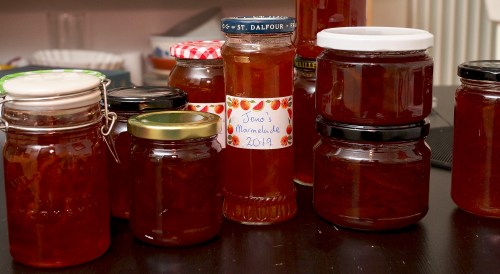
Jono's Seville Orange Marmelade

There is a batch of this made in our kitchen every year and this year there were two batches (we bought too many oranges). There are lots of fancy marmalade recipes but we find the classic version the best. This also requires a large preserving pan. If you think your pan may be too small then the recipe can easily be halved.

Jono’s Seville Orange Marmalade

  • 1.3kg Seville orange marmalade
  • 2 lemons, juice only
  • 2.6kg preserving or granulated sugar

Put the whole oranges and lemon juice in a large preserving pan and cover with 2 litres of water (if the water doesn’t cover the fruit you need to try a smaller pan). Use a heat-proof plate to keep the oranges submerged as they tend to bob to the surface; we use a second, smaller pot lid. Bring to the boil, cover and simmer very gently for about 2 hours or until the peel can be pierced easily with a fork.

We find we have to weight down the saucepan lid with heat-proof items to keep the lid pressed down and the oranges submerged; a small mortar and an iron teapot usually get drafted for this role.

Warm the sugar in a very low oven. Pour the cooking water from the oranges into a jug and tip the oranges into a bowl. Return the cooking liquid to the pan. When the oranges are cool enough to handle, cut them in half and scoop out all the pips and pith and add to the orange liquid in the pan. Bring this to the boil and continue to boil for 6 minutes, then strain the liquid through a sieve into a bowl and press the pulp through with a wooden spoon.

Pour this liquid into a large preserving pan. Cut the peel into fine shreds and add to the liquid in the preserving pan with the warmed sugar. Gently stir over a low heat for about 10 minutes until the sugar has completely dissolved. This is very important as undissolved grains effects the outcome. Bring to the boil and bubble rapidly for 15-25 minutes or until setting point is reached. A jam thermometer is useful here, but you can also test the set by checking if the marmelade wrinkles when put onto a cold plate

Remove the pan from the heat and skim any scum from the surface. The remaining excess scum can be dissolved by dropping a small knob of butter on to the surface and stirring gently. Leave the marmalade to stand in the pan for 20 minutes, then pot into sterilised jars.

(Original recipe from BBC Good Food)

Read Full Post »

Syrian Spiced Fish

This Syrian fish dish is bursting with delicious herbs and spices. We loved it! Really great with spinach & sumac and spicy potatoes. One of the best meals we’ve had in ages!

Wine Suggestion: Our choice tonight was the Rustenberg Five Soldiers Chardonnay which had power and complexity but also elegance and a beautiful, supple balance so it finished light and persistent. An excellent wine well worth seeking out and a great match for this dish.

Spiced Fish (Samaka Harra) – serves 2

  • 6 garlic cloves, chopped
  • 2 red chillies, finely chopped
  • ½ tsp ground cumin
  • 40g walnuts chopped
  • 2 tbsp olive oil, plus extra
  • 2 whole fish e.g. sea bream or snapper (we used bass)
  • a bunch of fresh coriander, roughly chopped, including stems
  • 1 lemon, plus ½ a lemon, sliced

Heat the oven to 180C/350F/Gas 4.

Mix the garlic, chillies, cumin, walnuts and 2 tbsp of olive oil, salt and pepper.

Stuff the fish with the mixture, keeping 2 tbsp aside for later, then add a handful of coriander, saving some to garnish.

Squeeze the lemon over both fish, then drizzle with olive oil and season with salt and pepper. Marinate in the fridge for a good half hour.

Put the fish into a large oven tray with the reserved stuffing sprinkled over the top and some lemon slices, then bake for 30 minutes.

(Original recipe from Syria: Recipes from Home by Itab Azzam and Dina Mousawi, Trapeze, 2017.)

Read Full Post »

Spinach with Sumac

This simple Syrian side dish has fantastic flavour. We ate it with some spiced fish but it would complement many things. Also great on its own with some plain yoghurt and flatbreads.

Spinach with Sumac (Spanekh wa Sumac) – serves 4

  • 1 small red onion, finely diced
  • oil, for frying
  • 350g baby spinach
  • 1 tbsp sumac
  • a squeeze of lemon

Fry the onion over a very low heat for 20-30 minutes or until softened and almost caramelised. Add the spinach and cook until wilted. Remove from the heat, sprinkle with the sumac, lemon juice, salt and pepper.

(Original recipe from Syria: Recipes from Home by Itab Azzam & Dina Mousawi, Trapeze 2017.)

Read Full Post »

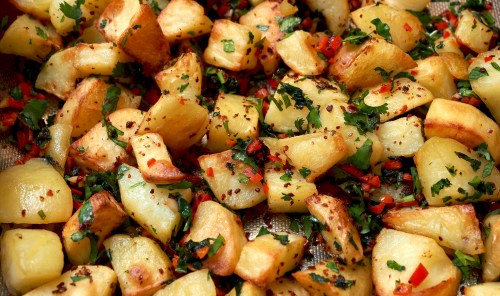
Spicy Syrian Potatoes

These spicy Syrian potatoes are really delicious and we’re going to be cooking them with lots of dishes. A great alternative to roast potatoes.

Spicy Syrian Potatoes (Batata Harra) – serves 4

  • 4 potatoes, peeled and cut into 1-2 cm cubes
  • olive oil, for roasting
  • 3 garlic cloves, finely chopped
  • 2 chillies, deseeded and finely chopped
  • a bunch of coriander, chopped
  • 1 tbsp Aleppo pepper

Heat the oven to 200C/400F/Gas 6.

Roast the potatoes with olive oil and salt for about 30 minutes or until nicely browned.

Meanwhile, quickly fry the garlic, chillies and half the coriander. When the potatoes are ready, mix the fried ingredients with the potatoes, ground Aleppo pepper and the rest of the coriander.

(Original recipe from Syria: Recipes from Home by Itab Azzam and Dina Mousawi, Trapeze, 2017.)

Read Full Post »

Valentines baked potatoes with caviar

This was our Valentine’s dinner and very special it was too!

Wine Suggestion: it’s any excuse for bubbly in our house and it makes a natural pair for this dish too. Our choice was the Domaine de la Paleine Cremant de Loire, a blend of Chardonnay and Chenin Blanc that celebrated the saltiness of the caviar and went seamlessly with the creamy potatoes.

Baked potatoes with crème fraîche and trout caviar – serves 4

  • 4 small baking potatoes
  • 1 ½ tbsp rapeseed or olive oil
  • sea salt flakes
  • 2 tbsp chopped flat-leaf parsley
  • 200ml crème fraîche
  • 40g trout caviar

Heat the oven to 200C/Fan 180C/Gas 6.

Drizzle the potatoes with ½ tbsp of the oil and a good pinch of salt and toss well. Put onto a baking tray and bake for 45 minutes.

When the potatoes are cool enough to handle, cut them in half lengthways and scoop the flesh out into a bowl, careful not to damage the shells. Mash the potatoes, then stir in the parsley, 120ml of the crème fraîche and seasoning. Brush the potato skins with the remaining oil, then spoon the potato mixture back into them.

Bake for 15 minutes or until heated through and crispy on the outside. Spoon the remaining crème fraîche on top, followed by a spoon of caviar and some black pepper.

(Original recipe by Clodagh McKenna in Olive Magazine, February 2019.)

Read Full Post »

Fesenjoon

We love this Persian dish, so rich and full of unusual but intriguing flavours. We’ve tried to make it before with limited success but this version by Yasmin Khan was much more like the dish we remembered. Serve with steamed basmati rice and salad.

Chicken with Walnuts & Pomegranates – Fesenjoon – serves 4

  • 250g walnuts (fresh is best)
  • 1.2 litres of cold water
  • 100ml pomegranate molasses
  • 1 tbsp tomato purée
  • ¼ tsp ground cinnamon
  • 2 tbsp sugar
  • 2 tsp sea salt
  • 1 tsp black pepper
  • 800g skinless chicken thighs, on the bone
  • a handful of pomegranate seeds to garnish

Grind the walnuts in a food processor until extremely fine – they will eventually turn into a smooth paste. Transfer the ground nuts into a large casserole pot with a litre of water and mix well. Bring to the boil and cook over a high heat for 5 minutes, then reduce the heat and simmer for 1 hour, partially covered. Stir occasionally to make sure the walnuts don’t stick.

Stir in the remaining 200ml of water and simmer for another hour with the lid on. Add more cold water if the sauce starts to look dry – in the end it should have a thick, porridge-like consistency.

By the end of the time the sauce should have thickened and darkened in colour. Add the pomegranate molasses, tomato purée, cinnamon, sugar, salt and pepper and stir well. Add the chicken, put the lid back on the pot and cook over a low heat for 45 minutes, until the chicken is cooked and the sauce is dark and glossy.

Taste the sauce and season, you might like to add more sugar or pomegranate molasses to adjust the sweet/sour balance. Cook for a final 10 minutes with the lid off so the sauce thickens around the meat. Serve over rice and sprinkled with the pomegranate seeds.

(Original recipe from The Saffron Tales by Yasmin Khan, Bloomsbury, 2016.)


Read Full Post »

Turmeric Broth

We try and cook healthy mid-week, with some weeks being more successful than others. That said, we rarely eat anything particularly unhealthy, so we don’t beat ourselves up too much. This dish is low fat and low calorie – but it tastes really full-flavoured and restorative, almost medicinal, and you can’t help but feel better for eating it.

Turmeric broth with chicken & ginger dumplings – serves 4

  • 50g ginger sliced
  • 1.5 litres light chicken stock
  • 3 scallions, green parts and white parts separated
  • 2 star anise
  • 2-3 tsp ground turmeric
  • 200g baby leaf greens, chopped – we used pak choi
  • 300g cooked egg noodles
  • 1 red chilli, finely chopped

FOR THE DUMPLINGS:

  • 500g chicken mince or turkey mince
  • 1 tbsp finely grated ginger
  • ½ red chilli, seeded and finely chopped
  • a handful of coriander, finely chopped
  • sesame oil
  • 1 tbsp cornflour
  • 1 egg white
  • white pepper

Put the sliced ginger, chicken stock, scallion greens, star anise and turmeric in a large pot. Bring to a simmer and cook with a lid on for 20 minutes.

Meanwhile, finely chop the scallion whites and put into a bowl with the mince, grated ginger, chilli, coriander, 1 tsp of sesame oil, the cornflour and egg white. Season with salt and white pepper then mix well and roll into balls.

Strain the broth and return to the pot. Add the chicken dumplings and simmer for 8-10 minutes or until cooked through. Add the greens and noodles for the last 2 minutes. Finish with the chilli and a drizzle of sesame oil.

(Original recipe by Janine Ratcliffe in Olive Magazine, January 2017.)

Read Full Post »

Dill potatoes

We’re always banging on about food waste but can honestly say that at least half the recipes we try, are chosen solely on the basis that they use an ingredient left over from another dish. This is precisely how we came to try this potato dish from Caroline Eden & Eleanor Ford’s beautiful book, Samarkand. Dill is one of the herbs we find most difficult to use up and it’s also one we haven’t had a lot of success growing ourselves. Never again will we shy away from recipes using fresh dill, instead we will look forward to melting potatoes with dill the following day.

Melting Potatoes with Dill – serves 4

  • 50g butter
  • 2 tbsp olive oil
  • 2 onions, sliced
  • 500g waxy potatoes, unpeeled and cut into 1cm slices
  • 3 garlic cloves, finely sliced
  • 1 tsp cracked black peppercorns
  • a small handful of dill fronds, chopped

Heat the butter and oil in a large frying pan and cook the onions very slowly until soft and golden. Add the potato slices and garlic and stir into the buttery onions. Season well with salt and cover with a lid.

Cook the potatoes over a very low heat, stirring occasionally, for about 45 minutes. Stir through the peppercorns and a handful of fresh dill before serving.

(Original recipe from Samarkand by Caroline Eden & Eleanor Ford, Kyle Books, 2016.)

Read Full Post »

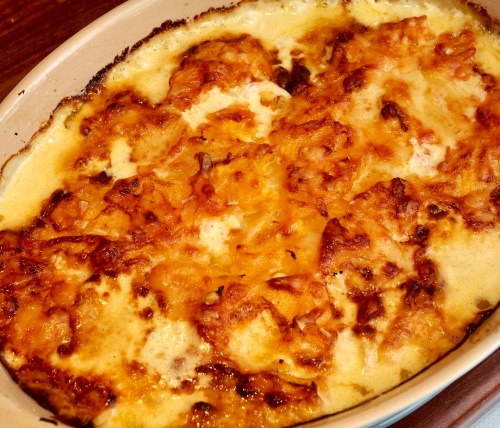
Turnip & Gruyere Gratin

Turnip (or swede as some of you call it) gets a lot of bad press but we absolutely love it and even more so when cooked with lots of cream and cheese. Jono has declared this his favourite turnip dish and has demanded we cook it again.

Gruyère and turnip gratin – serves 4

  • 700g turnip/swede (the large, orange-fleshed variety)
  • 300ml double cream
  • 1 tbsp dijon mustard
  • 1 clove of garlic, crushed
  • 100g gruyère, grated

Heat the oven to 180C/fan 160C/gas4.

Peel and thinly slice the turnip – a mandolin or food processor works really well for this.

Bring a pan of salted water to the boil then add the turnip and cook for 4 minutes. Drain really well.

Whisk the cream, mustard and garlic together and season. Layer the turnip and mustardy cream alternately and sprinkle in half the cheese. Sprinkle the rest of the cheese over the top.

Bake for 40-50 minutes, or until very tender, browned and bubbling.

(Original recipe by Janine Ratcliffe, Olive Magazine, January 2017)

Read Full Post »

Smoked Mackerel Loaded Leaves

This is the kind of nibble we like before dinner. Really tasty but light so it won’t spoil your appetite. Radicchio and/or chicory leaves are preferable but if you can’t find these you can substitute Little Gem lettuce – as we did.

Wine Suggestion: Your choice of bubbles, whether it’s Prosecco, Cremant, Cava or Champagne

Smoked Mackerel Loaded Leaves – serves 4-8

  • 200g smoked mackerel fillets, skin removed and flaked
  • 4 tbsp crème fraîche
  • juice and zest of ½ lemon
  • small bunch of chives, snipped
  • small handful of dill, chopped
  • 1 small radicchio, separated into leaves
  • 1-2 chicory heads separated into leaves

Gently mix the mackerel with the crème fraîche, lemon juice, half the herbs and some pepper. Chill until ready to serve.

Spoon generous amounts of the mackerel mixture into each leaf and arrange on a plates or a platter. Sprinkle over the remaining herbs and the lemon zest.

(Original recipe from BBC Good Food)

Read Full Post »

Pea & Mint Soup

It’s getting close to that time of year when we start to really crave some daylight and spring veg. Fresh peas are a long way off yet but this hearty pea and mint soup is full of promise. Leave out the swirl of cream to keep it vegan.

Pea & Mint Soup – serves 4 generously

  • 80g yellow split peas
  • 1 tbsp olive oil
  • 2 large onions, finely diced
  • 3 garlic cloves, finely chopped
  • 1.2 litres vegetable stock
  • 700g frozen peas
  • 2 handfuls of mint leaves, roughly chopped
  • 4 tsp single cream (optional to garnish)

Put the split peas into a saucepan and add 800ml of water. Bring to the boil, then lower the heat and simmer for 30-45 minutes, or until just tender. Remove any scum from the surface as they cook.

10 minutes before the split peas are cooked, heat the oil in a large saucepan over a medium heat. Add the onions and cook for 5 minutes to soften, add a splash of water if they start to stick. Add the garlic and cook for another 2 minutes.

Drain the split peas and add to the onions along with the vegetable stock. Bring the boil, then simmer gently for 5 minutes.

Stir in the frozen peas and chopped mint and season with salt and black pepper. Simmer for another 5 minutes, then remove from the heat.

Whizz the soup with a blender until smooth (or smoothish if you prefer) – you might have to do this in batches.

Ladle into warm bowls and drizzle with cream if you like.

(Original recipe from Lose Weight for Good by Tom Kerridge, Absolute Press, 2017.)

Read Full Post »

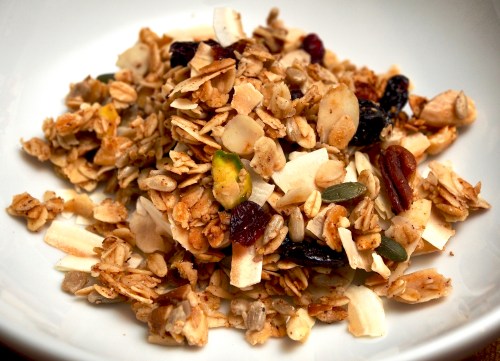
Jules' granola

We love granola but often find it too sweet. This home-made version by Tom Kerridge is a super-flavoursome breakfast option. Serve with plain yoghurt and fresh fruit.

Homemade Granola 

  • 300g rolled oats
  • 100g mixed seeds -e.g. pumpkin, sunflower and sesame seeds
  • 50g hazelnuts, roughly chopped
  • 50g pecans, roughly chopped
  • 50g pistachios, roughly chopped
  • 50g flaked almonds
  • 4 tbsp coconut oil
  • 125ml maple syrup
  • 50ml honey
  • 2 tbsp vanilla extract
  • ½ tsp ground cardamom
  • ½ tsp ground ginger
  • 1 tsp ground cinnamon
  • 1 tsp sea salt flakes
  • 50g coconut flakes
  • 150g mixed dried fruits e.g. cranberries, chopped apricots, chopped dried apple, raisins

Preheat the oven to 170C/Fan 150C/Gas 3.

Line two baking trays with baking parchment.

Mix the oats, seeds, chopped nuts and flaked almonds together in a big bowl.

Put the coconut oil, maple syrup, honey, vanilla and spices into a small saucepan and heat gently, stirring, until the coconut oil has melted. Pour over the oat mixture, add the salt and mix well.

Spread the mixture out in a thin layer on the baking trays and bake for 15 minutes. Add the coconut flakes and dried fruit. Mix well and bake for a further 8-10 minutes or until the coconut flakes have browned. Remove from the oven and leave aside to cool.

Store in an airtight container and serve with yoghurt and fresh fruit.

(Original recipe from Tom Kerridge’s Fresh Start, Bloomsbury Publishing, 2018.)

Read Full Post »

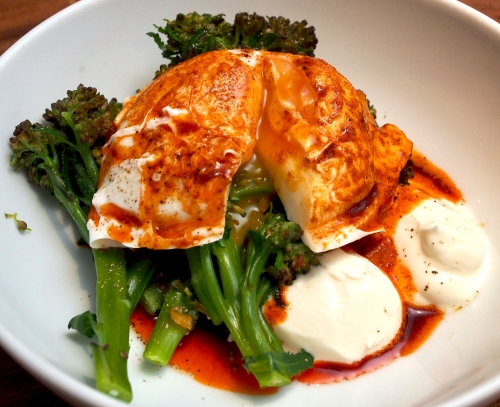
Purple sprouting broccoli with smoked paprika, yoghurt & eggs

We’re trying to make more of an effort at breakfast time. This dish by Gill Meller of River Cottage is more suited to a weekend when you have a bit more time but it’s worth it as the flavours are great. The vegetable shop can get a bit boring at this time of year but then arrives Purple Sprouting Broccoli to keep us in good spirits.

Serve this with some toasted brown bread for mopping up the hot, smoky butter.

Purple Sprouting Broccoli with Smoked Paprika, Yoghurt & Eggs – serves 2

  • 2 eggs
  • 250g purple sprouting broccoli
  • 50g butter
  • 1 garlic clove, thinly sliced
  • 1 rosemary sprig
  • 2 tsp sweet smoked paprika
  • 4 tbsp natural yoghurt
  • toasted brown bread, to serve

Start by poaching the eggs and keeping them warm.

Bring a large pan of salted water to the boil and simmer the purple sprouting broccoli for a few minutes until tender. Drain and allow to steam dry.

Meanwhile, melt the butter in a small pan until sizzling then add the garlic, rosemary and smoked paprika. Cook for about a minute or until the garlic is softened but not browned, then remove from the heat.

Divide the yoghurt between two warmed bowls. Lay the broccoli in the bowls with the poached eggs. Season everything with salt and pepper and spoon over the smoky butter. Serve immediately with plenty of toast.

(Original recipe from Time by Gill Meller, Quadrille, 2018.)


Read Full Post »

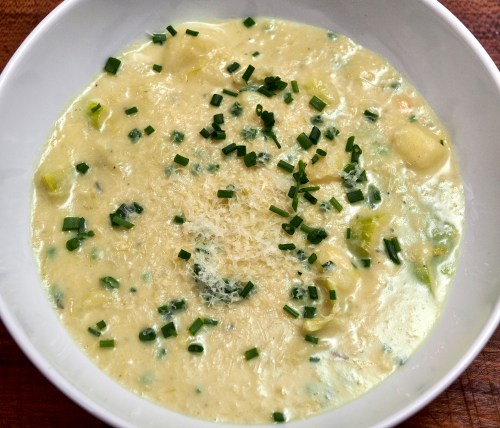
Potato & leek soup with smoked Gubbeen cheese & chives

This is no ordinary leek and potato soup but rich and complex with a subtle smoky flavour from the cheese. We’ve been cooking from Gill Meller’s latest book, Time, and the recipes are stunning.

This is the kind of soup that goes well with Northern Irish Wheaten Bread.

Leek & Potato Soup with Smoked Gubbeen & Chives – serves 4

  • 1 litre of vegetable stock or chicken stock
  • 3 floury white potatoes (about 350g), peeled and cut into 1-2cm cubes
  • 3 medium-large leeks, sliced into 1cm rounds
  • 25g butter
  • 1 tbsp olive oil
  • 2 shallots or 1 onion, thinly sliced
  • 2 garlic cloves, peeled and thinly sliced
  • 2 or 3 thyme sprigs, leaves stripped
  • 100ml double cream
  • 50g smoked Gubbeen (Gill suggests smoked Cheddar or goat’s cheese), grated, plus extra to serve
  • a small bunch of chives, finely chopped

Bring the stock to the boil in a large heavy pan. Add just a third of the potato, bring the stock back to a simmer and cook, uncovered, for 6-8 minutes, or until the potato cubes are tender. Add a third of the leeks and cook for a few minutes to soften, then drain the vegetables in a colander set over a bowl to catch the stock.

Return the pan to a medium heat and heat the butter and olive oil. When bubbling, add the onion, garlic and thyme leaves. Cook, stirring, for 4-5 minutes, then add the remaining leeks and potato to the pan, seasoning well with salt and pepper. Cook gently for 3-4 minutes, then add the reserved stock and bring to a gentle simmer.

Cook the soup for about 15 minutes or until the leeks and potatoes are tender. Remove from the heat and blend until smooth.

Return the soup to the pan. Add the cooked leeks and potatoes from earlier, along with the cream, grated cheese and chopped chives. Season again, then put back on the heat and bring slowly to a simmer. Stir well, remove from the heat, and stand for 5 minutes before serving. Garnish with some extra cheese, chives and seasoning.

(Original recipe from Time: A Year & a Day in the Kitchen by Gill Meller, Quadrille, 2018.)

Read Full Post »

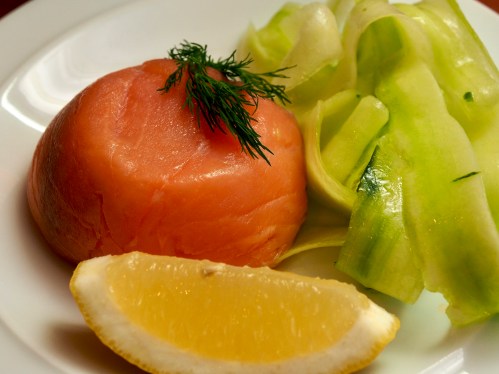
Smoked salmon & crab timbales with cucumber parpadelle

This luxurious starter of smoked salmon timbales filled with creamy crab can be made up to a day ahead. You do need to find big slices of smoked salmon as you need to completely line the moulds to stop the filling leaking out.

Wine Suggestion: as befits the occasion these go great with bubbly. We love good Champagne, but have recently been sampling various Cremants from around France and enjoying the variation and character each brings. With this we served the Manciat Poncet Cremant de Bourgogne which our friend brought along to dinner.

Smoked salmon timbales with cucumber pappardelle – serves 8

  • 12 large slices of smoked salmon
  • 225g full-fat soft cheese
  • 100-150ml sour cream
  • 100g white crab meat
  • 2 tsp chopped fresh dill, plus some sprigs to garnish
  • lemon wedges, to garnish

FOR THE CUCUMBER PAPPARDELLE:

  • 1 tbsp caster sugar
  • finely grated zest and juice of 1 lemon
  • 150ml olive oil
  • a few black peppercorns
  • 1-2 tsp white wine vinegar
  • 1 large cucumber peeled

Line eight 100ml ramekins with the smoked salmon making sure there are not gaps and hanging it well over the sides.

Beat the cheese to soften and mix in 100ml soured cream – loosen with a little more cream if still too firm to spoon.

Pick over the crab and remove any tiny bits of shell. Stir into the cheese with the chopped dill and season. Spoon into the moulds and fold over the overhanging salmon, then cover with cling film and chill in the fridge for 2 hours (you can do this up to a day ahead).

Make the dressing for the cucumber. Put the sugar and 3 tbsp of water int a small saucepan and bring quickly to a simmer. Add the lemon zest and juice, oil and peppercorns, then taste and add 1-2 tsp of vinegar. Season with salt. Return to the boil, then cool (this can also be made up to a day ahead).

Use a swivel peeler to shave long strips of cucumber until you get to the seeds. Discard the centre. Don’t do this any more than 30 minutes beforehand or it will go soggy.

To serve, unwrap and run a knife between the salmon and the ramekins to pop them out onto plates. Strain the dressing through a sieve, mix a few tablespoons with the cucumber and arrange next to the timbales. Garnish with lemon wedges and dill and drizzle over some more dressing.

(Original recipe by Gary Rhodes in BBC Good Food Magazine, December 2004.)

Read Full Post »

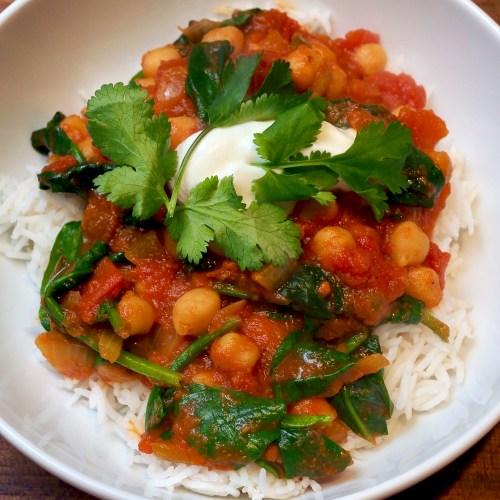
Chickpea and spinach curry

We don’t know about you lot but our bellies are crying out for a rest and we haven’t even got to New Year’s yet. This is a lightweight curry suitable for veggies and vegans (if you don’t serve with yoghurt) and it’s also substantial enough to serve as it is without any rice. The spices are very gentle as confirmed by our 5 year old who has developed a recent aversion to anything ‘too spicy!!’.

Chickpea & spinach curry – serves 4

  • 1 tbsp vegetable oil
  • 2 medium onions, finely chopped
  • 6 garlic cloves, finely grated
  • 6cm piece of ginger, finely grated
  • 2 long green chillies, finely chopped
  • 1 tsp ground cumin
  • 1 tsp ground coriander
  • 2 tsp garam masala
  • 1 tsp ground turmeric
  • 1 tsp sea salt flakes
  • 2 tbsp tomato purée
  • 2 x 400g tins chopped tomatoes
  • 400ml vegetable stock
  • 2 x 400g tins chickpeas, rinsed and drained
  • 150g baby spinach
  • 4 tbsp natural yoghurt (optional to serve)
  • Sprigs of coriander (to serve)

Heat the oil in a large non-stick pan over a high heat. Add the onions and cook for 5 minutes or until starting to brown, add a splash of water if they stick.

Add the garlic, ginger and chillies and cook for a couple of minutes. Add the spices and salt and stir for a minute, then add the tomato purée and cook for another minute.

Add the tinned tomatoes, stock and chickpeas, then bring to a simmer and cook for 20-30 minutes or until the sauce thickens.

When ready to serve, stir through the spinach and cook briefly until just wilted.

Divide between bowls (on top of some steamed rice if you like) and top with a spoon of yoghurt and some coriander.

(Original recipe from Lose Weight for Good by Tom Kerridge, Absolute Press, 2017.)

Read Full Post »

Buttered Sprouts with Chestnuts & Bacon

Sprouts are not just for Christmas and indeed should be eaten throughout the frosty months in our opinion. We particularly like this recipe with butter, bacon bits and chestnuts – a sprout-lovers dream!

Buttered sprouts with chestnuts & bacon – serves 8 (easily halved)

  • 1.25kg Brussels sprouts, trimmed
  • 6 rashers streaky smoked bacon cut into bit-sized pieces or cubes of pancetta
  • 200g vacuum-packed chestnuts
  • 50g butter

Bring a large pan of salted water to the boil and tip in the sprouts. Return to the boil and cook for 5 minutes, then drain and run under the cold tap until cold, then drain again.

Heat a large frying pan, add the bacon and gently fry for 10 minutes until crispy. Scoop the bacon out of the pan with a slotted spoon and leave the fat behind, then add the chestnuts and fry over a high heat for about 5 minutes until they have darkened in places, then tip out of the pan.

Put the sprouts into the frying pan with a splash of water, then cover the pan with a lid and finish cooking over a medium heat for about 5 minutes or until just tender. Remove the cover, turn up the heat, then add most of the butter and sauté the sprouts for another 2 minutes. Tip in the bacon and chestnuts, season generously, then serve with the last bit of butter on top.

(Original recipe from BBC Good Food Magazine, December 2009.)

Read Full Post »


Spiced Roast Beef with Red Wine Gravy

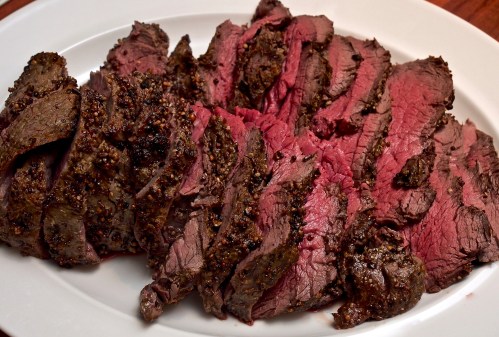
Fillet of beef is not a cut we usually go for but we thought we’d try it as it seems fittingly festive and a bit extravagant. This is a pricey cut but it melts in the mouth and cuts out so beautifully.

Wine Suggestion: This is the type of dish that deserves something extra special to accompany it so we dipped into our cellar to revisit the Chateau Capbern Gasquetton 2009 and while still very youthful was a great match. Other Cabernet Sauvignon wines and blends would be our first choice, but if you’re looking for something different we also think a good cru from Beaujolais, like Domaine Rochette’s Morgon, would go alongside this just as well.

Spiced roast beef with red wine gravy – serves 6

  • 2 tbsp mixed peppercorns
  • 2 tbsp mustard seeds
  • 2 tsp fennel seeds
  • 1.5kg fillet of beef
  • 2 tbsp olive oil
  • 1 tbsp wholegrain or English mustard
  • 3 red onions, skins left on, thickly sliced into rounds
  • a few thyme leaves, to serve (only if you have them)

FOR THE GRAVY

  • 2 tbsp olive oil
  • 1½-2 tbsp cornflour
  • 2 beef stock cubes
  • 3-4 tbsp redcurrant jelly
  • 400ml red wine

Up to 2 days beforehand you can crush the peppercorns and seeds together using a pestle and mortar. Brush the beef all over with the mustard, then roll in the peppercorn mixture to coat. Cover and chill.

Remove the beef from the fridge 2 hours before you want to start cooking it to allow it to come to room temperature.

Heat the oven to 200C/180C Fan/Gas 6.

Heat the oil in a pan big enough to hold the beef and brown it all over, seasoning with salt.

Scatter the onions over the base of a roasting tin and set the beef on top. Roast for 20 minutes for rare, 25 minutes for medium, and 35 minutes for well-done. You need your instincts a bit here – we like our beef rare but our fillet was kind of fat rather than long and thin and so it took 30 minutes to get it cooked just how we like it. If you have a meat thermometer this is where it excels, and they aren’t expensive so are a very useful addition to any kitchen.

Lift the beef out of the tin and rest on a warm platter, covered with foil, for about 30 minutes.

Put the roasting tin onto the hob and stir in the oil, cornflour and crumbled stock cubes. Stir in the jelly, then gradually add the wine and 400ml boiling water, scraping the sticky bits from the bottom of the tin. Simmer for 15 minutes until reduced a bit. Season, then sieve into a clean pan to keep warm, discard the onions.

Slice the beef, scatter over some thyme leaves (if using) and serve with the gravy.

(Original recipe from BBC Good Food)

Read Full Post »

« Newer Posts - Older Posts »