Feeds:
Posts
Comments

Posts Tagged ‘Gluten-free’

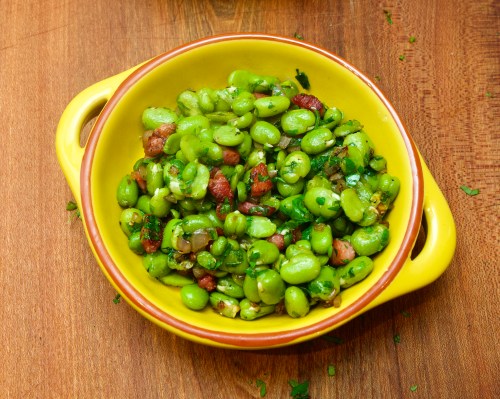
Broadbeans with pancetta

A tasty side dish that works at any time of the year provided you’ve a stash of broad beans in the freezer.

Broad beans with pancetta – serves 4

  • 500g frozen broad beans
  • 70g cubetti di pancetta
  • 2 shallots, finely chopped
  • a small bunch of flatleaf parsley, chopped

Cook the beans in boiling water for 2 minutes then drain and remove from the skins.

Fry the pancetta in a dry pan until the fat runs, then turn the heat up and brown well. Add the shallots for a couple of minutes to soften, then add the broad beans to heat through. Stir through the parsley and season before serving.


Read Full Post »

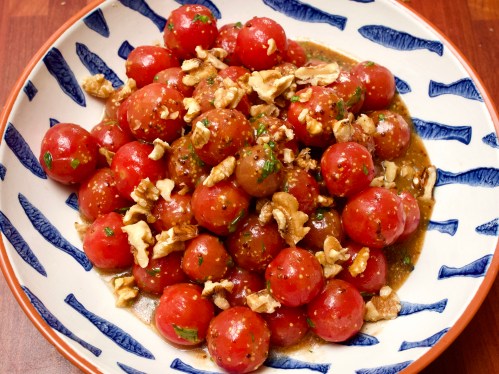
Cherry tomato salad with wholegrain mustardSuch a nice tomato salad with lots of delicious dressing for which you will require some crusty bread. You do need to skin the tomatoes but it actually takes no time at all if you follow the instructions below and it allows them to soak up the dressing so don’t be tempted to leave that step out.

Cherry tomato salad with wholegrain mustard – serves 4 to 6

  • 900g cherry tomatoes
  • 50g walnuts, coarsely chopped

FOR THE DRESSING:

  • small bunch of tarragon
  • 2 tbsp balsamic vinegar
  • 1 heaped tbsp wholegrain Dijon mustard
  • 125ml walnut oil or olive oil

Peel the tomatoes by cutting a slit in the base of each then putting them into a large bowl. Pour over some boiling water from the kettle and immediately drain – the skins should peel of easily.

Keep a sprig of tarragon to garnish and remove the rest of the leaves from the stalks. Coarsely chop the leaves and discard the stalks. Whisk the vinegar and mustard together with some salt and pepper. Gradually whisk in the oil so the dressing thickens slightly, then whisk in the chopped tarragon.

Pour the dressing over the tomatoes,  mix gently and taste for seasoning. You can leave at room temperature for a couple of hours at this point. Pile into a salad bowl and sprinkle with the walnuts and the reserved tarragon just before serving.

(Original recipe by Anne Willan IN: BBC Good Food Magazine, April 2002)

Read Full Post »

Watercress & Scallion salad

We love this green salad with barbecues as the scallions taste amazing and you’re not likely to get the barbecue out just for a green salad.

Watercress & scallion salad – serves 8 to 10

  • 6 tbsp olive oil
  • 4 shallots, sliced into fine rings
  • 2 tsp caster sugar
  • 4 tbsp white wine vinegar
  • 3 bunches scallions, trimmed
  • 4 bunches of watercress (or failing that a bag of mixed salad leaves as we had to resort to this time but it we prefer it with watercress)

Heat a pan over a medium heat, then fry the shallots for a few minutes with a splash of oil, then add the sugar and vinegar. Bring to the boil, then set to one side.

Toss the scallions in a little oil then cook on a hot barbecue for a a couple of minutes on each side (use a griddle pan if that’s easier). Put the scallions in a bowl with the shallots and the rest of the olive oil. Season and toss with the watercress.

(Original recipe by James Martin IN: BBC Good Food Magazine, April 2008)

Read Full Post »

Left-over Chicken Curry

A quick curry made with leftover roast chicken. We liked it and the fresh tomatoes definitely lighten things up for this time of year. We didn’t have any coriander but mint was a good substitute. Rachel Kelly also says that you can just use 2 tsp each of garam masala, coriander and ground cumin if you don’t have all the spices.

Wine Suggestion: This is quite a mild curry and we think you could choose most fruity, white wines and lighter, juicy reds easily. We had a glass of La Piuma Pecorino from the Marches in Italy and it was a refreshing match.

Leftover Chicken Curry – serves 4

  • vegetable oil
  • 1 onion, finely chopped
  • 3 garlic cloves, very finely chopped
  • 1 tbsp fresh ginger, very finely chopped
  • 2-3 large tomatoes, chopped (plus some extra to serve)
  • 300ml chicken stock
  • leftover roast chicken, roughly chopped
  • 2 tbsp plain yoghurt
  • 2 tsp ground coriander
  • 1 tsp ground cumin
  • 1 tsp garam masala
  • ½ tsp ground cardamom
  • ½ tsp ground cinnamon
  • ½ tsp ground turmeric
  • ½ tsp chilli powder
  • cooked basmati rice, to serve
  • coriander, chopped, to serve

Heat 2 tbsp of vegetable oil in a large heavy-based saucepan. Gently fry the onion with a pinch of salt for about 15 minutes or until softened, then add the garlic and ginger. Continue to fry gently for another few minutes.

Add the spices and mix well with the onion. Fry for another 3 minutes.

Add the chopped tomatoes and cook for another minute or two then add the chicken stock. Bring to the boil and simmer for 15 minutes.

Add the cooked chicken and warm through. Dollop in about 2 tbsp of yoghurt, then warm gently – easy does it here so the sauce doesn’t curdle.

Serve with steamed rice and sprinkle over some fresh coriander and chopped tomato.

(Original recipe by Rachel Kelly in The Guardian)

Read Full Post »

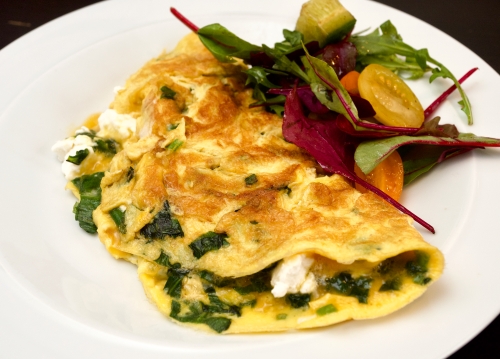
Wild Garlic Omelette with goats cheese

We just loved this simple omelette with lots of wild garlic and some melting goat’s cheese. You could leave the goat’s cheese out and it would still be a super supper dish with some salad and crusty bread.

Wild Garlic & Goat’s Cheese Omelette – serves 2

  • a good handful of wild garlic leaves – about 50g
  • 4 large eggs, lightly beaten (beat 2 eggs in 2 separate cups for ease)
  • 25g butter
  • 50g goat’s cheese crumbled

Finely shred the wild garlic and season the eggs.

Heat half the butter in a nonstick frying pan. Add half the wild garlic and wild for about 20 seconds, then add half the eggs. Leave for about 15 seconds, then tilt the pan and gradually scrape up the set bits of omelette around the edge into the middle of the pan, letting the raw egg run out to the edges.

When the omelette is still a bit liquid on top but set underneath, put half the cheese over one half. Fold the other half over the filling, then let the cheese melt for about 20 seconds before turning out onto a warm plate.

Repeat with the remaining ingredients to make another omelette, then serve right away.

(Original recipe from Food from Plenty by Diana Henry, Mitchell Beazley, 2010.)

Read Full Post »

Roast drumsticks with parsley and garlic

The title is a little bit deceptive as you don’t actually need to put these in the oven. They are very cheap and tasty and especially good with some potatoes and green veg. We’ve given the recipe to feed four people but we used just four drumsticks to feed two and scaled down the extra bits slightly and it worked perfectly.

Wine Suggestion: We had a simple, unoaked Viura (the grape used in white Rioja) from Castilla in Spain and the flinty texture and balance between fruit, freshness and a lighter body worked even better than we hoped.

Roast chicken drumsticks with parsley & garlic – serves 4

  • 1 tbsp olive oil
  • 4 tbsp butter
  • 12-16 chicken drumsticks
  • 3 garlic cloves, finely chopped
  • 2 tbsp parsley, chopped
  • 1 tbsp lemon juice

Season the drumsticks generously with salt and pepper.

Heat a large, heavy-based casserole with a lid or a frying pan over a medium heat. Add the oil and half the butter. When the butter is foaming, add the drumsticks, and fry until browned all over.

Cover the pan with a lid and continue to fry gently for 20-25 minutes, turning often. Remove the lid and add the rest of the butter, the garlic, parsley and lemon juice. Remove the pan from the heat and rest for a few minutes before serving.

(Original recipe by Paul & Jeanne Rankin IN: BBC Good Food Magazine, March 2014.)

Read Full Post »

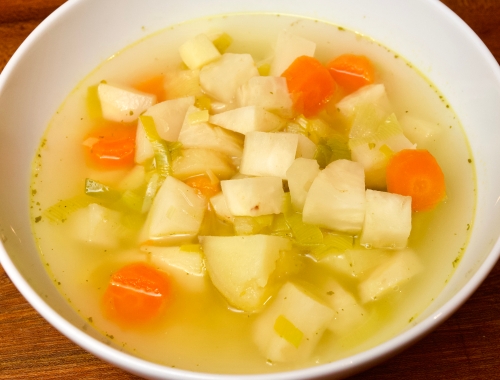
Winter root vegetable soup

So here we are almost March and we are experiencing an artic blast. The snow is piled up at the back door and Dubliners have been advised to stay indoors tomorrow as more is on the way. Soup seems like our only defence. Nothing fancy here but full of fresh vegetable flavours. It will protect you against almost all weather eventualities, or at least both fill and warm you up.

Winter Root Vegetable Soup – serves 6 to 8

  • 1 tbsp butter
  • 1 onion, chopped
  • 1 leek, sliced
  • 2 potatoes, peeled and chopped
  • 2 litres vegetable stock
  • 2 carrots, chopped
  • 1 parsnip, chopped
  • 1 small celeriac, peeled and chopped

Melt the butter in a large pot over a medium to high heat. As soon as it has melted and started to froth, add the onion, leek and potatoes. Sauté for a couple of minutes, then cover and sweat over a low heat for 8 minutes.

Add the stock, the rest of the vegetables and some salt and pepper (white pepper would be our preference), then lower the heat and simmer for about 20 minutes, partially covered. Taste the vegetables to check that they are completely soft, then check the seasoning before serving.

(Original recipe from Fresh by Donal Skeehan, Hodder & Stoughton, 2015.)

Read Full Post »

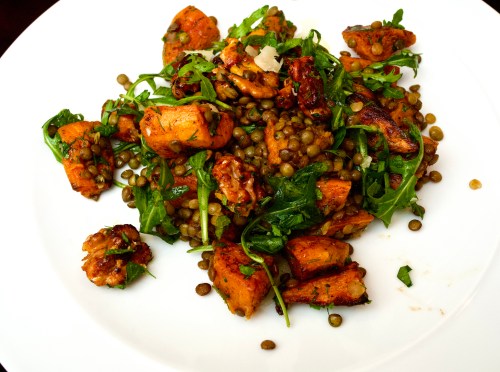
Spiced Sweet Potato, Puy Lentils and Rocket with Honey-roasted Walnuts

We picked up an amazing salad book, called Community, on our last trip to Australia which really pushes salad to centre stage. The recipes can all be served as a main course or as a side and they portions are accordingly generous. This one is good but the predominant flavour is honey so if that’s not your thing then perhaps give it a miss. We thought it might be nice with some roast pork.

The honey-roasted walnuts are a nice snack on their own too, so don’t be afraid of making too many.

Wine Suggestion: We went a little left-field for this and opened a Colterenzio Lagrein, a spicy, earthy red from Alto Adige – Südtirol; choose something a little earthy with a little spice and good fruit.

Spiced sweet potato, puy lentils and rocket with honey-roasted walnuts – serves 4 to 6

  • 2 kg sweet potatoes, peeled and cut into 2 cm cubes
  • 2-3 tbsp extra virgin olive oil
  • ½ tsp ground nutmeg
  • 1 tsp ground cinnamon
  • 2 tsp ground cumin
  • ½ tsp ground allspice
  • sea salt and black pepper
  • 250g Puy lentils, rinsed
  • 1 x 250 ml cup of soft herbs e.g. mint, parsley, chervil, tarragon, chives, dill or coriander – finely chopped
  • 2 x 250ml cups of  baby rocket leaves
  • 50g Parmesan, shaved

SWEET VINAIGRETTE:

  • 1 tbsp honey
  • 1 garlic clove, crushed
  • 2 tbsp red wine vinegar
  • 4 tbsp extra virgin olive oil

HONEY-ROASTED WALNUTS:

  • 2 tbsp honey
  • ¼ tsp dried chilli flakes
  • ½ tsp turmeric
  • pinch sea salt
  • 2 x 250ml cups walnuts

Preheat the oven to 200C.

Combine the sweet potato, olive oil, nutmeg, cinnamon, cumin and allspice in a large bowl with some salt and pepper. Roast for 30 minutes or until tender and turning golden.

Bring a large pot of water to the boil, then simmer the lentils for about 20 minutes or until tender but still with a little bite. Drain.

Whisk together all the ingredients for the sweet vinaigrette and season with salt and pepper. Stir the vinaigrette through the lentils while they’re still warm.

To prepare the honey-roasted walnuts, combine the honey with the chilli flakes, turmeric, salt and just enough water to make a thick paste. Toss the walnuts in the paste and spread over a baking tray. Roast for 15 minutes or until they are crunchy. They will still be a bit sticky. Watch very carefully after the first 10 minute as they can go from toasted to burnt in seconds.

Combine half the chopped herbs with the rocket, sweet potato and lentils and season well. Scatter over the walnuts, the remaining herbs and the Parmesan before serving.

(Original recipe from Community: Salad recipes from Arthur Street Kitchen by Hetty McKinnon, Pan Macmillan Australia, 2014.)

Read Full Post »

Easy lamb kebabs

These definitely taste best off a barbecue but if you’re not up for that in February then you could cook them on a griddle pan instead. Marinade the lamb up to a day in advance if you can.

Wine Suggestion: A juicy Californian Zinfandel or Italian Primitivo; cheers!

Easiest ever lamb kebabs – serves 4

  • 600g lamb neck fillet, cut into 2cm chunks
  • 2 tbsp olive oil
  • 1 tsp dried oregano
  • 2 red onions, cut into small wedges

Heat the barbecue or griddle pan.

Put the lamb into a large bowl and toss with the oil and oregano. Season with salt and pepper, then set aside for as long as you can (overnight ideally).

Thread alternate pieces of lamb and onions onto metal skewers (you can use wooden skewers either but you need to soak them in cold water for about 20 minutes so they don’t catch fire).

Cook the skewers for about 8 minutes, turning regularly.


Read Full Post »

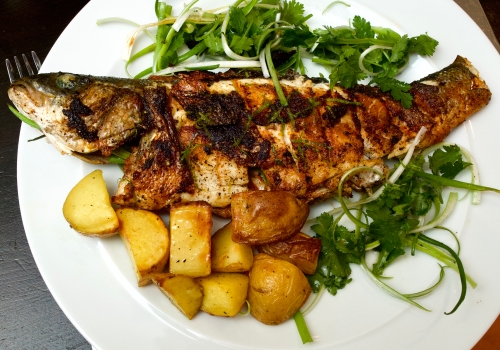
Thai-style crispy Sea bass

This was a  delicious Friday night feast and oh so simple! Serve with some roast new potatoes.

Wine Suggestion: Although not a regular choice we had a Pinot Grigio by Bonotto delle Tezze in our fridge and it was a pleasant surprise in how well it went with this dish. However, we shouldn’t have been surprised as it has all the elements you’d need to look out for: round and generous fruit to work with the spice, and a freshness and texture despite having moderate acidity.

Thai-style crispy sea bass – serves 2

  • 4 scallions
  • ½ a bunch of coriander – about 15g
  • 2 x 300g whole sea bass, scaled, gutted & trimmed
  • 2 tbsp Thai red curry paste
  • 1 lime

Trim and halve the scallions, then finely shred lengthways and put into a bowl of ice-cold water to crisp up. Pick in the coriander leaves and reserve the stalks.

Score the sea bass at 2cm intervals, then rub all over with the curry paste including inside the cavity. Put the coriander stalks into the cavities and season with salt and pepper.

Put a large non-stick frying pan over a medium-heat. When the pan is hot add a tbsp of oil and cook the fish for 3 to 4 minutes per side or until dark golden and cooked through.

Drain and shake the water off the scallions & coriander then pile onto two plates. Place the sea bass on top and spoon over any spicy oil from the pan. Finely grate over the lime zest and squeeze over some juice to serve.

(Original recipe from 5 Ingredients by Jamie Oliver, Michael Joseph, 2017.)
Read Full Post »

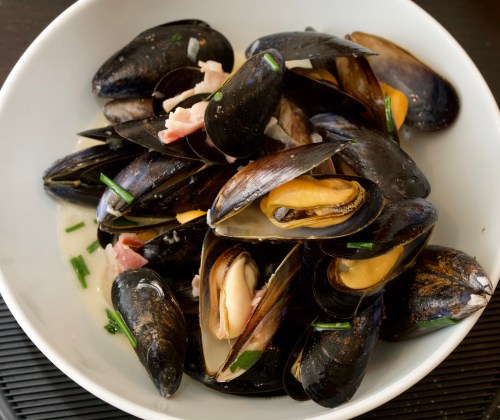
Mussels cooked in cider

There’s been a bottle of Normandy Cider in our fridge door and we’ve been saving it for a dish like this. Fabulous and fresh for a Friday night with lots of crusty baguette. Serve with a generous glass of cider.

Mussels cooked in Cider – serves 4

  • 2.5kg mussels
  • 15g butter
  • 1 onion, peeled and finely chopped
  • 3 garlic cloves, peeled and finely grated or crushed
  • 6 rashers of rindless streaky bacon, cut into small pieces
  • 400ml dry cider
  • 100ml double cream
  • 1 tbsp finely chopped parsley
  • 1 tbsp finely chopped chives

Scrub the mussels and remove any barnacles and beards. Throw away any open shells that don’t close when you tap them on the edge of the sink.

Put a large saucepan over a medium heat. Melt the butter in the warm pan, then add the onion, garlic & bacon and cook gently for about 6 minutes or until the onion is softened.

Pour in the cider, bring to a simmer and simmer for a minute before adding the mussels and covering with a tight-fitting lids. Turn the heat up hight and cook for 3-4 minutes until the mussels have opened, giving the pan a shake occasionally. Throw away any mussels that haven’t opened.

Drain the mussels in a colander over a bowl to catch the cooking liquid, then return to the pot to keep warm. Pour the cooking juices through a sieve into a pan, add the cream and herbs and bring to the boil, seasoning with salt & pepper.

Divide the mussels between 4 bowls and pour over the hot sauce, then serve with crusty bread.

(Original recipe from Rachel’s Everyday Kitchen by Rachel Allen, Harper Collins, 2013.)

Read Full Post »

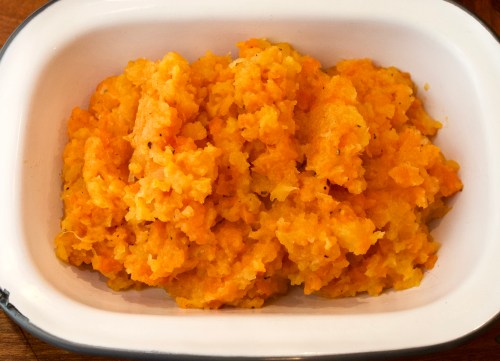
Carrot and turnip mash

At home in Northern Ireland we call swedes turnips and we’re much more likely to make carrot & parsnip mash. Here in Dublin people serve us mashed carrot and swede which is pretty good too. Serve with meat dishes.

Mashed carrots & swedes – serves 4

  • 300g carrots, chopped small
  • 200g swede, chopped small
  • 25g butter
  • 1 tsp light brown sugar
  • pinch of grated nutmeg

Boil the vegetables in a large pan of boiling salted water for about 20 minutes or until soft. Drain well and return to the pan. Add the butter, sugar and nutmeg and mash together well.

Read Full Post »

Fried Jerusalem Artichokes with Walnuts

These knobbly little tubers are plentiful at this time of year and most often turn up in soups. We wanted to try something different so cooked this tasty side dish. We had hoped to serve it with some roast Guinea Fowl but had to make do with a roast chicken and some super-charged gravy. Definitely the nicest Jerusalem artichoke dish we’ve tasted and the perfect seasonal side for a roast dinner.

Fried Jerusalem artichokes with walnuts – serves 4

  • 850g Jerusalem artichokes
  • 5 tbsp olive oil
  • 1 tsp golden caster sugar
  • 85g walnut halves
  • 1 fat garlic cloves, finely chopped
  • handful parsley leaves, chopped

Peel the artichokes with a small knife and slice into chunks. Cook in a pan of boiling water for about 5 minutes, or until just tender, then drain.

Heat the oil in a heavy frying pan and sauté the artichokes for 10 minutes or as long as it takes to turn them golden and starting to crisp. Add the sugar, season with salt and pepper, then add the walnuts. Keep cooking until the walnuts are toasted, then toss in the garlic and parsley and toss for about a minute before serving.

(Original recipe by Greg Wallace IN: BBC Good Food Magazine, January 2007.)


Read Full Post »

This is really tasty and aromatic and much quicker to prepare than most tagine. You can serve with some plain buttered couscous but the Golden Couscous below is particularly good and the two brightly coloured dishes look fab when served in a bowl and scattered with fresh herbs.

Wine Suggestion: we love the wines from Lebanon as they tend to go well with the cuisine of the Middle East and North Africa. For this dish we opened the Massaya Terrasses de Baalbeck, a blend of Grenache, Mourvedre and Syrah from the slopes of Mount Lebanon, above the Temple of Baalbeck. Earthy spice and pure, it provided a nice lift to the drizzly days we’ve had recently.

Lamb kofta tagine – serves 4 to 6

  • 1 tbsp olive oil
  • 15g butter
  • 1 onion, chopped
  • 2-3 garlic cloves, crushed
  • 2 tsp finely chopped root ginger
  • ½ red chilli pepper, deseeded and finely chopped
  • 2 tsp ground turmeric
  • 2 tbsp lemon juice
  • 2 tbsp chopped coriander
  • 1 x 400g tin chopped tomatoes
  • 1 tsp sugar
  • 2 tbsp chopped mint

FOR THE KOFTA:

  • 500g lamb mince
  • 125g very finely chopped onion
  • 2 tbsp chopped parsley
  • 1 tsp ground cinnamon
  • 1 tsp ground cumin
  • 1 tsp ground coriander
  • ¼ tsp cardamom seeds (crush some green cardamom pods with a pestle & mortar or the end of a rolling pin to get the seeds)
  • ½ tsp paprika

Preheat the oven to 150°C/300ºF/Gas 2.

Put the oil and butter into a large casserole dish over a medium heat. When the butter has melted, add the onion, garlic, ginger and chilli and cook for 6-8 minutes or until starting to turn a light golden colour.

Stir in the turmeric, 1 tbsp of the lemon juice and half the chopped coriander. Add the tin of tomatoes and the sugar, then bring to the boil. Lower the heat and simmer with a lid on for 10 minutes.

Meanwhile make the kofta by placing all of the ingredients into a large bowl and seasoning with salt and black pepper. Mix together well using your hands, then roll into about 30 small balls.

Carefully lower the koftas into the pot with a spoon and gently roll them to cover in the sauce, then cook in the oven for 20 minutes. Season to taste, then stir in the remaining lemon juice and sprinkle with the chopped mint and coriander.

(Original recipe from Rachel’s Everyday Kitchen, HarperCollins, 2013.)

Lamb Kofta Tagine with Golden Couscous

Read Full Post »

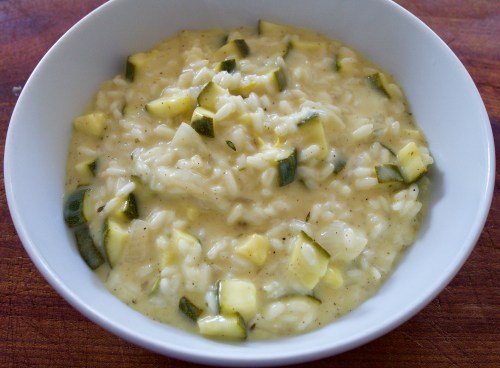
Cauliflower risotto

Using one of our favourite vegetables, that strangely we haven’t cooked for a while. Perfect comfort food for chilly evenings.

Wine Suggestion:  not as easy to suggest a wine as we thought given the conflicting flavours but we found that the Quinta Soalheiro Alvarinho Reserva a surprisingly good match. This combined a vibrant freshness with a layer of subtle oak, mineral nuttiness from the fine lees and a textured persistence that both balanced the food and didn’t overwhelm it. This wine continues to surprise with it’s quality and brilliance.

Cauliflower, leek & blue cheese risotto – serves 4

  • ½ a head of cauliflower, broken into florets
  • 25g butter
  • 2 leeks, cut into rings and washed thoroughly
  • 250g risotto rice
  • 1 litre hot chicken stock
  • 25g Parmesan cheese
  • 100g creamy blue cheese, e.g. Cashel blue or dolcelatte, broken into small chunks

Cook the cauliflower florets in boiling salted water until just tender, then drain well and set aside.

Melt the butter in a saucepan and cook the leeks over a low heat for about 10 minutes or until soft. Add the risotto rice and stir around until glistening with the butter. Now add the hot stock a ladleful at a time, stirring continuously until each has been absorbed before adding another. It should take about 25 minutes to add all of the liquid and by this time the rice should be cooked. A few minutes before the end, carefully stir in the cooked cauliflower and stir gently so you don’t break it up to much, then add the Parmesan and blue cheese.

(Original recipe from Food from Plenty by Diana Henry, Mitchell Beazley, 2011.)


Read Full Post »

Sweet potato vindaloo

It hasn’t happened just yet but there will come a time when we will grow tired of all the winter root veg and will be hankering for spring and some lighter dishes. If you start to feel this way we recommend turning to cookbooks inspired by India which often contain some of the most interesting and delicious veggie dishes. Don’t be put off by the fiery connotations of ‘vindaloo’, this is a spicy dish but nothing too scary and is tamed by the additions of fluffy white rice and cool yoghurt.

Sweet potato vindaloo – serves 4

  • 4 tbsp rapeseed oil
  • 6 cloves
  • 1 star anise
  • 20 black peppercorns
  • 1 cinnamon stick
  • 2 tsp cumin seeds
  • 6 cloves of garlic, crushed
  • 4cm piece of ginger, peeled and grated
  • 5 tbsp white wine vinegar
  • ¾ tbsp chilli powder (feel free to adjust to your own tolerance level)
  • 2 medium onions, finely sliced
  • 1 tsp salt
  • 1 tsp sugar
  • 1 x 400g tin of plum tomatoes
  • 1kg sweet potatoes, peeled and cut into bite-size cubes
  • yoghurt, to serve
  • steamed white basmati rice, to serve

Heat 1 tbsp of the oil in a large frying (for which you have a lid) over a medium heat, then add the cloves, star anise, black peppercorns, cinnamon stick and cumin seeds. Stir-fry for a couple of minutes until fragrant and then remove from the heat and grind in a spice grinder or pestle and mortar. Add the garlic, ginger & vinegar and continue to grind to a smooth paste, then mix in the chilli powder.

Heat the remaining 3 tbsp of oil in the same pan over a medium heat, then add the onions. Cook for 15 minutes or more until brown and caramelised. Add the spice paste, salt and sugar, then cook for another couple of minutes before tipping in the tomatoes and crushing with a wooden spoon. Fill the empty tomato tin half full with water and add to the pan. Cover the pan with a lid and cook for around 5 minutes, then add the sweet potatoes.

Bring the curry to the boil, then cover and simmer for 20 to 25 minutes or until the sweet potato is completely tender. Serve with cool natural yoghurt and hot basmati rice.

(Original recipe from Fresh India by Meera Sodha, Penguin, 2016.)

Read Full Post »

Winter minestrone

We’re never in our own house for Christmas as we travel up north to be with family. That doesn’t stop us on insisting that the stock left in the pot in which the ham was cooked, goes into the freezer ready for us to take home and make minestrone with. The perfect foil for all the over-indulgence in the days preceding.

Winter Minestrone – serves 6

  • 500g cavolo nero, remove any thicker stalks and shred thickly
  • 1 large onion, diced
  • 3 ribs of celery, diced, with a few leaves
  • 6 tbsp olive oil
  • 400g pumpkin/squash flesh, peeled and cut into 1cm chunks
  • 1 potato
  • 400g cooked white beans – we used a tin of cannellini beans
  • 1.5 litres of ham stock, water or bean broth (if you’ve cooked dried beans)
  • A parmesan rind (always good to keep in the fridge to add extra depth of flavour to soups)
  • A small sprig of sage
  • Freshly grated Parmesan, to serve

Wash the cavolo nero, strip any particularly thick stems from the leaves and roughly chop. Roll up the leaves and shred thickly.

Heat the olive oil in a large heavy-based pan and slowly fry the onion and celery with a pinch of salt, until soft, about 8 minutes.

Add the pumpkin/squash to the pan along with the cavolo nero stems and a tiny pinch of salt, stirring until each chunk glistens with oil. Add half the cavolo nero leaves, half the beans, the water and the parmesan rind.

Turn up the heat so the soup is almost boiling, then reduce to a simmer for 30 minutes or until the vegetables are tender. Five minutes before the end of the cooking time, add the rest of the cavolo nero and beans. Taste and season, then add the chopped sage. Allow it to sit for 5 minutes, then serve with some freshly grated Parmesan.

(Original recipe by Rachel Roddy in The Guardian24th November 2017.)

Read Full Post »


Pepper crusted Salmon with garlic chickpeasWe really liked this simple fish dish and the garlic chickpeas are delicious! Nice and easy for a Friday night.

Wine Suggestion: We opened a Muscadet, as it was in the fridge and they typically work with fish and seafood. That said we weren’t sure it would hold up to the stronger salmon, pepper and spices but were refreshingly surprised at how it more than held it’s own.

Pepper-crusted salmon with garlic & chickpeas – serves 4

  • 4 skinless salmon fillets, about 150g
  • 2 tsp black peppercorns
  • 1 tsp paprika
  • grated zest and juice of 2 limes
  • 1 tbsp olive oil

FOR THE CHICKPEAS:

  • 2 x 400g tins chickpeas
  • 3 tbsp olive oil
  • 2 garlic cloves, finely chopped
  • 150ml vegetable stock
  • 130g bag baby spinach

Heat oven to 190C/Fan 170C/Gas 5.

Put the salmon into a shallow ovenproof dish in a single layer. Roughly crush the peppercorns with a pestle and mortar, then mix with the paprika, lime zest and some sea salt.

Brush the salmon lightly with oil, then sprinkle over the pepper mix. Bake for 12-15 minutes or until the salmon is just cooked.

Meanwhile, drain the chickpeas and rinse well under cold water, then drain. Heat the oil in a pan, then add the garlic and cook gently for 5 minutes without browning. Add the chickpeas and stock and warm gently. Crush the chickpeas lightly with a potato masher, then add the spinach and stir well until the leaves are wilted. Add the lime juice and some salt and pepper, then heat through before serving with the salmon. Serve a lime wedge on the side if you like.

(Original recipe by Dhruv Baker in BBC Good Food Magazine, December 2008.)

Read Full Post »

Potato soup

An invaluable recipe especially in Ireland as we always seem to have surplus potatoes lying around. This is what we cook when ‘there’s no food in the house’ and it’s pretty good.

Potato and fresh herb soup – serves 6

  • 50g butter
  • 425g potatoes, peeled and cut into 1cm cubes
  • 110g onions, cut into 1cm cubes
  • 1 tsp salt
  • 1 tbsp chopped herbs: parsley, thyme, chives
  • 850ml chicken or vegetable stock
  • 125ml creamy milk

Melt the butter in a heavy saucepan. Wait until it starts to foam, then add the potatoes and onions and stir to coat in the butter. Add the salt and some black pepper. Cover with a butter wrapper or some greaseproof paper and the saucepan lid. Sweat gently for about 10 minutes while you bring the stock to the boil in a separate pan.

When the vegetables are softened but not coloured, add the herbs and stock, then continue to cook until the vegetables are completely soft. Whizz the soup until smooth and season to taste. Thin with some creamy milk if necessary and garnish with some more herbs.

(Original recipe from Darina Allen’s Ballymaloe Cookery Course, Kyle Cathie Ltd., 2001.)

Read Full Post »

Swedish spinach and butterball soup

We loved this spinach soup with and without the melting butterballs, which are a nice addition but by no means essential. Green soup makes us feel good about ourselves (even if there is some cream and butter in it).

Swedish spinach soup with egg butterballs – serves 6

FOR THE BUTTERBALLS:

  • 115g butter
  • yolks of 3 hard-boiled eggs

FOR THE SOUP:

  • 25g butter
  • 1 onion, finely chopped
  • 40g long-grain white rice
  • 1 litre chicken stock
  • 500g spinach
  • 150ml double cream
  • juice of ½ lemon

To make the butterballs, mash the butter and egg yolks together and season with salt and black pepper. Roll into 2.5cm balls, then cover with clingfilm and put into your fridge.

To make the soup, melt the butter in a large saucepan and sweat the onion over a low heat with the lid on for about 10 minutes or until soft but not coloured. Add a splash of water if the pan looks dry. Add the rice and stock and bring to the boil, then simmer for 15 minutes. Add the spinach and push down into the pan with a wooden spoon as it wilts. Bring to the boil, season and cook for 6 minutes, stirring, then cool.

Whizz the soup until smooth, then add the cream. Return to a saucepan to heat and add a squeeze of lemon juice and adjust the seasoning if necessary. Serve hot with the melting butterballs on top.

(Original recipe from Food From Plenty by Diana Henry, Mitchell Beazley, 2011.)

Read Full Post »

« Newer Posts - Older Posts »