Feeds:
Posts
Comments

Archive for the ‘Asian’ Category

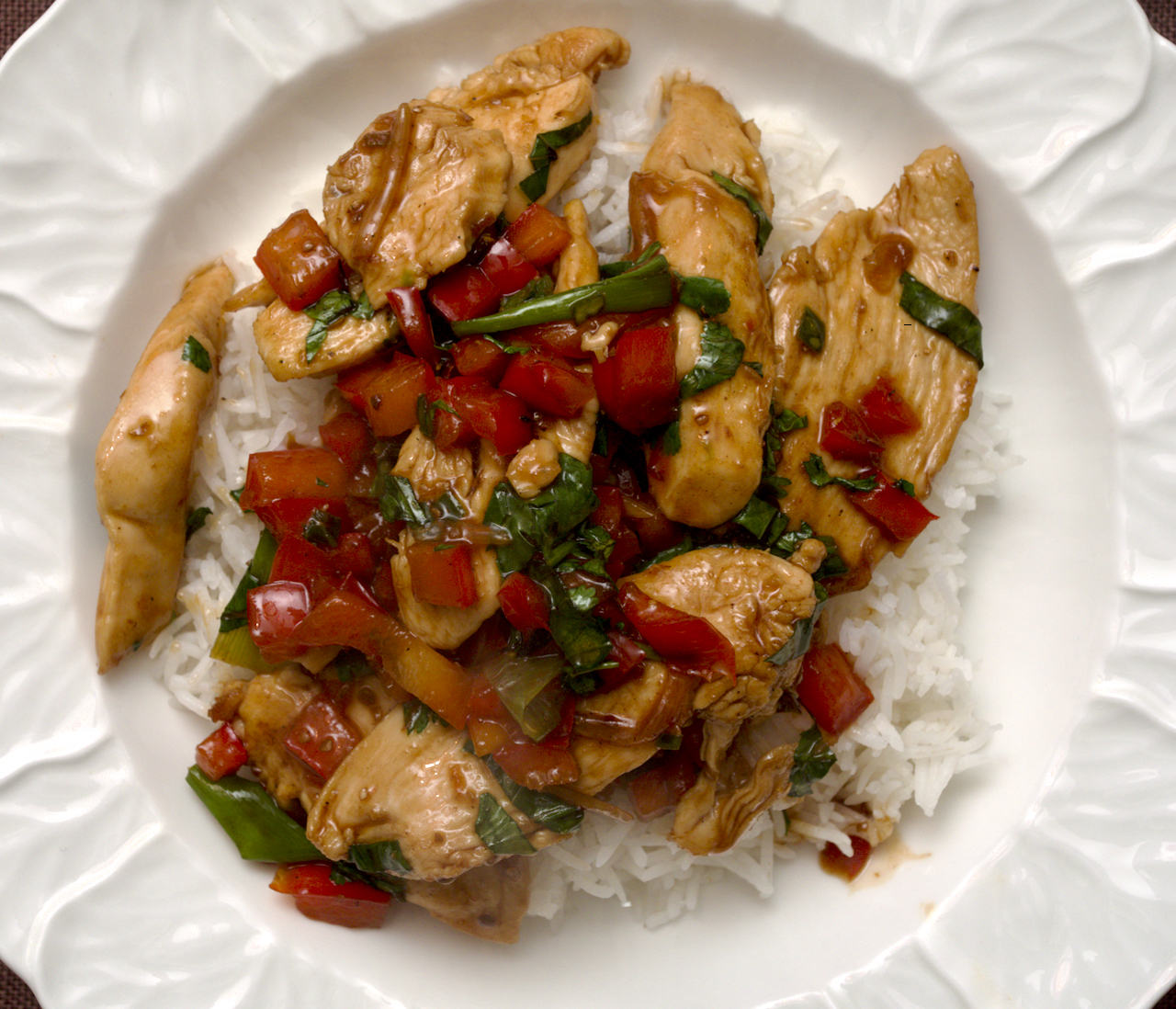
A tasty and colourful dish which we have also successfully cooked with pork fillet so feel free to try that either. The Thai basil makes this dish so we only every make it when we can get that.

Wine Suggestion: Thai basil brings an herbaceousness that we think goes with red Northern Rhone or Burgundy, especially if there’s a little whole bunch fermentation. So for this dish we opened an bottle of Domaine Jamet’s Cotes du Rhone rouge which is made from Syrah grown on the upper slopes around Cote Rotie and with some whole bunch. A wine that benefits from 6 to 12 months in the bottle this had a smoothness, earthiness and well integrated tannins as well as remaining fresh and weightless so not to overwhelm the food.

Thai Chicken with Basil – serves 3

  • 2 tbsp vegetable oil
  • 2 skinless chicken breasts, cut into strips
  • 1 Thai green chilli, deseeded and finely chopped
  • 2 cloves of garlic, julienned
  • 1 tbsp sesame oil
  • 1 medium red pepper, deseeded and diced into 1cm pieces
  • 3 scallions, cut into 5cm pieces
  • 1 tsp freshly roasted and ground coriander
  • 1 tbsp palm sugar or soft brown sugar
  • 1 tsp cornflour
  • 2 tbsp fish sauce (nam pla)
  • 1 tbsp light soy sauce
  • 7g fresh Thai basil, shredded
  • plain rice and fresh coriander, to serve

Heat a tbsp of the vegetable oil in a wok over a high heat, then add half the chicken strips. Add the green chilli and garlic and stir-fry for about 5 minutes or until the chicken has changed colour. Sprinkle with a little of the sesame oil, then remove to a plate.

Add the remaining tbsp of vegetable oil to the wok, then add the red pepper, scallions, ground coriander and sugar. Stir-fry for 2 minutes, then add the chicken.

Mix the cornflour with the fish sauce and soy until smooth, then pour into the pan, stirring constantly for a minute or until the juices thicken slightly. Sprinkle with the remaining sesame oil. Toss in the basil, season to taste and serve with plain rice and lots of chopped coriander.

(Original recipe from Grow, Cook, Nourish by Darina Allen, Kyle Books, 2017.)
Read Full Post »

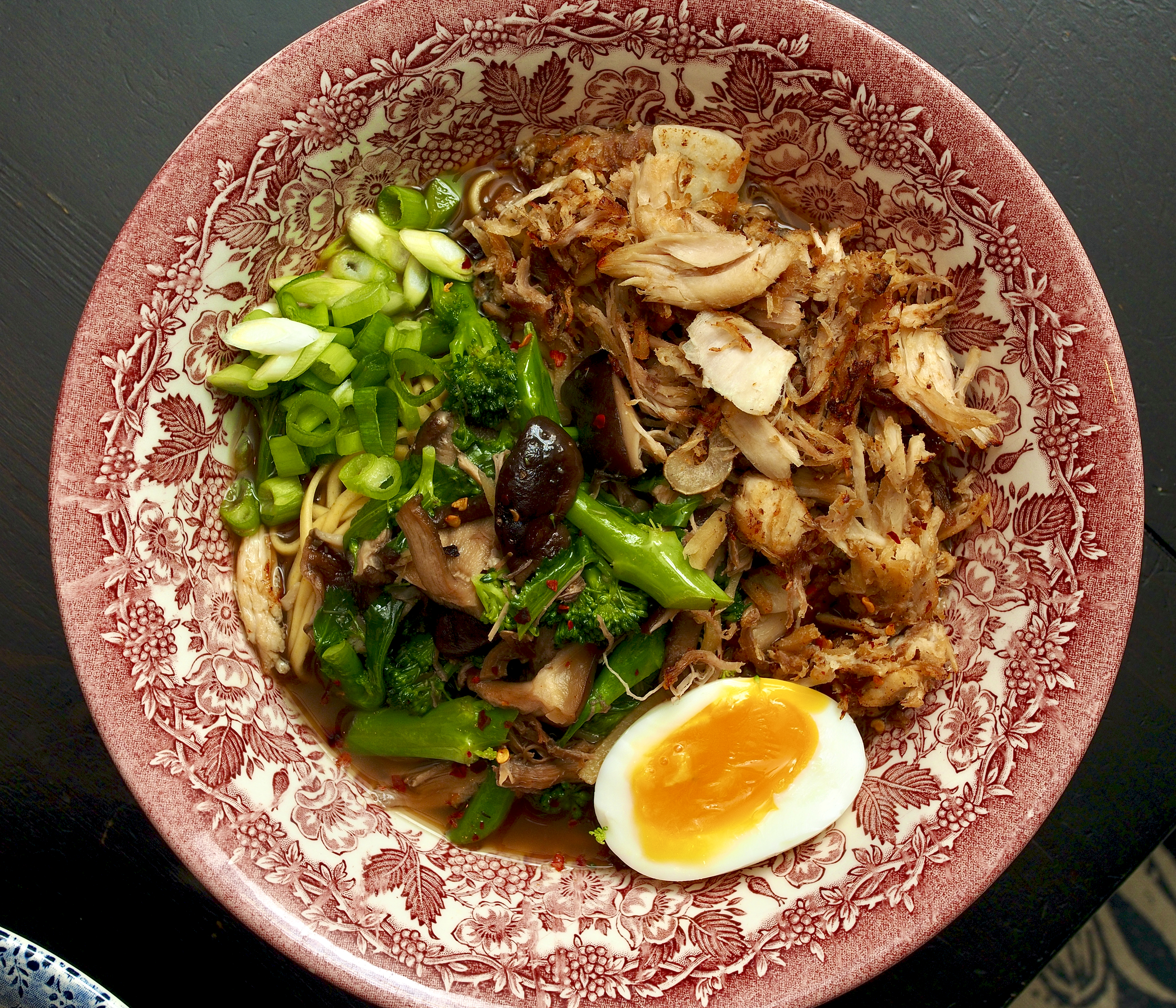
So, here’s what you have to do. Speak to whoever is cooking the Christmas turkey and tell them to save you the carcass. Break it into pieces, stuff it into a bag and put it in the fridge,  you can deal with it later. You will also need some turkey meat, about 400g, but any scraps will do, so you don’t have to take the prime cuts. Some day later in January you will be very pleased with yourself when you make this delicious ramen.

You can make the stock and freeze ahead, which is what we do. We also freeze the right quantity of meat in a freezer bag.

Wine Suggestion: This is lovely with a juicy, youthful Grenache, but avoid the big alcohol ones; look for warm spices but not a hot palate. There are some gems coming out of the Languedoc at the moment and Domaine Gayda’s Grenache had a real purity and lovely depth; the gentle tannins complimenting the turkey well.

Turkey ramen – serves 4

  • a thumb-sized piece of ginger, shredded
  • 3 tbsp soy sauce
  • 150g shiitake mushrooms, halved and quartered
  • 250g long-stemmed broccoli, cut into bite-sized pieces
  • 2 x 275g packs ready-cooked egg noodles (or cook your own and run under cold water to stop the cooking process)
  • 1½ tbsp toasted sesame oil
  • 400g cooked turkey meat, shredded
  • 2 cloves of garlic, thinly sliced
  • 2 tbsp white miso
  • 2 scallions, thinly sliced
  • a good pinch of dried chilli flakes
  • 2 soft-boiled eggs, halved (to soft boil, add the eggs to boiling water, then boil for 6½ minutes and peel under a cold running tap)
  • sriracha sauce, to serve (optional)

FOR THE TURKEY STOCK:

  • 1 turkey carcass, broken into pieces
  • 1 onion, quartered
  • 1 carrot, roughly chopped
  • 1 celery stick, roughly chopped
  • woody herbs e.g. bay leaf, thyme or rosemary

To make the stock, put the carcass into a large pan with the onion, carrot, celery and herbs. Add 2 litres of cold water and gently bring to the boil. Skim any fat or scum from the surface, then simmer for 1 hour.

Strain the stock through a fine sieve. When cooled, remove as much meat as possible from the carcass and discard the bones and vegetables. You can do this and freeze the stock and reserved meat for later.

When ready to make the ramen, bring the stock to the boil and add the ginger, soy sauce and mushrooms, and simmer for 20 minutes. Add the broccoli and cook for 2-3 minutes or until just tender.

Meanwhile, put the egg noodles into a colander and pour over a kettle of just-boiled water. Divide the noodles between 4 bowls. Ladle over the broccoli, mushrooms and stock.

Heat a non-stick frying pan over a high heat and add the sesame oil. Cook the turkey for 4-5 minutes or until starting to crisp, then add the garlic and cook for a minute. Add the miso and cook for a minute more. Divide the turkey between the 4 bowls, then finish with the scallions, chilli flakes and half a boiled egg. Drizzle over some sriracha sauce if you like.

(Original recipe by Adam Bush in Olive Magazine, Christmas, 2019)

Read Full Post »

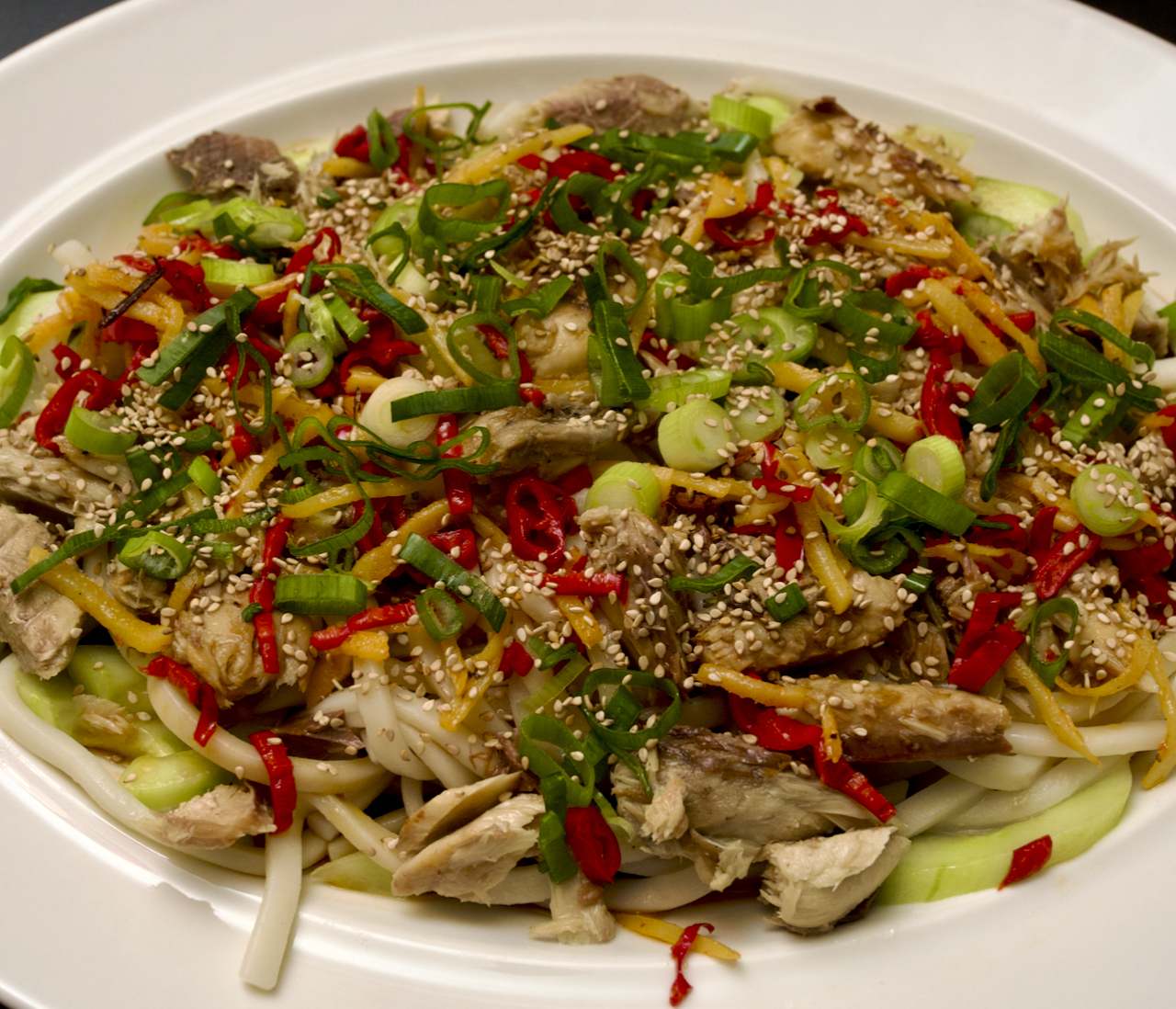
Amazing flavours in this super quick and easy dish. We’re loving pretty much every recipe that Ixta Belfrage has a hand in.

Wine Suggestion: A really hard one to match we thought, but we pulled out Dr Loosen’s Graacher Dry Riesling … a wine he has “declassified” from Grosses Gewächse (Great Growth) as the vines are only 15-20 years old … not old enough for Ernie Loosen! A wine of both elegance and power, with a crispness that balances any oilyness of the mackeral, and joyful fruit to match chillies, limes, soy and star anise.

Mackerel udon – serves 2

  • 1 medium cucumber, peeled, halved and seeds scooped out with a teaspoon
  • 1 tsp flaked salt
  • 2½ tbsp lime juice
  • 300g straight-to-wok fresh udon noodles (not dried)
  • 2 x 115g tins of mackerel in olive oil, drained and flaked into chunky pieces
  • 2 scallions, thinly sliced
  • 2 tsp black or white (or both) sesame seeds, toasted

FOR THE DRESSING:

  • 5 tbsp mild olive oil or sunflower oil
  • 40g ginger, peeled and julienned
  • 2 large mild red chillies, finely sliced into rounds (discard the seeds)
  • 2 whole star anise
  • 1 cinnamon stick, bashed with the side of a knife
  • 2 tbsp soy sauce
  • 1½ tbsp maple syrup
  • ¾ tsp toasted sesame oil

Cut the cucumber into half-centimetre diagonal slices. Put the cucumber in a bowl and mix with the flaked salt and lime juice. Set aside to pickle while you make the rest.

Put the udon noodles in a large bowl and, cover with boiling water, then drain well and set aside.

Put a heatproof sieve over a heatproof bowl and set aside.

Put the oil for the dressing into a medium saucepan over a medium heat and allow to get hot. Add the ginger, chillies, star anise and cinnamon and fry gently, stirring often, until the ginger is crisp and golden – about 5 minutes but watch carefully. Drain through the sieve and keep both the oil and the crispy aromatics.

Transfer 3 tbsp of the aromatic oil to a separate bowl along with the soy sauce, maple syrup and sesame oil.

Drain the cucumbers and toss with the warm noodles. Transfer them to a platter and top with the mackerel. Spoon over the dressing, followed by the crispy aromatics, scallions and sesame seeds. Serve with lime wedges on the side.

(Original recipe from Mezcla by Ixta Belfrage, Ebury Press, 2022.)

Read Full Post »

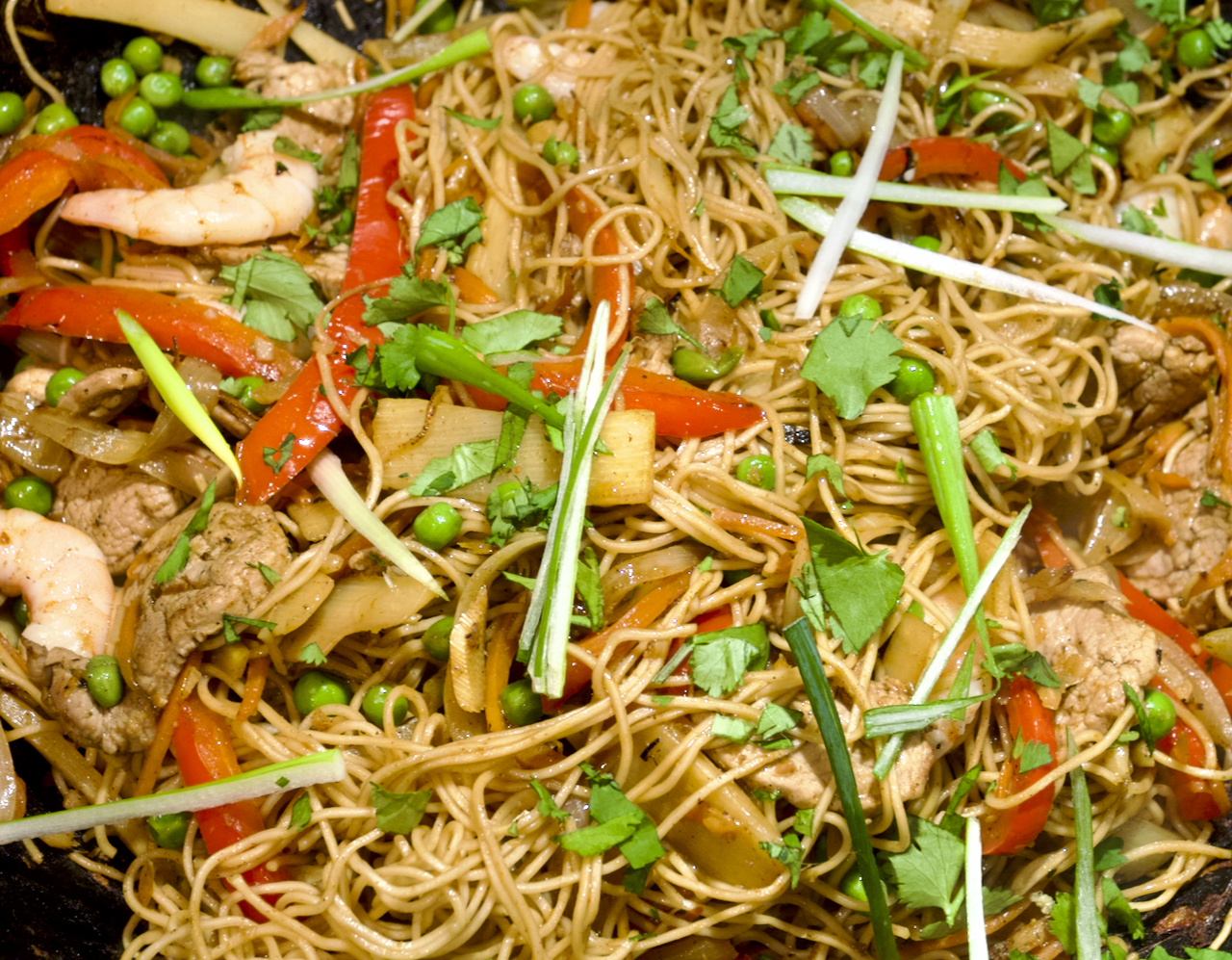
Made to satisfy our daughter’s constant craving for noodles … and much bettter than the packets she tries to make us buy. We recommend you prep everything before you start cooking.

Wine Suggestion: we think dry Pinot Gris is great with loads Asian foods and this is no different. From Nelson in NZ, Neudorf’s Tiritiri Pinot Gris is a charmer. Great fruit and lovely texture with gentle spices mean this combination is a winner.

Singapore Noodles – serves 4

  • 200g fine egg noodles or rice noodles
  • 2 tbsp veg oil
  • 1 onion, sliced into thin wedges
  • 1 carrot, cut into fine matchsticks (use a mandonline if you have one)
  • 1 red pepper, thinly sliced
  • 2 cloves of garlic, finely chopped
  • 10g fresh root ginger, finely chopped
  • 200g pork fillet, finely sliced
  • 225g tin bamboo shoots, drained
  • 100g frozen peas, defrosted
  • 1 tsp Chinese 5-spice powder
  • 2 tsp mild curry powder
  • 2 tbsl light soy sauce
  • 1 tbsp rice wine
  • 1 tbsp rice wine vinegar
  • 140g cooked shelled prawns

To garnish:

  • 1 tsp sesame oil
  • 2 scallions, finely shredded
  • 1 green or red chilli, finely sliced
  • chopped fresh coriander
  • soy sauce, to serve

Cover the noodles with freshly boiled water and leave to stand for a minute, then drain and set aside.

Heat the oil in a large work. Add the onion, carrot and red pepper and stir-fry over a high heat until they’re starting to brown. Add the garlic, ginger and pork and continue to stir-fry until the pork is coloured on all sides. Tip in the bamboo shoots, peas, spices, soy sauce, rice wine and rice wine vinegar, then add the noodles and stir to combine (chopsticks are good for separating the noodles). Leave to cook for a couple of minutes until hot, then stir in the prawns and allow to heat through. Serve with the sesame oil, scallions, chilli and coriander over the top. We like ours with extra soy sauce.

(Original recipe from The Hairy Bikers’ One Pot Wonders by Si King & Dave Myers, Seven Dials, 2019.)

Read Full Post »

We made these noodles on the day we got our new puppy, Remy. We can barely remember what they tasted like as we were too busy congratulating ourselves on picking the best little dog ever. However we wrote, usefully, on the recipe that they tasted very good indeed … so we’ll go with that.

Wine Suggestion: The coconut and turmeric elements to this dish work really well with an off-dry Riesling, like those from the Mosel in Germany. The Dr Loosen “L” Riesling is an inexpensive, but very well made option with charming fruit and a very good balance, finishing clean and fresh.

Spicy Coconut and Chicken Noodles – serves 4

  • vegetable oil
  • 2 onions, roughly chopped
  • 600g boneless and skinless chicken thighs
  • 4 green cardamom pods, lightly crushed
  • 1 tsp cumin seeds
  • 2 tsp ground turmeric
  • 2 tbsp rose harissa
  • 400ml tin coconut milk
  • 300g medium egg noodles

TO SERVE:

  • a handful of bean sprouts
  • lime wedges
  • coriander leaves, roughly chopped

Put a large saucepan over a medium-high heat, drizzle in some vegetable oil and fry the onions until soft. Add the chicken and dry spices along with lots of salt and pepper and stir to coat the chicken in the mixture, then stir-fry for a few minutes. Add the harrisa and stir-fry for a few more minutes.

Reduce the heat to medium, then pour in the coconut milk and some water so that the chicken is just covered. Stir, then cover the pan with a lid and cook gently for an hour, stirring now and then to make sure it hasn’t stuck. You can top up the liquid a little if needed.

Cook the noodles according to the pack instructions, then drain and divide between 4 bowls.

Pour the chicken over the cooked noodles, then add the bean sprouts, lime wedges and coriander.

(Original recipe from Flavour by Sabrina Ghayour, Aster*, 2023.)

Read Full Post »

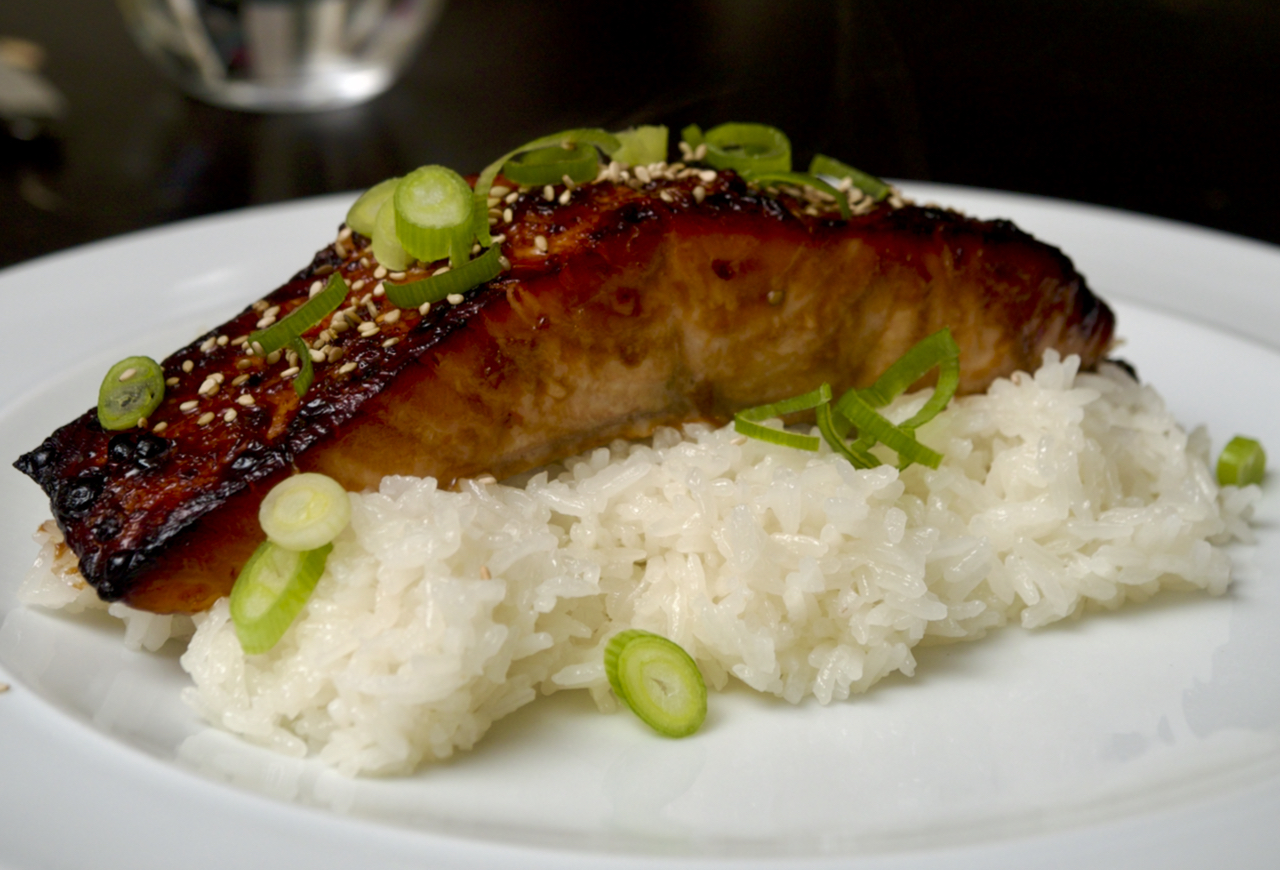
You need to marinade the salmon for 30 minutes or up to 24 hours ahead. After that, it’s dinner in 15 minutes. We served with with some sticky rice and dressed Asian greens.

Wine Suggestion: This works with a good Pinot Gris, like Neudorf’s Tiritiri. An underestimated grape, given the oceans of bland Pinot Grigio sold, but in the right hands … the riper, richer and more textural French styled Pinot Gris is a joy. Neudorf’s version is all about mouth feel: depth, viscosity, and richness while staying deliciously clean and deceptively moreish. And the back-bone is a fresh, salty-stoney texture keeping it all clean and vibrant.

Sticky glazed salmon – serves 2-3

  • 2-3 salmon fillets
  • rapeseed oil spray

FOR THE MARINADE:

  • 1 tsp finely grated ginger
  • 1 garlic clove, finely grated
  • 1 tbsp soy sauce
  • 2 tbsp oyster sauce
  • 2 tbsp sweet chilli sauce

TO SERVE

  • sesame seeds
  • 1 scallion, finely sliced

Mix all of the marinade ingredients together in a shallow dish, then add the salmon and turn to coat.

When you are ready to cook, heat the grill to high. Line a grill tray with tin foil and place the salmon fillets on top, skin-side down. Brush with the marinade but don’t pour if over as any on the tin foil will burn, discard any extra.

Put the salmon under the grill, about 15-20 cm away from the heat. Cook for 7 minutes, then remove and spray with the rapeseed oil. Put back under the grill for another 1-3 minutes or until nicely caramelised.

Allow the salmon to rest for 5 minutes before serving with the scallions and sesame seeds scattered over.

(Original recipe from Recipetin Eats Dinner by Nagi Maehashi, Pan MacMillan, 2022.)

Read Full Post »

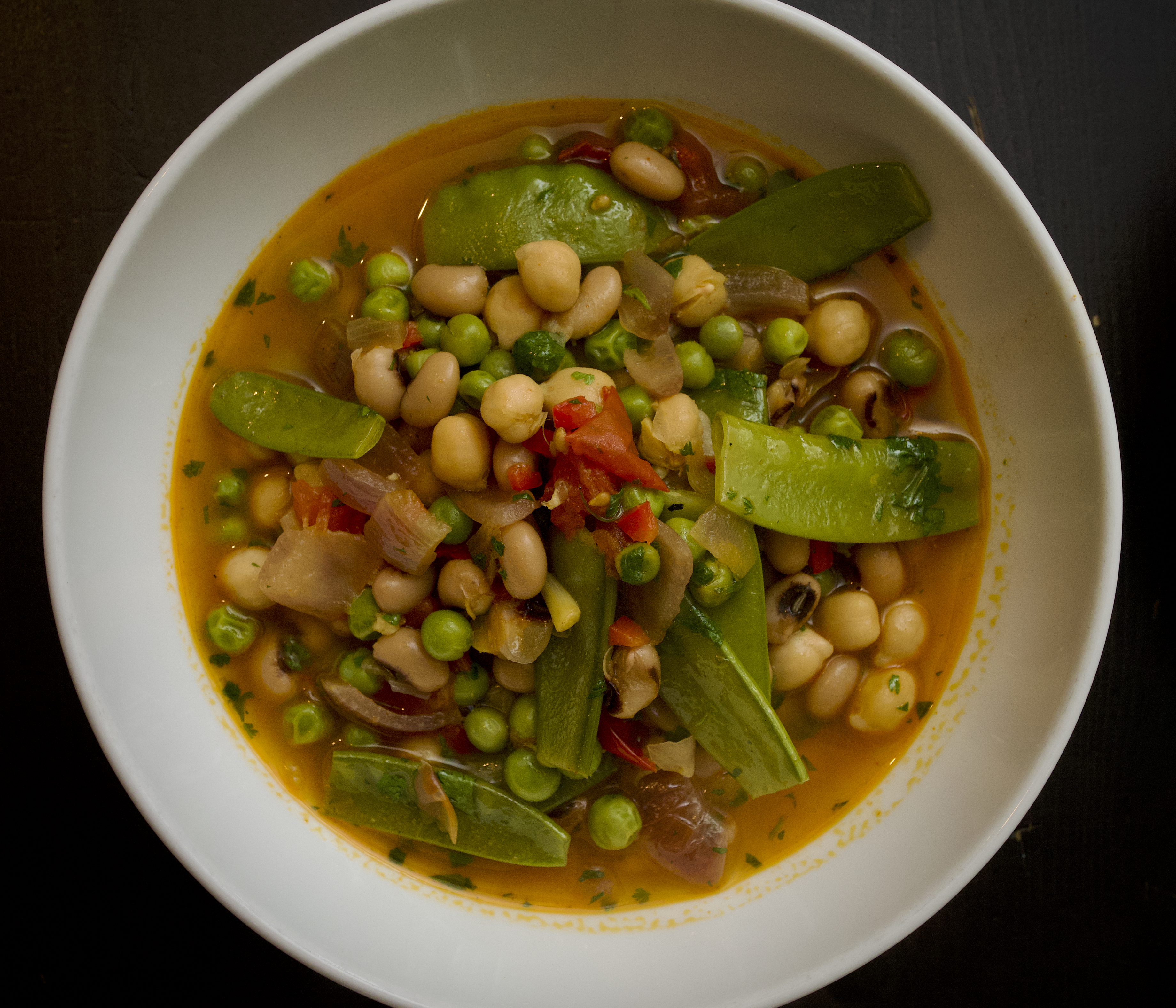
Our favourite vegetarian cookbook at the moment is East by Meera Sodha. This is an Indian main course dish but it’s like a soup and works well as both a mid-week dinner, and in a flask for lunch the next day. Also vegan and gluten-free if this is useful information for you. Serve with crusty bread.

Black-eyed bean and chickpea usal – serves 4

  • 4 tbsp rapeseed oil
  • 2 red onions, chopped
  • 2 long green chillies, very finely chopped
  • 4 cloves of garlic, crushed
  • 2 large vine tomatoes, chopped
  • 1¾ tsp salt
  • 1 tsp Kashmiri chilli powder
  • 1 tsp garam masala
  • 1 tsp ground cumin
  • ½ tsp ground turmeric
  • 1 x 400g tin of black-eyed beans, drained
  • 250g frozen peas, defrosted
  • 1 x 400g tin of chickpeas, drained
  • 200g mangetout
  • 1 tbsp lemon juice
  • a handful of coriander leaves, finely chopped

Heat the oil in a saucepan over a high heat. Add the onion and chillies and cook for about 10 minutes, then add the garlic and cook for a minute more.

Add the tomatoes and cook for about 5 minutes or until they have broken down, then add the salt and spices and stiry-fry for another minute.

Stir in the black-eyed beans, peas, chickpeas and mangetout and continue cooking for 5 minutes.

Add the lemon juice and coriander, then taste and season with more salt if needed.

(Original recipe from East by Meera Sodha, Penguin, 2019.)

Read Full Post »

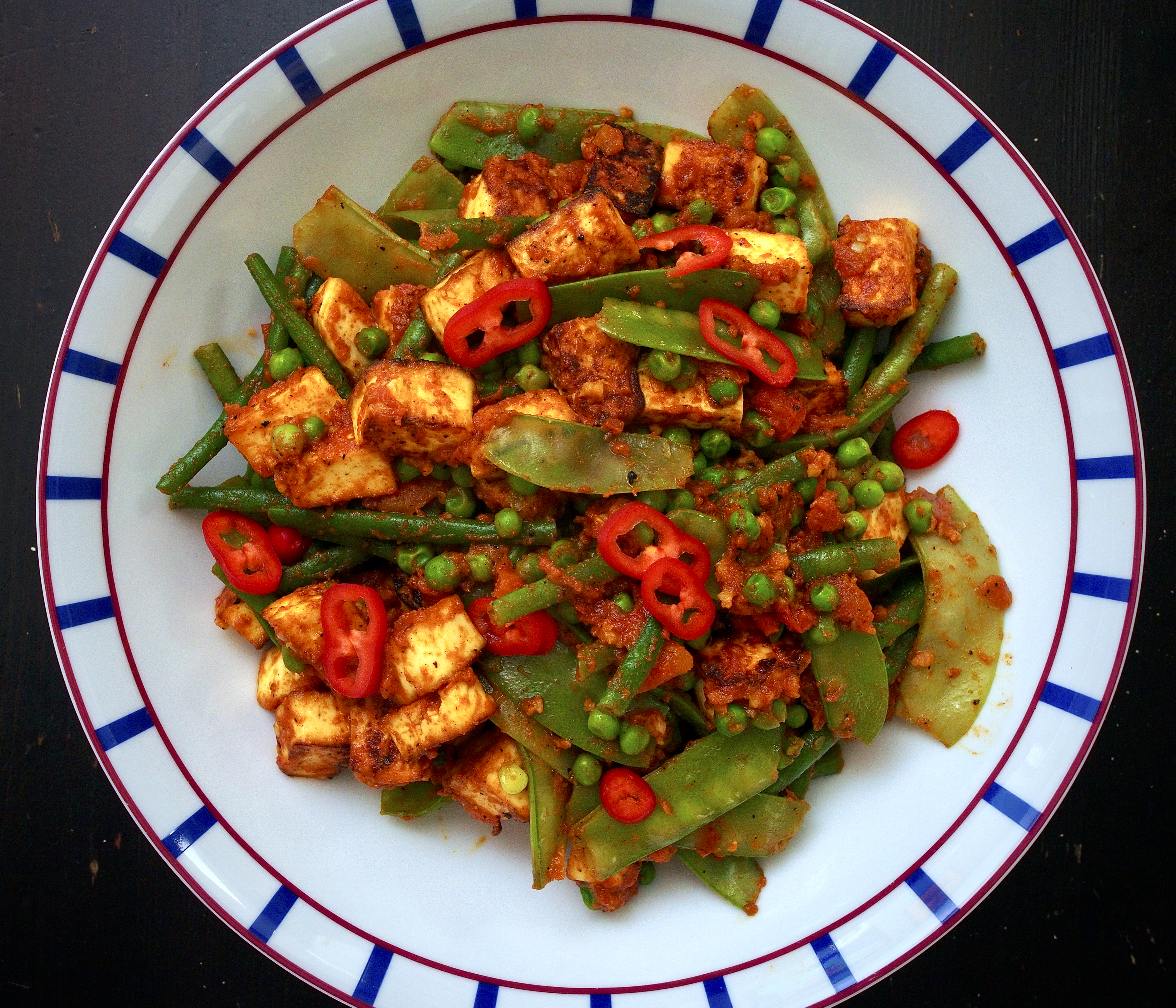
This is Meera Sodha’s fresh take on Matar Paneer, which is usually a richer dish. Delicious with warm naan breads and plain yoghurt, this version could easily become a regular favourite.

Fresh Matar Paneer – serves 4 as a main or more as a side with other dishes

  • rapeseed oil
  • 550g hard paneer, cut into 1.5cm cubes
  • 6 cloves of garlic, crushed
  • 400g tin chopped tomatoes
  • 1¼ tsp salt
  • ½ tsp ground black pepper
  • 1 tsp ground cumin
  • 1 tsp chilli powder
  • ½ tsp ground turmeric
  • 200g green beans
  • 200g mangetout
  • 200g frozen peas (defrosted), or you can use fresh of course if you have them
  • 1 red chilli, finely sliced to serve

Heat a couple of tbsp of the oil in a large frying pan. Fry the panner over a medium heat until browned and crisp all over, then remove to a plate with a slotted spoon and set aside.

Heat another tbsp of oil in the pan, then add the garlic and stir-fry for a couple of minutes (make sure the frying pan isn’t too hot when you add the garlic or it will burn). Add the tomatoes and cook for about 6 minutes or until just turning jammy. Add the salt, pepper, cumin, chilli powder and turmeric, then stir for another minute before taking off the heat.

Bring a large pan of water to the boil and add salt. Add the green beans and cook for 2 minutes, then add the mangetout and cook for another 2 minutes. Add the peas and cook for 1 more minute, then drain and leave to steam dry.

Heat the sauce, then stir in the paneer. When both are hot, stir in the veg. Sprinkle over the sliced red chilli and serve.

(Original recipe from Fresh India by Meera Sodha, Fig Tree, 2016.)

Read Full Post »

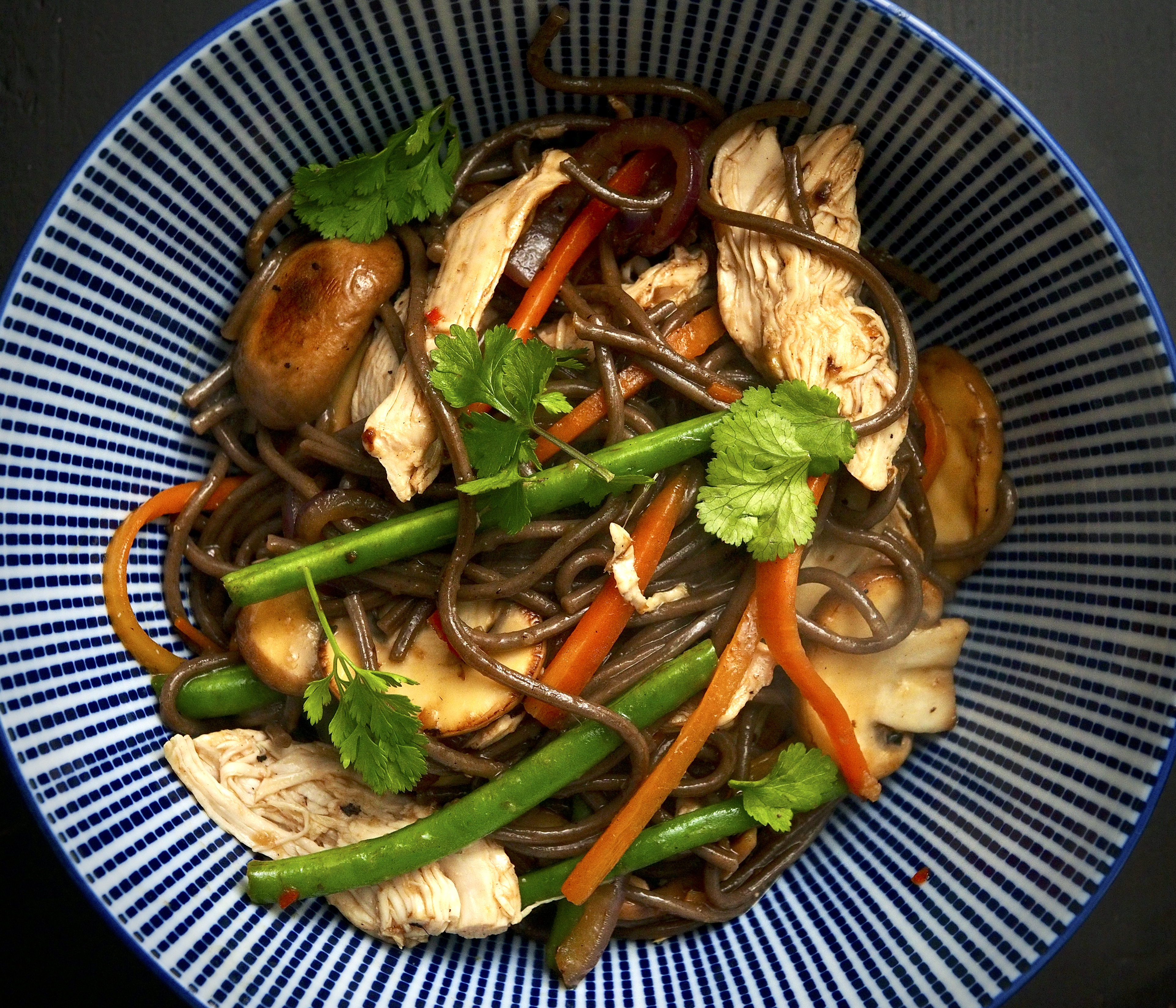
In our house almost anything will be eaten if it’s mixed with noodles (though not mushrooms sadly … but we’re working on it). Any leftovers of this will make a popular lunchbox too.

Chicken & soba noodle stiry-fry – serves 4

  • 800ml chicken stock
  • 400g chicken breasts
  • 200g dried soba noodles
  • 2 tbsp rapeseed oil
  • a thumb-sized piece of ginger, grated
  • half a red chilli, deseeded and finely chopped
  • 1 red onion, thinly sliced
  • 1 carrot, peeled and finely shredded
  • 150g green beans, trimmed
  • 150g chestnut mushrooms, sliced
  • 1½ tbsp light soy sauce
  • 1 tsp toasted sesame oil
  • a small handful of coriander leaves, roughly chopped

Bring the chicken stock to the boil in a pot, then add the chicken breasts and cook for 20 minutes. Make sure they are completely submerged in the stock. Remove the chicken breasts, shred with two forks and set aside.

Add the noodles to the chicken stock and cook according to the pack instructions. Remove the noodles from the stock with tongs and set aside, reserve the stock.

Heat the oil in a wok, then stir-fry the ginger, chilli and garlic for 30 seconds. Add the onion, carrot, green beans and mushrooms and stir-fry for 4-5 minutes.

Add the shredded chicken, the noodles, 50ml of the reserved stock, the soy sauce and the sesame oil. Toss to combine and heat through. You can add a little more stock for moisture if you need.

Divide between warm bowls and scatter the coriander over the top.

(Original recipe by Nadine Brown in Olive Magazine, May 2021.)

Read Full Post »

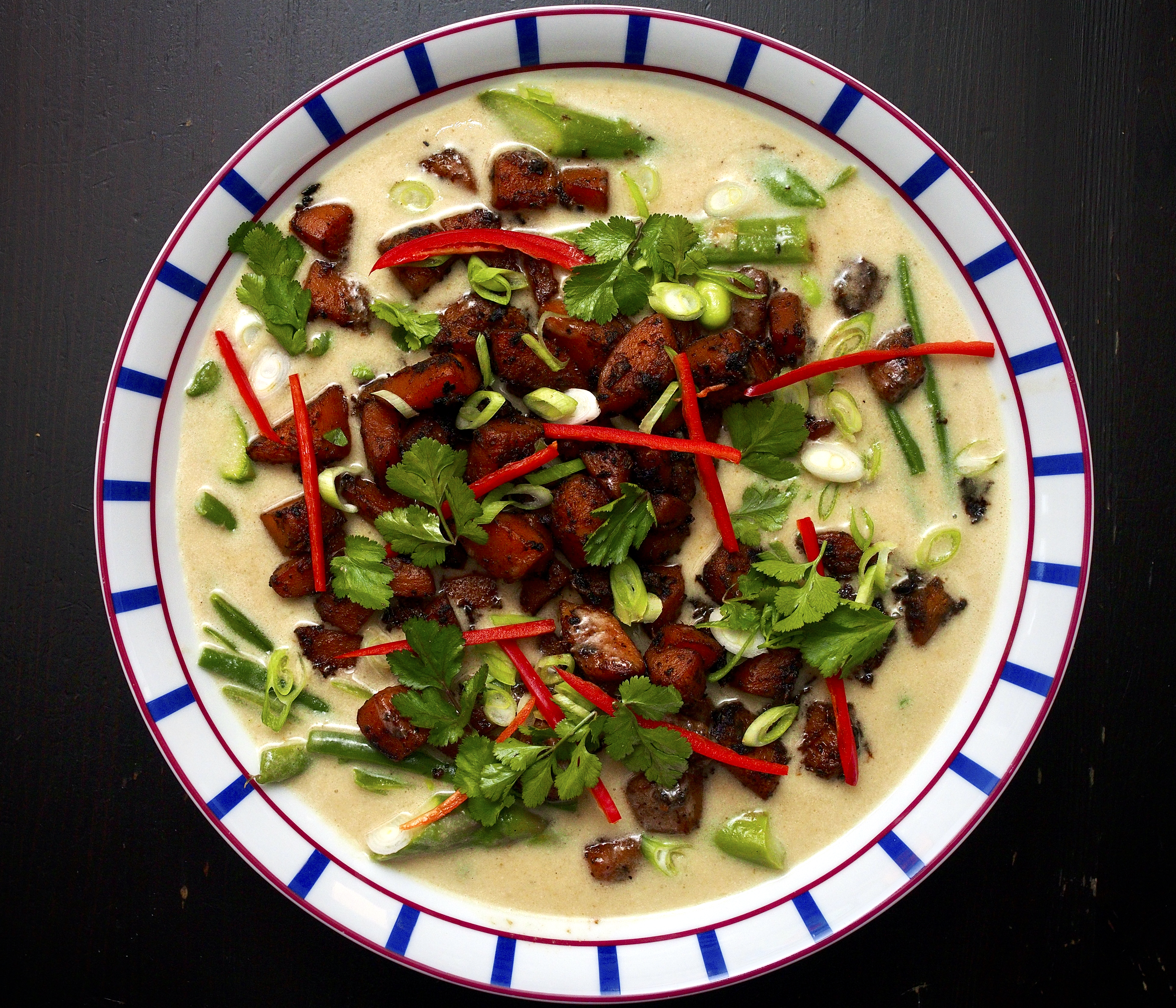
If you use a vegan curry paste you can easily make this a vegan dish. Lots of bright colours and great flavours in this one, and it’s quick to make.

Wine Suggestion: We think a minerally, just off-dry Riesling like Pikes Hills & Valleys from the Clare Valley is the ticket here with the limey fruit characters lifting the flavours of the dish and then the hint of residual sugar to balance the chillies.

Thai Green Veggie Curry – serves 4

  • 2 tbsp sunflower oil
  • 1 medium butternut squash (800g), cut into small cubes
  • 3 tbsp light soy sauce
  • a handful of sugar snap peas
  • a handful of asparagus, snap off the woody ends and discard
  • a handful of green beans
  • a handful of frozen edamame beans
  • 1 lime, cut into wedge, to serve
  • a handful of coriander leaves, to serve
  • 1 red chilli, finely sliced, to serve
  • 1 scallion, finely sliced, to serve
  • jasmine rice, to serve

FOR THE CURRY BASE

  • 1 lemongrass stalk, bash with a rolling pin to bruise it
  • 2 tbsp Thai green curry paste
  • 2 x 400ml coconut milk

Toss the cubes of butternut squash with the light soy sauce in a bowl. Heat 1 tbsp of the sunflower oil in a wok, then add the squash and cook over a medium heat for about 10 minutes or until softened and browned, stirring often.

To make the curry base, heat 1 tbsp of sunflower oil in a large frying pan, then add the lemongrass stalk and curry paste and cook over a high heat for a minute.

Stir in the coconut milk, then reduce the heat a bit and simmer for 8 minues.

Discard the lemongrass, then add the sugar snap peas, asparagus, green beans and edamame beans to the sauce and cook for 4-5 minutes or until just tender.

Ladle the curry sauce into bowls and top with the squash, a squeeze of lime, some coriander, red chilli and scallion. Serve with jasmine rice.

(Original recipe by Katy Beskow in Olive Magazine, April 2018.)

Read Full Post »

This will improve your veg intake for the day and puts frozen prawns to good use. A perfect curry for mid-week. Serve with naan breads or rice and lime wedges.

Prawn, spinach & coconut curry – serves 2-3

  • 2 tbsp olive oil
  • 200g raw prawns, defrosted if frozen
  • 1 onion, diced
  • 3 large cloves of garlic, finely chopped
  • 1-2 chillies, deseeded
  • 1 red pepper, sliced
  • 2 tbsp curry paste, we like Patak’s Madras
  • 400ml tin of coconut milk
  • 80g Tenderstem broccoli, cooked until tender
  • 100g baby spinach
  • lime wedges, to serve

Heat the oil in a frying pan over a medium heat and fry the onion for 5 minutes until softened. Add the garlic and chillies and fry for another 2 minutes, then addd the sliced pepper and cook for 3 minutes until softened.

Push the veg to one side and fry the curry paste for a couple of minutes to heat through, then add the coconut milk and mix well to combine. Simmer for about 10 minutes, or until thickened, then add the prawns, broccoli and spinach. Stir well and simmer until the prawns are just cooked and the spinach wilted.

Serve with rice or naan breads and lime wedges for squeezing over.

Read Full Post »

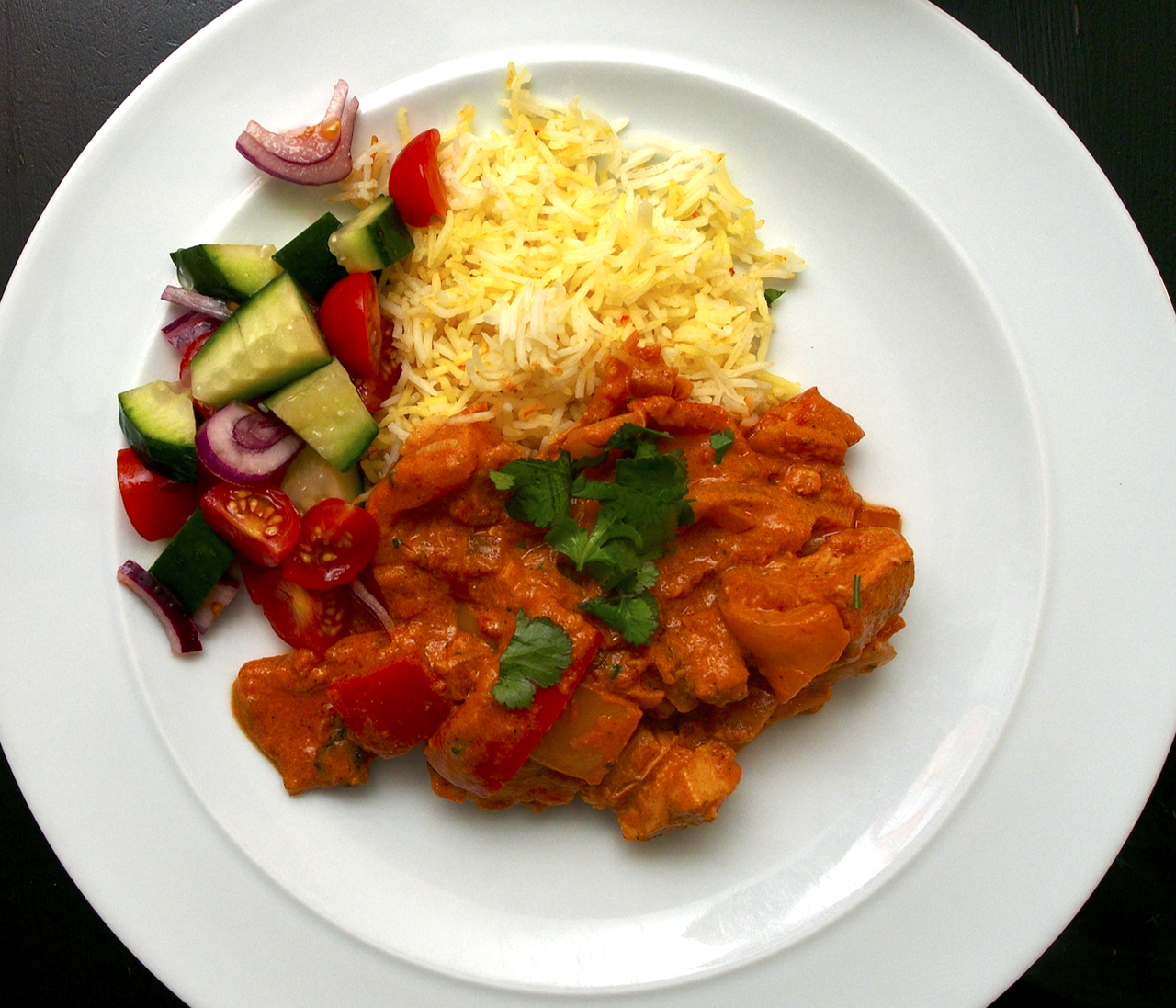
A healthy version of chicken tikka masala with salad and saffron rice. You will be eating the rainbow for dinner with this one.

Wine Suggestion: A new find matched this well: Umani Ronchi’s Centovie, a rosé made from Montepulciano in Abruzzo. The cherry fruit flavours and savoury, dry finish were a good compliment to the food. If you can’t find a rosé made from this grape find a nice red and chill it a little instead.

Chicken tikka masala – serves 4

  • 1 large skinless chicken crown (about 1kg), get your butcher to do this for you

FOR THE MARINADE:

  • juice of half a lemon
  • 5cm piece of ginger, finely grated
  • 4 large cloves of garlic, grated
  • 2 tbsp medium Madras curry powder
  • 2 heaped tsp smoked paprika
  • a large pinch of salt
  • 100g Greek yoghurt (you can use 0% if you wish)

FOR THE CURRY SAUCE:

  • 1 tbsp sunflower oil
  • 2 large onions, finely chopped
  • 2 large garlic cloves, grated
  • 2.5cm piece of ginger, finely grated
  • 1 tsp ground turmeric
  • 2 tsp paprika
  • 2 tsp ground coriander
  • 1 tbsp tomato purée
  • 400g tin chopped tomatoes
  • 300ml water
  • 1 large red pepper, chopped
  • 1 large green pepper, chopped
  • 150g natural yoghurt
  • 2 tbsp finely chopped coriander

FOR THE SALAD:

  • 1 small red onion, finely diced
  • 2 large tomatoes, diced
  • half a cucumber, diced
  • juice of half a lime
  • 1 tsp chaat masala

TO SERVE:

  • coriander leaves, roughly torn
  • basmati rice, cooked with salt and a pinch of saffron strands (only if you have them)

Put the chicken into a large dish and slash the breasts with a sharp knife. Mix all of the ingredients together for the marinade, then spread over the chicken. Cover with cling film and refrigerate overnight, or for at least 4 hours.

Preheat the oven to 120C fan.

Put the chicken into a roasting dish and spoon over any remaining marinade. Cook for 2 hours (this won’t cook it through).

Meanwhile, make the curry sauce. Heat the oil in a deep frying or sauté pan. Add the onions and cook for 10 minutes or until golden brown, add a splash of water if they stick. Add the garlic and ginger with a splash of water, stir well and cook for 1 minute. Add the spices with some salt and pepper and cook for another minute.

Stir in the tomato purée and cook for a minute, then add the tinned tomatoes and the 300ml of water. Bring to the boil, then reduced the heat to a gentle simmer and cook for 5-10 minutes. Add the chopped peppers and cook for 5 minutes, then remove from the heat.

Remove the chicken from the oven and use a blowtorch over the surface to slightly blacken the marinade in places. If you don’t have a blowtorch just pop it under a hot grill. Set aside to rest for 10 minutes.

Mix the salad ingredients together in a bowl and set aside.

Remove the chicken breasts from the bone and cut into bite-size chunks. Reheat the curry sauce, then add the chicken and simmer for 5 minutes or until the chicken is cooked through. Stir in the yoghurt and chopped coriander, then season to taste.

Serve with some coriander leaves, saffron rice and the salad on the side.

(Original recipe from Lose Weight for Good by Tom Kerridge, ABSOLUTE PRESS, 2017.)

Read Full Post »

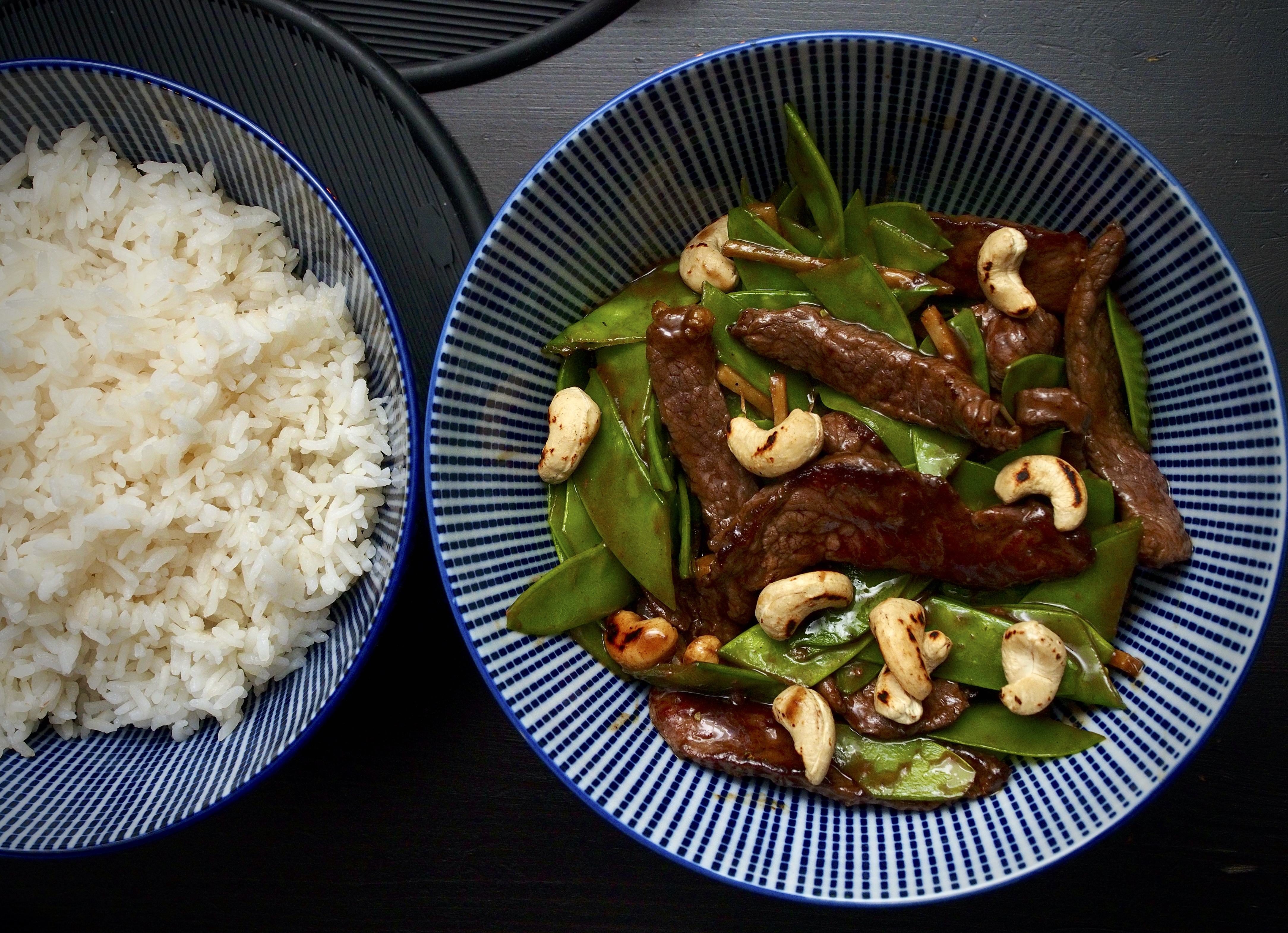
Chinese New Year was on a Tuesday this year and we had to squeeze our Chinese food in between homework, swimming lessons etc. If that is you, then this recipe is for you. As ever you need to prep everything before you start cooking. We served with rice but noodles would be good too.

Beef with mangetout & cashews – serves 4

  • 50g unsalted cashews
  • 1 tsp cornflour
  • 1 ½ tbsp low-salt soy sauce
  • 4 tbsp oyster sauce
  • 1 tbsp rice vinegar
  • 1 tbsp honey
  • 1 tbsp vegetable oil
  • 280g rump steak, thinly sliced
  • a thumb-sized piece of ginger, cut into matchsticks
  • 2 cloves of garlic, crushed
  • 200g mangetout, halved

Toast the cashews in a dry wok or frying pan, until browned, then set aside.

Mix the cornflour and soy sauce together to make a paste, then add the oyster sauce, rice vinegar and honey.

Heat your wok until very hot. Add the oil and swirl around to cover the base and sides. Use tongs to place the steak pieces into the wok in a single layer. Cook, without turning for 30 seconds – 1 minute, or until a dark crust starts to form. Add the ginger and garlic and toss everything together, then add the mangetout and the sauce. Cook for another 30 seconds – 1 minute or until the beef is just cooked through and the sauce is glossy. Sprinkle over the cashews and serve.

(Original recipe from BBC Good Food)

Read Full Post »

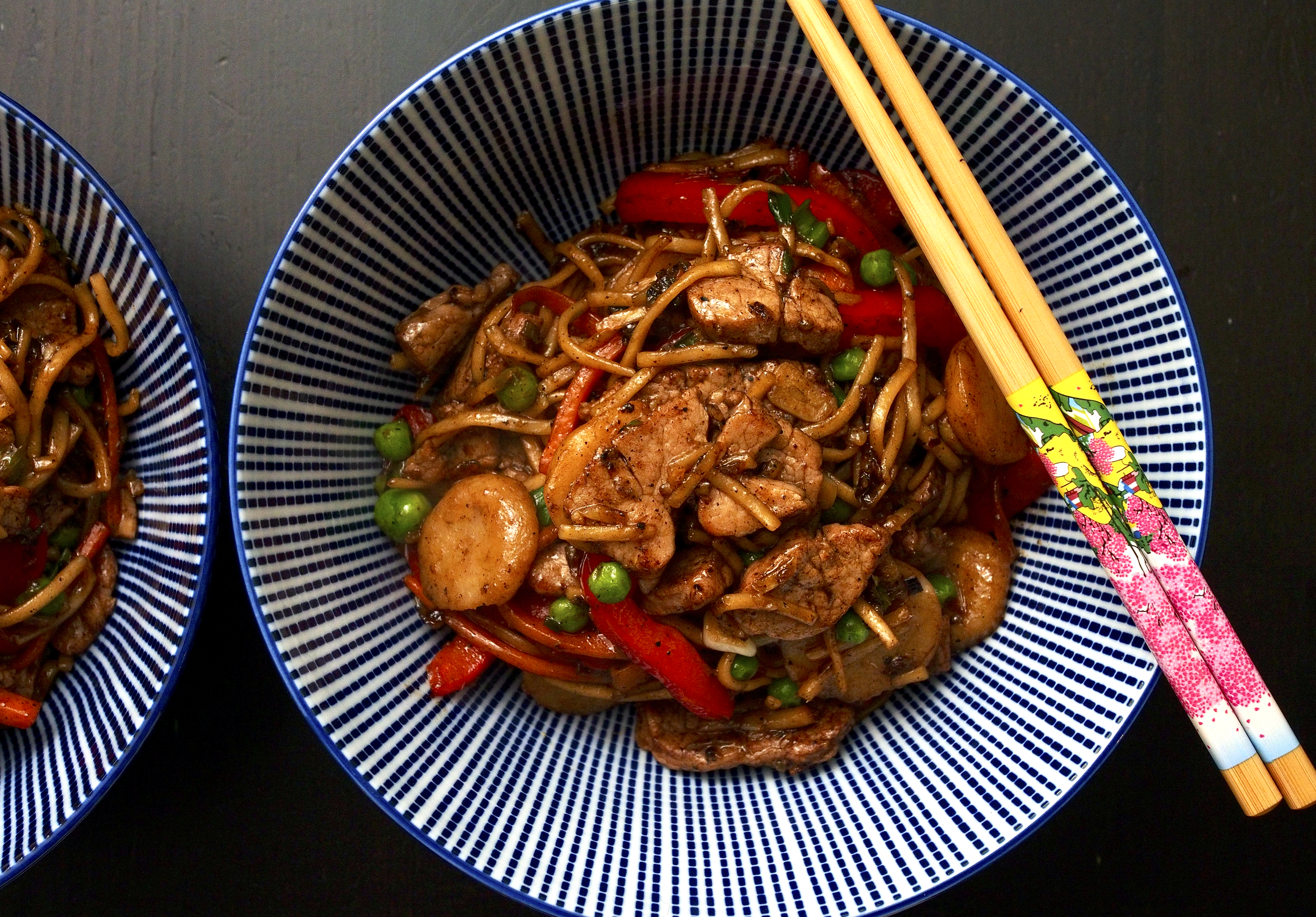
It’s Chinese New Year tomorrow so we thought we’d post some dinner inspiration for the year of the tiger. This is a good crowd-pleaser and definitely better than take-away. It’s simple too, just prep everything before you get your wok on.

Wine Suggestion: an umami laden southern-French red, like the schist laden Domaine Cébène Faugères à la Venvole. Textural and velvety Grenache with hints of Syrah plums and gravelly Carignan; loads of flavour but not too much weight.

Pork chow mein – serves 4

  • 500g pork fillet
  • 1 tsp Chinese five-spice powder
  • 200g dried medium egg noodles
  • 4 tbsp vegetable oil
  • 2 tbsp soft light brown sugar
  • 2 tsp cornflour
  • 4 tbsp dark soy sauce
  • 2 tbsp mirin or dry sherry
  • 1 red pepper, deseeded and sliced
  • 1 large carrot, cut into very thin strips
  • 25g fresh ginger, peeled and very finely sliced
  • 3 cloves of garlic, very thinly sliced
  • 6 scallions, sliced
  • 50g frozen peas
  • 225g tin water chestnuts, drained and sliced

Trim any fat and sinew off the pork, then cut in half lengthways and cut into thin slices. Put into a bowl and add the five-spice powder, ½ tsp sea salt and black pepper, then set aside.

Bring a large pan of water to the boil and cook the noodles acording to the pack instructions, then drain and rinse in a sieve under running water until cold, then toss with a 1 tbsp of vegetable oil and set aside.

Mix the sugar and cornflour together in a bowl and gradually stir in the soy sauce, mirin and 100ml water, then set aside.

Heat 1 tbsp of the oil in a wok. Add the pork and stir-fry over a high heat for 2 minutes or until browned. Scoop out and set aside.

Add another tbsp of oil and stir-fry the pepper and carrot for 2 minutes. Add the ginger, garlic, scallions, peas and water chestnuts and stir-fry for 2 minutes more until just softened, then scoop out onto a plate.

Pour the last tbsp of oil into the wok and add the noodles. Stir-fry for 2-3 minutes or until some have turned crispy and brown. Add the meat and veg back into the work and toss everything together for 1-2 minutes, or until well mixed and hot.

Stir the soy and mirin mixture again and pour it into the pan. Continue tossing for 1-2 minutes or until hot and glossy. Serve straightaway.

(Original recipe from The Hairy Bikers’ Meat Feasts by Si King and Dave Myers, Weidenfeld & Nicolson, 2015.)

Read Full Post »

This was made at the end of a weekend where all the previous recipes we’d tried hadn’t quite come together, or worked as we’d hoped, so our expectations were low. What a relief: we were blown away with the flavour, and our enthusiasm returned with a vengeance! The recipe is by Jamie Oliver but inspired by the Japanese restaurant Nobu in London who are known for their black cod miso and for good reason. The recipe is simple but you need to start 24 hours in advance.

Wine Suggestion: This is a dish jam packed full of savoury umami flavours and needs a similarly umami loaded wine to match. We started with a small glass of Hidalgo La Gitana’s Pasada Pastrana, a single vineyard aged manzanilla which was excellent. Then we segued into savoury Grenache territory with Roc des Ange’s Segna da Cor from the wilds of Roussillon; vibrantly textured and almost sucking the stones it was grown on. What a way to end the weekend.

Black Cod Miso- serves 4

  • 4 bulbs of pak choi, quartered
  • 1 cucumber, peeled halved and deseeded, then sliced into long 1cm thick strips
  • juice of 1 lime
  • soy sauce
  • cooked sticky rice (to serve)

FOR THE MARINADE:

  • 2 stems of lemongrass
  • 1 red chilli, deseeded and chopped
  • 2.5cm piece of fresh ginger, peeled and chopped
  • 200ml of sake or white wine
  • 2 tbsp runny honey
  • 300g miso paste
  • 4 x 200g cod steaks, skin-on and pin-boned

Start the marinade the day before. Remove the outer layer from the lemongrass stems and discard. Bash the lemongrass with the back of a knife, then finely chop. Put the lemongrass into a pestle and mortar with the chilli, ginger and a pinch of salt, then bash to a paste.

Put the paste into a saucepan with the sake and honey, then bring to the boil. While the mixture is warming, gradually add the miso paste, a little at a time, stirring constantly. Simmer until the mixture is lightly golden, then remove from the heat and pour onto a flat tray so it cools quickly.

When the marinade is cool, put the fish into a container and pour over three-quarters of the marinade. Move the fish fillets around to ensure they are completely coated, then cover and put into the fridge. Put the rest of the marinade into a container and keep in the fridge until needed.

When ready to cook, preheat the grill until very hot. Put the pieces of fish onto an oiled baking tray, skin-side up and cook until slightly caramelized and golden. This will take 6-8 minutes depending on how thick your pieces of fish are.

Meanwhile, lay the pak choi into a steamer over a pan of boiling water. Add the strips of cucumber and steam until the pak choi is tender.

Stir the lime juice into the container of leftover marinade to loosen it slightly. Serve the fish with the greens and drizzle over a little soy sauce. Serve with cooked rice and the miso dressing on the side.

(Original recipe from Cook with Jamie by Jamie Oliver, Penguin Books, 2006.)

Read Full Post »

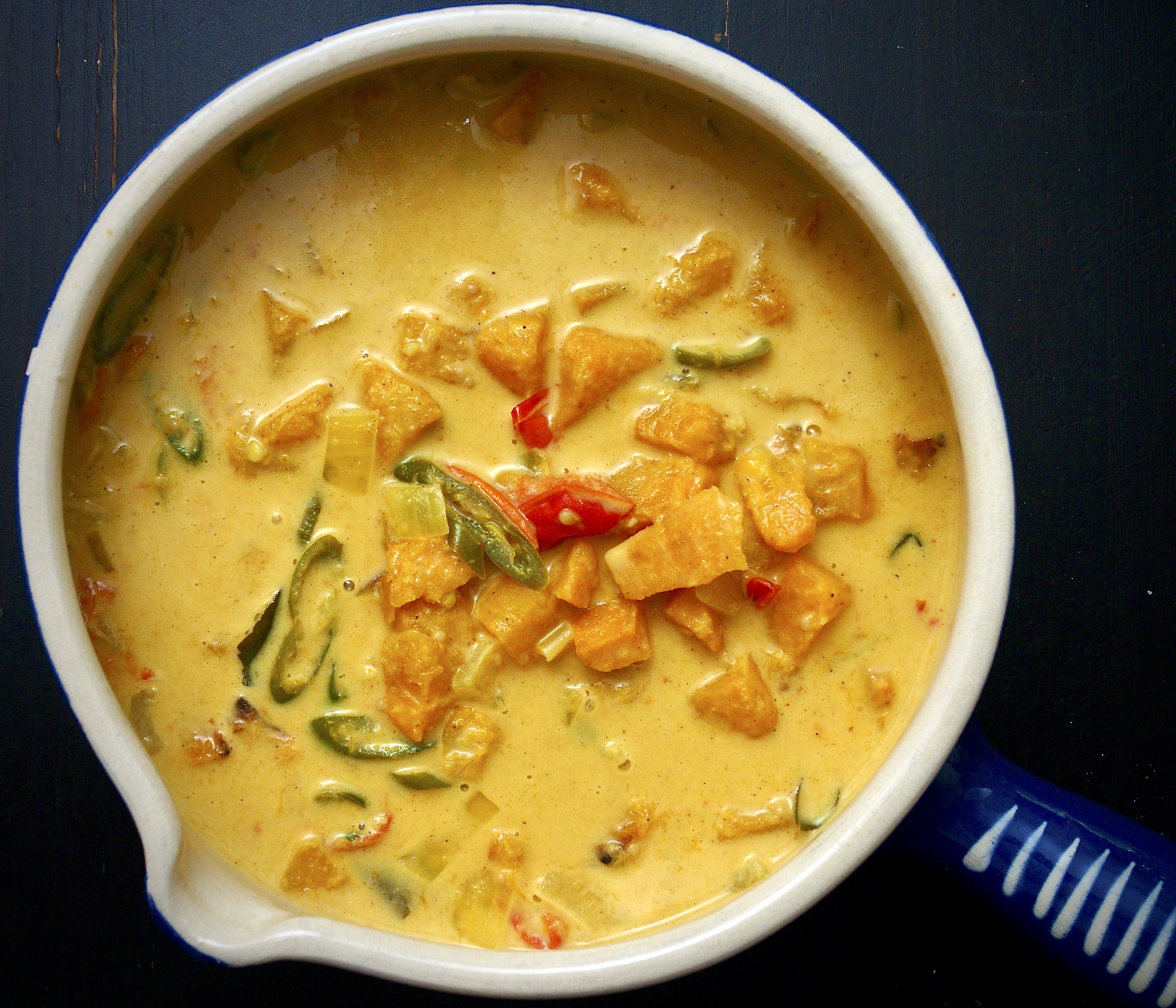
We were very pleased to find a late season crown prince pumpkin at our farm shop last week, which is our favourite variety. You could easily use a butternut squash instead if pumpkin is not available. This is a mild and creamy curry from Sri Lanka.

This is not an attempt at veganuary, we love to eat vegetables just as much as meat and fish. After the excess of Christmas we find a variety of dishes very welcome.

Wine Suggestion: Look to complement the rich, creaminess with a richer, creamy white, like an oaky Chardonnay, or similar. We went a bit left field with an older bottle or Jean-Michel Gerin’s le Champine Viognier which had in our cellar. With a heady apricot, pineapple and mango exoticism and a rich, very textural palate it was an unexpected treat.

Vegan pumpkin & coconut curry – serves 4

  • 1kg pumpkin or butternut squash, peel, deseed and cut into 1 ½ cm cubes (you want about 900g of cubed pumpkin)
  • 2 tsp curry powder, not too hot
  • 1½ tbsp rapeseed oil
  • fine sea salt
  • 1 onion, finely diced
  • 5 long green chillies, finely sliced, we took the seeds out but you can leave them in if you want more heat
  • 12-15 curry leaves
  • ¾ tsp ground turmeric
  • ½ tsp fenugreek seeds
  • 5 garlic cloves, peeled and crushed
  • 150g cherry tomatoes
  • 1 x 10cm cinnamon stick, snapped in two
  • 2 x 400ml tins coconut milk
  • juice of 1 lime
  • rice, to serve

Heat the oven to 200C/180C fan/Gas 6.

Line a baking tray with baking parchment.

Put the pumpkin pieces into a large bowl with the curry powder, rapeseed oil and ¾ tsp of fine sea salt, then toss together to coat. Tip the pumpkin out onto the lined tray and spread it out evenly. Bake in the oven for 35 minutes, then set aside to cool.

Meanwhile, put the onion, chillies, curry leaves, turmeric, fenugreek, garlic, cherry tomatoes, cinnamon stick and 1½ tsp of salt into a saucepan with 200ml of cold water. Bring to the boil over a medium-high heat and cook for about 12 minutes or until the onions and tomatoes are soft and the liquid almost evaporated.

Add the coconut milk and roasted pumpkin, then bring back to a gentle simmer, then remove from the heat and add the lime juice. Taste and add more lime or salt if needed.

(Original recipe by Meera Sodha in The Guardian, 1st January 2022.)

Read Full Post »

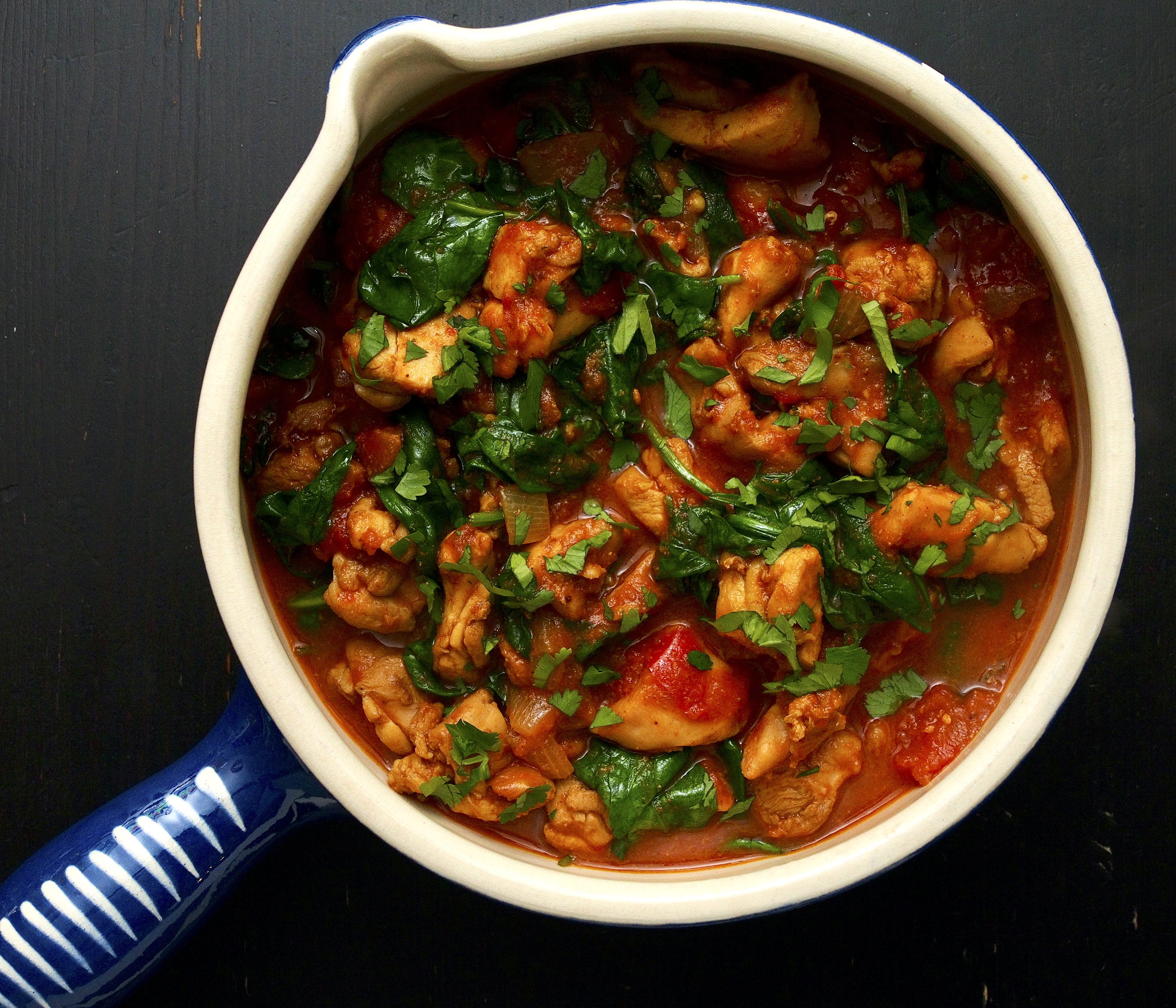
This is a mildly spiced curry and quick to prepare. We had it on Friday with some naan breads from the take-away, but it’s easy enough for a weeknight too. An easy, tasty treat.

Wine Suggestion: This dish needs a lighter red wine with lower tannins and little to no oak. We enjoyed Domaine de Boede’s Pavillon rouge with this. An easy, Cinsault-Syrah blend which has such purity and precision of fruit that we love; a good accompaniment for the food.

Chicken & spinach curry – serves 4

  • 2 tbsp vegetable oil
  • 1 large onion, chopped
  • 2 tsp ground cumin
  • 2 tsp ground coriander
  • ½ tsp turmeric
  • a pinch of cayenne pepper
  • 2 cloves of garlic, crushed
  • 1 tbsp grated ginger
  • 750g chicken thigh fillets, cubed
  • 400g tin chopped tomatoes
  • 1 tsp sea salt
  • 2 tsp soft brown sugar
  • 1 tbsp lime juice
  • 90g baby spinach, chopped
  • a large handful of coriander leaves, chopped

Heat the vegetable oil in a heavy-based pan, then gently cook the onions for about 5 minutes or until softened.

Stir in the spices, garlic and ginger, and cook for another 2 minutes, stirring.

Turn the heat up to medium-high, then add the chicken and cook for about 5 minute until browned all over.

Add the tomatoes and salt, bring to a simmer, then cover and simmer on a low heat for 15 minutes.

Stir in the sugar and lime juice, then add the spinach and stir until wilted. Take the pan off the heat, scatter the coriander over the top and serve.

(Original recipe from Every Day by Bill Granger, Murdoch Books, 2006.)

Read Full Post »

We made this a few weeks ago for a small group of friends (before omicron took hold) and it was devoured with gusto. Despite the list of ingredients it’s all quite straight forward and a recipe to keep up your sleeve for any occasion … for friends, or just for yourself.

Wine Suggestion: the wine opened at the time was determined by the event, the Altosur Malbec made by Finca Sophenia in Tuppangato, Mendoza and what a triumph it was. Body and depth with seemless and juicy tannins; it just made it taste the dish a bit richer and more sophisticated.

Chicken kari – serves 4 to 6

  • 4 tbsp vegetable oil
  • 1 tsp black mustard seeds
  • 1 tsp fenugreek seeds
  • 1 tsp cumin seeds
  • 1 tsp coriander seeds
  • 1 cassia bark stick (not a cinnamon stick)
  • 3 cardamom pods, crushed
  • 1 large onion, very finely chopped
  • thumb-size piece of fresh root ginger, peeled and finely grated
  • 4 big cloves of garlic, thinly sliced
  • 1-2 small green chillies or 1-2 long red chillies, split but leave the stalks intact
  • 8 large chicken thighs, skin removed but bone-in
  • 2 tsp ground turmeric
  • 4 large tomatoes, roughly diced
  • 400g tin chopped tomatoes
  • Steamed rice, to serve

Warm the vegetable oil in a large saucepan over a medium-high heat. Add the mustard, fenugreek, cumin and coriander seeds, the cassia bark and cardamom pods and fry until the mustard seeds start to pop. Keep giving the pan a shake.

Stir in the onion and cook for a few minutes until it starts to brown and caramelise.

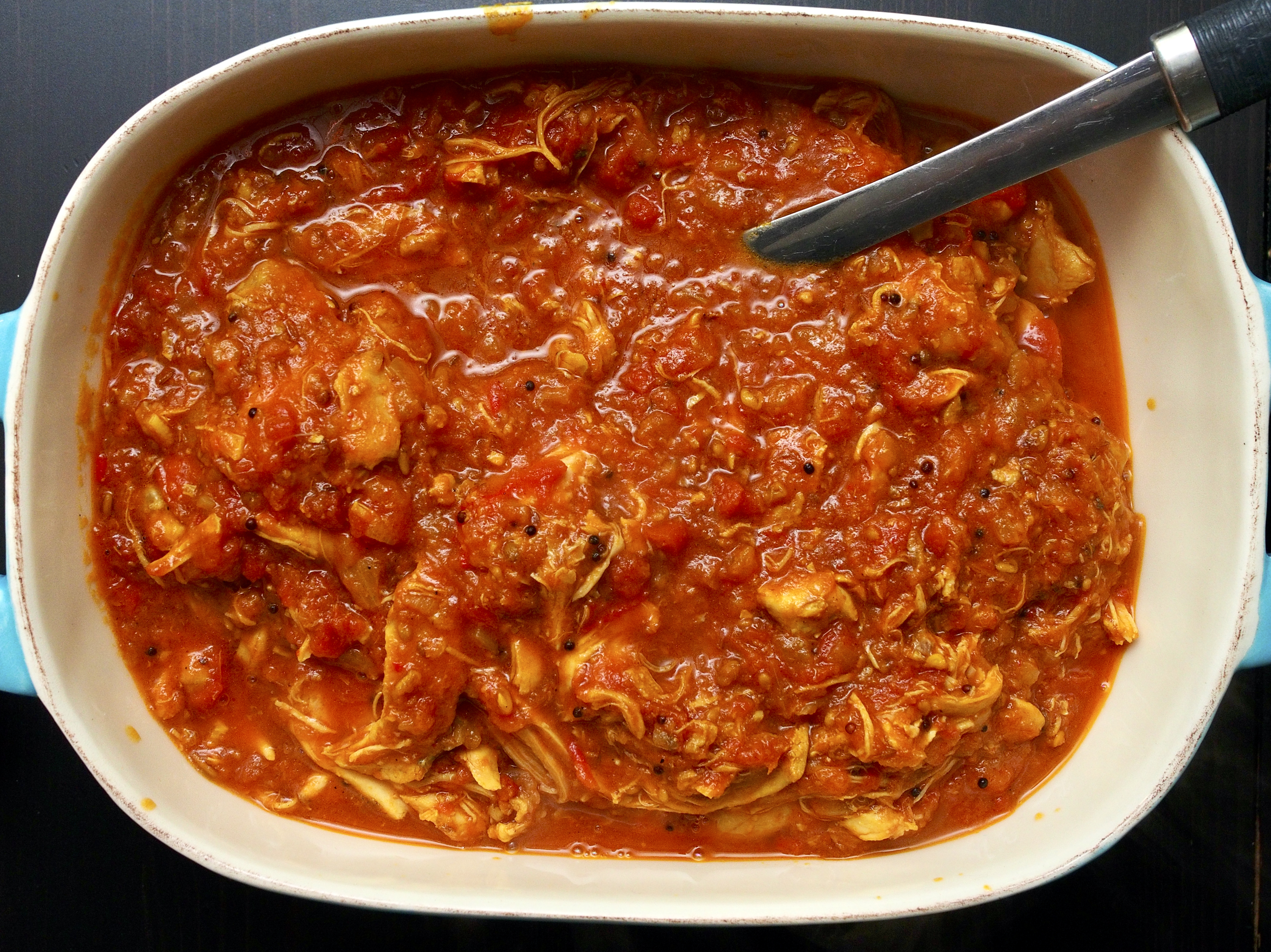
Add the ginger, garlic and chillies and stir-fry for a minute, then add the chicken thighs, turmeric and lots of salt and pepper and stir well. Add the fresh and tinned tomatoes, then add enough cold water to cover the chicken. Bring to a simmer, then reduce the heat and simmer gently for 2 hours, stirring now and then. Top up with more water if needed.

Remove the cassia bark and cardamom pods, then season again to test if needed and serve.

(Original recipe from Simply by Sabrina Ghayour, Mitchell Beazley, 2020.)

Read Full Post »

Our daughter is a gyoza addict and luckily we have a good local Japanese restaurant. She would order three or more portions if we let her. So in order to avoid bankruptcy we’ve decided to start making them ourselves. They are actually very straightforward, and helped immensely by shop-bought gyoza wrappers and a little gyoza folding gadget.

The wrappers keep in the freezer and defrost in an hour at room temperature. Just put them in the fridge afterwards until you’re ready to make the gyoza.

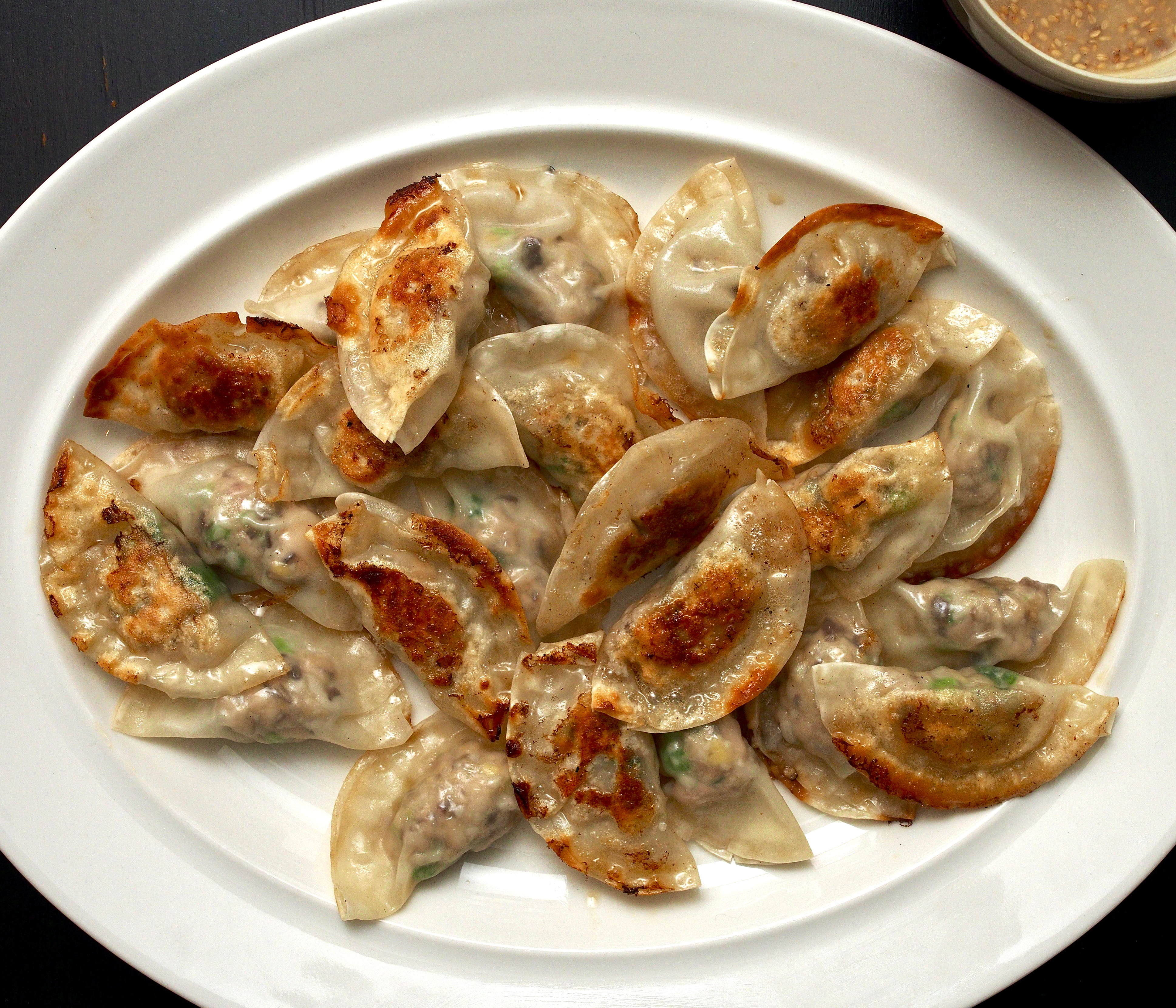
Chicken & Shiitake Gyoza with Miso Lemon Dipping Sauce – makes about 30 gyoza

  • 300g chicken thigh fillets, quartered
  • 10 shiitake mushrooms, finely chopped
  • 8 water chestnuts, finely choped
  • 3 tsp light soy sauce
  • 2 tsp finely chopped ginger
  • 1 tsp sake or mirin
  • 6 scallions, finely chopped
  • 1 tbsp cornflour
  • 30 gyoza wrappers
  • 1 tbsp sesame oil

FOR THE DIPPING SAUCE

  • 2 tbsp pale miso
  • 2 tbsp lemon juice
  • 2 tsp caster sugar
  • 1 tbsp maple syrup
  • 2 tsp toasted sesame seeds

Pulse the chicken thighs in a food processor until minced, then tip into a bowl.

Add the mushrooms, water chestnuts, soy sauce, ginger, sake/mirin, scallions and cornflour. Season with salt and plenty of black pepper, then mix together well with a metal spoon. You can leave the mixture in the fridge until you’re ready to cook.

Mix together the ingredients for the dipping sauce and set aside.

Line a large tray with non-stick baking paper and have a bowl of water handy.

Put a gyoza wrapper into your gyoza maker, floured side down, and put 1 tbsp of the filling in the middle (you can and should use a piping bag for this). Dip your finger in the water and lightly run it round the edge of the wrapper. Close the gyoza maker and squeeze tight to seal. If you don’t have a little machine, you can look up how to fold them on youtube.

Heat a large frying pan with a lid over a medium high heat. Add ½ tbsp sesame oil, then place the gyozas into the pan, you will probably have to do 2 batches. Leave them for about 2 minutes or until the bottoms have turned golden, then add 40ml water and cover with a lid. Cook for another 2 minutes until most of the water has evaporated, then remove the lid. Drizzle over another ½ tsp of sesame oil and allow to crisp up for about 30 seconds.

Remove from the pan and serve with the dipping sauce.

(Original recipe from My Asian Kitchen by Jennifer Joyce, Murdoch Books, 2018.)

Read Full Post »

A simple fish dish for weeknights, and something a bit lighter before the feasting starts.

Wine Suggestion: A delight with a light, playful Riesling like Korrell’s Slice of Paradise from the Nahe in Germany, or Pikes Traditionale from the Clare Valley.

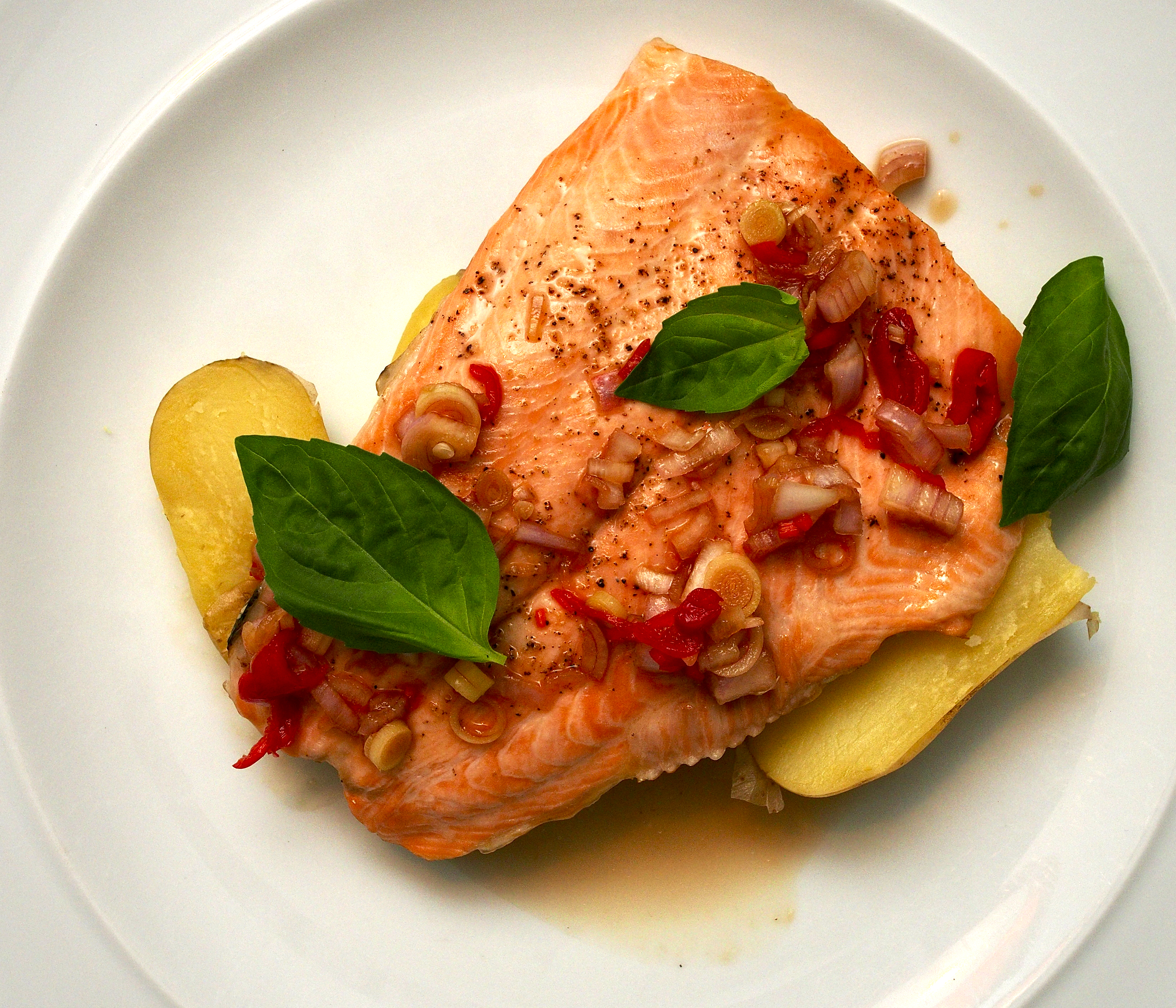
Grilled trout with Asian dressing – serves 2

  • 300g Charlotte potatoes
  • 2 skinless trout fillets
  • Thai basil or regular basil, to serve

FOR THE DRESSING:

  • 1 small shallot, finely chopped
  • 1 lemongrass stalk, remove the woody outer leaves and finely chop
  • 2 tbsp lime juice
  • 1 tbsp fish sauce
  • 1 tsp brown sugar
  • 1 red chilli, finely chopped

Boil the potatoes in salty water until tender, then drain and slice thickly, lengthways.

Season the trout, then grill for 3-4 minutes.

Arrange the potatoes onto plates and top with the trout. Whisk the dressing ingredients together and spoon over the top, then garnish with basil leaves.

(Original recipe by Janine Ratcliffe in Olive Magazine, November 2014.)

Read Full Post »

Older Posts »