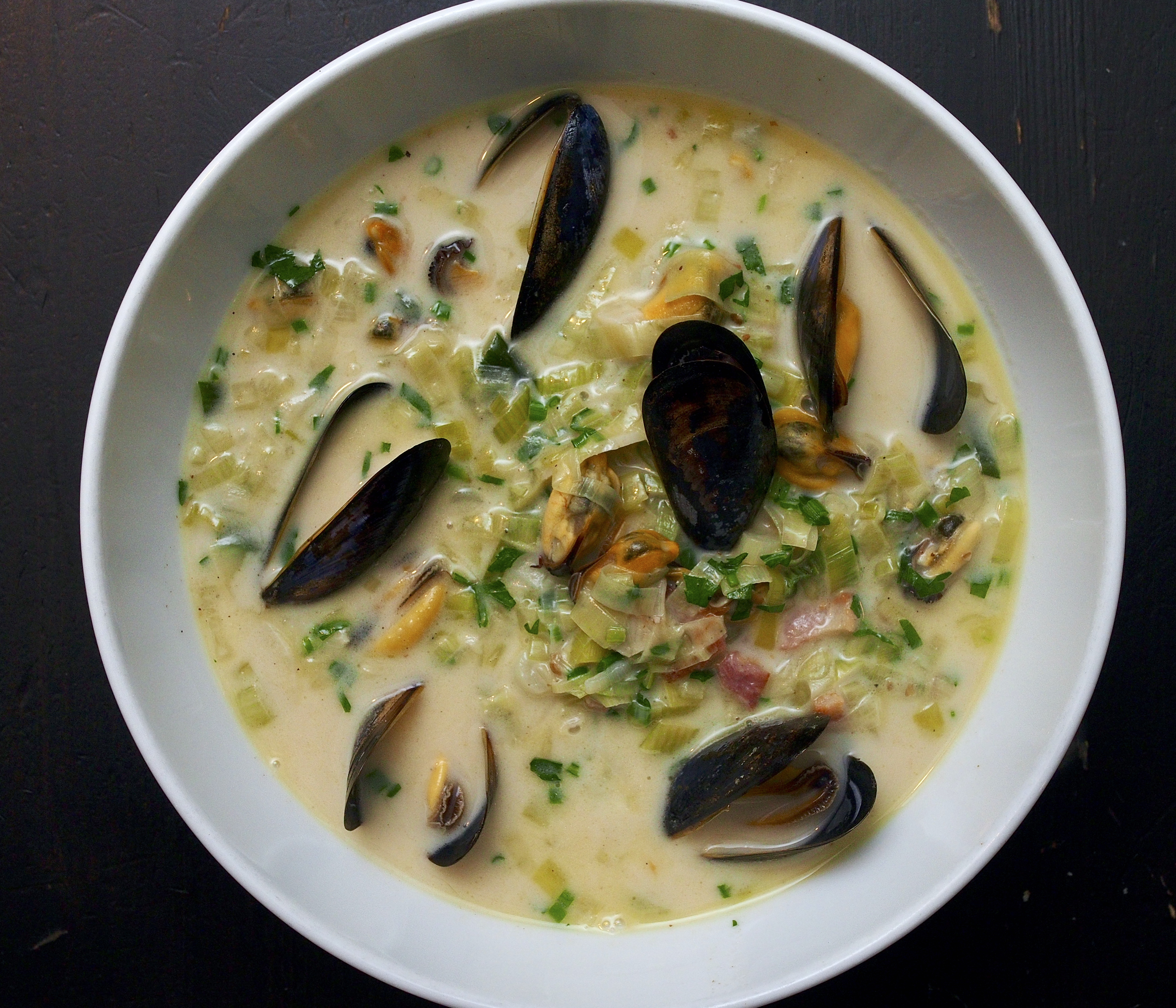
This is all you need with some fresh bread and butter. The simple things are the best.
Wine Suggestion: For a wine to work with this dish you need to balance a crisp, acidity to cut through the cream, body to match the depth of flavour and a minerally-savouriness to compliment the briny backbone of flavour from the mussels. If you look to a good Chablis producer or a top Muscadet then you’ll find your solution. We chose Jérémie Huchet’s lieu dit Les Montys le Parc from a very special vineyard in Muscadet that has that extra depth to match this rich, full flavoured dish.
Mussel, bacon and leek soup – serves 2
750g mussels
2 bay leaves
a small handful of parsley, leaves picked and chopped and stalks reserved
a knob of butter
75g streaky bacon, cut into small pieces
¼ tsp coriander seeds, toasted and crushed
1 garlic clove, finely sliced
1 leek, finely sliced
250ml fish stock (or veg stock)
75ml double cream
a small handful of chives, finely snipped
Wash the mussels in cold water and remove any beards. Give any open mussels a hard tap and discard them if they don’t close.
Put 75ml of water into a large saucepan with a tight fitting lid. Add the parsley stalks and bay leaves and bring to the boil. Add the mussels, clamp on the lid, and cook for 2-3 minutes or until the mussels have opened. Give the pan a good shake now and and then as they cook.
Tip the mussels into a colandar set over a bowl to catch all of the cooking juices, you will need the these later so don’t throw them away.
Wipe out the pan and return to the heat. Add a knob of butter, then gently fry the bacon until begining to crisp. Add the coriander seeds, garlic, and leek and season with salt and pepper. Cook for about 8 minutes, stirring now and then, until the leeks are nice and soft.
Add the mussel cooking liquid (watch out for the gritty bit at the bottom which you can discard) and the stock, then simmer uncovered for 5 minutes.
Meanwhile, pick the meat out of the mussels but leave about 12 in their shells to garnish.
Add the cream to the soup and bring back to a simmer. Add the mussel meat, chives and parsley and check the seasoning. Serve in warm bowls, garnished with the mussels in their shells and with bread and butter on the side.
(Original recipe from Outside by Gill Meller, Quadrille, 2022)
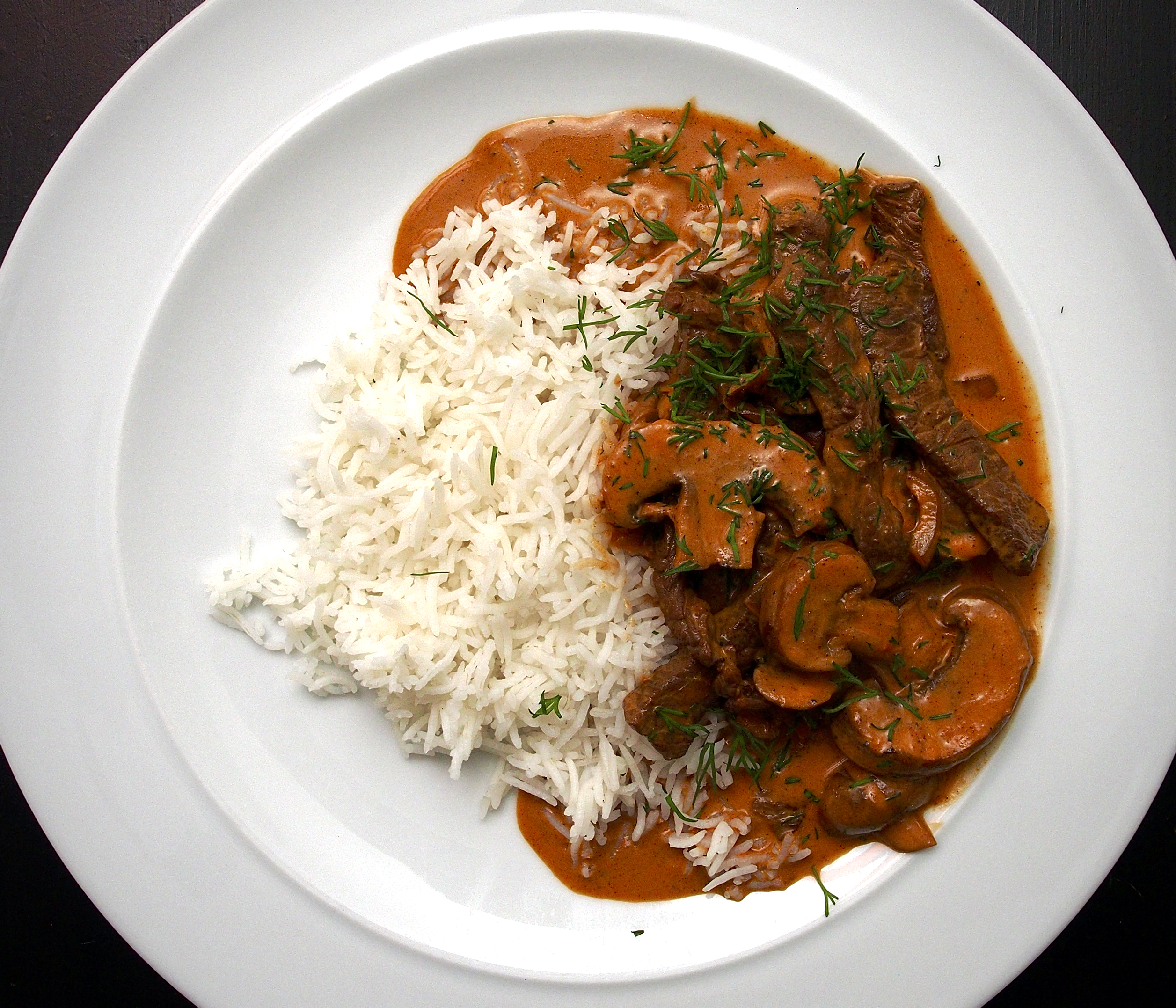
Jules’ Mum makes this all the time and serves it with home-made chips. We almost always cook it when we’re camping in France as it all cooks in the one pan and you can easily find all the ingredients. This one is different from our usual with the addition of paprika and dill, it’s very nice served with some plain white rice.
Wine Suggestion: We think this works best with a rich, full-bodied red. For us a treat from the ancient wine world, though a relatively young winery run by some young, passionate Syrians, the Bargylus, Grand Vin de Syrie 2014. Something to be celebrated due to the sheer class of this Syrah, Cabernet Sauvignon and Merlot blend, and mourned due to all the problems now in this part of the world. Superbly integrated tannins and layered fruit and spice; almost hedonistic in it’s velvetiness. You can taste some heat, but in a very good way with no evidence of alcohol. Mature but maintaining it’s freshness. We just wish this was more easily available for everyone to try.
Beef stroganoff – serves 4
30g butter
600g beef rump steak, thinly sliced
1 medium onion, thinly sliced
2 clove of garlic, crushed
1 tsp sweet paprika
400g chestnut mushrooms, thickly sliced
2 tbsp tomato purée
2 tbsp red wine
1 tbsp lemon juice
300g double cream
1 tbsp coarsely chopped dill, plus a bit extra to garnish
Season the meat with salt and pepper.
Heat 15g of butter in a large frying pan over a high heat and lightly brown the meat. Do this in batches and don’t overcrowd the pan, remove each batch to a plate and set aside.
Heat another 15g of butter in the same pan and add the onion and garlic. Cook over a gentle heat for about 4 minutes, or until softened. Add the paprika, mushrooms and tomato purée and cook for another few minutes, stirring.
Return the meat to the pan with any juices from the plate. Add the wine and lemon juice and bring to a simmer. Cover with a lid and simmer gently for 5-7 minute or until the meat is tender. Add the cream and dill and cook, stirring constantly, until heated through. We turn the heat off the second the sauce begins to simmer, don’t take it any further in case the cream splits. Season to taste with salt and pepper and serve with steamed rice. Garnish with a little more chopped dill.
(Original recipe from Rick Stein at Home, BBC Books, 2021.)
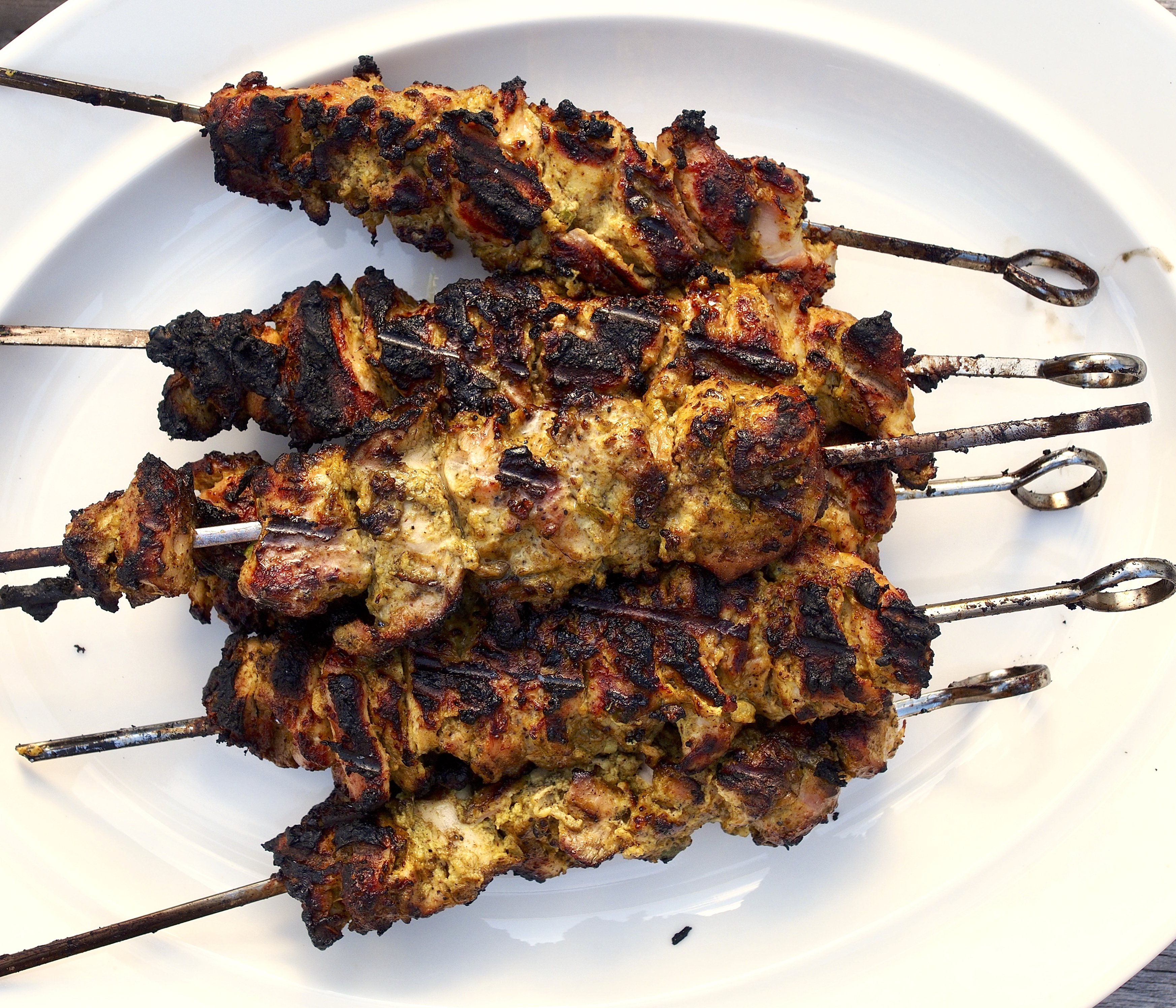
It hasn’t been the best of summers in Ireland so far but we’re barbecuing at every opportunity nonetheless. This marinated chicken is very tasty. We’ve given instructions for cooking on a charcoal barbecue but it will of course work just as well on a gas barbecue too.
Wine Suggestion: Choose a Mediterranean inspired, fruity, medium bodied red or white to pair with this. For a red something like a youthful Montepulciano would be great, but for tonight we chose the Edetana via Edetaria Grenacha Blanca from Terra Alta in Spain. A spot truly blessed with an amazing terroir for Grenache of both colours, and this version is bursting with flowers and fruit aromas and a core of citrus on the palate. It really complimented the char from the barbecue and the subtle spicing on the marinade.
Chicken kebabs – serves 6
1 tbsp cumin seeds
1 tsp black peppercorns
6 cardamom pods
½ cinnamon steak
4 cloves
35g cashews
½ tsp ground turmeric
a pinch of freshly grated nutmeg
800g chicken thigh fillets, diced
150g Greek yoghurt
juice of 1 lemon
50g ginger, grated
3 cloves of garlic, crushed
2 green chillies, finely chopped
1 tsp salt
50g butter
a small handful of mint leaves, chopped, to serve
FOR THE SALAD:
200g cherry tomatoes, halved
1 small red onion, sliced
a small handful of coriander, chopped
juice of ½ lemon
Warm a small frying pan over a medium heat, then add the cumin seeds, peppercorns, cardamom, crumbled cinnamon stick and cloves. Toast for a minute until fragrant, then tip them into a spice grinder or pestle and mortar and grind to a powder.
Tip the cashews into the frying pan and roast for a couple of minutes, then add these to the freshly ground spices along with the turmeric and the nutmeg. Grind again, then transfer to a large bowl.
Add the chicken, yoghurt, lemon juice, ginger, garlic, chillies and salt to the bowl and mix well. Cover and put in the fridge for up to 24 hours.
When you’re ready to cook get your charcoal barbecue going with charcoal on one side only.
Thread the chicken, not too tightly, onto metal skewers.
Put the skewers onto the barbecue, on the opposite side to the coals so the heat isn’t too high. Cook with the lid on, turning regularly, until the temperature inside reaches 74C or for about 20 minutes.
Put the butter into a small frying pan on the hob to melt. When the chicken is almost cooked, move them over the heat to crisp them up and start brushing all over with the melted butter. Keep an eye on them as they’ll start to flare up a bit.
Toss the salad ingredients together and serve the kebabs with the salad on the side.
(Original recipe from Seared by Genevieve Taylor, Quadrille, 2022.)
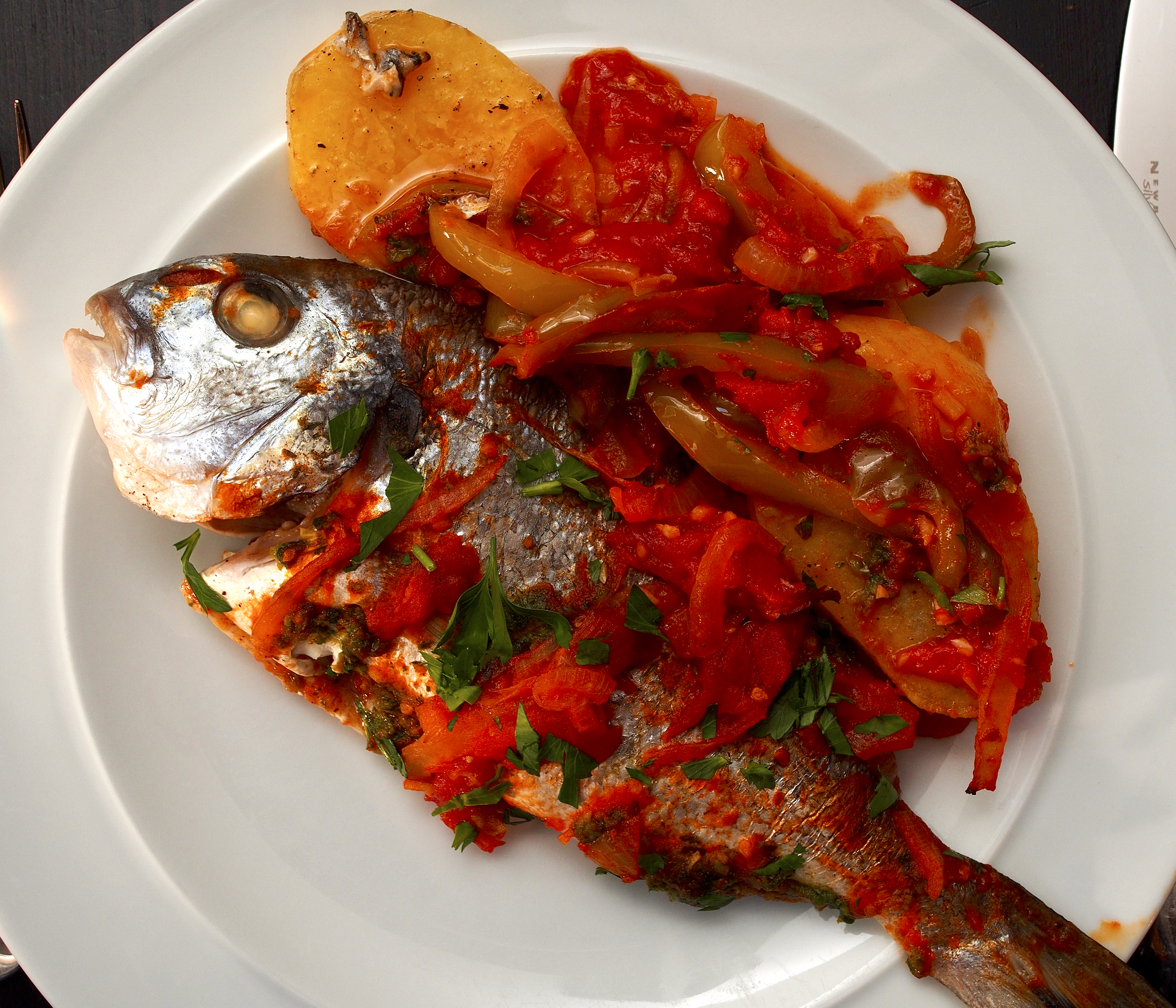
It’s the first night of our holidays and we felt like eating something to remind us of the beach!
Wine Suggestion: Dominio de Tares La Sonrisa Godello, or something similar with a chalky, Chablis-esk minerally finish; unoaked, vibrant and dry.
Baked sea bream – serves 2
5 tbsp olive oil
1 large onion, sliced
1 garlic clove, chopped
1 large green pepper, sliced
400g tin tomatoes
1 bay leaf
3 large waxy potatoes, peeled
2 x 400g whole sea bream, scaled and gutted
juice of ½ lemon
6 black peppercorns
60ml dry sherry
a small handful of flatleaf parsley leaves, chopped
FOR THE PICADA:
a small handful of flatleaf parsley leaves, chopped
2 large garlic cloves, roughly chopped
½ tsp sea salt
Warm 2 tbsp of olive oil in a large frying pan. Add the onions, garlic and pepper and cook for 10-15 minutes or until soft. Add the tomatoes, bay leaf and a splash of water, then cover and cook gently for 20 minutes.
Meanwhile, heat the oven to 180C/Fan 160C. Slice the potatoes, not too thin and not too thick so they hold together but cook through. Spread them over the base of a roasting dish that can easily accomodate the fish. Drizzle over 2 tbsp of olive oil and season with salt and pepper. Toss together then bake for 20 minutes.
To make the picada, put the parsley, garlic and salt into a pestle and mortar and grind to a paste, then set aside.
Season the fish with salt and pepper and put on top of the cooked potatoes. Spread the picada over the fish. Add the lemon juice and a couple of tbsp of water, then pour the tomato sauce over everything. Drizzle over the last tbsp of olive oil, add the peppercorns and sherry, then bake for 20-25 minutes. Scatter with the chopped parsley to serve.
(Original recipe from Rick Stein at Home, BBC Books, 2021.)
Pork ribeyes are a bit of revelation for us but they’re excellent on the barbecue and also good value. You cook them low and slow first, then a fast sear at the end. This will give you tender meat with a good browned crust on the outside. You will need a meat thermometer – they’re not expensive and an essential piece of equipment for cooking outside. You also want to start this the day ahead so you can season the meat the whole way through.
Wine Suggestion: We were treated to a gem from the cellar of our friends David & Joyce. The Domaine Tempier Bandol 2006 was at it’s absolute peak. Fresh as a daisy with velvety layers of plums and sloes and a deep, earthy bass note with touches of leather, tobacco and gentle spices. The forceful tannins from the Mourvèdre tamed by time into a silky texture allowing the fruit to emerge.
Sprinkle the pork steaks all over with the salt and place on a rack over a tray. Leave uncovered in the fridge for 24 hours (or for as long as you’ve got).
When ready to cook you need to set up the barbecue for both direct and indirect heating. This means piling up the charcoal on just one side. You can then put the meat on the opposite side (without charcoal underneath) and cover with the lid to cook indirect – this will cook the meat slowly. When you want to finish over a high heat, you transfer the meat to the other side.
Put the dried mushrooms into a bowl and pour over enough boiling water to just cover. Leave to soak until soft, then finely chop the mushrooms and return to the soaking liquid. Set aside.
Put the pork steaks on the opposite side to the charcoal and allow them to cook gently for 30-40 minutes. You want the internal temperature to reach 50C.
Meanwhile, make the sauce. Heat the oil and butter in a heavy-based frying pan and add the fresh mushrooms. Fry until soft, then add the garlic and fry for a few minutes. Add the wine and the dried mushrooms along with their soaking liquid. Allow to bubble until the liquid is almost completely reduced, then add the cream, tarragon and seasoning. Allow to heat through, then cover with a lid and set aside.
Remove the steaks to a plate and, if you need to, add a bit more charcoal to the barbecue to get it super hot again. Then sear the steaks over a really high heat, with the lid off, turning them every 30 seconds until really well browned. Keep cooking like this on the internal temperature ahas reached 63C for medium or 71C for well done.
Warm the sauce a little if you need, then serve the steaks with the sauce poured over. Potatoes and green veg are good on the side.
(Original recipe from Seared by Genevieve Taylor, Quadrille, 2022.)
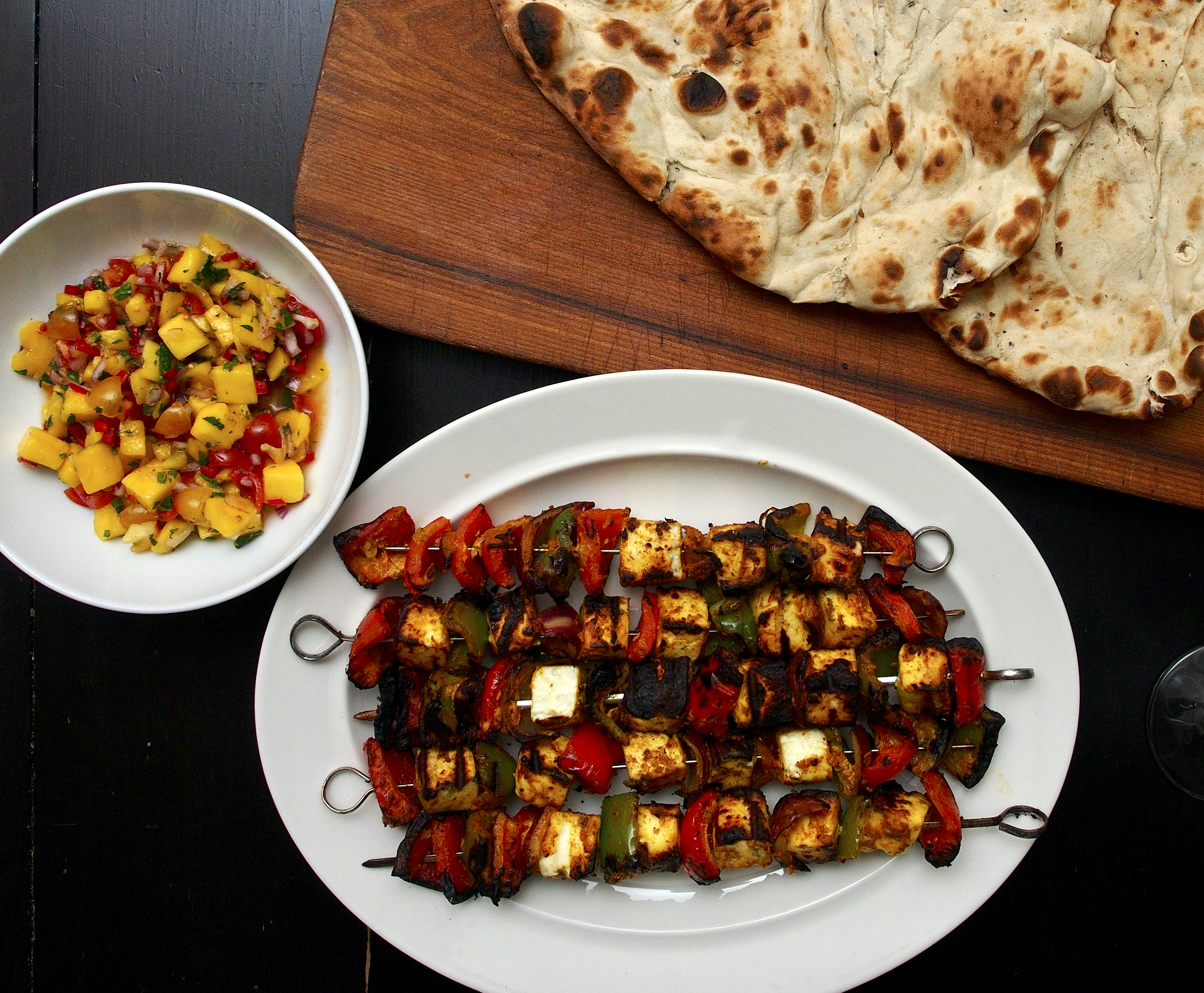
A great combination and nice to cook something meat-free on the barbecue. Serve with naan breads – we get ours from the local takeaway. You need to get started a few hours ahead.
Wine Suggestion: Nothing complex or too heavy with this so focus on pleasurable fruit and balance. For us tonight Umani Ronchi’s organic Serrano. A Montepulciano – Sangiovese blend from Rosso Conero, in the Marches. Youthful and vibrant which suited us perfectly for a summer barbecued dinner.
Barbecued tikka paneer with fresh mango chutney – serves 4
150g natural yoghurt
3 tbsp tikka curry paste, we use Patak’s
2 cloves of garlic, crushed
3 cm piece of ginger, finely grated
300g paneer, cut into 18 cubes
1 green pepper, cut into 18 pieces
1 red pepper, cut into 18 pieces
1 red onion, cut into 6 wedges
vegetable oil, for brushing the grill
a small handful of coriander leaves, roughly chopped
naan breads, to serve
FOR THE FRESH MANGO CHUTNEY:
left over red onion from the kebabs (see below)
1 large mango, finely diced
150g cherry tomatoes, finely diced
1-2 red chillies, finely chopped
a few sprigs of mint, leaves finely chopped
1 tsp caster sugar
juice of half a lemon
Put the yoghurt, curry paste, garlic, and ginger into a large bowl, season with salt and pepper and mix together. Add the paneer and peppers. Peel off the outer 2-3 layers of each onion wedge and add these too (keep the rest for the chutney), then fold everything together gently. Cover and put into the fridge for a few hours, or if short of time leave at room temperature for an hour.
To make the mango chutney, finely chop the leftover onion and put into a bowl with the mango, tomatoes, chillies and mint and stir to mix. Stir in the sugar and lemon juice to taste, then set aside.
Get your barbecue on and hot, then brush the grill with vegetable oil to prevent the kebabs from sticking.
Thread the paneer, peppers and onions onto kebab skewers and cook for 12-15 minutes or until lightly charred.
Sprinkle coriander over the skewers and serve with the mango chutney and naan breads.
(Original recipe from Charred by Genevieve Taylor, Hardie Grant: Quadrille, 2019.)
a few leaves of oregano or basil, picked and chopped or torn
Heat the oven to 200C/fan 180C/gas 6.
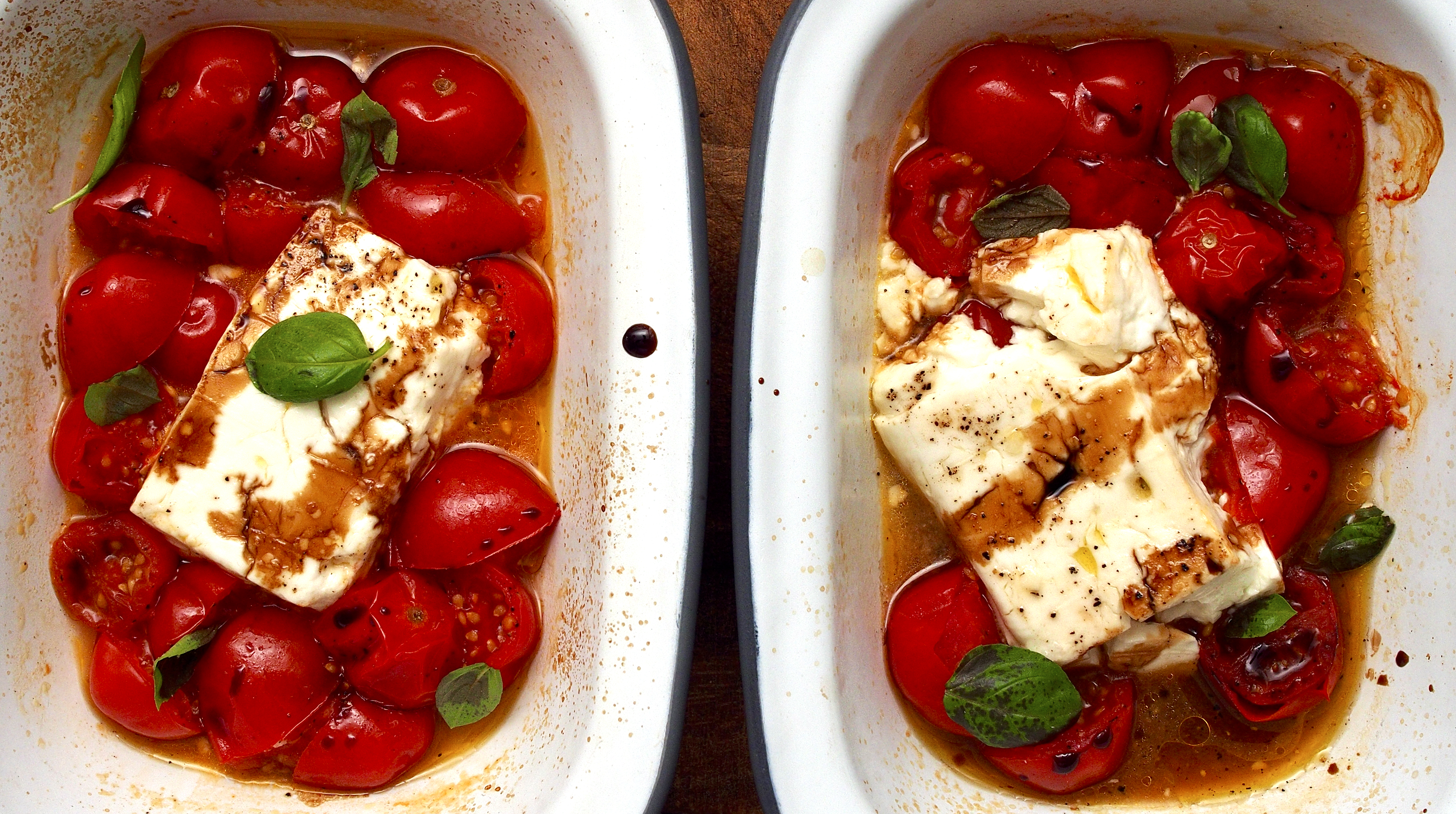
Drizzle a little olive oil in the bottom of 2 small ovenproof dishes. Sprinkle some tomatoes into each and season with salt and black pepper. Set the pieces of feta on top, then top with the rest of the tomatoes, season again and drizzle with a little more oil.
Cover with foil and bake for 20 minutes.
Toast the sourdoubh and rub one side with the cut side of the garlic and drizzle with olive oil.
Take the foil off the dishes, drizzle with the balsamic and sprinkle over the herbs. Serve the salad with the sourdough toast.
(Original recipe by Janinie Ratcliffe in Olive Magazine, April 2016.)
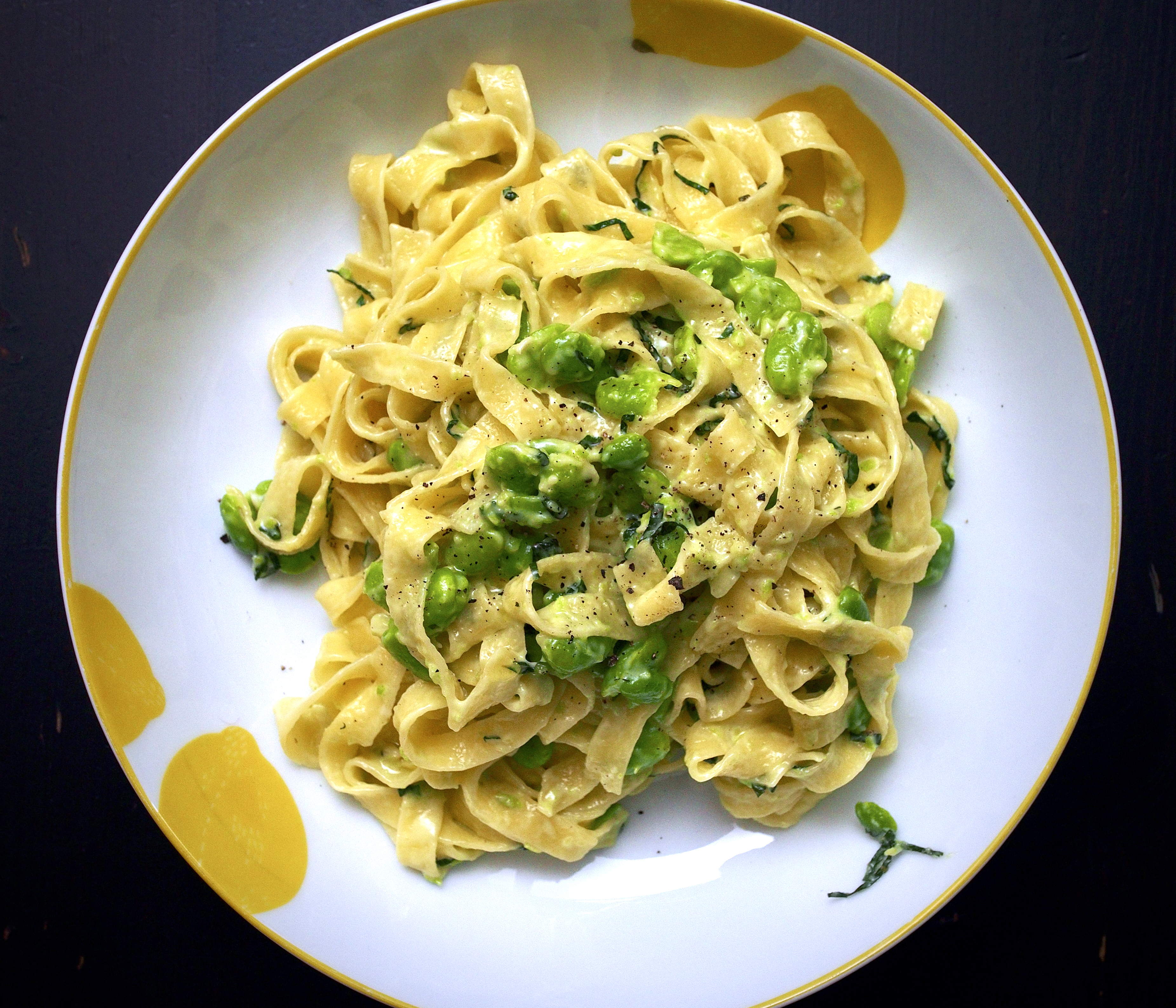
A great dish for using up the end of a tub of cream with just a few ingredients that you might well have already.
Wine Suggestion: Central Italian whites just seem to sing with this dish and the La Piuma Pecorino which is light as a feather, citrussy and floral hits the spot; and is a bargain to boot.
Tagliatelle with broad beans, cream & mint – serves 2
150g broad beans, blanched and skins slipped off
2 tbsp olive oil
1 clove of garlic, finely chopped
100ml double cream
a small handful of mint, finely chopped
75g pecorino, finely grated
200g dried tagliatelle
Get the pasta water on, then start the sauce.
Whizz half the beans in the small bowl of a food processor to get a rough purée.
Warm the 1 tbsp of the oil and the garlic in a heavy-based saucecpan for a minute or two to soften the garlic but without letting it colour.
Add the puréed broad beans, to the pan and cook for a minute, then add the double cream and the rest of the broad beans. Stir in the mint and bring to a simmer. Add half the pecorino and season to taste – careful as the cheese is quite salty.
Meanwhile, cook the pasta in lots of salty water then scoop straight out of the cooking water and into the pan with the sauce. Toss to combine and add a little more pasta cooking water if needed to make a sauce. Serve with the extra pecorino for sprinkling over the top.
We made this on a rainy Sunday last year in an effort to entertain Orlaith for a while. It’s light and buttery, and easy enough for little helpers. You will need 2 x 20 cm round sandwich tins.
Orlaith’s Strawberry Cake
225g butter, at room temperature
225g caster sugar
4 large eggs, lightly beaten
225g self-raising flour
icing sugar, to dust
FOR THE FILLING:
100ml double cream
175g strawberries, sliced
Preheat the oven to 180C/Gas 4.
Line two 20cm round sandwich tins with baking parchment.
Mix the butter and sugar with an electric whisk or stand mixer until light and creamy.
Whisk in the eggs a little at a time, then sift in the flour and gently fold it in using a metal spoon.
Divide the cake mixture between the prepeared tins and bake for 25 minutes.
Cool briefly in the tins then turn out onto a wire rack and allow to cool completely.
Whisk the cream, then spread it over the flat side of the first cake and cover with the sliced strawberries. Place the other cake on top with the round side up. Dust with icing sugar.
(Original recipe from the Complete Cookbook for Children, edited by Claire Lloyd, DK – Penguin Random House, 2017.)
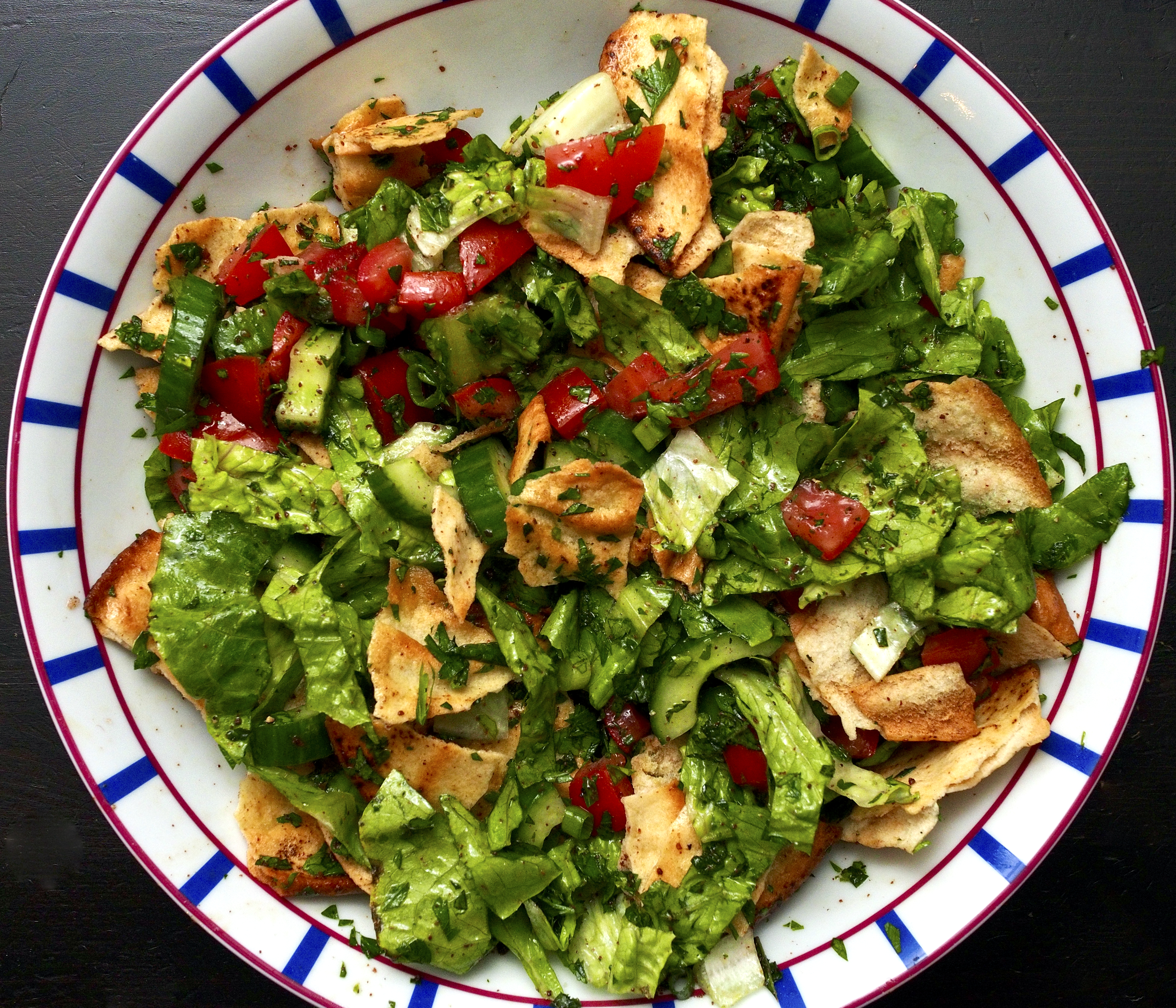
We love this fresh salad, the perfect side dish for so many summer dishes. You can crumble some feta over the top before serving if you like.
Fattoush – serves 4
FOR THE SALAD:
2 flatbreads or pitta breads (about 120g in total)
4 tbsp extra virgin olive oil
3 small Persian cucumbers or 1 small regular cucumber
4 tomatoes (about 450g in total)
75g Romaine lettuce, roughly chopped
3 scallions, finely chopped
10g mint leaves, finely chopped
20g parsley leaves, finely chopped
75g feta cheese (optional)
FOR THE DRESSING:
1 tbsp sumac
3 tbsp lemon juice
4 tbsp extra virgin olive oil
Preheat the oven to 200C/fan 180C/Gas 6.
Toss the pitta breads in the olive oil, then bake in the hot oven for 10 minutes or until very crisp. Leave to cool then snap into chunky pieces.
Cut the cumcumbers in half and scrape out the seeds with a teaspoon. Chop into 1-2cm pieces and put into a salad bowl.
Cut the tomatoes in half and scoop out the seeds, chop the flesh into pieces the same size as the cucumber and add the bowl with the crispy pieces of bread. Add the lettuce and herbs.
Mix the dressing ingredients together and season with salt and pepper. Pour over the salad, then use your hands to toss everything together. Adjust the seasoning to taste, then crumble over some feta if you like.
(Original recipe from Zaitoun by Yasmin Khan, Bloomsbury, 2018.)
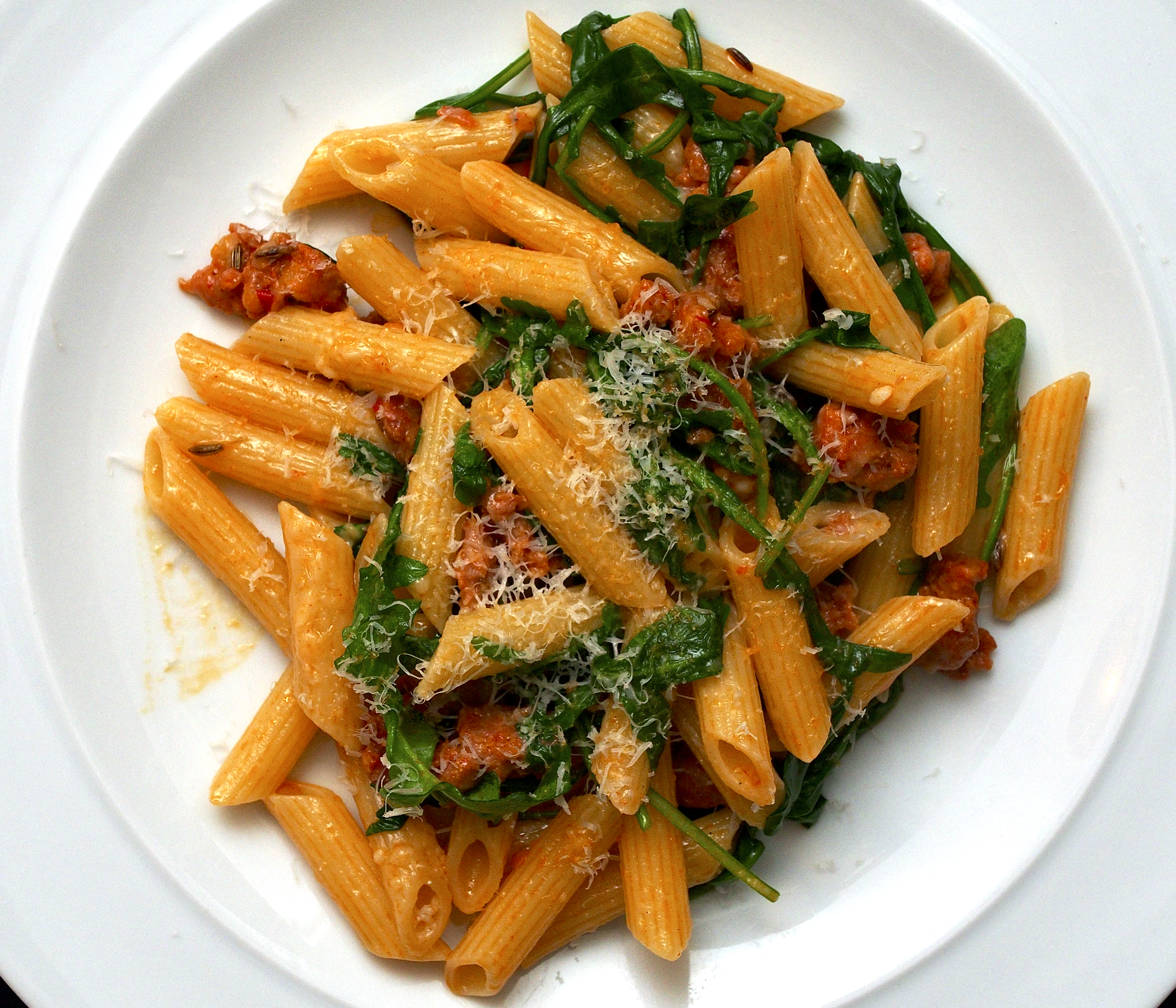
This simple pasta dish will be ready in 10 minutes, the kind of dish we like on a Friday night! The Italian sausages we used tonight were the spicier sort but this would be delicious with milder ones too, the key is the higher meat content. If the sausages have fennel in them halve the fennel seeds.
Wine Suggestion: An under-rated Tuscan coast gem, Morisfarm’s Mandriolo. A classic, youthful Sangiovese with a touch of Cabernet Sauvignon and Petit Verdot this is juicy and vibrant, but also hiding a serious core that stands up to flavoursome food
Penne with Italian sausages & rocket – serves 4
200g Italian sausages
5 tbsp extra virgin olive oil
1 clove of garlic, peeled and finely sliced
1 tsp fennel seeds
½ glass of white wine
500g penne rigate pasta
100g freshly grated pecorino
100g rocket
Remove the skins from the sausages and break them up into a bowl.
Warm the oil in a large frying pan over a low heat, add the sausages and garlic and cook for about 3 minutes. Add fennel seeds and some salt and continue to cook for another minute. Add the wine and cook for a minute more, then remove from the heat.
Meanwhile cook the pasta in lots of salty water.
When the pasta is cooked, return the sauce to a medium heat. Drain the pasta and tip into the sauce. Sprinkle over the pecorino and rocket and toss for about 30 seconds over a medium heat to allow them to come together.
(Original recipe from Gino’s Pasta by Gino D’Acampo, Kyle Books, 2010.)
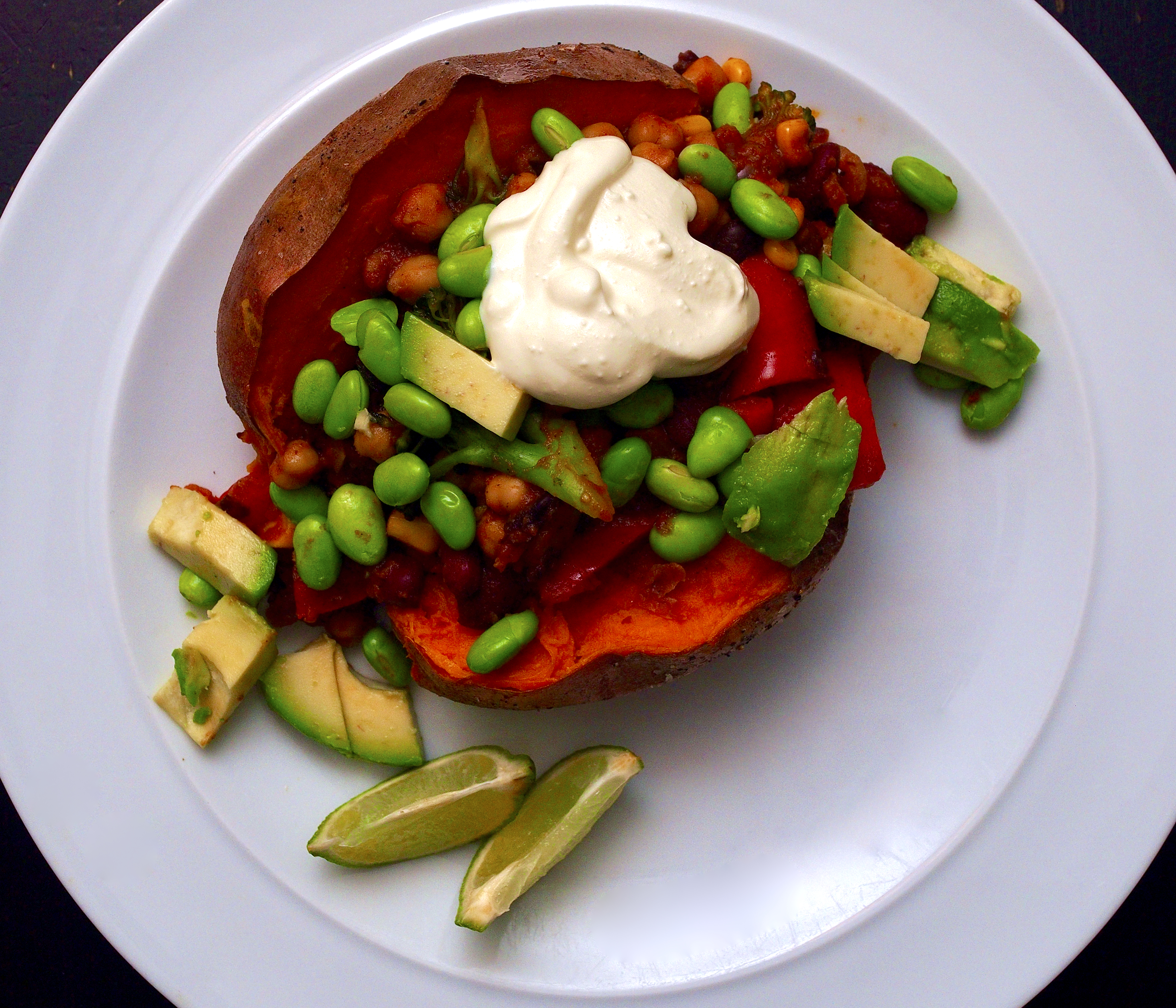
Well this is just delicious; we love bean chillies anyhow but this is a particularly good one. We are not vegan and so served this with sour cream. We’ve included the instructions for a vegan crème fraîche below if you prefer.
Wine Suggestion: For some reason we gravitate to American (both North & South) reds when eating chillies, and with the Wines of Argentina tasting in Dublin yesterday it was natural we’d open a Malbec. A star of the show, and definitely by no means the most expensive, the Altosur Malbec by Finca Sophenia in Gualtallary, Mendoza was our choice. And it seems like Decanter agrees with our choice too – Best in Show and Best Value in their World Wine Awards just announced. Bravo Finca Sophenia and perfect for our chilli.
Vegan chilli – serves 4-6
4 sweet potatoes, skins scrubbed
2 tbsp sunflower oil, plus a bit extra to rub on the potatoes
100g broccoli florets
1 red onion, finely sliced
1 large clove of garlic, grated or finely chopped
2 tsp cayenne pepper
1 tsp ground cinnamon
1 tsp ground cumin
1 red pepper, chopped
2 x tins chopped tomatoes
400g tin chickpeas, drianed and rinsed
100g fresh, frozen or tinned sweetcorn kernels
400g tin black beans, drained and rinsed
400g tin kidney beans, drained and rinsed
sour cream or crème fraîche (or make the vegan crème fraîche below)
IF YOU WANT VEGAN CRÈME FRAÎCHE:
65g cashews soaked in 120ml water for 30 minutes, then drained
juice of ½ lemon
TO SERVE:
75g edamame beans
1 avocado, chopped
lime wedges
Preheat the oven to 200C/Fan 180C.
Rub the sweet potatoes with a little bit of vegetable oil and sprinkle with salt and black pepper, then bake in the oven for about 45 minutes or until tender.
Steam the broccoli until tender, then set aside.
If you want to make the vegan crème fraîche, put the soaked and drained cashews in a blender with the lemon juice. Season with salt and blitz to a cream.
Heat the oil in a large, deep pan, over a medium heat. Add the onions, garlic and spices and cook for a few minute or until softened. Add the red pepper and tomatoes and cook for a couple of minutes, then add the chickpeas, sweetcorn, black beans and kidney beans. Season with salt and simmer for 10-15 minutes. If it starts to look dry, you can add a splash of water.
Add the steamed broccoli and mix to warm through.
Trim the ends off the sweet potatoes and cut them in half but not the whole way through. Spoon the chilli into the potatoes and top with some edamame beans and sour cream or crème fraîche, then serve with the avocado and lime wedges.
(Original recipe from Rick Stein at Home, BBC Books, 2021.)
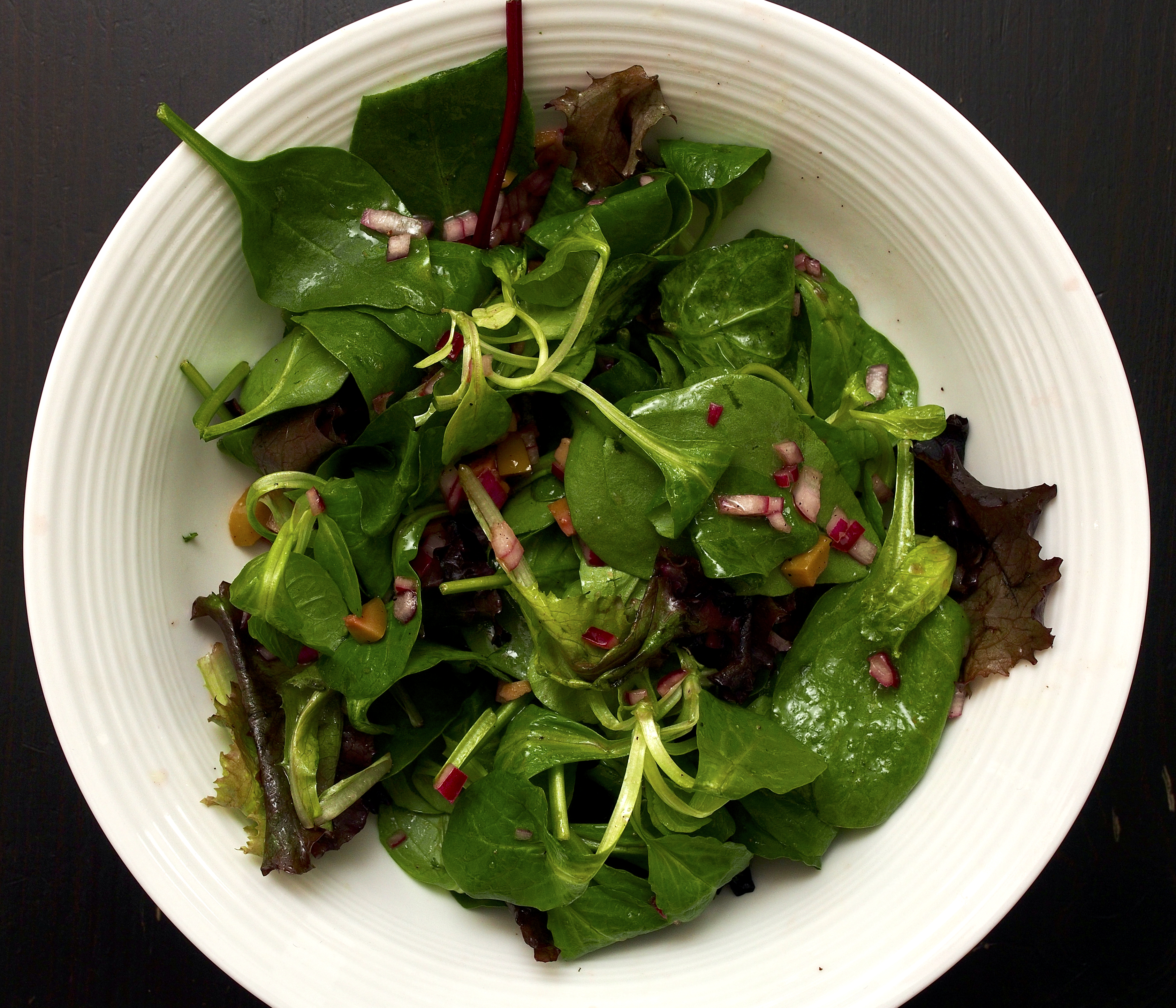
This is just a simple green salad but the addition of chopped green olives and red onions takes it to the next level. It’s particularly good with tomato-based dishes, like lasagne or Parmigiana.
Green salad with olive dressing – serves 6
1 small red onion, finely chopped
50g green olives, finely chopped
2 tbsp olive oil
2 tbsp red wine vinegar
2 tsp golden caster sugar
6 big handfuls of mixed green salad leaves
Whisk the olive oil, vinegar and sugar together in a small bowl, then add the olives and red onion and season.
Tip the salad leaves into a bowl and drizzle over the dressing, then toss gently to coat.
Today was a sunny Sunday so we grilled aubergine slices on the barbecue, made this delicious veggie bake, and ate it outside. Happy days! Serve with garlic or crusty bread and salad.
Wine Suggestion: We think youthful, fruity reds are a joy with this dish and can’t pass up a chance to open a good Beaujolais. For this dish Domaine Rochette’s Régnié, a cru that is often overlooked and unfairly so. Bright and almost crunchy fruit that shouts just as much of sunshine as the Parmigiana.
Melanzane Parmigiana – serves 4 to 6
2 tbsp olive oil, plus extra for brushing over the aubergines
3 garlic cloves, crushed
3 thyme sprigs
8 large sage leaves, finely chopped
4 x 400g tins chopped tomatoes
3 tbsp red wine vinegar
3 tbsp golden caster sugar or granulated sugar
6 large aubergines, sliced very thinly, lengthways
100g Parmesan, finely grated
85g white breadcrumbs
50g pine nuts
2 x 125g mozzarella balls, torn into small pieces
a handful of basil leaves
Get the sauce on first. Heat the oil in a large frying pan or a wide saucepan, then add the garlic, thyme and sage and cook for a few minutes. Add the tinned tomatoes, vinegar and sugar, and simmer gently for about 25 minutes or until slightly thickened.
Meanwhile, light your barbecue – a gas barbecue is particularly good for this as it’s easier to control the heat, you don’t want the aubergine to char before it’s softened. If you don’t have a barbecue (or if it’s not barbecuing weather) you can use a griddle pan instead.
Brush the aubergine slices with olive oil, then barbecue in batches until softened and lightly charred.
Mix 25g of the Parmesan with the breadcrumbs and pine nuts, and set aside.
Spread a little of the tomato sauce over the base of a large baking tray or lasagne dish. Top with a layer of aubergine slices, then season well. Spoon over some more sauce, then scatter over some mozzarella, Parmesan and bssil leaves.
Repeat the layers and finish with a layer of tomato sauce. Sprinkle over the cheesey breadcrumbs. You can bake the dish now or stick it in the fridge for up to 24 hours and bake when you’re ready.
Heat the oven to 200C/180C fan/gas 6.
Bake for 30-40 minutes or until the top is crispy and golden and the tomato sauce bubbling. Rest for 10 minutes, then serve with salad and bread.
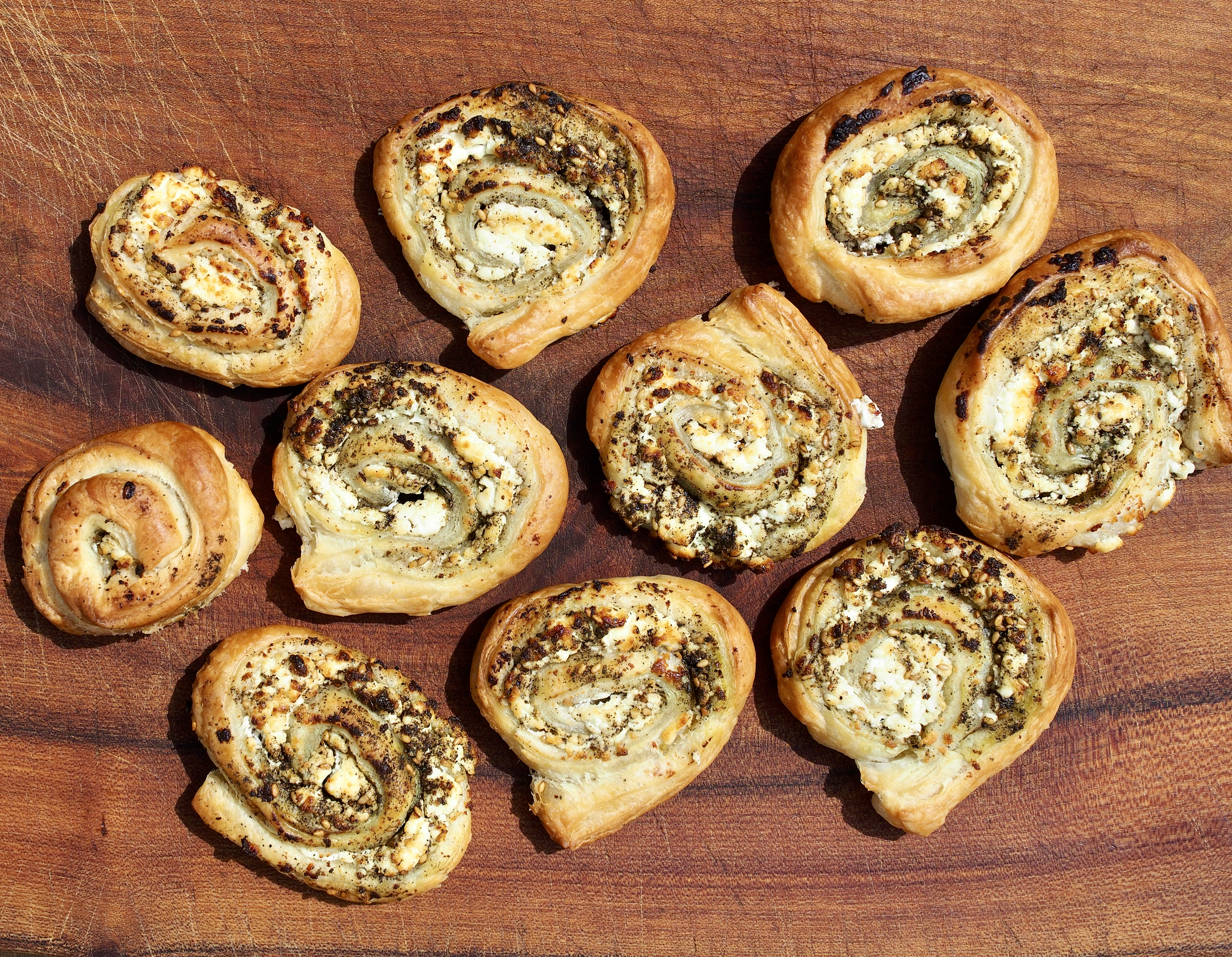
These have to be the easiest snack ever and they’re great to serve with drinks. The best thing is that you can have them made up in the fridge and just bake them when you need them.
Wine Suggestion: Find a bone-dry white that gets your digestive juices watering. For something really special look out for Quinta Soalheiro’s Granit which is an high altitude, single vineyard selection from, as you might have suspected Granitic soil. Piercingly dry and laser focused, and yet so beautiful and expressive it made us sit up and pay attention.
Za’atar & Goats’ Cheese Puffs – makes 20
1 x 320g ready-rolled puff pastry sheet
olive oil
2 heaped tbsp za’atar
300g soft goats’ cheese
Preheat the oven to 220C/Gas 7.
Put the cheese into a bowl and break it up with a fork.
Unroll the pastry sheet but keep it on the greaseproof liner it’s wrapped in.
Place the pastry on the work surface with the long side facing you and brush lightly with olive oil.
Scatter over 1 tbsp of the za’atar, then distribute the cheese all over the sheet, leaving a 2.5cm border at the edge of the pastry furthest from you. Season generously with salt and pepper, then sprinkle over the other tbsp of za’atar.
Start to roll the pastry, starting with the long edge closest to you and rolling away from you. Roll it as tightly as possible without crushing it. Use a serrated knife to cut the roll in half then cut each half into 10 slices. Put the slices onto a baking tray lined with baking paper and pat them down flat with your fingers to hep them stay together.
Bake for 15 minutes or until golden brown and serve immediately.
(Original recipe from Sirocco by Sabrina Ghayour, Michell Beazley, 2016.)
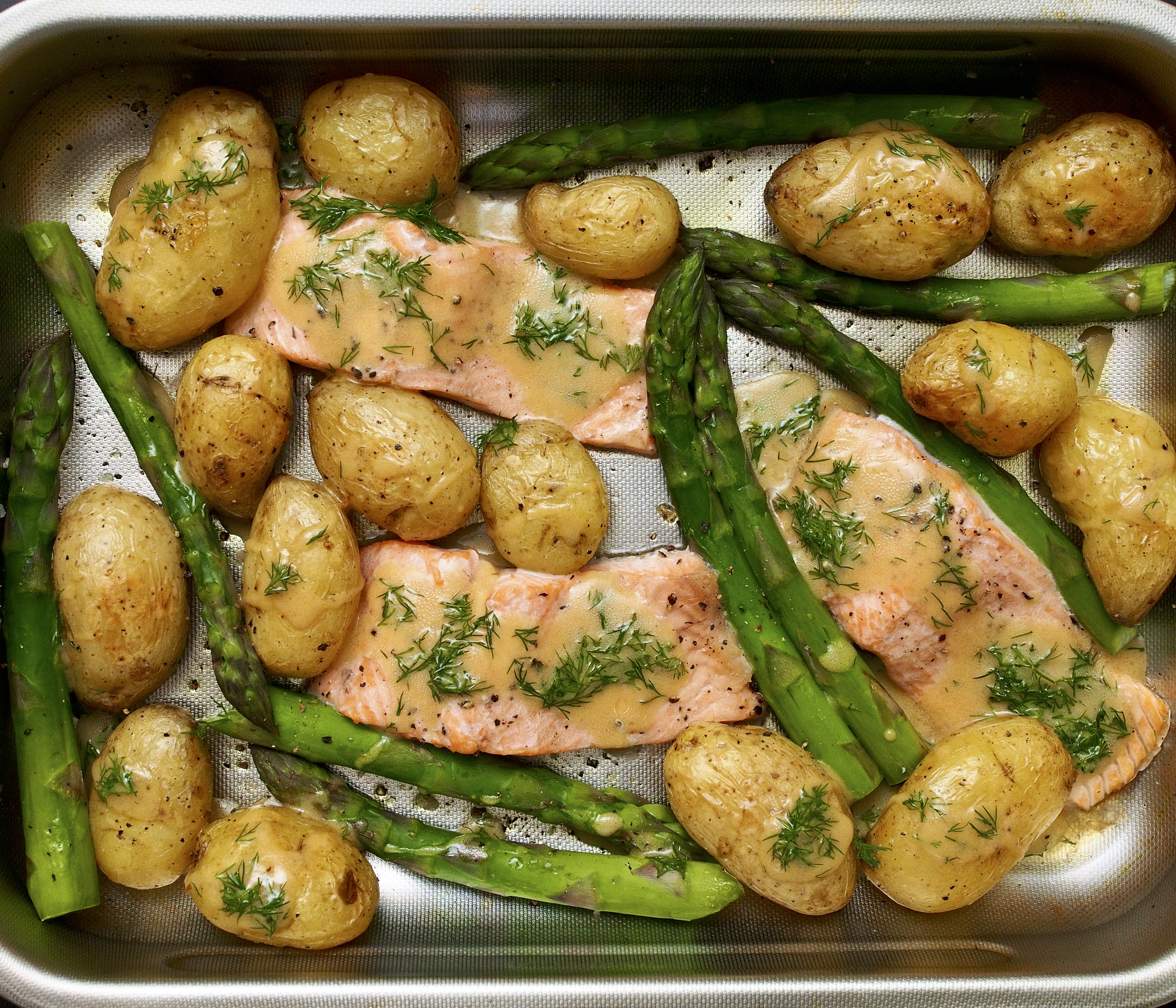
This dish couldn’t be easier and is all cooked in the one tray; a great spring celebration. It helped that we were able to source all of the ingredients locally, always makes us feel good about what we’re eating.
Wine Suggestion: Simple, but fresh and asparagus friendly Sauvignon Blanc from the Loire Valley, in this case blended with a touch of Chardonnay from the Cheverny appelation. Pascal Bellier produces a charmer.
Sea trout, new potatoes and asparagus with a dill & mustard sauce – serves 4
1kg baby new potatoes, we used Jersey Royals
400g asparagus
2 tbsp olive oil
4 fillets of sea trout (or you could use salmon)
FOR THE SAUCE:
2 tbsp Dijon mustard
1 tbsp soft light brown sugar
2 tbsp white wine vinegar
4 tbsp groundnut oil
2 tbsp chopped dill, plus a bit extra to serve
Heat the oven to 200C/fan 180C/gas 6.
Cook the potatoes in salty water for about 3 minutes, then add the asparagus and cook for a further 2 minutes. Drain well and and run the asparagus under cold running water to stop it cooking any further.
Put the potatoes into a large non-stick baking tray, toss with the olive oil and season well with salt and pepper. Put into the oven for 15-20 minutes or until starting to brown.
Tuck the trout and asparagus in and around the potatoes and season these too. Roast again for 10-12 minutes or until the trout is just cooked.
Meanwhile, whisk the mustard, sugar, vinegar and oil together to make the dressing. Stir through the dill just before you’re ready to serve. Drizzle the sauce over the dish and scatter with some more dill if you like.
(Original recipe by Janine Ratcliffe and Adam Bush in Olive Magazine, May 2019.)
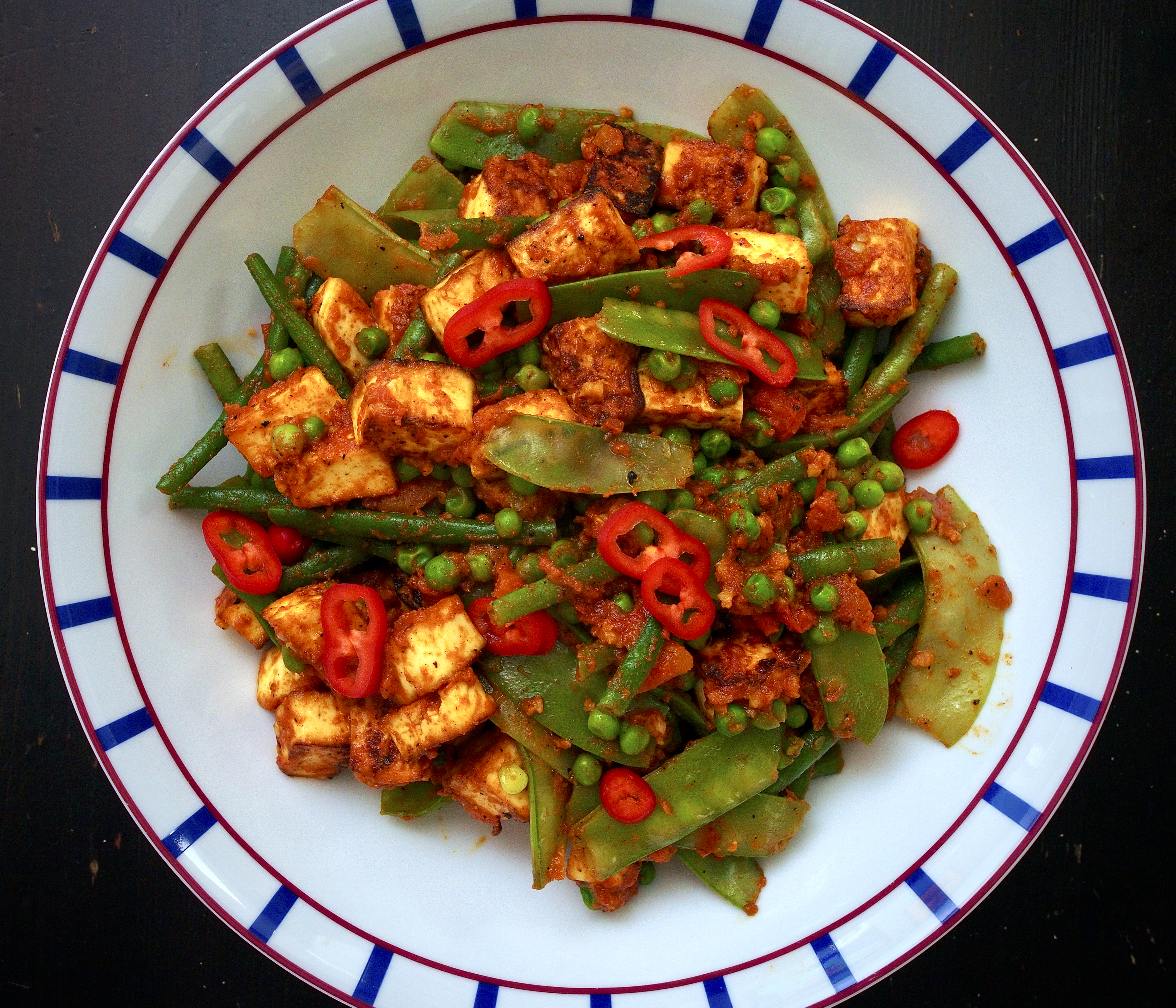
This is Meera Sodha’s fresh take on Matar Paneer, which is usually a richer dish. Delicious with warm naan breads and plain yoghurt, this version could easily become a regular favourite.
Fresh Matar Paneer – serves 4 as a mainor more as a side with other dishes
rapeseed oil
550g hard paneer, cut into 1.5cm cubes
6 cloves of garlic, crushed
400g tin chopped tomatoes
1¼ tsp salt
½ tsp ground black pepper
1 tsp ground cumin
1 tsp chilli powder
½ tsp ground turmeric
200g green beans
200g mangetout
200g frozen peas (defrosted), or you can use fresh of course if you have them
1 red chilli, finely sliced to serve
Heat a couple of tbsp of the oil in a large frying pan. Fry the panner over a medium heat until browned and crisp all over, then remove to a plate with a slotted spoon and set aside.
Heat another tbsp of oil in the pan, then add the garlic and stir-fry for a couple of minutes (make sure the frying pan isn’t too hot when you add the garlic or it will burn). Add the tomatoes and cook for about 6 minutes or until just turning jammy. Add the salt, pepper, cumin, chilli powder and turmeric, then stir for another minute before taking off the heat.
Bring a large pan of water to the boil and add salt. Add the green beans and cook for 2 minutes, then add the mangetout and cook for another 2 minutes. Add the peas and cook for 1 more minute, then drain and leave to steam dry.
Heat the sauce, then stir in the paneer. When both are hot, stir in the veg. Sprinkle over the sliced red chilli and serve.
(Original recipe from Fresh India by Meera Sodha, Fig Tree, 2016.)
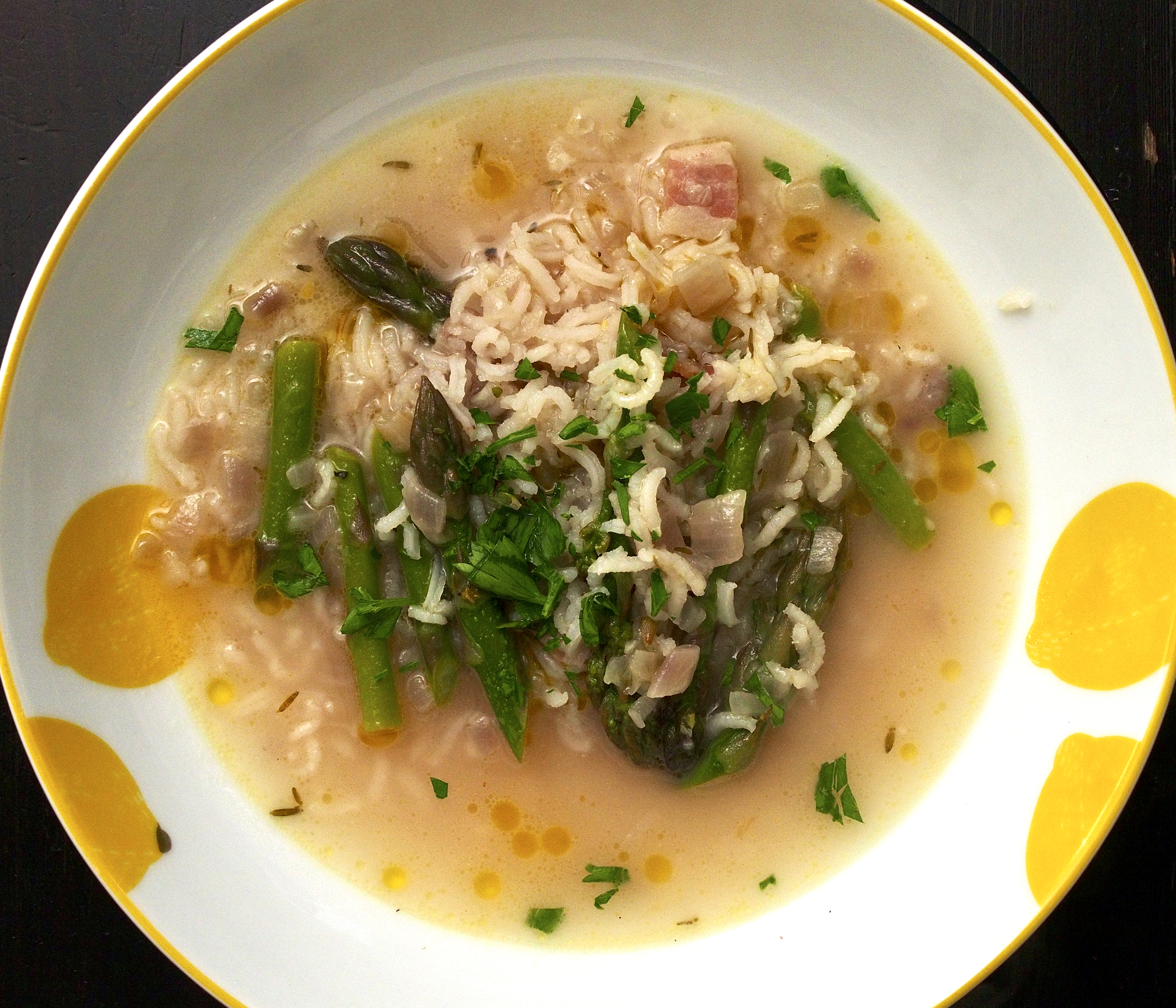
This soup recipe by Skye Gyngall is delicious. Make it while you can get local aspragus and serve with some crusty bread.
Asparagus, rice & pancetta soup – serves 4
50ml extra virgin olive oil, plus extra to serve
2 red onions, finely chopped
a small bunch of thymes, leaves stripped and stalks discarded
5 slices of pancetta, chopped into small pieces
3 garlic cloves, peeled and crushed
100g white rice
1 litre good chicken stock
500ml water
12 green asparagus spears, snap off the woody ends and cut into short lengths on the diagonal
100g Parmesan, freshly grated
2 tbsp chopped flat-leaf parsley
Warm the olive oil in a large, heavy-based pan. Add the onions, thyme and a pinch of salt and cook gently for 10 minutes.
Add the pancetta and garlic and continue to cook for another 5 to 10 minutes, then stir in the rice. Pour in the stock and water and bring to a simmer. Turn the heat down low, then cover and simmer for about 15 minutes or until the rice is cooked.
Add the asparagus to the soup and cook for a few minutes until just tender, then stir in the Parmesan. Season to taste with lots of black pepper and salt to taste.
Ladle into warm bowls and top with the parsley and a drizzle of olive oil.
(Original recipe from My Favourite Ingredients by Skye Gyngell, Quadrille Publishing Limited, 2008.)
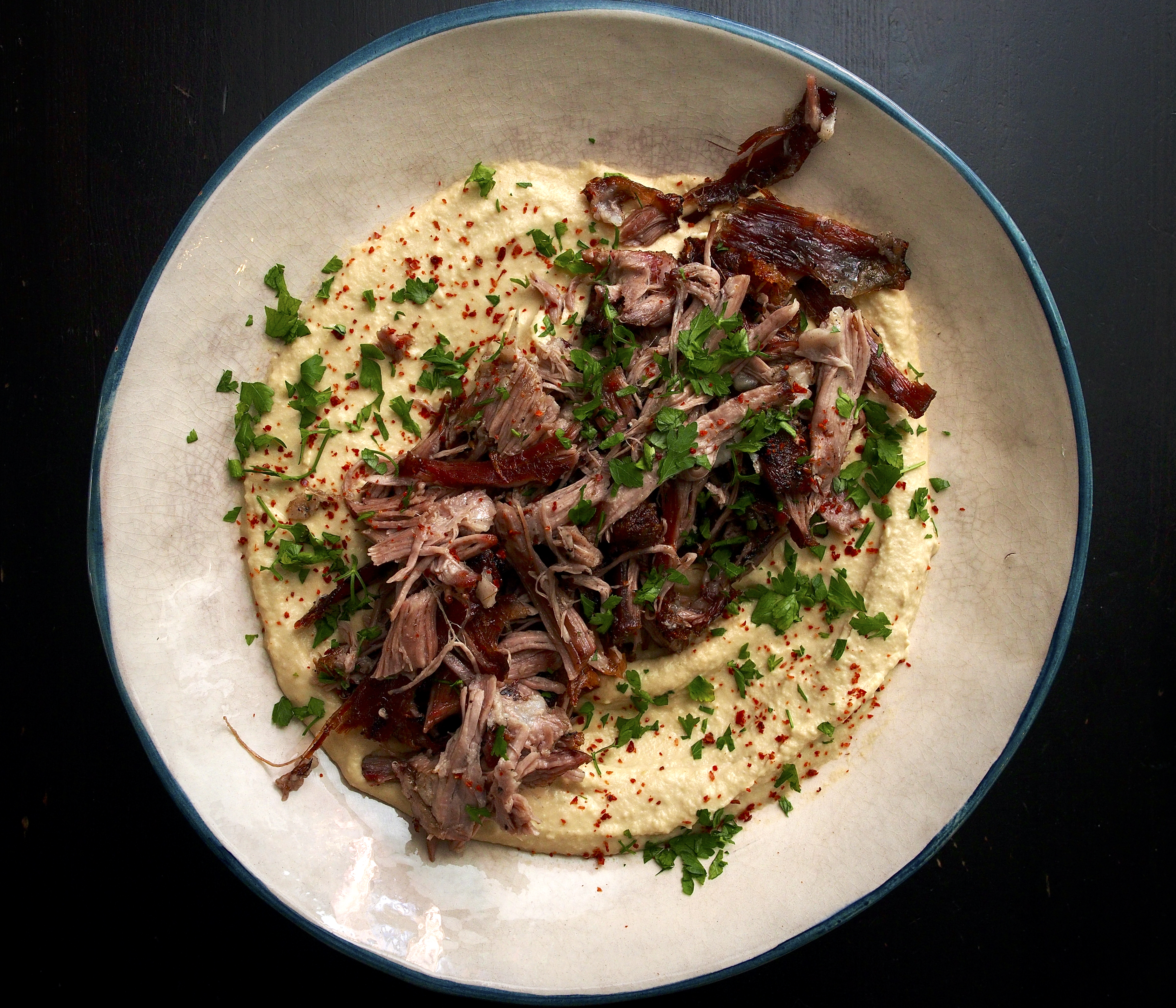
This recipe comes from Chasing Smoke by Sarit Packer and Itamar Srulovich of Honey & Co. in London. This is hands-down the best hummus we’ve ever made (and we’ve made lots) and the crispy lamb belly (poached then finished over charcoal) is fatty but fabulous. It’s good with a simple salad (we went for cucumbers, tomatoes, scallions & Baby gem dressed with olive oil, lemon juice and sumac) and lots of warm pittas. You need to soak the chickpeas the night before.
Wine Suggestion: Anything with a hint of middle-eastern spices or warm sunshine. A Garnacha, or maybe a Tempranillo. Tonight the classic Massaya le Colombier from the Beqaa Valley in Lebanon. A lot has happened in this part of the world and we’re glad to support the friends we’ve met still trying to make great wine despite all the challenges. Well done Sami and Ramzi, bravo!
Crispy lamb on creamy hummus – serves 4 (generously)
FOR THE LAMB:
1 lamb breast on the bone, about 1.5kg
1 tbsp table salt
1 tbsp cumin seeds
1 tsp black peppercorns
2 onions, quartered
1 litre of water
FOR THE HUMMUS:
200g dried chickpeas, soaked overnight in lots of water
1 tsp bicarbonate of soda
1 clove of garlic, peeled
1 tsp table salt
250g tahini paste
½ tsp ground cumin
2 tbsp lemon juice
TO SERVE:
a small handful of parsley, chopped
1 tsp biber chilli flakes (or Allepo)
pitta breads
salad (see suggestion above
Rub the lamb all over with the salt, cumin seeds and peppercorns, then leave in the fridge for a couple of hours. Put the lamb in a large pan with the onions and water. Bring to the boil, then cover with a lid, reduce the heat to low, and simmer slowly for about 1½ hours.
Make the hummus while the lamb is cooking. Drain the soaked chickpeas, then place in large saucepan and cover with plenty of cold water. Bring to the boil and skim off the foam. Allow to boil for 5 minutes, then skim again.
Add the bicarbonate of soda and mix well. Skim it really well this time then simmer for 30-40 minutes, skimming regularly, until the chickpeas are very soft – they should melt in your mouth.
Drain the chickpeas into a colander over a bowl so you can reserve the cooking liquid. You need to finish the hummus now while everything is still hot. Pour 250ml of the cooking liquid over the chickpeas and add the garlic. Now whizz using a stick blender or food processor until really smooth. It will be pretty thick at this stage but not to worry.
Add the salt, tahini, cumin and lemon juice and whizz again until well combined. Give it a taste and add more salt or lemon juice if you like. Cover the surface with cling film to stop a skin forming and set aside. It will be quite liquid but it will thicken as it cools.
Lift the lamb out of the cooking water, keep a few spoonfuls of liquid for serving. The meat should be completely soft and easy to pull from the bones. Carefully (so it doesn’t fall apart altogether) lift it onto a hot charcoal barbecue and cook for about 10 minutes. Turn it over and cook for 10 minutes on the other side. You need to do this over indirect heat or it will burn or catch fire as there is a lot of fat.
To cook over indirect heat pile the charcoal to one side and with the lid on cook the meat on the other side. Despite no direct flames underneath the meat cooks a treat – slower, but no less effectively.
Take the cooked meat off onto a chopping board and shred it with two forks – like crispy duck.
Spread the hummus on a serving platter and top with the lamb and a drizzle of the cooking liquid. Sprinkle with the chopped parsley and chilli flakes and serve with lots of pitta and a salad if you like.
(Original recipe from Chasing Smoke: Cooking over fire around the Levant by Sarit Packer and Itamar Srulovich, Pavilion, 2021.)
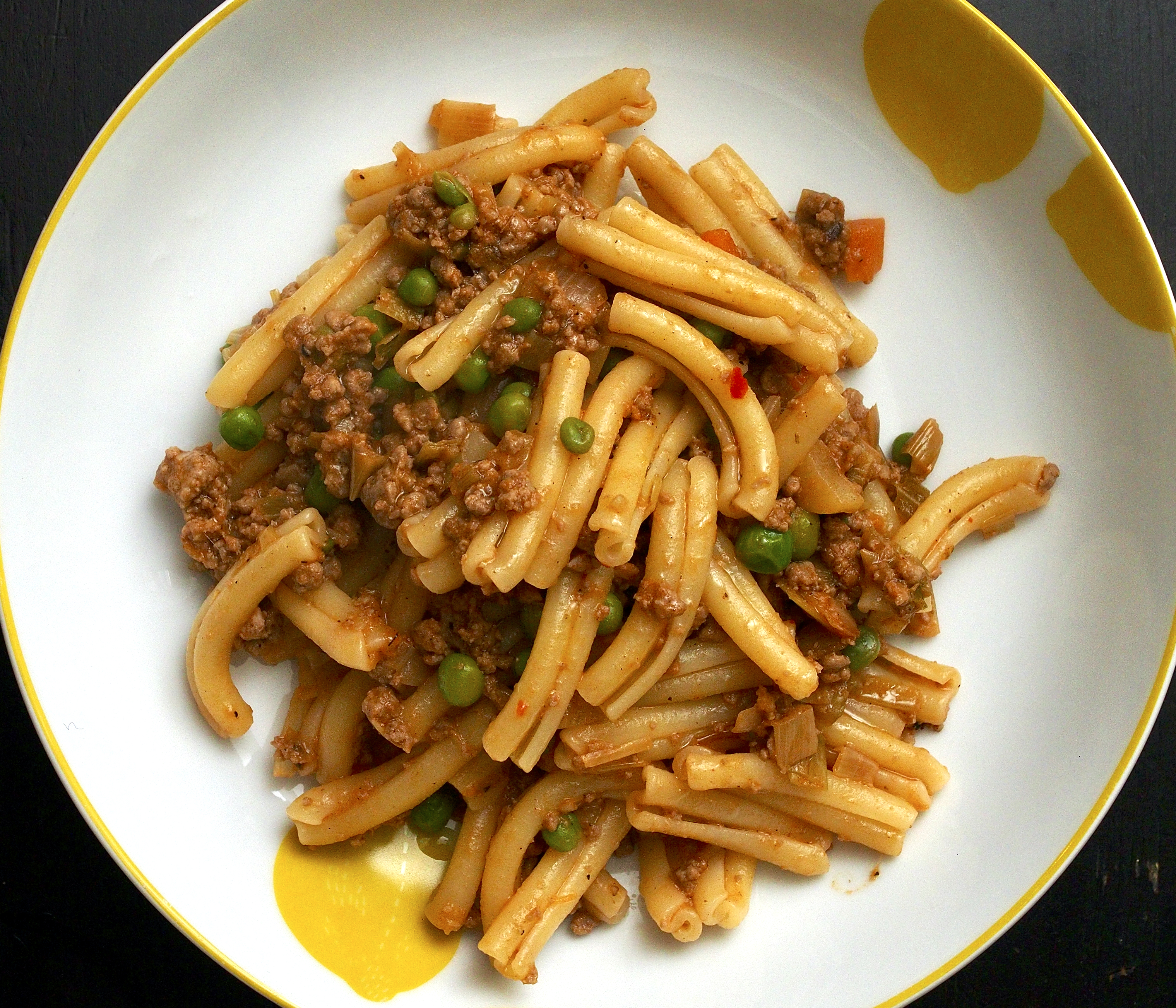
Bored with bolognese? Try this lamb and pea ragu for a change, it’s just as comforting but peas for a bit of Spring freshness.
Wine Suggestion: We had a glass of the Umani Ronchi Rosso Conero Serrano, which is an unoaked Montepulciano with a touch of Sangiovese. Springtime in a glass.
Lamb & pea ragu – serves 6
2tbsp olive oil
500g lamb mince
1 onion, finely diced
1 small carrot, finely diced
1 stick of celery, finely diced
1 leek, finely diced
3 cloves of garlic, crushed
a pinch of dried chilli flakes
1 tsp ground fennel seeds
1 anchovy fillet, drained
a splash of white wine
200g tomato passata
250ml chicken stock
250ml full-fat milk
1 tbsp balsamic vinegar
150g frozen peas
grated Parmesan
500g casarecce, fusilli or other pasta
Heat the oil in a large, deep frying pan over a high heat. Add the mince and fry until well browned. Season with salt and pepper and scoop out with a slotted spoon and set aside.
Add the carrot, celery and leek to the fat in the pan and cook gently for about 10 minutes. Add the garlic, chilli flakes, ground fennel seeds, and anchovy to the pan and cook for another minute.
Return the lamb to the pan and stir into the vegetables, then add the splash of wine and allow it to almost evaporate. Add the passata and simmer for 5 minutes, then add the chicken stock and simmer for 10 minutes more, until the sauce is quite thick.
Add the milk and simmer for about 15 minutes or until the sauce is thick and creamy, then stir in the balsamic vinegar and peas and cook for a final 3 minutes. Season again to taste.
Meanwhile, cook the past is lots of very salty water. Drain and reserve a mug of cooking water. Combine the sauce and pasta and add a bit of pasta cooking water to moisten if you need.




 Jono & Jules do food & wine